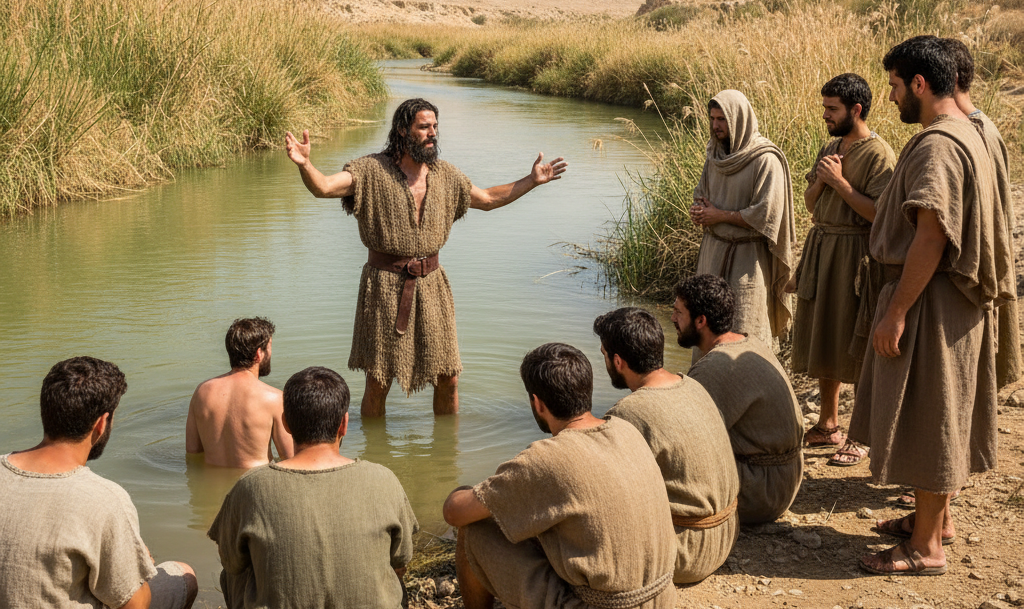
This appendix studies the birth and ministry of John the Baptist based on the Gospel of Luke. It presents his parents Zechariah and Elizabeth, a priest and a barren woman of Ein Kerem, and analyzes John's prophetic role as the forerunner of the Messiah. The article draws on Luke 1.5-20 and refers to many complementary appendices on the context of the Nativity.
48 min
John the BaptistZechariahElizabethbirthministry
26 verses
10 books
John the Baptist is a key figure at the beginning of Jesus' ministry, as the Gospels emphasize. While Matthew and Mark mention John the Baptist only briefly, it is Luke, in his capacity as a historian, who provides a wealth of details about his parents and his life.
Luke's description removes every legendary aspect surrounding John the Baptist, presenting an authentic reality that had a significant impact on the history of the Jewish people. The third Gospel reveals important information about John's family, his birth and his activity, portraying him as an atypical figure, more in tune with the great than with his contemporaries.
The questions we are asking are the following:
- What role did John the Baptist play in Jesus' ministry?
- How did he become so famous throughout the whole region of Israel?
- How should we understand the doubts he expressed while he was in prison?
- What influence did he have on Jesus' ministry?
To answer these questions, we will examine the Gospels and the prophetic writings carefully in order to better grasp the scope and importance of his work.
John the Baptist was born to parents descended from the line of Levi and Aaron, belonging to the priestly class. His father, Zechariah, is a priest in the temple of Jerusalem, while his mother, Elizabeth, is barren. They are described as devout Jews, faithful to the law of Moses, and they are advanced in years.
Luke is the only evangelist to provide this information, but he does not explicitly mention the couple's village of residence. Tradition suggests that they lived in Ein Kerem, a small town in the hill country of Judea, about 8 km west of Jerusalem, roughly a two-hour walk. This traditional hypothesis is generally not controversial.
Zechariah serves at the temple twice a year, for one week each time, as well as at every religious feast. The three main Jewish feasts, Passover (Pesach), Pentecost (Shavuot) and (Tabernacles), mentioned in Deuteronomy 16.16-17 and Exodus 23.14-17, last a week and require the presence of all the priests at the Temple.
The couple's life, marked by the absence of children, is shaped by Zechariah's priestly duties. Elizabeth often spends time alone, although she generally accompanies her husband to Jerusalem for the great feasts.
Luke describes the revelation made by the angel, probably Gabriel, with great precision, which raises questions about the origin of his information. At the time Luke wrote his Gospel, John the Baptist and his parents had already died. It seems that Mary, the mother of Jesus, would have been one of the few people still alive who could provide such a detailed account.
Although it is plausible that Luke had exchanges with some apostles, the detailed information he presents suggests that he obtained it directly from Mary. Indeed, according to Luke, Mary visited Elizabeth, who was then six months pregnant, and stayed with her for three months. This raises the question: did Mary stay until Elizabeth gave birth?
Mary's presence would have allowed Elizabeth to rest and be freed from daily tasks, thus contributing to a serene and uneventful end of pregnancy.
IV. How can we discover the dates of Mary's journey?
To establish the birth dates of John the Baptist and Jesus, as well as to determine the period of Mary's journey, we start from the day of Jesus' birth. We explain our choice of 12 October 2 BC for this date in the appendix ANN004: The date of birth of the Messiah Jesus.
We assume that Mary's labor was prematurely brought on by her journey, since it is unlikely that Joseph would have undertaken such a trip with Mary about to give birth. They would not have taken such a risk. If the delivery was expected around the end of October, conception would have taken place at the end of January.
Mary would have undertaken her journey (ANN007) to join Elizabeth in February 2 BC. Traveling alone, especially at night, was risky because of highway robbers, which led people to travel in groups for greater safety. Mary probably took advantage of merchants from her village traveling to Jerusalem to join them, since neither her father nor Joseph would have approved of such a journey alone.
Thus, the chronology of events could be as follows:
- The revelation of the angel Gabriel and the conception of Jesus in January 2 BC Luke 1.26-38.
- Mary's journey to visit Elizabeth at Ein Kerem in February 2 BC Luke 1.39-40
- Elizabeth begins her sixth month of pregnancy in February 2 BC Luke 1.36.
This sequence of events agrees, in our view, with Luke's accounts and the prophecies of Daniel 9.24-27.
V. Did Mary stay until John's birth?
The importance of traveling in groups in antiquity is already well established. For her outward journey, Mary knew the plans of the inhabitants of her village and was thus able to plan her departure accordingly. For the return, however, she no longer had such information. It is therefore plausible that she took advantage of the return of the pilgrims who had come to Jerusalem for Passover.
According to our calculations based on Jewish date converters, Passover in the year 2 BC would normally have taken place on 17 March. However, since the equinox was not expected until four days later, on 21 March, the would probably have added an extra month, Adar 2, so that Passover would coincide with spring. Thus, Passover could be dated to 16 April 2 BC. As this celebration lasted seven days, until 23 April, the pilgrims' return would have begun the next day.
It is likely that Mary, knowing these dates, joined the Nazarenes returning from the Passover pilgrimage to go back to Nazareth. Her parents, as well as her brothers and sisters, could also have been part of this group of pilgrims and would have taken the opportunity to visit Zechariah and Elizabeth at Ein Kerem, thus celebrating the birth of John.
We estimate that Mary returned to Nazareth on 23 April 2 BC. A departure before Elizabeth's delivery seems unlikely, but Mary had to comply with the pilgrims' return dates. Her presence at John's birth was essential in order to verify whether the child matched the prophecies she knew. She was able to understand that events were unfolding in accordance with the angel's announcements.
Elizabeth and Zechariah shared their extraordinary experiences with Mary. In his Gospel, Luke provides intimate details about Mary, Joseph and the couple, which suggests that he obtained this information directly from Mary. The angel's announcement to Zechariah represents not only an answer to the couple's prayers, but also a divine miracle. Those around them watched these events with amazement, anticipating that the child would become an important figure.
VI. Zechariah of the division of Abijah
This information, though seemingly trivial, proves crucial for determining the birth dates of John the Baptist and Jesus.
In the appendix ANN004: The date of the birth of Jesus, we analyze these priestly divisions in detail and conclude that Zechariah's service ended on 5 July 3 BC. On the basis of this date, we can deduce that John the Baptist was born in April 2 BC, six months before Jesus.
These historical and liturgical details therefore offer us a framework for better understanding and situating these important events in the context of the time.
VII. John's working method
This information, though seemingly trivial, proves crucial for determining the birth dates of John the Baptist and Jesus.
In the appendix ANN004: The date of the birth of Jesus, we analyze these priestly divisions in detail and conclude that Zechariah's service ended on 5 July 3 BC. On the basis of this date, we can deduce that John the Baptist was born in April 2 BC, six months before Jesus.
These historical and liturgical details therefore offer us a framework for better understanding and situating these important events in the context of the time.
VIII. Elizabeth's barrenness and old age
Luke informs us that Elizabeth and Zechariah were advanced in years, which did not prevent them from praying constantly for a child. This description suggests that Elizabeth was still of childbearing age.
In biblical times, social norms and expectations regarding age were different from today's. In that society, at 25 a Jew had often already started a large family. Thus, a couple in their forties without children was considered exceptional and was often perceived as an anomaly. Barrenness was frequently interpreted as a divine curse linked to sin.
The example of Hannah, the wife of Elkanah, who wept over her infertility before receiving God's blessing with the birth of her son Samuel 1 Samuel 1.1, illustrates this perception well.
As for Zechariah, he had not yet reached the age of 50, considered the retirement age for priests according to the customs of the time Numbers 8.25. Luke confirms that Zechariah was still performing his priestly duties in the temple of Jerusalem.
It was common for men to marry younger women. It is therefore likely that Elizabeth was in her forties. Despite their desire for a child, the couple bore the burden of Elizabeth's barrenness, clearly stated by Luke.
IX. The childhood of John the Baptist
Little information is available about the childhood and youth of John the Baptist. We find him later in the Judean wilderness, where he preaches repentance. Consequently, we have no precise indication about his upbringing, although it was probably similar to that of other children of his time.
However, a detail in Luke's account indicates a notable difference: John was not to drink alcohol. This evokes the Nazirite vow of the Old Testament, a consecration to God. For John, this Nazirite vow did not seem to be temporary. The text does not specify whether he was to let his hair grow in accordance with the requirements of this vow, as described in the book of Numbers. (See the appendix: ANN044: The Nazirite vow.)
It appears that John followed the Nazirite rules in their entirety. The angel, probably Gabriel, had announced that he would be like the prophet Elijah. It is likely that John asked his parents, Elizabeth and Zechariah, for explanations about the particularities of his upbringing. They would thus have revealed to him the extraordinary circumstances of his birth, foreshadowing an exceptional destiny.
We assume that they also told him the story of Mary, which would have informed John that another remarkable child, Jesus, had been born. He could from then on envisage the coming of the Messiah.
However, it is important to note that John did not at first recognize Jesus as the Messiah. It was only at the baptism of Jesus, marked by miraculous signs, that John understood and recognized Jesus as the Messiah.
John the Baptist did not introduce a new doctrine, but rather announced the imminent arrival of a great change with the coming of the Messiah. His call to baptism by immersion was a symbol of repentance, rather than a means of forgiveness of sins.
Although his message seemed innovative, it was not revolutionary in the context of the law of Moses. According to that law, the forgiveness of sins required a sacrifice at the temple, a practice that John did not challenge.
His preaching did not lead to direct conflict with the Jewish religious authorities. Had John advocated an end to the sacrifices at the temple, he would undoubtedly have provoked much stronger opposition from those authorities.
XI. Luke's dating, which confirms the information from Daniel
For more information on the practice of baptism and its development, see the appendix ANN017: Baptisms.
Luke provides us with valuable historical details for dating the beginning of the ministry of John the Baptist, which is distinct from that of the Messiah. Tiberius officially became emperor after Augustus on 19 August AD 14. However, because of Augustus' illness, the Senate had passed an exceptional law granting Tiberius the regency over the provinces from AD 12, thus establishing a co-regency from AD 12 to 14.
Consequently, when Luke mentions the beginning of Tiberius' reign, he is probably referring to the year AD 12. Thus the "fifteenth year" of Tiberius' reign, mentioned by Luke, would correspond to the year AD 26.
This interpretation is in agreement with the information derived from the texts of Daniel. For a more thorough analysis of these claims, it is recommended to consult the appendices cited at the beginning of this study, where these data are detailed.
XII. Deductions about the life of John the Baptist
By examining the information provided by the evangelists, we can sketch a portrait of the life of John the Baptist. As an only son, he probably took care of his parents, Zechariah and Elizabeth, until their death. The absence of any mention of other pregnancies of Elizabeth in the texts suggests that she probably had no other children.
In accordance with Jewish law, John went up three times a year to the temple in Jerusalem for the great feasts, a practice made easier by the proximity of their family home, probably located in Ein Kerem, a village about 8 km west of Jerusalem. This village is traditionally considered their place of residence.
John's appearance and way of life, with his distinctive clothing, his long hair and his diet, recalled those of the ancient prophets. While some might mock him, many respected him and saw him as a successor of those great men of God.
After the death of his parents, John withdrew into the wilderness to live there as a hermit. During the important feasts, he probably went near the temple to preach. His frankness, his exemplary way of life and his appearance recalled Elijah. His reputation spread quickly, and many wondered whether he was the Messiah.
Matthew 3.5-6 reports that the inhabitants of Jerusalem, of all Judea and of the whole region of the Jordan came to listen to him and were baptized by him. John the Baptist was therefore well known throughout the country.
The religious authorities of Jerusalem, worried by his growing popularity, sent a delegation to investigate, as reported in John 1.19-20. John assured them that he was not the Messiah.
The success of John the Baptist and the interest he aroused cannot be explained without a long period of preparation. His preaching, centered on the coming of the Messiah, touched a sensitive chord among the Jews who were eagerly awaiting this messianic figure. This announcement had the potential to disrupt the established order.
The apostle John remains the only one to inform us about the ministry of John the Baptist.
In the appendix ANN063: Aenon and Bethany beyond the Jordan, we detail our process for locating these two sites. According to the account of John 1.28, John the Baptist baptized Jesus at Bethany.
Afterwards, John carried out his ministry at Aenon, sometimes in collaboration with Jesus. However, following tensions between their disciples, reported in John 3.25-36, John the Baptist and Jesus parted ways.
Jesus then settled in Bethany, where he learned of the arrest of John the Baptist by Herod Antipas, an event mentioned in Matthew 4.12. All the details of our study of the ministry of John the Baptist are set out in the pericopes cited at the beginning of this paragraph.
XIV. The reputation of John the Baptist
The fame of John the Baptist was such that even Herod Antipas, a tetrarch and not a king as he liked to appear, and therefore so mentioned in the Gospels, hesitated to put him to death, fearing a popular revolt. Mark notes that Herod Antipas (or Antipater) respected John and listened to him with interest, even though his message left him perplexed.
One wonders how John, initially a mere preacher, acquired the status of a prophet admired and feared by the king and the whole nation. His rise is all the more remarkable because he performed no spectacular act or miracle John 10.41. His incisive preaching, far from the centers of power, in the wilderness, drew people to him rather than the reverse. The Gospels, although they deal with his ministry briefly, give the mistaken impression that his rise was rapid.
If one considers 19 August AD 14 as the beginning of Tiberius' reign, one could conclude, wrongly according to our analysis, that the ministry of John the Baptist began in AD 28. This dating is important because it affects the interpretation of the prophecy of Daniel 9.24-27. Accepting this hypothesis could suggest an error in this prophecy or in its interpretation. In reality, all the details of the events must fit together precisely, like a puzzle, to reveal the divine plan.
Luke therefore took into account the two years of Tiberius' co-regency in his calculation, which implies a start of John the Baptist's ministry around the Passover feast of 5 April AD 26.
Many theories, though credible in appearance, can obscure the perfection of this plan. We therefore conclude that John the Baptist's course did not unfold over a few weeks or months.
According to Daniel's prediction, the last week of years is divided into two periods of 3.5 years each. The ministry of Jesus takes place during the second half, while that of the prophet John the Baptist takes place during the first. This is why the Gospels, notably Matthew, evoke the figure of the prophet Elijah in connection with John.
XV. The similarities with the prophet Elijah
The description by Mark, taken up by Matthew, shows John the Baptist, who knew the book of Kings and was aware of Elijah's identity. He deliberately decides to imitate Elijah's way of life.
Zechariah, his father, served as a priest and entered the holy place to offer incense, which placed him in a privileged class of society. As the son of Zechariah, John could have led a comfortable and easy life.
However, he chose to withdraw into the wilderness, adopting an ascetic way of life characterized by wearing simple and modest clothing. This decision of John is later recalled by the Messiah Jesus, who highlights his asceticism.
XVI. Why does the Messiah Jesus mention Elijah when speaking of John the Baptist?
The prophet Isaiah speaks of a messenger who announces the coming of the Messiah, but he does not establish a direct link with the famous Elijah. It would take the prophet Malachi, who names him explicitly.
Isaiah provides details of surprising precision when he speaks of the voice crying in the wilderness Isaiah 40.3. From these two texts, we understand the reasons why the Jewish people were expecting two Messiahs: the first, a prophet announcing the second, a great Messiah, the King of the Jews.
Luke reports the words of the Messiah Jesus, who explains these two texts by establishing a direct link between Elijah and John the Baptist. We see that, even without knowing the great events related to Jesus, it was easy, when reading these prophets, to understand the course of events.
Thus, the coming of John the Baptist, and then that of the Messiah Jesus, should have been understood and accepted as the fulfillment of these texts.
XVII. Why does John declare that he is not the prophet?
.
We know that Zechariah and Elizabeth, the parents of John the Baptist, had received revelations concerning the future mission of their son. John was therefore aware of the comparison between his ministry and that of Elijah.
In this context, why does he declare that he is not the Prophet?
John the Baptist seemed simply to want to make clear that he was not the prophet Elijah returned in human form. Indeed, Elijah did not die, but was taken up to heaven in a chariot of fire, which led many Jews to think that he might one day reappear.
It would have been presumptuous for John the Baptist to compare himself to such an illustrious prophet who, unlike ordinary mortals, did not experience death but was taken up to heaven. John recalled the words of the angel that his mother had passed on to him: “He will go before God in the spirit and power of Elijah.” He would only resemble that prophet. It was the Messiah Jesus who declared that John the Baptist was indeed the Elijah who had been announced, in accordance with the writings of the prophet Malachi.
This revelation did not mean that the prophet Elijah was to return physically to the world of the living, but rather that another man would resemble him and would likewise be a messenger of God.
XVIII. Why does John the Baptist say that he did not know Jesus?
John the Baptist declared that he did not know Jesus. It was at their meeting on the banks of the Jordan that John received the revelation of Jesus' messianic identity. The signs confirmed that Jesus was the Messiah. The expression “I did not know him” can also be interpreted as “I did not know who he was,” suggesting that John the Baptist knew Jesus personally but was not aware of his role as Messiah. Some exegetes think that they knew each other without having a close relationship. It is surprising that this relationship is not explicitly mentioned, which suggests that they were distant. John the Baptist, having lived in the wilderness from the age of 26, then met Jesus, who came from Galilee to be baptized by him.
John the Baptist led a significant religious movement, gathering many disciples and sympathizers. He was aware that he was not the Messiah, but that he was preparing his coming.
Elizabeth and Zechariah had informed him of his future role. He also knew that Mary had given birth to the one who would be recognized as the Messiah. John anticipated this meeting. The coming of Jesus was the fulfillment of the message of John the Baptist. Later, John would be arrested by Herod Antipas.
The rivalries mentioned by the Apostle John concerned only the disciples.
The renown of Jesus, recognized as the Messiah, grows. This rise causes tensions among the disciples of John the Baptist, who struggle to accept that their master is being eclipsed by this rising figure. Faced with this situation, John the Baptist reiterates that he is not the Messiah, stressing that he came only to prepare the way for his coming.
XIX. Clarification on the arrest of John the Baptist
The arrest of John the Baptist marks a crucial turning point in the life of Jesus, the Messiah. Herod Antipas, tetrarch of Galilee, took a considerable political risk by arresting John, who enjoyed the favor and respect of the people as a great prophet of Yahweh. Yet, curiously, this action did not provoke a popular revolt.
It is possible that the news of John the Baptist's arrest was concealed for a time, which could explain the absence of an immediate reaction from the people.
The precise dating of this event remains difficult to establish. We may suppose that it occurred relatively early in Jesus' mission, since neither Matthew, nor Mark, nor Luke mentions this period of his life in Judea, which seems to end with this arrest.
This arrest marks the end of the public activity of John the Baptist. The situation then becomes clearer: there is now only one Master to follow, the Messiah Jesus. We place it around the end of February AD 31.
However, John's arrest does not lead immediately to his death. Nevertheless, Herod could not keep him imprisoned indefinitely at Machaerus without risking a popular uprising, given John's reputation as a great prophet.
According to the Gospel of Matthew 4.12: ‘When he heard that John had been arrested’, Jesus was not present at the arrest of John the Baptist. This suggests that Jesus and his disciples had already separated from John and had left for Bethany.
John the Baptist would have been arrested at Aenon, while Jesus was working at Bethany. The Gospel according to John then reports that Jesus leaves the region to head north, to Galilee, passing through Sychar in Samaria, which lies on the road between Bethany and Galilee.
It is possible that John the Baptist, after his arrest, was taken to Tiberias, a city housing a Roman garrison, before being transferred to the fortress of Machaerus, near Jerusalem, to be imprisoned there.
Some researchers put forward the idea that Jesus chose the route through Samaria, rather than the one usually taken by the Jews along the Jordan, in order to avoid a possible arrest. John simply mentions that he ‘had to’ pass through Samaria, without giving a formal explanation. We understand, from the rest of the story, that he had to meet the woman at that moment.
XX. The reasons for his arrest
Herod Antipas probably did not intend to murder John the Baptist, but rather to hold him temporarily so as to make him retract his condemnations.
John the Baptist had the courage to openly voice opinions that many Jews shared in secret. His criticisms had no political aim, but were rather observations he could have made about anyone living outside the law of God, regardless of social status.
John the Baptist was arrested by Herod Antipas, who exercised his power in Galilee while Judea was governed by the prefect Pontius Pilate. It is possible that the two men collaborated in this matter.
Herod Antipas, governor of Galilee, was then married to the daughter of Aretas IV, Nabataean king of Jordan. During a visit to Rome to justify his administration, he met his half-brother Philip and his wife Herodias. Herod seduces Herodias and persuades her to leave Philip for him.
This action leads to the divorce from Aretas' daughter, and will trigger a conflict between the two nations. Herod and Herodias thus begin a relationship treated as a marriage for social reasons, although it is closer to concubinage.
It was this situation that John the Baptist publicly denounced, a criticism amplified by his own renown and supported by the people. We can imagine Herodias' profound animosity toward John the Baptist.
Some researchers put forward the idea that Herod feared the popularity of John the Baptist and imagined him potentially capable of triggering a popular revolt. Perhaps the public condemnation of the tetrarch's marital situation was merely the straw that broke the camel's back.
How can we explain the doubts of the imprisoned prophet?
Indeed, Herod Antipas had had John the Baptist put in prison. This event takes place about 16 months after the baptism of the Messiah Jesus, during his ministry in Judea. We think it was around the end of February AD 31.
John the Baptist spent a period in prison in the fortress of Machaerus. Despite his detention, he managed to communicate with some of his disciples who had remained faithful to him, although many of them had chosen to follow the Messiah Jesus. It is probable that Herod Antipas authorized these visits.
XXII. How can we explain this doubt that emerges now?
The question posed by John the Baptist is indeed surprising. It is not the solitude of prison, nor the loss of freedom, nor even the prospect of a bleak future, that lies at the origin of his doubt. Rather, it is the behavior of the Messiah Jesus that shakes the prophet's confidence and faith.
John the Baptist is troubled by the differences in Jesus' ministry, preaching and the way he interacts with people. He expected an ascetic life like his own, in the great tradition of the prophets. Many people had imagined the Messiah Jesus according to their own thoughts, hopes and expectations, which were often disappointed.
The difficulty for John the Baptist lies precisely in this divergence: the actions of the Messiah Jesus differ greatly from what he had imagined. While people went to John the Baptist, Jesus goes to meet people, addressing in particular those regarded as neglected and unfit to associate with. John the Baptist's behavior recalls that of the Apostle Peter.
John the Baptist, like the apostle Peter, respected the laws and traditions of Judaism. For them, it was unacceptable to associate with foreigners and people of bad reputation, or to touch a corpse or a woman suffering from a hemorrhage, in accordance with Jewish ritual prescriptions.
The is clear.
The is unequivocal. It echoes the words of the prophet Isaiah, in Isaiah 35.5, verses well known to John the Baptist. What is particularly interesting in this reply is what is implicit! Indeed, we read in the preceding verse:
Isaiah announces the coming of God. Thus Jesus' reply is clear: he asserts his divinity, an assertion corroborated by the extraordinary acts he performs.
It was not necessary for Jesus to add: ‘Today this scripture has been fulfilled,’ as he did in the of Nazareth Luke 4.21, because John knew this text perfectly well.
According to the Gospels, the death of John the Baptist occurred at the beginning of the ministry of the Messiah Jesus. This dating seems to agree with the prophecy of Daniel 9.24-27.
The renown and spiritual authority of John the Baptist made his arrest difficult, a reality of which Herod Antipas was fully aware. Nevertheless, he decided to imprison him, presumably to silence him, but with no apparent intention of killing him. However, the plot orchestrated by Salome and her mother Herodias upset the situation, forcing Herod Antipas to execute the prophet.
In Mark 6.22-23, the daughter of Herodias dances and captivates Herod and his guests. Herod, impressed, promises to give her whatever she asks, even up to half of his kingdom.
This promise, though excessive, must be interpreted as a hyperbole rather than a real offer, since Herod was only a Tetrarch, that is, the ruler of a quarter of his father's kingdom. Herodias seized this opportunity.
According to Mark 6.24-26, Salome, after consulting with her mother, asks for the head of John the Baptist. Despite his reluctance, Herod, bound by his oath and under pressure from his guests, grants her request.
The evangelist Mark provides the most detailed account of this affair, devoting sixteen verses to it. Matthew devotes twelve and Luke only two, while John does not address this event. Mark clearly illustrates how Herodias' manipulation forced Herod to act against his own wishes. Matthew's account also emphasizes Herod's distress at this situation.
The writings of the prophet Daniel 9.24-27 allow us to understand that the ministry of Jesus began with the end of that of John the Baptist. This last week of years would be divided into two parts: 3.5 years with John the Baptist and another 3.5 years with Jesus.
On the basis of these writings, we can deduce that the beginning of Jesus' ministry would have taken place in October AD 29, at the age of almost 30. Although the end of John's ministry does not necessarily coincide with his death, it is unlikely that he remained in prison for long, given his renown and Herodias' hatred of him.
Herod Antipas could not afford to keep John imprisoned for long without risking a popular revolt.
In Matthew 14.1-2, Herod Antipas, still affected by the death of John, mistakes Jesus for John risen from the dead because of the miracles performed. This period, mentioned by Matthew, marks a turning point in the ministry of Jesus, who from now on devotes himself mainly to the training of his disciples.
The miracle of the and the fish, which took place at and is related in all four Gospels, symbolizes the future mission of the disciples.
Herod Antipas shows an interest in the ministry of Jesus, which reminds him of that of John the Baptist. He will meet Jesus after his arrest in AD 33.
In Matthew 11.11, Jesus pays tribute to John, calling him the greatest of the prophets born of women, while stressing that the least in the kingdom of heaven is greater than he.
Thus, the death of John the Baptist, probably occurring at the beginning of Jesus' ministry in AD 29, marks the end of the first half of the 70th prophetic week. The Messiah Jesus can then fully assume his role as Messiah.
Mark 1.14-15 indicates that it is only after John's arrest that Jesus goes to Galilee to preach the good news. This illustrates the passing of the baton between the two figures.
Conclusion
A careful analysis of the data of the Gospels reveals chronological agreements with secular history. By referring to the co-regency of Tiberius from the year 12, Luke thus corroborates the prophecy of Daniel. Nevertheless, the commonly accepted date of the death of King Herod the Great, in 4 BC, remains open to debate and may be revised to 1 BC.
This revision enhances the credibility of the information conveyed by Luke. Thus, we can determine with a certain precision the important dates in the lives of John the Baptist and the Messiah Jesus.
It is also possible to locate fairly precisely the places where John the Baptist preached, helping us to follow the movements of the Messiah Jesus.
In reality, the writings of the Synoptics and those of John present no contradictions; a prudent and thoughtful interpretation is nevertheless necessary to detect an intrinsic harmony.
It is important to point out a significant limitation: the lack of contemporary factual evidence. This gap could be filled by future archaeological discoveries.
As you can see, our conclusions are strictly based on the information contained in the Gospels, without recourse to fiction or fanciful writings. Our approach is made easier by the assumption of the truthfulness of the Gospel accounts, and our task consists in assembling these elements like a puzzle, in order to build a coherent and well-supported understanding.
A title, a person, a place, a reference (“Luke 15”)…
Bible reference
INF208
Information note
INF208 - Souccot ou la fête des Tabernacles
Sukkot, or the Feast of Tabernacles
La fête des Tabernacles (Souccot) est l’une des trois grandes fêtes de pèlerinage du judaïsme, célébrée en automne. Elle commémore à la fois la protection divine lors de l’Exode et la fin du cycle agricole annuel.
Origine et signification
Nom hébreu : Hag HaSoukkot (חַג הַסֻּכּוֹת), littéralement « fête des cabanes » ou « des huttes ».
Durée : 7 jours en Israël (8 dans la diaspora), à partir du 15 Tichri (septembre-octobre).
Double sens :
Historique : rappelle les 40 années d’errance des Israélites dans le désert, vivant dans des abris temporaires (Souccot).
Agricole : fête de la récolte (Hag HaAssif), marquant la fin de l’année agricole et l’action de grâce pour les fruits de la terre.
Pratiques et rituels
La Soukka : cabane construite avec des parois simples et un toit de feuillage (skhakh) permettant de voir les étoiles. Les repas (et parfois le sommeil) se prennent dans la soukka pour se souvenir de la fragilité et de la dépendance à Dieu.
Les Quatre Espèces (Arba Minim) : Loulav (branche de palmier), Etrog (citrus ressemblant à un citron), Hadass (myrte), Arava (saule) Ces plantes sont secouées dans six directions (nord, sud, est, ouest, haut, bas) pour symboliser la souveraineté divine sur toute la création.
Hoshana Rabbah : le 7ᵉ jour, marqué par des prières spéciales et des processions.
Chemini Atseret et Sim’hat Torah : fêtes qui suivent immédiatement Souccot, célébrant la clôture et le recommencement de la lecture annuelle de la Torah.
Dimension spirituelle
Souccot est appelée Zeman Simhaténou (« le temps de notre réjouissance »). C’est une fête joyeuse qui met l’accent sur la gratitude, la confiance en Dieu et l’unité du peuple.
La soukka rappelle la fragilité humaine et la protection divine, tandis que les Quatre Espèces symbolisent la diversité des individus au sein du peuple juif, tous nécessaires à l’unité.
Lien avec le Nouveau Testament
Dans l’évangile de Jean (chapitres 7–9), Jésus se rend à Jérusalem pour Souccot. Les cérémonies de lumière et d’eau de la fête servent de toile de fond à ses paroles :
« Je suis la lumière du monde » (John 8.12).
La guérison de l’aveugle-né (John 9.1-34) illustre cette affirmation, en lien direct avec le thème de la lumière célébré à Souccot.
En résumé, Souccot est une fête de joie, de mémoire et de gratitude, qui relie l’histoire d’Israël, la nature et la foi. Elle est au cœur de la symbolique biblique de la lumière et de la protection divine.
Nous rappelons que selon nos recherches nous avons établi la naissance du Messie Jésus lors de cette fête et plus précisément le 12 octobre -2 av J.C.
Si la naissance de Jésus a eu lieu à Souccot, comme nous l’avons démontré, cela donne une profondeur théologique immense : la fête des Tabernacles devient le moment où Dieu "plante sa tente" dans l’humanité par Jésus.
INF104
Information note
INF104 - The Two Miracles of the Loaves
The Two Miracles of the Loaves
Jesus the Messiah refers to the two feedings of the multitude in the Gospels of Matthew and Mark during a conversation with his disciples. Here are the passages in which he mentions the two miracles:
Matthew 16.9-10
“Don’t you understand yet? Don’t you remember the five loaves for the five thousand men, and how many baskets you picked up? Or the seven loaves for the four thousand men, and how many baskets you picked up?”
Mark 8.19-20
“When I broke the five loaves for the five thousand men, how many baskets full of pieces did you take away? They said to him, ‘Twelve.’ “And when I broke the seven loaves for the four thousand men, how many baskets full of pieces did you take away?” They said, “Seven.”
In these passages, Jesus the Messiah reminds his disciples of the miracles of the multiplication of the loaves to highlight their lack of understanding and faith. He emphasizes the lessons they should have learned from these events regarding divine provision and their trust in him.
INF063
Information note
INF063 - The Jewish Prophetic Tradition
The Jewish Prophetic Tradition
The Jewish prophetic tradition is an essential part of Jewish religion and history, marked by the writings and teachings of the prophets. Here are some key elements:
Characteristics of the Prophetic Tradition
Prophètes : Les prophètes sont des individus choisis par Dieu pour transmettre ses messages au peuple d'Israël. Ils ont souvent un rôle de critique social, de guide spirituel et de visionnaire. Messages : Leurs messages se concentrent sur l'appel à la justice, la repentance, et la fidélité à l'alliance avec Dieu. Ils dénoncent les injustices sociales, les idolâtries et les péchés du peuple. Écrits Prophétiques : Les livres prophétiques de la Bible hébraïque incluent Isaïe, Jérémie, Ézéchiel, et les Douze Prophètes Mineurs (comme Osée, Joël, Amos).
Role and Impact
Critique Sociale : Les prophètes jouent souvent le rôle de critiques sociaux, dénonçant les injustices et appelant les dirigeants et le peuple à respecter les lois divines. Espoir et Consolation : En plus de leurs critiques, les prophètes offrent aussi des messages d'espoir et de consolation, promettant le rétablissement et la rédemption du peuple d'Israël. Vision Eschatologique : Ils ont souvent des visions eschatologiques (de la fin des temps), décrivant un futur idéal où la justice et la paix régneront.
Influence Influence Théologique : La tradition prophétique a profondément influencé la théologie juive, en mettant l'accent sur la moralité, la justice sociale, et l'alliance avec Dieu. Héritage Littéraire : Les écrits prophétiques sont parmi les textes les plus puissants et poétiques de la Bible hébraïque, offrant une richesse littéraire et spirituelle.
The Jewish prophets have therefore played a crucial role not only in the religion and spirituality of Judaism, but also in shaping the ethical and moral values of society.
INF146
Information note
INF146 - La réponse du Messie Jésus
La réponse du Messie Jésus
Context
Des témoins de ses miracles l’accusent de collaborer avec le diable. Le Messie Jésus, connaissant leurs pensées, répond par une série d’arguments logiques et spirituels.
Analyse du passage
Le raisonnement logique (Luke 11.17-19)
Un royaume divisé contre lui-même ne peut subsister. Si Satan chasse ses propres démons, son royaume est voué à l’échec. Le Messie Jésus renverse l’accusation : si lui agit par Béelzébul, alors que dire des exorcismes pratiqués par les disciples juifs ?
La révélation spirituelle (Luke 11.20)
Le messie Jésus affirme qu’il chasse les démons par le doigt de Dieu, une expression qui évoque la puissance divine directe (cf. Exodus 8.19). Cela signifie que le Royaume de Dieu est déjà là, présent au milieu d’eux.
La parabole de l’homme fort (Luke 11.21-22)
Satan est comparé à un homme fort qui garde ses biens. Le Messie Jésus est le plus fort qui vient le vaincre, libérant ceux qui étaient sous son emprise. C’est une image de la victoire du Christ sur les puissances du mal.
L’appel à l’engagement (Luke 11.23)
Il n’y a pas de neutralité : être avec Jésus ou contre lui. Celui qui ne participe pas à son œuvre de rassemblement contribue à la dispersion.
Le danger du vide spirituel (Luke 11.24-26)
Une personne libérée d’un esprit impur mais qui ne remplit pas sa vie de Dieu reste vulnérable. Le retour des démons en plus grand nombre montre que la délivrance doit être suivie d’une transformation intérieure.
Enseignement principal
Ce texte est une déclaration de la souveraineté de Messie Jésus sur les forces du mal, une invitation à reconnaître la présence du Royaume, et un avertissement contre l’indifférence spirituelle.
INF107
Information note
INF107 - Les Samaritains
The Samaritans
Les Samaritains étaient une communauté religieuse et ethnique distincte vivant en Samarie, une région située entre la Galilée et la Judée. Leur relation avec les Juifs au temps de Jésus était complexe et souvent marquée par des tensions.
Historical background
Origines : Les Samaritains prétendaient descendre des anciens Israélites du royaume du Nord, tandis que les Juifs se considéraient comme les descendants des anciens Israélites du royaume du Sud. Conflits Religieux : Les Samaritains adoraient Dieu sur le mont Garizim, tandis que les Juifs adoraient Dieu à Jérusalem. Cette divergence religieuse a conduit à des tensions et des hostilités entre les deux groupes.
Relations au Temps de Jésus Hostilité : Les Juifs considéraient souvent les Samaritains comme des schismatiques et même comme des païens. Ils évitaient les contacts avec eux et ne demandaient pas leurs services. Interactions avec le Messie Jésus : Les Samaritains, bien que souvent en conflit avec les Juifs, ont eu plusieurs interactions significatives avec le Messie Jésus, qui sont relatées dans les Évangiles. Ces interactions montrent comment le Messie Jésus a transcendé les barrières culturelles et religieuses pour prêcher l'amour, la compassion et l'inclusivité.
Voici quelques exemples notables
Le Bon Samaritain (Luke 10.25-37) :
Dans cette parabole, le Messie Jésus utilise l'exemple d'un Samaritain pour enseigner sur la vraie signification de l'amour du prochain et de la compassion. La Samaritaine au puits (John 4.1-42) :
Le Messie Jésus rencontre une femme samaritaine au puits de Jacob et engage une conversation avec elle, lui révélant qu'il est le Messie. Cette rencontre aboutit à la foi de nombreux Samaritains dans la ville de Sychar. Guérison du Lépreux Samaritain (Luke 17.11-19) :
Parmi les dix lépreux guéris par le Messie Jésus, seul un Samaritain revient pour rendre grâce. Cet acte de gratitude est mis en avant par le Messie Jésus pour souligner l'importance de la reconnaissance envers Dieu.
Ces interactions montrent comment le Messie Jésus a brisé les barrières sociales et religieuses pour prêcher un message d'amour universel. Jésus a également guéri des Samaritains, démontrant son message d'inclusivité et de réconciliation.
Thèmes Clés
Inclusivité : Les interactions de Jésus avec les Samaritains montrent son refus des barrières religieuses et sociales, et son message d'amour et de compassion pour tous. Tensions Historiques : Les hostilités entre Juifs et Samaritains étaient anciennes et profondes, mais Jésus a souvent cherché à transcender ces divisions.
En résumé, les Samaritains étaient une communauté distincte des Juifs, avec des différences religieuses et historiques importantes. Cependant, Jésus a souvent cherché à briser ces barrières et à promouvoir l'inclusivité et la compassion.
INF231
Information note
INF231 - De la part ?
De la part de Jean, de la part de Dieu, de la part des 7 esprits, de la part de Jésus Christ ?
Revelation 1.4-5 : « De la part de Jean aux sept Églises… que la grâce et la paix vous soient données de la part de celui qui est, qui était et qui vient, de la part des sept esprits qui sont devant son trône, et de la part de Jésus-Christ… »
Qui écrit ?
Jean est bien l’auteur humain : il rédige la lettre, il signe son nom, il s’adresse directement aux Églises.
Mais il se présente comme messager : il transmet une révélation qui ne vient pas de lui.
C’est pourquoi il dit : “de la part de…” → il se met en position de relais, pas de source.
Les trois “de la part de”
De la part de Dieu : “celui qui est, qui était et qui vient” → Dieu éternel, présent dans tout le temps.
De la part des sept esprits : image symbolique de la plénitude de l’Esprit de Dieu (le chiffre 7 = totalité). Cela signifie que l’Esprit agit pleinement devant le trône.
De la part de Jésus-Christ : présenté comme témoin fidèle, premier ressuscité, chef des rois.
Ces trois “de la part de” forment une salutation trinitaire : Dieu, l’Esprit, et Jésus-Christ. Jean écrit, mais il situe son message dans cette source divine.
In summary
Oui, c’est Jean qui écrit.
Mais il insiste : le contenu vient de Dieu, par l’Esprit, et par Jésus-Christ.
Sa formule “de la part de…” est une manière de dire : je vous écris, mais ce n’est pas mon message, c’est celui que j’ai reçu et que je transmets.
Cela donne à l’Apocalypse son autorité : ce n’est pas une opinion personnelle de Jean, mais une révélation qu’il relaie fidèlement.
INF003
Information note
INF003 - The Sanhedrin
The Sanhedrin
Le Sanhédrin était une institution clé dans le judaïsme antique, ayant des fonctions législatives, judiciaires et religieuses. Voici quelques points clés à son sujet :
Le Sanhédrin (ou Sanhédrin juif) désigne, à l’époque du Second Temple (env. IIe s. av. J.C. – 70 ap J.C.), l’instance suprême d’autorité religieuse, juridique et parfois politique du judaïsme en Judée.
Points essentiels
Composition et siège : traditionnellement 71 membres (le Nassi/président, l’Av Beit Din/vice‑président, et des juges/sages). Il siégeait à Jérusalem, près du Temple, probablement dans une salle appelée la « Salle des Pierres taillées ».
Compétences : interprétation de la Loi (Torah), fixation de normes religieuses, arbitrage de litiges importants, supervision du calendrier (sanctification des mois et intercalations), validation d’ordonnances communautaires, et, en théorie, jugement des affaires les plus graves. Sous domination romaine, ses pouvoirs pénaux étaient limités.
Sources historiques : on en trouve des échos dans les Évangiles (procès de Jésus mentionnant un conseil juif) et surtout dans la littérature rabbinique (Mishnah, Talmud), qui décrit son fonctionnement idéal et ses règles de procédure.
Fonctionnement procédural : témoignages examinés par un collège, forte exigence de crédibilité des témoins, quorum nécessaire, votes commençant par les plus jeunes juges pour éviter l’influence des plus anciens, préférence pour l’acquittement en cas de doute ; pour les affaires capitales, des règles plus strictes encore.
Après 70: la destruction du Temple par les Romains met fin au Sanhédrin tel qu’il existait à Jérusalem. Une autorité rabbinique se reconstitue en Galilée (Yavné, puis Ousha, Sepphoris, Tibériade), parfois appelée « Sanhédrin » par analogie, centrée sur l’étude, la halakha et l’organisation communautaire ; elle décline vers le IVe–Ve siècle.
Héritage : le Sanhédrin symbolise l’idéal d’une autorité collégiale savante dans le judaïsme. Des traités talmudiques (notamment Sanhédrin, Makkot) conservent ses règles théoriques, qui ont influencé la pensée juridique juive. À l’époque moderne, le terme a été repris par analogie (par ex. le « Grand Sanhédrin » convoqué par Napoléon en 1807), sans continuité institutionnelle antique.
Repères terminologiques
Nassi : président du Sanhédrin ; des traditions attribuent ce rôle à Hillel l’Ancien et à ses descendants pendant la période tardive.
Av Beit Din : « père du tribunal », second du Nassi.
Beit Din : tribunal rabbinique ; au pluriel, désigne aussi des cours locales de 23 juges (pour affaires graves) ou de 3 (pour affaires civiles).
Limites et débats
Histoire vs. idéal normatif : les descriptions talmudiques mélangent souvenirs historiques et modèles juridiques ; les historiens discutent l’ampleur réelle de ses pouvoirs à chaque période.
Compétence pénale sous Rome : la capacité d’appliquer la peine capitale est particulièrement débattue ; elle fut probablement très restreinte à la fin de la période.
En bref : le Sanhédrin fut la plus haute instance savante et judiciaire du judaïsme du Second Temple, avec un rôle central dans l’interprétation de la loi et la cohésion communautaire ; sa forme antique disparaît après 70, mais son modèle continue d’inspirer l’organisation rabbinique et la pensée juridique juive.
INF090
Information note
INF090 - The synagogue
The synagogue
A synagogue is a place of worship, teaching and gathering for the Jews. Here are some key points to better understand what a synagogue is:
Main functions:
Lieu de prière : La synagogue est utilisée pour la prière communautaire et individuelle. Elle abrite les services religieux réguliers, y compris les prières quotidiennes, le Shabbat et les fêtes juives. Étude et éducation : C'est un centre d'apprentissage où l'on étudie la Torah (les cinq premiers livres de la Bible hébraïque) et d'autres textes sacrés. Les synagogues organisent souvent des cours pour les enfants et les adultes. Rassemblement communautaire :La synagogue sert de lieu de rassemblement pour la communauté juive, offrant un espace pour des événements sociaux, des discussions communautaires et des célébrations.
Architectural and symbolic elements:
Arche sainte (Aron Kodesh) : L'arche sainte est une structure ornée où sont conservés les rouleaux de la Torah. Elle est généralement située à l'avant de la synagogue, orientée vers Jérusalem. Bimah : Une plateforme surélevée d'où l'on lit la Torah et d'autres textes pendant les services. La bimah est souvent située au centre ou à l'avant de la synagogue. Ner Tamid :Une lampe éternelle qui brûle constamment près de l'arche sainte, symbolisant la présence perpétuelle de Dieu.
Key roles and people:
Rabbi: The rabbi is a spiritual leader and teacher who leads the religious services, gives sermons and offers spiritual and ethical guidance to the community. Hazzan (cantor):The hazzan leads the sung prayers and hymns during religious services. Gabbai: A person responsible for organizing the services and managing the day-to-day affairs of the synagogue.
Varieties of synagogues:
Synagogues can vary according to the religious movements within Judaism, such as Orthodox, Conservative and Reform, each with its own specific traditions and practices.
In summary, the synagogue is a vital center of religious, educational and community life for the Jews, offering a space where faith, culture and community meet.
Jesus the Messiah, through his teachings and his miracles, left a deep mark on the synagogues of his time, central places of Jewish religious life. Whether teaching with unparalleled authority or healing people possessed by unclean spirits, as the accounts of Mark 1.23-28 and Luke 4.33-37 show, Jesus the Messiah used the synagogues as places for the revelation of his ministry. In these places of worship and teaching, he proclaimed the good news of the Kingdom of God and demonstrated his divinity through acts of compassion and power, often confounding the religious authorities of the time by his profound understanding of the Scriptures and his ability to perform miracles.
INF105
Information note
INF105 - Bethsaida
Bethsaida
Bethsaida was an ancient city in Galilee, located on the northeastern shore of the Sea of Tiberias, near the point where the Jordan River flows into the lake. The name Bethsaida means “house of fishing” or “house of provision” in Aramaic.
Here are a few interesting facts about Bethsaida:
History: In the year 30, Herod Philip II, son of Herod the Great, decided to transform this modest fishing village into a large city, which he named Julias in honor of Livia, the wife of Emperor Augustus. However, the name Bethsaida has remained better known thanks to the Gospels.
Role in the Gospels:Bethsaida is mentioned several times in the Gospels as the place of residence of several of Jesus’ disciples, including Simon Peter, Andrew, James, and John. It was also in Bethsaida that Jesus performed several miracles, including the healing of the blind man mentioned in Mark 8.22-26.
Archaeology: Archaeological excavations have uncovered remains of this city, including the ruins of public and private buildings dating from the Roman period. The city was destroyed during the Great Jewish Revolt and again by an earthquake and a flood.
Location: Two sites are often suggested as the location of Bethsaida: Et-Tell and Al-Araj. Excavations have uncovered evidence of Roman occupation in the first century.
Bethsaida is therefore a city of great historical and biblical significance, known for its connections to Jesus' disciples and for the miracles he performed in that region.
It appears that the city was built on both banks of the Jordan River. Thus, one part would be located to the west in Galilee, while the other would be to the east in the Decapolis.
INF004
Information note
INF004 - The Romans
The Romans
En l’an -63 av. J.-C. le général romain Pompée, envahi le territoire d’Israël et prend Jérusalem. Le judaïsme grâce à Jule César devient en l’an -45 av. J.-C. une religion légale.
Cinq ans plus tard, en -40 av. J.-C. L’empereur Auguste met un terme à la dynastie hasmonéenne et nomme Hérode le Grand, un Iduméen, donc, pas de lignée royale, roi des Juifs.
Quelques années, après la mort d’Hérode le Grand, en l’an 6, Rome change le statut de la Judée ainsi que de la Samarie et de l’Idumée (l’Edom biblique) pour le transformer en provinces romaines placées sous la responsabilité de procurateurs romains.
Les fils du monarque Hérode seront promus par l’autorité romaine, tétrarques, et gouverneront ces différentes provinces sous l’égide de ces procurateurs.
Nous sommes par conséquent, pendant le ministère du Messie Jésus avec un préfet, Ponce Pilate et un tétrarque, Hérode Antipas qui se partagent le pouvoir. Les deux hommes se haïssent jusqu’au jour de la condamnation du Messie Jésus (Luke 23.12).
Quarante ans après la crucifixion du Messie Jésus, l’insurrection des Juifs, commencée en 66, est jugulée, Titus détruit le temple de Jérusalem en l’an 70 et tout se termine avec la chute de Massada le 2 mai 73.
D’autres révoltes suivront jusqu’en 135.
En 130, l’empereur Hadrien change de nouveau le statut du pays d’Israël, en créant une nouvelle colonie romaine, le nom de Jérusalem est remplacé par Aelia Capitolina.
Le Messie Jésus exercera son ministère dans un territoire occupé par les Romains, avec un gouverneur désigné par Rome.
Trois hommes se partagent donc à ce moment de l’histoire, la direction du pays d’Israël :
Ponce Pilate, le préfet romain, il détient tous les pouvoirs en particulier sur la Judée.
Hérode Antipas, règne sur la Galilée et la Pérée.
Le Souverain Sacrificateur, Caïphe, responsable des problèmes religieux.