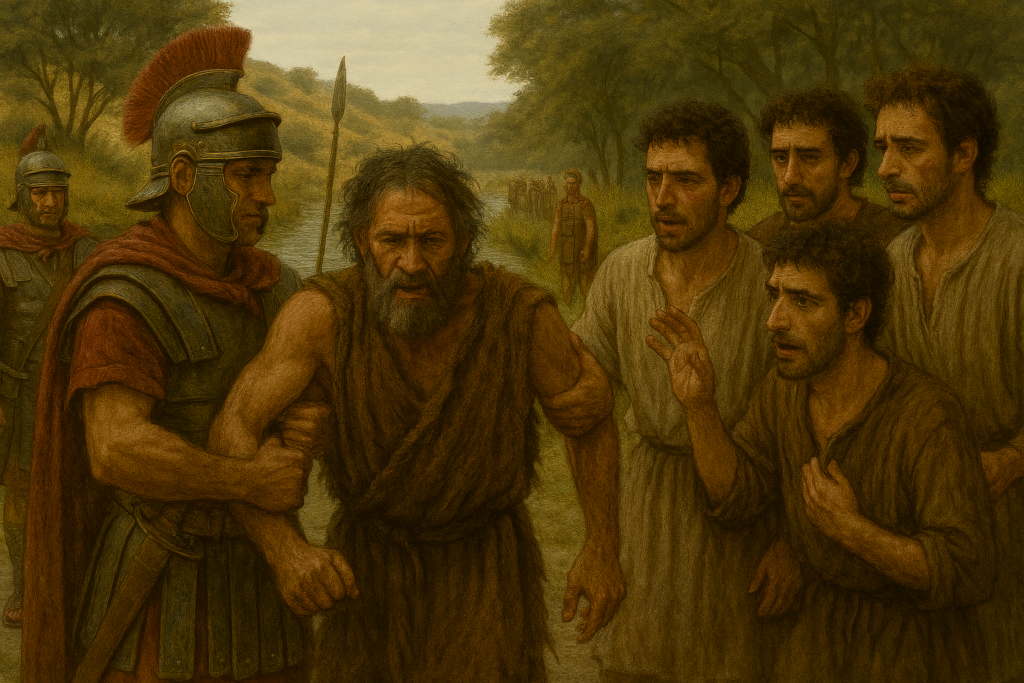

John the Baptist’s arrest marks a crucial turning point in Jesus the Messiah’s life. Herod Antipas, tetrarch of Galilee, takes a considerable political risk in arresting John, since the people favour and respect him as a great prophet of Yahweh. However, this action does not provoke a popular revolt.
News of John the Baptist’s arrest may have been concealed for some time, possibly explaining the absence of an immediate reaction from the people.
It is difficult today to date this event precisely. We suppose it occurred relatively early, because neither Matthew, Mark nor Luke mentions this period of Jesus the Messiah’s life in Judea, which appears to end with the arrest.
We rely on John’s information, which subsequently specifies that Jesus the Messiah passed through Sychar on his way north to Galilee. This implies that these events take place in Bethany, south of Sychar.
This arrest signals the end of John the Baptist’s public activity. The situation then becomes clearer: there is now only one Master to follow, Jesus the Messiah.
However, John the Baptist’s arrest does not lead to his immediate death. Even so, Herod could not keep him imprisoned indefinitely at Machaerus without risking a popular insurrection, given John’s reputation as a great prophet.
The Gospel according to Matthew 4.12 says: ‘When he heard that John had been arrested.’ This seems to indicate that Jesus was not with John the Baptist when he was arrested.
This detail seems to confirm that Jesus and his disciples had already parted from John and left for Bethany. John the Baptist would thus have been arrested at Aenon while Jesus was working in Bethany.
John’s Gospel then reports that Jesus leaves the region and travels north towards Galilee, passing through Sychar in Samaria, which lies on the route between Bethany and Galilee.
After his arrest, John the Baptist may have been taken to Tiberias, a town housing a Roman garrison, before being transferred to the fortress of Machaerus, near Jerusalem, to be imprisoned there.