ANN017

The Baptisms

The article examines the different baptisms of the New Testament, from John the Baptist to Jesus and Paul. It shows how each baptism marks a key stage in the formation of the early Church, incorporating repentance and faith in Christ.

10 min baptism John the Baptist Jesus Paul

Further information

Introduction

When we read the Gospels, we notice the existence of three distinct baptisms.

The first is practiced by John the Baptist, while the second is that of the Messiah Jesus during his ministry in Judea.

It is also appropriate to add a third, that of the Apostle Paul. We are thus faced with various baptisms, a source of confusion. Even the Apostle Paul asked the Christians of Ephesus what kind of baptism they had received.
We may also note the baptism of the Holy Spirit, which took place on 22 May AD 33 at the .

Acts 19.4-7 (King James Version)

Then said Paul, John verily baptized with the baptism of repentance, saying unto the people, that they should believe on him which should come after him, that is, on Christ Jesus.

When they heard this, they were baptized in the name of the Lord Jesus.

And when Paul had laid his hands upon them, the Holy Ghost came on them; and they spake with tongues, and prophesied.

And all the men were about twelve.

I. Les trois baptêmes d’eau

We see three different baptisms, and even the Apostle Paul will ask the Christians of Ephesus:

Acts 19.3 (King James Version)

And he said unto them, Unto what then were ye baptized? And they said, Unto John’s baptism.

He could have left it there, but the text adds:

Actes 19.4–5 (S21)

Acts 19.4-5 (King James Version)

Then said Paul, John verily baptized with the baptism of repentance, saying unto the people, that they should believe on him which should come after him, that is, on Christ Jesus.

When they heard this, they were baptized in the name of the Lord Jesus.

The Apostle Paul considered it necessary to rebaptize these people, showing thereby that the baptism of John the Baptist was insufficient. The new baptism in the name of the Lord Jesus became the only one necessary, indispensable to mark commitment to the Messiah Jesus, as well as for the forgiveness of faults and sins.

Acts 18.24-25 (King James Version)

And a certain Jew named Apollos, born at Alexandria, an eloquent man, and mighty in the scriptures, came to Ephesus.

This man was instructed in the way of the Lord; and being fervent in the spirit, he spake and taught diligently the things of the Lord, knowing only the baptism of John.

We see that there was a transitional period during which some Christians were baptized according to the rite of John the Baptist, others, in great numbers, according to the baptism of the Messiah Jesus, and finally, the majority according to the baptism of the Apostle Paul, in the name of the Lord Jesus.

It is legitimate to ask: what is the origin of John’s baptism? What are the differences between these three baptisms?

II. Le baptême de Jean le baptiste

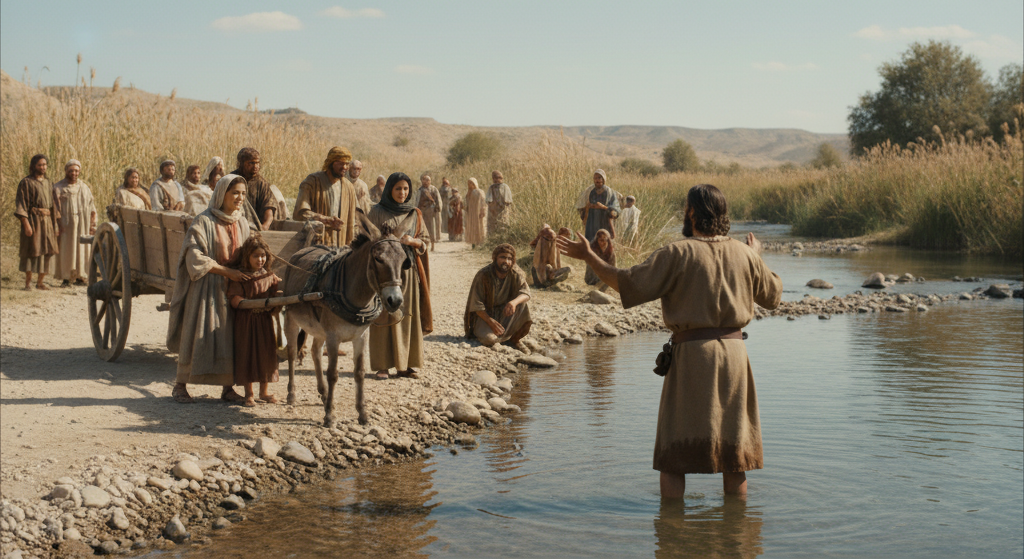
John the Baptist will introduce a new sign to mark one’s commitment to a new life: Baptism. From now on, this term will be attached to his name.

It is a revolution, for this rite does not exist in Judaism.

Mark 1.4 (King James Version)

John did baptize in the wilderness, and preach the baptism of repentance for the remission of sins.

Mark makes it clear here that this is a baptism of repentance, but he adds: “for the forgiveness of sins”. Matthew, moreover, states that many and also came to be baptized.

Matthew 3.7-9 (King James Version)

But when he saw many of the Pharisees and Sadducees come to his baptism, he said unto them, O generation of vipers, who hath warned you to flee from the wrath to come?

Bring forth therefore fruits meet for repentance:

And think not to say within yourselves, We have Abraham to our father: for I say unto you, that God is able of these stones to raise up children unto Abraham.

The are great defenders of the law of Moses; they even regard themselves as the guarantors of its transmission and interpretation. Nevertheless, they accept this new baptism, apparently without objection.

One point does surprise them, though!

John 1.24-28 (King James Version)

And they which were sent were of the Pharisees.

And they asked him, and said unto him, Why baptizest thou then, if thou be not that Christ, nor Elias, neither that prophet?

John answered them, saying, I baptize with water: but there standeth one among you, whom ye know not;

He it is, who coming after me is preferred before me, whose shoe’s latchet I am not worthy to unloose.

These things were done in Bethabara beyond Jordan, where John was baptizing.

Evidently these religious men considered that only the Messiah, or Elijah, or the prophet had the right to baptize. They are therefore not surprised by the baptism itself, but by the one who practiced it.

They are familiar with this kind of practice.

Leviticus 14.8 (King James Version)

And he that is to be cleansed shall wash his clothes, and shave off all his hair, and wash himself in water, that he may be clean: and after that he shall come into the camp, and shall tarry abroad out of his tent seven days.

There is therefore, neither in the message nor in the practices of John the Baptist, any incitement to reject the law of Moses, quite the contrary.

He advocates a return to the roots of Judaism, to God himself. This position explains why many and embraced his teachings, considering that John the Baptist fits fully within the Jewish tradition.

To better understand the meaning of this baptism, let us examine the passage where John the Baptist rebukes the religious men who also wish to receive baptism.

Matthew 3.8-9 (King James Version)

Bring forth therefore fruits meet for repentance:

And think not to say within yourselves, We have Abraham to our father: for I say unto you, that God is able of these stones to raise up children unto Abraham.

For many, the mere fact of being Jewish is considered sufficient to obtain redemption by performing the rites of the law of Moses.

However, the notion of repentance has been lost; they are rooted in a routine tradition, while the personal relationship with God has faded.

Luke 18.10-14 (King James Version)

Two men went up into the temple to pray; the one a Pharisee, and the other a publican.

The Pharisee stood and prayed thus with himself, God, I thank thee, that I am not as other men are, extortioners, unjust, adulterers, or even as this publican.

I fast twice in the week, I give tithes of all that I possess.

And the publican, standing afar off, would not lift up so much as his eyes unto heaven, but smote upon his breast, saying, God be merciful to me a sinner.

I tell you, this man went down to his house justified rather than the other: for every one that exalteth himself shall be abased; and he that humbleth himself shall be exalted.

The attitude of this Pharisee, in this cited by Luke, is symptomatic.

A Jew who keeps the law, and is therefore religious, is in harmony with God. That is what he thinks, but also what he believes! One vital point is missing from this approach: repentance.

This is the very foundation of John the Baptist’s message, which proposes as a sign of commitment to this path the so-called baptism of repentance. Redemption is therefore not possible through this baptism alone; it is still found in the sacrifices at the temple.

Matthew 3.2 (King James Version)

And saying, Repent ye: for the kingdom of heaven is at hand.

This note from Matthew, “Change your attitude”, which is sometimes translated as “repent”, summarizes this Baptism of John very well.

John the Baptist is aware of the limitations of his baptism, which does not take redemption into account:

Matthew 3.11-12 (King James Version)

I indeed baptize you with water unto repentance: but he that cometh after me is mightier than I, whose shoes I am not worthy to bear: he shall baptize you with the Holy Ghost, and with fire:

Whose fan is in his hand, and he will throughly purge his floor, and gather his wheat into the garner; but he will burn up the chaff with unquenchable fire.

Mark 1.7-8 (King James Version)

And preached, saying, There cometh one mightier than I after me, the latchet of whose shoes I am not worthy to stoop down and unloose.

I indeed have baptized you with water: but he shall baptize you with the Holy Ghost.

Luc 3.16–17 (S21)

Luke 3.16-17 (King James Version)

John answered, saying unto them all, I indeed baptize you with water; but one mightier than I cometh, the latchet of whose shoes I am not worthy to unloose: he shall baptize you with the Holy Ghost and with fire:

Whose fan is in his hand, and he will throughly purge his floor, and will gather the wheat into his garner; but the chaff he will burn with fire unquenchable.

John 1.26-27 (King James Version)

John answered them, saying, I baptize with water: but there standeth one among you, whom ye know not;

He it is, who coming after me is preferred before me, whose shoe’s latchet I am not worthy to unloose.

The four authors of the Gospels report the words of John the Baptist, who clearly announces the imminent coming of someone far greater than himself. He foretells the arrival of the Messiah, who will offer a revolutionary baptism.

III. Le baptême du Messie Jésus

John 3.26 (King James Version)

And they came unto John, and said unto him, Rabbi, he that was with thee beyond Jordan, to whom thou barest witness, behold, the same baptizeth, and all men come to him.

With John’s account we discover the beginning of the ministry of the Messiah Jesus in Judea.

John 3.22-24 (King James Version)

After these things came Jesus and his disciples into the land of Judæa; and there he tarried with them, and baptized.

And John also was baptizing in Ænon near to Salim, because there was much water there: and they came, and were baptized.

For John was not yet cast into prison.

John 4.2 (King James Version)

(Though Jesus himself baptized not, but his disciples,)

For a short period after his baptism, the Messiah Jesus, accompanied by many disciples, practiced in the same region, as John the Baptist did.

However, it was not he but his disciples who baptized. But which baptism is referred to here? It is AD 29, and the baptism of the Apostle Paul, based on the death of the Messiah Jesus, does not yet exist. It seems that what is spoken of here is the baptism of repentance, the one practiced by John the Baptist.

It is only after the death of the Messiah Jesus that the new baptism, the one advocated by the Apostle Paul, will begin to spread. It should be noted that there are no other allusions in the Gospels to the baptism practiced by Jesus’ disciples, apart from this passage in John.

It seems that the Messiah Jesus, followed by his disciples, adopted a practice similar to that of John the Baptist at the very beginning of his ministry in Judea.

Matthew 28.19-20 (King James Version)

Go ye therefore, and teach all nations, baptizing them in the name of the Father, and of the Son, and of the Holy Ghost:

Teaching them to observe all things whatsoever I have commanded you: and, lo, I am with you alway, even unto the end of the world. Amen.

Mark 16.15-18 (King James Version)

And he said unto them, Go ye into all the world, and preach the gospel to every creature.

He that believeth and is baptized shall be saved; but he that believeth not shall be damned.

And these signs shall follow them that believe; In my name shall they cast out devils; they shall speak with new tongues;

They shall take up serpents; and if they drink any deadly thing, it shall not hurt them; they shall lay hands on the sick, and they shall recover.

In these words of the Messiah Jesus, after his resurrection, allusion is obviously made to the new baptism, the one announced and practiced by the Apostle Paul.

IV. Le baptême de l’Apôtre Paul

We will not study the doctrine of Christian baptism in detail here, but simply recall some of its aspects in order to clarify the difference from that of John the Baptist. This baptism draws its origin from the death of the Messiah Jesus, which is the basis of a permanent redemption.

It is the atoning death of the Messiah Jesus that offers all people, in every age, redemption, or the forgiveness of their sins. Thus, this new baptism replaces the animal sacrifices at the temple. We also understand why the Apostle Paul encourages the Ephesians to receive this new baptism, in the name of the Lord Jesus, as he specifies.

Acts 19.4-5 (King James Version)

Then said Paul, John verily baptized with the baptism of repentance, saying unto the people, that they should believe on him which should come after him, that is, on Christ Jesus.

When they heard this, they were baptized in the name of the Lord Jesus.

Peter defines the direct link between the death of the Messiah Jesus and this new baptism.

1 Peter 3.21-22 (King James Version)

The like figure whereunto even baptism doth also now save us (not the putting away of the filth of the flesh, but the answer of a good conscience toward God,) by the resurrection of Jesus Christ:

Who is gone into heaven, and is on the right hand of God; angels and authorities and powers being made subject unto him.

He makes it clear to us that the cleansing of sins flows from faith in the death of the Messiah Jesus, and that baptism is the sign of the commitment of a good conscience toward God.

The principle is therefore the same as in the old covenant: it is the death of an innocent sacrifice that allows the cleansing of faults. The death of the Messiah Jesus now constitutes a perpetual sacrifice. This is also what Paul tells us.

1 Timothy 2.5-6 (King James Version)

For there is one God, and one mediator between God and men, the man Christ Jesus;

Who gave himself a ransom for all, to be testified in due time.

We therefore see a fundamental difference between the baptism of John the Baptist and that of the Apostle Paul. The latter now takes into account the forgiveness of sins, and therefore redemption, and it is also a commitment to God.

V. Le baptême du Saint-Esprit

In his words, John the Baptist announces the coming of the Messiah and states that he will baptize with the Holy Spirit and fire.

Matthew 3.11 (King James Version)

I indeed baptize you with water unto repentance: but he that cometh after me is mightier than I, whose shoes I am not worthy to bear: he shall baptize you with the Holy Ghost, and with fire:

Mark 1.7-8 (King James Version)

And preached, saying, There cometh one mightier than I after me, the latchet of whose shoes I am not worthy to stoop down and unloose.

I indeed have baptized you with water: but he shall baptize you with the Holy Ghost.

Luke 3.16 (King James Version)

John answered, saying unto them all, I indeed baptize you with water; but one mightier than I cometh, the latchet of whose shoes I am not worthy to unloose: he shall baptize you with the Holy Ghost and with fire:

What does this new baptism mean?

We find elements of an answer in the event that took place on 22 May AD 33, recorded in Luke’s second book:

Acts 2.1-4 (King James Version)

And when the day of Pentecost was fully come, they were all with one accord in one place.

And suddenly there came a sound from heaven as of a rushing mighty wind, and it filled all the house where they were sitting.

And there appeared unto them cloven tongues like as of fire, and it sat upon each of them.

And they were all filled with the Holy Ghost, and began to speak with other tongues, as the Spirit gave them utterance.

Luke describes the reaction of the witnesses:

Acts 2.5-13 (King James Version)

And there were dwelling at Jerusalem Jews, devout men, out of every nation under heaven.

Now when this was noised abroad, the multitude came together, and were confounded, because that every man heard them speak in his own language.

And they were all amazed and marvelled, saying one to another, Behold, are not all these which speak Galilæans?

And how hear we every man in our own tongue, wherein we were born?

Parthians, and Medes, and Elamites, and the dwellers in Mesopotamia, and in Judæa, and Cappadocia, in Pontus, and Asia,

Phrygia, and Pamphylia, in Egypt, and in the parts of Libya about Cyrene, and strangers of , Jews and proselytes,

Cretes and Arabians, we do hear them speak in our tongues the wonderful works of God.

And they were all amazed, and were in doubt, saying one to another, What meaneth this?

Others mocking said, These men are full of new wine.

It is at this moment that Peter speaks up to explain this extraordinary event, but he relies not on the words of John the Baptist but on those of the prophet Joel.

Acts 2.14-21 (King James Version)

But Peter, standing up with the eleven, lifted up his voice, and said unto them, Ye men of Judæa, and all ye that dwell at Jerusalem, be this known unto you, and hearken to my words:

For these are not drunken, as ye suppose, seeing it is but the third hour of the day.

But this is that which was spoken by the prophet Joel;

And it shall come to pass in the last days, saith God, I will pour out of my Spirit upon all flesh: and your sons and your daughters shall prophesy, and your young men shall see visions, and your old men shall dream dreams:

And on my servants and on my handmaidens I will pour out in those days of my Spirit; and they shall prophesy:

And I will shew wonders in heaven above, and signs in the earth beneath; blood, and fire, and vapour of smoke:

The sun shall be turned into darkness, and the moon into blood, before that great and notable day of the Lord come:

And it shall come to pass, that whosoever shall call on the name of the Lord shall be saved.

We develop the argument of this speech in the appendix ANN36: The Speech of the Apostle Peter.

Conclusion

We may consider that in reality there are only two baptisms, and that they are fundamentally different, even though the practice, immersion, is similar, since that is the meaning of the word. On the one hand, there is the baptism of John the Baptist, also practiced by the disciples of the Messiah Jesus at the beginning of his ministry in Judea, and on the other, that of the Apostle Paul. Although repentance is common to both, the great difference lies in redemption. John the Baptist offered only the first step; the Messiah Jesus had to sacrifice his life to accomplish the second step.

Considering the history of the world, we can marvel at the unfolding of these events, for in AD 70 the Jewish temple would be destroyed, putting an end to animal sacrifices. Thus, the baptism of John the Baptist was only a foreshadowing of this new baptism, in the name of the Lord Jesus.

It is also important to note that, in keeping with the words of the prophet Joel and those of John the Baptist, a new baptism was instituted on the day of Pentecost.

Within the Church, we identify only two baptisms: the first, the “water baptism”, is that of the Apostle Paul; the second, the “baptism of the Holy Spirit”, that of Pentecost.