ANN001

The Gospel of Luke

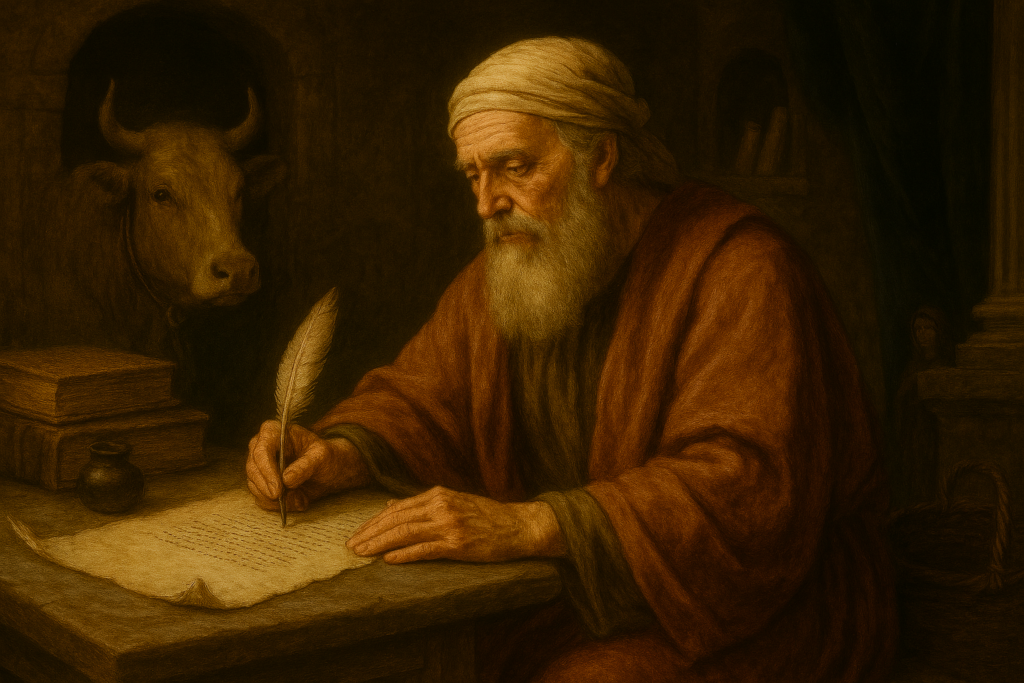
The Gospel of Luke and Acts of the Apostles form a two-volume work on the origins of Christianity. Luke did not witness Jesus' ministry directly, but he associated with the apostles and leaders of the earliest communities. A collaborator of Paul, probably Greek and a physician, he emerges as an educated, methodical author. In Luke 1.1-4, he explains that he studied existing accounts and eyewitness testimonies to offer Theophilus an orderly, reliable narrative. His Gospel is distinguished by its attention to historical context, the Holy Spirit, prayer, the poor, women and marginalised people. Its authority rests on his investigation, his apostolic sources and his place within the early Church.

16 min Gospel according to Luke Luke Acts of the Apostles Theophilus Paul 10 verses 4 books

Further information

Introduction

Luke wrote two texts focusing on the origins and history of the first-century Church. The first, entitled ‘The Gospel according to Luke’, describes the beginnings of Christianity, while the second, ‘Acts of the Apostles’, recounts the birth of the Church. Luke's work differs markedly from Matthew's and Mark's.

- Why did he compose a third Gospel?

- What reasons lead us to attribute this work to Luke?

- What authority enabled him to write a Gospel?

- When did he write this work?

We will now study his text and try to answer all these questions.

I. What do we know about Luke?

Luke does not describe events he witnessed. He converts to Christianity shortly after Jesus the Messiah's resurrection.

He did not meet Jesus, but undoubtedly associated with apostles and leaders of this new religious movement.

It is still a small world, and all the leaders know one another at this time.

He is not Jewish, but probably Greek. He writes in that language, and his refined expression reveals an educated man with a scientific mind.

He takes care to explain the setting of his work.

We will examine his working method in detail. Luke, the Greek, is neither one of the apostles nor one of Jesus the Messiah's close companions. He is a collaborator of Paul, the author of thirteen epistles in our Bibles.

Here we discover Luke's occupation: he is described as a physician. It is important to note that, at that time, the title ‘physician’ was often applied to healers, sometimes regarded as charlatans. In the first century, this designation therefore lacked the prestige and respectability it has today.

Despite this connotation, through Luke's contacts with Paul we see a figure resembling our contemporary therapists. Studying his writings reveals a learned intellectual with the abilities needed to write the history of the Church and Christianity.

His work, offering a non-Jewish perspective on events, addresses a mainly pagan audience. This orientation contrasts with other writings of the period. Matthew, for example, primarily targets Jews, Mark addresses non-Jews in neighbouring regions, while Luke broadens his audience to a worldwide context.

Furthermore, the composition of the Synoptic Gospels, including Luke's work, parallels the development of the Christian mission, highlighting the Christian message's evolution and expansion into different communities and cultures.

This reminds us of the Master's words:

II. The writer of the third Gospel

How can we affirm that the author of the third Gospel and Acts of the Apostles is indeed Luke, Paul's collaborator?

His name appears in neither work, but Paul mentions him three times: Philemon 1.23-25, 2 Timothy 4.11 and Colossians 4.13-14.

However, the author directly refers to himself by using ‘we’ in several passages of his second volume: Acts 16.10, Acts 16.17, Acts 20.5, Acts 20.21, Acts 21.18, Acts 27.1 and Acts 28.16.

He remains a faithful collaborator of Paul and a witness to various events in Acts of the Apostles. We therefore have little information about Luke, but since these two volumes appeared, they have been attributed to him without serious challenge. We have no reason to doubt his authorship. Moreover, no one else in the circle of disciples we know bears this name.

III. Luke's purpose

Luke undertakes his book for several reasons. First, he wants to demonstrate to his friend Theophilus that all the teaching he has received rests on verified facts. Addressing Theophilus, a convert from paganism, Luke hopes to reach all non-Jews and offer them a description of the origins of the religious movement they are joining: Christianity.

Luke also wants to provide historical references absent from Matthew's and Mark's accounts. This information helps place the events of Jesus' earthly life in chronological context. He thus wishes to offer an innovative account resulting from thorough research.

Theophilus, as a member of a privileged social class, may have financed Luke's research and encouraged him to share his discoveries with a wider audience.

In summary, Luke writes to provide verified facts and historical references, describe Christianity's origins and reach a non-Jewish audience, encouraged in this by Theophilus.

IV. Luke's working method

Luke informs us about his working method. He conducted thorough research to present accurate, precise information. He begins by examining various writings, including Matthew's and Mark's accounts and probably other documents. Luke mentions accounts based on the apostles' testimony, thus indicating that these are not Matthew's and Mark's writings: they directly witnessed what they testify to. Mark records Peter's memories.

Luke states that many attempted to recount the Master's history, understandably, since the emerging Church rested on Jesus' teaching. By interviewing witnesses and gathering personal details, especially about Joseph and Mary's lives, Luke seems to have obtained information directly from Mary, Jesus' mother. Since the work was probably written around the year 60, Mary would have been very elderly, about seventy-five. Luke may therefore plausibly have used notes from earlier interviews.

In his work, Luke acts somewhat like a modern investigative journalist, seeking an authentic, detailed account of Jesus' life. It is therefore reasonable to think that he scrupulously checked his information, giving his work real historical credibility.

Theophilus, and probably other readers, could compare Luke's statements with their own knowledge of the facts. Moreover, since Luke had Matthew's and Mark's writings, he is unlikely to have included contradictory statements that might undermine his account's credibility.

In summary, when Theophilus discovered Luke's notes, he immediately understood their importance to the Church and encouraged Luke to write a biography of Jesus. Building on this success, Luke then wrote ‘Acts of the Apostles’, an account in which he is himself a direct witness, continuing the Church's history.

V. The results of his work

We receive a two-volume text. The first volume, of particular interest to us, resembles Matthew's and Mark's already published accounts. It follows a similar pattern and presents a comparable chronological sequence of events. Luke thus logically joins Matthew and Mark among the Synoptics.

For financial reasons, Luke probably chose to use two papyrus scrolls for the two parts of his account. His becomes the longest of the three Gospels. John's, published several decades later, would also be shorter.

Following the principle developed in our study of the Gospels, counting the 178 distinct major events mentioned in the four Gospels, Luke reports 111. He takes seventy-four from Matthew and Mark: sixty-two accounts are already in both, six come from Matthew, six from Mark, and thirty-seven are unique to Luke.

When Luke begins his account, Matthew and Mark have already recorded 112 different pericopes. Luke adds thirty-seven, bringing the total to 149. John would later contribute twenty-nine, raising the number to 178.

Luke's research enabled him to identify thirty-seven episodes not mentioned by Matthew and Mark. What matters to us, however, is the historical information he carefully records. Despite its independence, his text complements Matthew's and Mark's accounts. He does not copy them, but adds details that prove essential to us today.

His chronological notes help us confirm the prophet Daniel's writings in establishing the date of Jesus the Messiah's death.

VI. The date of composition

Since Luke was not one of the apostles, he did not take part in decisions about writing their testimonies. Yet Matthew, Mark and Luke, known as the Synoptic Gospels, have a similar structure. This similarity suggests that Luke knew the other evangelists' accounts and wrote later.

We estimate that Mark's Gospel appeared around the year 46, shortly after Matthew's. Luke's writing, by comparison, seems much later. He evidently wrote the two volumes of his Church history consecutively, without much delay. If we place the apostle Paul's last journey around 59 or 60, we can estimate that Luke's Gospel was already complete by then.

Acts of the Apostles ends with Paul's work in . It does not mention his death, probably around the year 67. This leads us to think that Acts was completed around 62 or 63. Luke's Gospel can therefore be dated two or three years earlier, around 60, during Paul's imprisonment in Caesarea. Luke very probably finalised his Gospel during this period.

Conclusion

Unlike Matthew's and Mark's accounts, Luke's later one includes historical markers demonstrating the quality of his investigation. He did not face the same external constraints as the apostles in preparing his text. He therefore took several years to research and gather extensive documentation to write the Church's beginnings. Discovering the importance of Luke's information, Theophilus encouraged him to write the account we have today.

In the history of this Gospel's composition, it is important to distinguish the research phase from the writing phase. As we understand it, the writing of Acts followed quickly after the Gospel.

Luke, the beloved physician and collaborator of the apostle Paul, has always been recognised as this Gospel's author. New converts from different cultures and traditions knew nothing about Jesus the Messiah's history or Christianity's birth. Luke's work therefore fills this information gap.