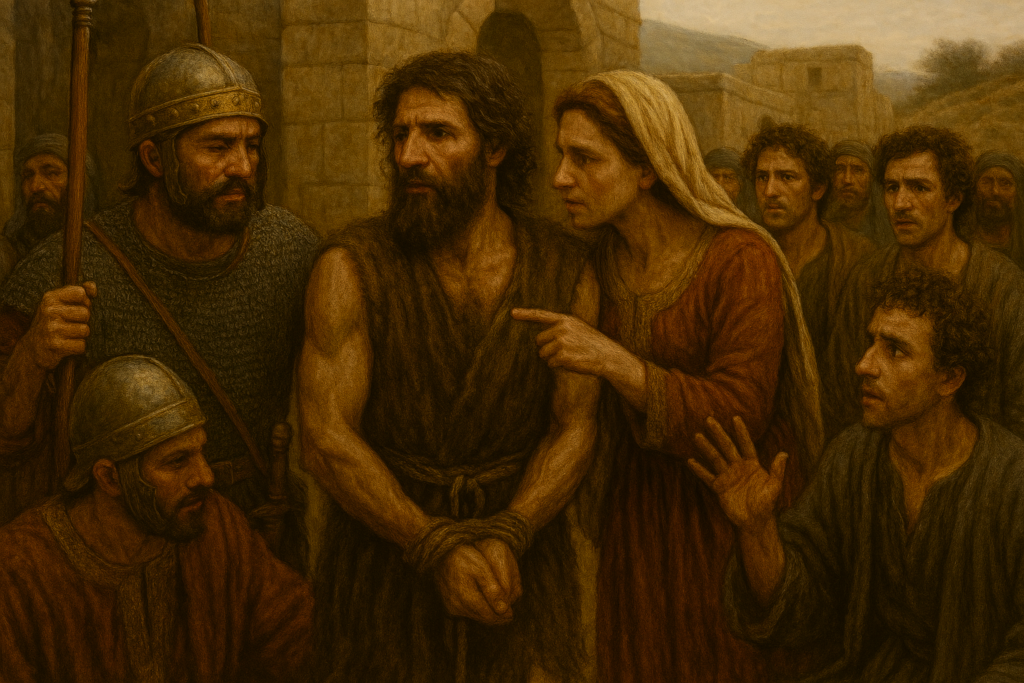

Matthew and Mark describe the circumstances in which John the Baptist was arrested and imprisoned. It appears that he was held in the fortress of Machaerus for several months before being murdered.
It is established that Matthew and Mark were not disciples of John the Baptist and surely did not know him personally. The apostle John, the only one who knew John the Baptist, mentions neither his arrest nor his death. This could be explained by the fact that he preferred not to repeat events already recounted by his colleagues, concentrating instead on supplying additional information.
Peter, who collaborated with Mark in the writing of his Gospel, had been a disciple of John the Baptist and was even baptized by him, according to our conclusions. It is likely that this relationship explains why Mark develops the account concerning this great prophet in more detail.
In these texts we discover the official reason for the arrest of John the Baptist. He proclaimed loudly and clearly that the marriage of Herod Antipas to Herodias was not lawful.
Indeed, according to John the Baptist, the marriage of Herod Antipas and Herodias was considered unlawful because it violated Jewish law (Deuteronomy 24.1-4). Herodias was the divorced wife of his brother Herod Philip, and according to Jewish law, a man was forbidden to marry the divorced wife of his brother. John the Baptist criticized this scandalous marriage, which led to his arrest and to his execution on the orders of Herod Antipas.
We note that the text of Deuteronomy 24.1-4, on which this prohibition rests, is not very explicit. However, it seems that this remarriage of Antipas provoked a scandal among the population, and that John the Baptist publicly expressed what many were thinking in private.
It was not Herod who reacted, but his wife Herodias. And we even discover from Mark's account that Herod feared John the Baptist and even enjoyed talking with him.
Comparative analysis
Reason for John's arrest:
Mark 6.17-18: Herod arrests John because of Herodias, since John criticized their marriage.
Matthew 14.3-4: The reason is similar: John criticized the marriage between Herod and Herodias.
Herod's attitude toward John:
Mark 6.19-20: Herod fears John, protects him, and is perplexed but enjoys listening to him.
Matthew 14.5: Herod fears the crowd and hesitates to put John to death, but there is no mention of enjoyment in listening to him.
Role of Herodias:
Mark 6.19: Herodias holds a grudge against John and wants him dead, but cannot obtain it directly.
Matthew 14.3-4: The role of Herodias is less explicit, but she is still the initial cause of John's imprisonment.
Context of the events:
Mark 6.17-20: A more detailed context, with nuances regarding Herod's feelings toward John.
Matthew 14.3-5: A more succinct context, centered on Herod's fear of the crowd's reaction.
In summary, Mark offers a more nuanced portrait of Herod, showing his complexity and his conflicting feelings toward John. Matthew, on the other hand, places greater emphasis on Herod's fear of the crowd and his hesitation to act against John.