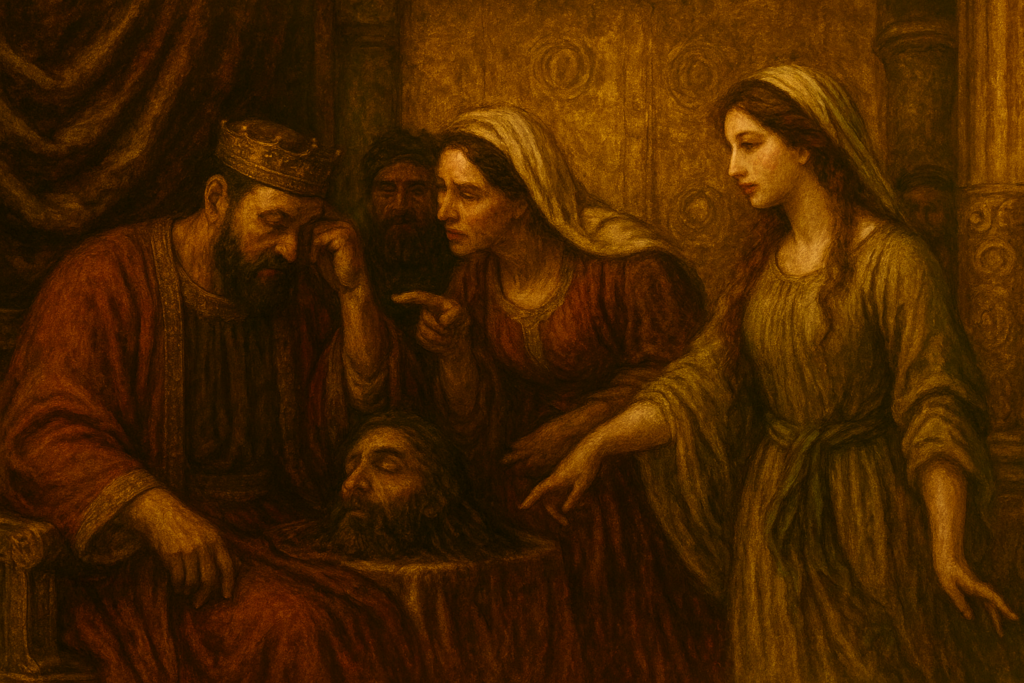

These passages speak of Herod Antipas, governor of Galilee, who had John the Baptist murdered to satisfy the request of Salome, daughter of Herodias, his wife.
Herod Antipas connected the two Messiahs: John the Baptist, the priestly Messiah, and Jesus, the royal Messiah. Rumors were circulating among the people and reached his ears. Some said that Jesus was John the Baptist risen from the dead, or Elijah, or a prophet. Be that as it may, Antipas thought that it was John the Baptist who had come back to life.
It follows that this murder left its mark on the life of Antipas and that he still thought of John the Baptist.
Let us compare the three texts in question: Matthew 14.1-2, Mark 6.14-16 and Luke 9.7-9. All these passages speak of Herod's reaction regarding Jesus.
Matthew 14.1-2
Convergence:
Herod hears about Jesus and thinks that he is John the Baptist raised from the dead.
Differences:
Matthew specifically mentions that it is Herod the tetrarch.
He makes a statement about the miracles associated with Jesus, saying that John has risen from the dead and that this is why these miraculous powers are at work in him.
Mark 6.14-16
Convergence:
Herod hears about Jesus and thinks that he is John the Baptist risen from the dead.
Differences:
Mark also mentions Herod in a similar way, but he gives more details about the other popular opinions, some saying that Jesus is Elijah or a prophet like those of the past.
Herod personally insists that Jesus is John the Baptist, whom he had beheaded and who has risen from the dead.
Luke 9.7-9
Convergence:
Herod hears about Jesus and is perplexed, because he receives reports that Jesus is either John the Baptist risen from the dead, or Elijah.
Differences:
Luke concentrates more on Herod's confusion and his desire to see Jesus.
He highlights the different rumors and speculates about Jesus being one of the ancient prophets risen from the dead.
Synthesis
PPoints of convergence:
All three texts speak of Herod's perplexity regarding Jesus.
The three passages mention the idea that Jesus might be John the Baptist risen from the dead.
Differences:
Matthew and Mark place more emphasis on Herod's identity and on the miracles associated with Jesus.
Mark and Luke mention other popular rumors, notably Elijah and the prophets of the past.
Luke particularly stresses Herod's curiosity and his desire to meet Jesus in person.
These three versions present a complementarity that allows us to better grasp this complex situation.
It should be noted that the fame of Jesus the Messiah was significant enough to attract the attention of the authorities. Indeed, all popular movements were subjected to rigorous analysis by the authorities, who sought to detect the first signs of a possible revolt in order to quell it quickly.