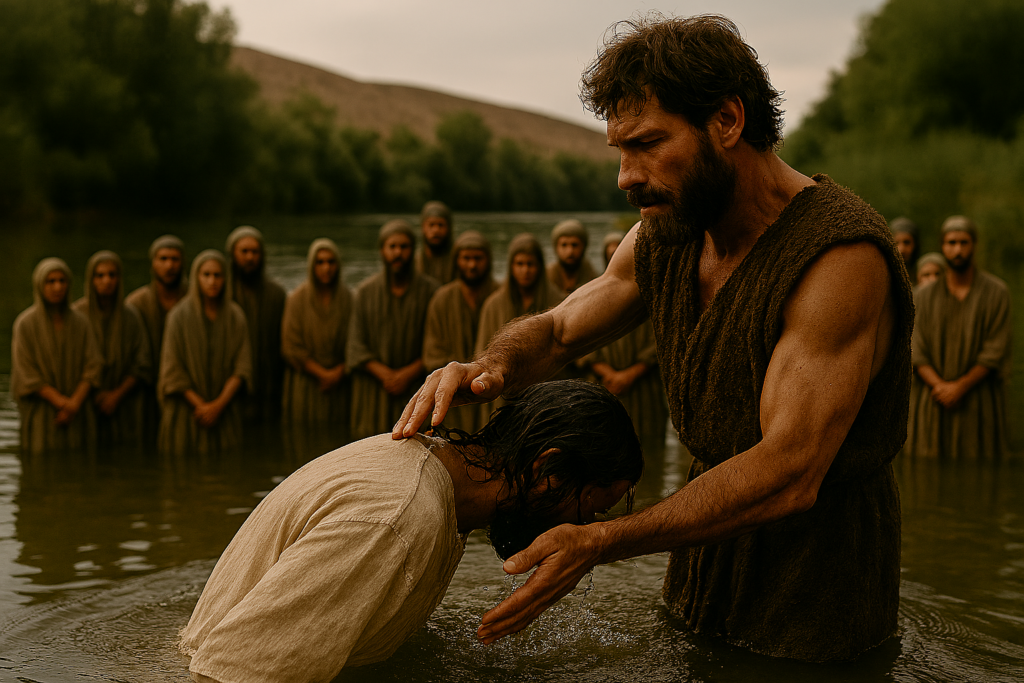

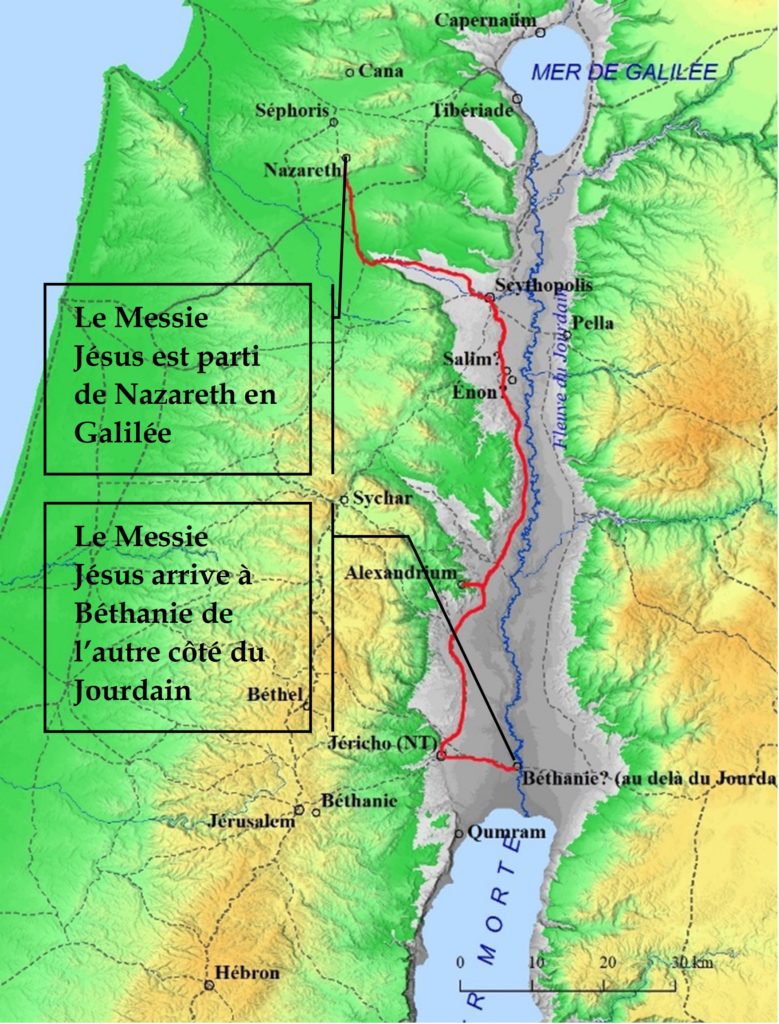
We learn that Jesus the Messiah lived in Nazareth in Galilee. At some point, having heard of John the Baptist’s renown, he decided to go to Judea to meet this prophet and be baptised.
Several of his future disciples had already taken this path. Jesus knew that John the Baptist was the great prophet announcing his coming, the priestly Messiah. He knew his mother’s accounts, the Jewish writings and the prophet’s reputation, but also possessed the knowledge inherent in his divine nature.
But why did he have to be baptised by John?
This baptism was not intended to replace the Temple sacrifices; it symbolised repentance rather than redemption. It was for repentant people wishing to leave their old life behind and embark on a new path. That was not the case with Jesus the Messiah, who had never sinned.
This act marked the link between the two messiahs and, above all, the continuity of John the Baptist’s work. Thus Jesus the Messiah’s time begins as John the Baptist’s draws to a close. Matthew’s writings make clear that the two men were not rivals; John the Baptist acknowledged Jesus’ superiority.
This baptism was unlike any other. The supernatural manifestation following Jesus’ immersion confirmed his messiahship to John the Baptist. The simultaneous presence of God the Father, God the Son and God the Holy Spirit illustrated the unity of the Trinity.
The two men seem to have been alone at this baptism. Afterwards, Jesus temporarily settled in the area and showed his first disciples where he was staying.
John the Baptist adds an important detail: Jesus the Messiah will introduce a new baptism (see Appendix ANN017 : Baptisms). Initially, John the Baptist hesitates to baptise Jesus, aware of the paradox of the situation. Convinced by Jesus’ arguments, however, he finally agrees to baptise him.
By being baptised by John, Jesus publicly confirms this prophet’s teaching and actions. He thus takes his place in the divine plan, demonstrating continuity with John’s mission. John the Baptist, descended from the priestly line, meets all the requirements for presenting this symbolic sacrifice, ‘the Lamb of God’, destined to die for the sins of the world.
This baptism also provides an example for all future generations, illustrating the importance and meaning of this act.
Matthew, Mark and Luke also offer a consistent interpretation of this manifestation. They emphasise the presence of the Father, manifested through the voice, the Holy Spirit, symbolised by the dove, and the Son, Jesus the Messiah. Thus the Trinity is present at this great event marking the beginning of Jesus’ ministry.
At this point, Jesus is completing his thirtieth year. This is significant in relation to Numbers 4.3, which stipulates a minimum age of thirty for assuming priestly responsibilities. The detail is repeated five times in the chapter, underscoring its legal importance. John the Baptist, six months older than Jesus, therefore had the age required to legitimise his actions.
We see that everything unfolds in accordance with Daniel’s prophecies. Knowing these texts, Jesus could not have been unaware of either the length of his ministry or the circumstances of his future death. He therefore embarks on a plan established long ago by his heavenly Father.
The carpenter now begins his ministry, the ultimate purpose of his coming and his life. For the precise location of the baptism and the sequence of events, we must consult the complementary account in the Gospel according to John.
John’s Gospel indicates that the disciples did not witness Jesus’ baptism. Only the next day do Andrew and another disciple, certainly the apostle John, hear John the Baptist’s testimony and decide to follow Jesus and spend the afternoon with him.