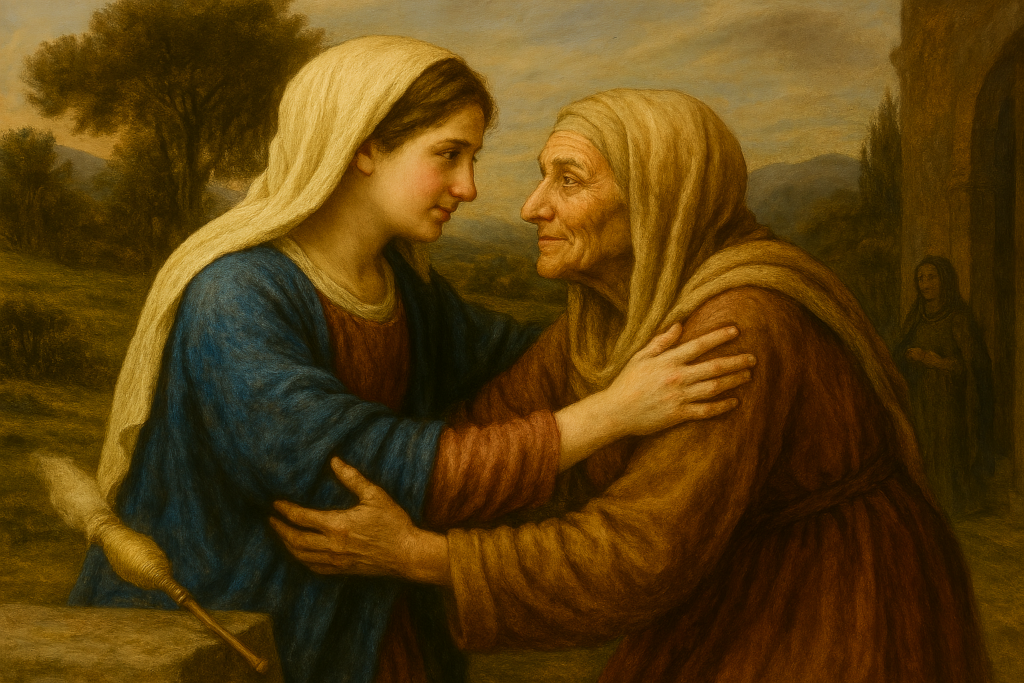
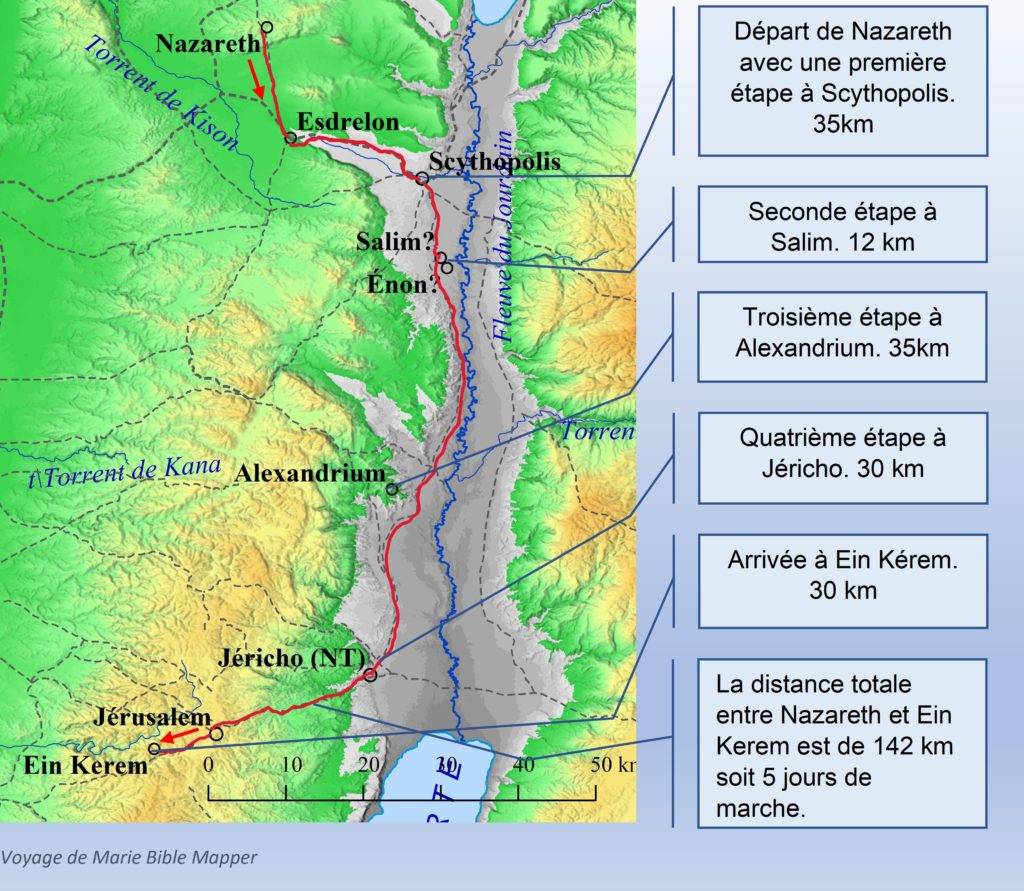
Shortly after the angel's revelation, Mary, probably having become aware of her pregnancy, decides to go quickly to Elizabeth's home to verify the truth of the angel Gabriel's words.
How did she manage to persuade her parents to let her undertake such a long journey?
Did she tell her mother about her pregnancy?
By revealing these details, she risked being seen as a deluded visionary, a liar or a madwoman.
How would her family and her fiancé have reacted?
Luke mentions only that Mary heads towards the village of Elizabeth and Zechariah, situated in the hill country of Judea. It is winter, and the journey takes about five days on foot. She would necessarily have joined a group of travellers from her village on their way to the capital.
Her parents and fiancé therefore gave their consent to this journey. Mary lives in a patriarchal society.
Luke does not specify the name of the village where Elizabeth and Zechariah live, although Mary seems to know it. Today, historians often identify this village as Ein Karem, near Jerusalem, because of Zechariah's duties.
Twice a year, he serves in the temple for a week, in addition to the festivals that also require his presence, often leaving Elizabeth alone.
Through Elizabeth's accounts, Mary understands that the religious teaching about the Messiah is becoming a reality. All the facts stated by the are coming true. Mary reveals herself to be a rational, intelligent woman with a sound knowledge of Jewish history and great faith.
This was necessary if she was to remain steady through such an upheaval in her life. The unassuming Mary proves to be exceptional.
We note that Elizabeth recognises Mary's pregnancy as that of the Messiah.
Did Mary describe her experience to her?
In any case, both women are aware of the significance of the events they are experiencing.
The Qumran manuscripts reveal that the Jews were awaiting two messiahs: one priestly and one royal. Elizabeth belongs to the line of Levi and Mary to that of Judah.
The coming together of these two lineages enables them to grasp the concrete fulfilment of the prophecies.