ANN063

Aenon and Bethany beyond the Jordan

This article explores Bethany and Aenon, important baptism sites in the Gospel of John, while modern hypotheses attempt to locate these biblical sites.

14 min John the Baptist Bethany Aenon baptism Jordan 10 verses 1 book

Further information

Introduction

We will study in more detail the two places, Bethany and Aenon, where, according to the Apostle John, John the Baptist baptized. Although we have very little information about these localities, certain biblical events suggest their region to us.

Matthew, Mark and Luke did not consider it useful to report information about the work of John the Baptist. John, wishing to fill this gap, reveals to us that the Messiah, Jesus, began His activity alongside John the Baptist. He also gives us two places where John baptized.

Of course, several decades passed between the events and the writing of his Gospel. John surely had not set foot in these places for a very long time, and the precise location of the sites was lost.

Archaeologists are looking for the exact place described by John, but they are reduced to formulating hypotheses. Nevertheless, two places prevail, and this is what we will now examine.

I. John’s indications

Here are the two texts of the Apostle John that mention the places where John the Baptist carried out his work.

John explains to us that at a certain moment the Messiah Jesus, accompanied by His disciples, returned to Bethany.

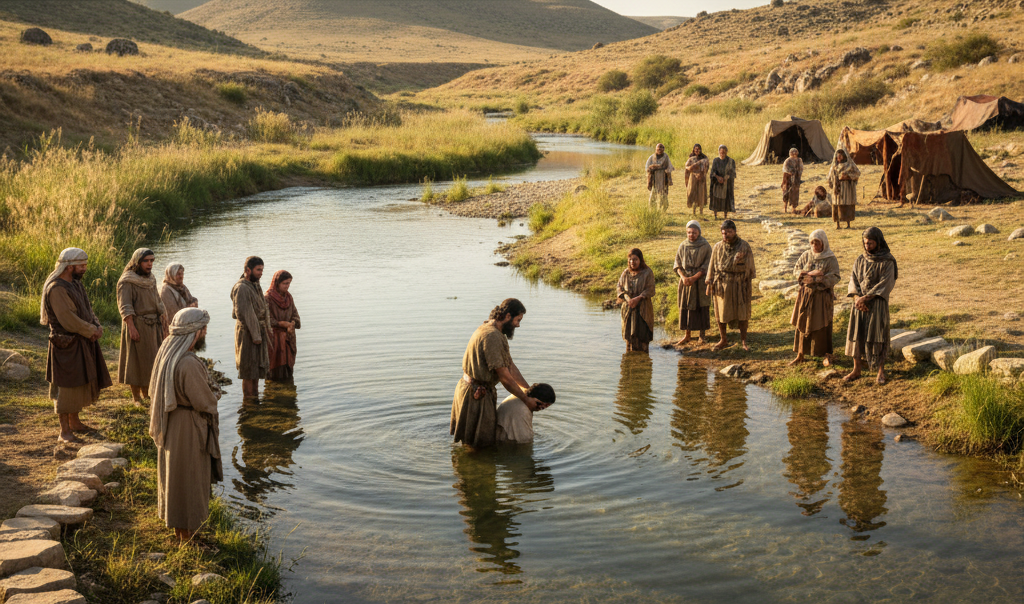
There is no information about these places in the Synoptic Gospels. However, thanks to the Apostle John, we know precisely that the Messiah Jesus was baptized by John the Baptist at Bethany beyond the Jordan, as it is reported in John 1.28-34.

Next, John informs us that the Messiah Jesus was at Aenon near Salim, where baptisms were being performed, as described in John 3.22-24.

It is important to recall that, according to John 4.2, the Messiah Jesus did not baptize Himself, but it was His disciples who officiated.

We will look for information about these two places: Aenon and Bethany. It seems that John the Baptist changed places depending on the water level of the Jordan.

II. Aenon near Salim

According to a commonly assumed hypothesis, “Aenon near Salim” would be considered only a place name, and Salim would represent a small village. However, the precise location of these two places remains uncertain, even though the biblical texts tend to place them in the north of Judea, near the border with Galilee.

Eusebius and Jerome place Salim and Aenon about 12 km south of the present location of Scythopolis, known to be a region abounding in water. Scythopolis, renamed by the emperor Pompey in 63 BC, was formerly called Beth-Shean. Strategically positioned at the confluence of the Harod and Jordan valleys, this city lies some 27 kilometers south of the .

According to another theory, Aenon would be located at the place called “Uyum,” near Ain Fa’rah, known as “the springs of Wadi Fa’rah,” a tributary of the Jordan, situated 12 kilometers northeast of Shechem, also called Samaria.

The uncertainty of the specialists about the exact location of Aenon and Salim stems from a lack of reliable information. Nevertheless, it is widely acknowledged that these sites would be in the north of Judea, close to Galilee. We favor the first hypothesis, supported by the testimonies of Eusebius and Jerome.

This summary presents our current knowledge of the location of Aenon near Salim. Future archaeological discoveries could provide further detail on these hypotheses.

Having examined the theories concerning Aenon and Salim, we now turn our research toward the location of Bethany, beyond the Jordan.

III. The caves in the Jordan Valley

In the Jordan Valley, extending from the Sea of Tiberias () in the north to the Dead Sea in the south, there are numerous caves. This region, characterized by a varied geology with limestone formations, is conducive to the creation of these natural cavities.

The geological structure of the Jordan Valley, as well as of surrounding areas such as the hills of Judea and Samaria, favors the erosion and dissolution of limestone rocks, leading to the formation of caverns and caves. These natural phenomena took place over long geological periods.

Historically, these caves were used for various purposes: dwellings, burial sites, places of spiritual retreat, and refuges. They have significant archaeological value, having yielded artifacts and traces of human occupation dating back to antiquity.

Travelers journeying along the road beside the Jordan found refuge in these natural shelters. Certainly, the threat of brigands and wild animals, particularly at night, was a constant danger for these travelers. These caves offered valuable shelter, although sometimes dangerous to reach.

IV. Bethany beyond the Jordan

It is essential not to confuse the locality in question with the village where Lazarus lived, . The latter is located about 3 kilometers (or 15 stadia) east of Jerusalem.

Whereas the location of the village of Lazarus, , is well established, that of Bethany beyond the Jordan, also called Bethany of Transjordan, remains uncertain. It seems evident that the Apostle John knew this place, and it is plausible, though unconfirmed, that he was baptized there by John the Baptist. It is important to note that this place is located east of the Jordan, about 30 km east of Jerusalem, corresponding today to an area near the Jordanian-Israeli border. However, this identification remains hypothetical.

We have no further information to locate this town, and several proposals exist. One of the most common theories suggests that Bethany could correspond to the present village of Bethabara, located about 30 kilometers east of Jerusalem.

Other researchers, basing themselves on the passages of John 1.43 and John 2.1, propose a different location. As we explain in the appendix ANN064: The next days noted by John, Jesus, after leaving Bethany, would have gone to the Judean wilderness for a period of forty days before heading toward Nazareth, where He meets Nathanael.

Three days later, He goes to . This analysis suggests that the place called Bethany, situated near the present location of Bethabara but east of the Jordan, poses no problem of distance. We also emphasize that this region contains numerous natural cavities and caves that allow pilgrims and travelers to take shelter.

V. Where was Jesus baptized?

We return to the baptism of Jesus. According to the details provided by John, there is no doubt that it was indeed Bethany, located on the other side of the Jordan (John 1.19-34).

The Messiah Jesus will return to Bethany, beyond the Jordan, around the month of September of the year AD 31, after the of September 18 of the same year, as mentioned in John 7.2. He will stay there for a certain period, and many people will come to see Him and be converted (John 10.40-42).

His action recalls that of John the Baptist, to which the Apostle John alludes (John 10.41). It is evident that the forerunner’s ministry left a lasting mark on the minds of his contemporaries, who had not forgotten his words.

One may wonder whether the Messiah Jesus, or rather His disciples (John 4.2), were baptizing at that time. However, no detail on this subject is mentioned.

VI. Location on the map of Israel

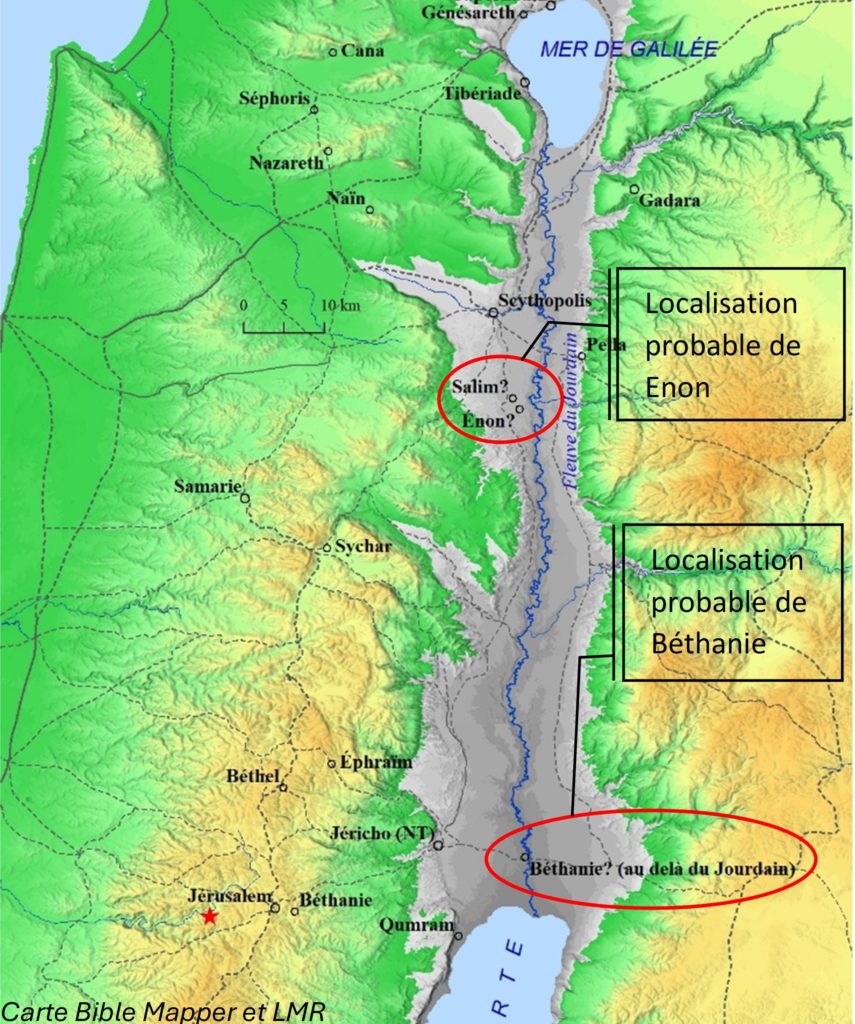
We present to you a map of Israel, on which the two sites where John the Baptist carried out his ministry are geographically located. This location is based on the data provided by the most eminent archaeologists.

Although the precise location has been forgotten over time, the accuracy of its localization remains proven.

Aenon and Bethany map

Conclusion

The locations of the sites mentioned by the Apostle John are engraved in his memory. At the time of his writing, these two places were still identifiable. However, with the passing of time, the localities have changed and the names have been altered, making John’s information insufficient to locate these two places precisely in the present day, except in the event of a new archaeological discovery. The only certainty is that they are situated on the banks of the Jordan River, in an area deep enough to allow the immersion of the faithful during baptism.

As we emphasize throughout the synopsis, the movements of Jesus the Messiah corroborate the proximity of Aenon to Galilee and of Bethany to Jerusalem. Thus, even though the precise location remains difficult to determine, the region itself leaves little room for doubt.