

_28 In everyone’s eyes, this matter is now definitively settled and the outcome is rather positive for these leaders; there was no commotion among the crowds.
_29 One last small point remains to be dealt with: the Messiah Jesus had spoken of resurrection, so it is safer to place guards in front of the tomb. This is the request made to Pilate on the very day of the ; nothing stops these devout men. Matthew 27.62-66.
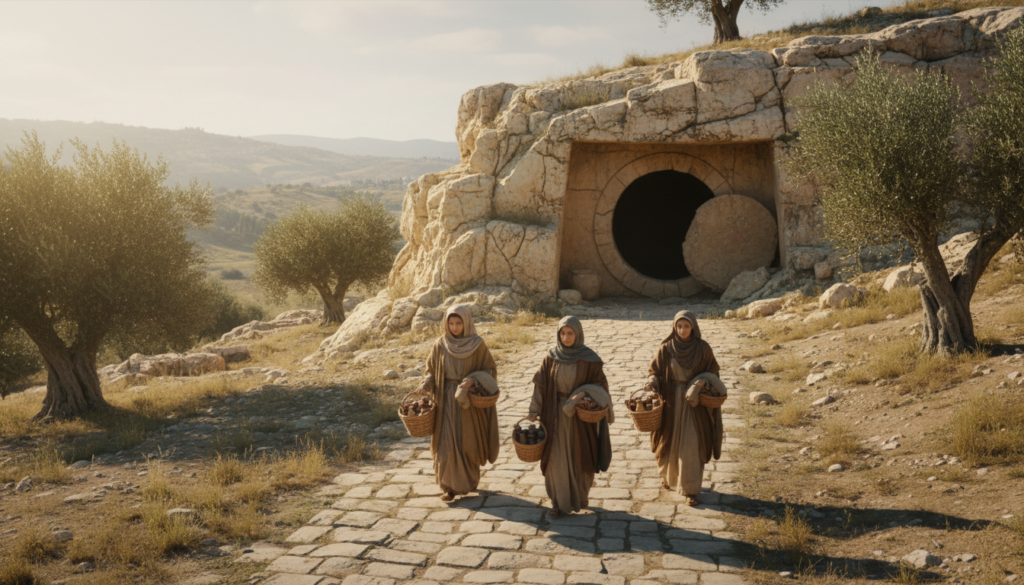
_30 The resurrection takes place on Sunday morning at dawn. We indeed have the 3 days and 3 nights according to the Jewish inclusive reckoning. Matthew 28.2-4 ; Mark 16.2-4 ; Luke 24.1-3. We take into account the night at midday.
You can consult the complete chronology in the study ANN026 : The hour of the crucifixion.
Commentary:
1- The faithfulness of the women
The women who had accompanied Jesus during his ministry are among the most faithful disciples at the time of his Passion. While most of the apostles scattered out of fear after their Master’s arrest (Matthew 26.56), several women remain present until the crucifixion and also witness his burial (Matthew 27.55-56 ; Mark 15.40-41 ; Luke 23.49). Their presence contrasts with the momentary failure of the disciples and underlines the important place they hold among Jesus’ close followers.
2- An act inspired by devotion to Jesus
From the first hours of the day after the , these women go to the tomb to bring spices meant to complete the burial care given to Jesus’ body (Mark 16.1-2 ; Luke 24.1 ; John 20.1). Their action seems to go beyond the mere fulfillment of a funeral custom. It appears to express the deep devotion they felt for the one who had profoundly marked their lives (Luke 8.1-3).
Mary Magdalene offers a particularly significant example. Jesus had delivered her from several demons, and she then appears among the disciples who faithfully accompany him to the cross and to the tomb (Luke 8.2 ; John 19.25). Nothing indicates, however, that she stands out from the other women at that point by a deeper understanding of the events.
3- A resurrection still not understood
Despite the many announcements of his Passion and his resurrection made during his ministry (Matthew 16.21 ; Matthew 17.22-23 ; Matthew 20.18-19), Jesus had not been fully understood by his disciples. Luke even specifies that the meaning of these words remained hidden from them before their fulfillment (Luke 18.31-34).
The women therefore do not go to the tomb expecting a miracle or an imminent resurrection. Their concern is much more concrete: “Who will roll away the stone for us from the entrance of the tomb?” (Mark 16.3). This question shows that they expect to find Jesus’ body inside the tomb.
4- The stone and the presence of the guards
This question suggests that they were probably unaware of the measures taken at the request of the chief priests and the . According to Matthew, a guard had been placed in front of the tomb and the stone had been sealed (Matthew 27.62-66).
The exact identity of these guards is a matter of discussion among commentators. Whether they were soldiers or guards attached to the Temple, their presence was a considerable obstacle. The women’s action therefore testifies more to their faithfulness and determination than to careful practical reflection.
5- The weight of grief and of recent events
The circumstances in which they find themselves also help us understand their behavior. In the space of only a few hours, they had witnessed Jesus’ arrest, his appearances before the and Roman authorities, his condemnation, his crucifixion and finally his death (Mark 14.43-15.39).
The grief, sadness and disorientation that accompany such an ordeal make any calm analysis of events difficult. Their desire to perform one last gesture of affection for the one they considered their Master therefore seems perfectly understandable.
6- Mary Magdalene in John’s account
The evangelist John focuses his account mainly on Mary Magdalene (John 20.1). This focus by no means implies that she was alone at the tomb. Moreover, when she reports her discovery to the disciples, she says: “They have taken the Lord out of the tomb, and we do not know where they have laid him” (John 20.2). The use of the plural suggests the presence of other women with her.
John nevertheless gives Mary Magdalene a special place because of the role she will play in the rest of the account. It is to her that the risen Christ will personally appear before any other individual appearance reported in the Gospels (John 20.11-18).
7- The women mentioned by the evangelists
The different evangelists provide complementary information. Matthew mentions Mary Magdalene and “the other Mary” (Matthew 28.1). Mark adds Salome (Mark 16.1), whom several commentators traditionally identify with the mother of James and John (Matthew 27.56), though this identification cannot be considered absolutely certain.
Luke also names Joanna and Mary, the mother of James, specifying that they were accompanied by still other women (Luke 24.10). These differences are not contradictions, but reflect the editorial choices of each evangelist.
8- The complementarity of the Gospel accounts
This diversity of testimonies is even an interesting sign of their authenticity. Absolute uniformity could have suggested an artificial harmonization. On the contrary, the four Gospels present complementary accounts which, when placed in parallel, give a more complete view of the events.
In keeping with the method announced by Luke in his prologue (Luke 1.1-4), the evangelists do not seek to report every detail exhaustively, but to faithfully pass on the facts they received from the witnesses.
9- The first witnesses of the resurrection
In the context of first-century Judaism, women’s testimony generally did not carry the same legal weight as that of men. It is therefore remarkable that the Gospels present women precisely as the first witnesses of the empty tomb and of the first angelic announcements (Matthew 28.5-7 ; Mark 16.5-7 ; Luke 24.4-8).
Far from weakening the credibility of the account, this detail is often considered a sign in favor of its historical authenticity. Had the authors sought to craft an account more in line with the expectations of their time, they would probably have put male witnesses in the foreground.
Thus, the women arrive at the tomb with their spices, concerned about the stone that closes its entrance, not knowing that they are about to become the first witnesses of the central event of the Christian faith: the resurrection of the Messiah Jesus (Matthew 28.5-6 ; Mark 16.6 ; Luke 24.5-6 ; John 20.1-18). Their faithfulness in the darkest hours will be honored by God, who will make them the first messengers of Christ’s victory over death (Matthew 28.7-10).
?