ANN090

The appearances of the risen Messiah Jesus

The study covers the appearances of the risen Jesus, based on the accounts of the Gospels, notably the encounter with Mary Magdalene. It aims to reconstruct the chronology of this period and points out the caution the Gospel authors had to exercise.

75 min resurrection Jesus Gospels appearances Mary Magdalene 93 verses 7 books

Further information

Introduction

The four Gospels relate the resurrection of the Messiah Jesus and the various appearances that followed this foundational event. For forty days, Jesus appeared alive to many people (Acts 1.3), and these testimonies are recorded in the Gospels. A difficulty arises, however: the four authors report distinct events without providing a detailed chronology. It is therefore necessary to go back over each text and try to place them in a coherent order. Some authors, such as Mark, offer a summary of the period and describe these forty days in a few lines, deliberately omitting certain details (Mark 16.9-20).

The aim of this study is to gather all the information scattered throughout the four Gospels in order to understand what happened between April 3, AD 33, the day of the resurrection (Matthew 28.1-6 ; Mark 16.1-6 ; Luke 24.1-6 ; John 20.1-9), and May 13, AD 33, the day of the ascension (Acts 1.9-11 ; Luke 24.50-51). Each passage concerning this period will be examined and fitted in like a piece of a puzzle, so as to form a coherent overall picture.

The resurrection of Jesus is at the heart of the Christian faith: it is what validates the whole message of the Gospel (1 Corinthians 15.14-17). If Christ has not been raised, faith would be in vain — yet the many and varied appearances are so many converging proofs of the reality of this event. The apostle Paul thus lists more than five hundred witnesses who saw the risen Jesus at the same time, most of whom were still alive when he wrote (1 Corinthians 15.3-8).

It is essential that each element be integrated in a harmonious and coherent way. We are aware of the complexity of this task: a superficial reading of these texts might give an impression of immediate coherence, but a careful examination of the details raises many questions, notably about the order of the appearances, the places mentioned — Jerusalem in Luke (Luke 24.33-49) and Galilee in Matthew (Matthew 28.16-20) — or the identity of the people present.

Far from being insurmountable contradictions, these differences reflect the richness and independence of the testimonies. Each evangelist reports what he retained or received, like eyewitnesses who were not present at the same moments (John 21.25). It is precisely this diversity, once harmonized, that strengthens the historical credibility of the resurrection.

We will rely on the analyses of the appendix ANN107 : The harmony of the texts concerning the resurrection. This study is based on the conclusions of that appendix and aims to extend its approach in a concise and accessible way.

I. 1st appearance of the risen Messiah Jesus to Mary Magdalene and the women

The information about this event is found in the Gospels of Matthew, Mark and John. Only Luke does not mention this episode. The accounts, however, present variations that can create difficulties of understanding. Although we do not have enough details to state with certainty how the scene unfolded, it is possible to make choices aimed at establishing a chronology. The hypotheses selected must be evaluated individually; nevertheless, our decision seems to us the most rational.

Here are the three accounts of the first appearance of the risen Messiah Jesus, right after his resurrection.

Comparison

Matthew 28.9-10 : The Messiah Jesus appears to the women (probably Mary Magdalene and the other Mary) who had come to the tomb. He greets them and asks them to tell his disciples to go to Galilee.

Mark 16.9 : The Messiah Jesus appears specifically to Mary Magdalene, from whom he had cast out seven demons.

John 20.11-18 : The Messiah Jesus appears to Mary Magdalene near the sepulchre. The account is more detailed, showing a dialogue between them.

Matthew 28.9-10 : The women take hold of the feet of the Messiah Jesus and bow down before him, an expression of respect and worship.

Mark 16.9 : No detail is given about Mary Magdalene’s immediate reaction.

John 20.11-18 : Mary Magdalene, initially in mourning, recognizes the Messiah Jesus after he calls her by name. She calls him “Rabboni” (Teacher), which expresses a personal relationship of respect. The Messiah Jesus asks her not to touch him because he has not yet ascended to the Father.

Instructions of the Messiah Jesus

Matthew 28.9-10 : The Messiah Jesus tells the women not to be afraid and to tell his brothers to go to Galilee, where they will see him.

Mark 16.9 : No direct instruction is given in this particular verse.

John 20.17 : The Messiah Jesus gives Mary Magdalene a clear instruction: go and tell his disciples that he is ascending to his Father.

It is essential to remember the climate of persecution that Christians faced at that time. According to our research, the first Gospel, attributed to Matthew, as well as the Gospel according to Mark, were published before the Council of Jerusalem in AD 49.

The authors absolutely had to take precautions regarding the information they published, so as not to harm the development of the Church or the Christians themselves. Places of worship and names were concealed. Toward the end of the first century, John was no longer subject to the same constraints, because many of the people concerned had died.

We believe this could explain the lack of precision observed in Matthew. Moreover, Mark is hardly more precise, except in the last part of his work, which seems to have been written later.

Conclusion

Contrary to what we might have imagined, the risen Messiah Jesus appeared first not to the apostles, but to faithful women, notably Mary Magdalene. The accounts of the three Gospels concerning this event agree and pose no difficulty in interpreting the facts. Each Gospel offers a distinct perspective on this event, but together they show consistently that Mary Magdalene was the first person to meet Jesus, the Messiah, after his resurrection. Although she was not alone, being accompanied by other women, it was she who spoke first.

In the appendix ANN107 : Harmonization of the texts on the resurrection, in the chapter: the synthesis of the four Gospels, and at point No. 13, we address the reconciliation of John’s text with those of the Synoptic Gospels. This analysis will therefore not be repeated here.

II. 2nd appearance to the women

2nd appearance to the women
(Matthew 28.9-10).

Here is the text that relates this event:

Meanwhile, the other women, who had left the tomb after the message of the angels, meet Jesus on the way (Matthew 28.9-10).

This appearance is a collective one, distinct from the one granted to Mary.

III. 3rd appearance to the apostle Peter

3rd appearance to the apostle Peter

(Luke 24.34 ; 1 Corinthians 15.5).

Here are the texts that relate this event:

This is what the two disciples, witnesses of the appearance of the risen Messiah Jesus on the road to Emmaus, say by way of introduction to their testimony. They mention a 3rd appearance that is known but of which we have no details. We are surprised, because Mark does not mention it even though Peter seems to have been directly involved in the writing of that Gospel.

We understand that Luke is pointing to a distinct appearance reserved for Peter, which therefore took place before the one to the disciples on the road to Emmaus and after the one to the women and Mary Magdalene.

All the disciples and apostles were therefore informed of Peter’s testimony, even though it did not convince them. Even the apostle Paul was aware of this appearance, which he mentions in 1 Corinthians 15.5. It should be noted that Paul uses the new name Jesus gave to Peter, Cephas (John 1.42), whereas Luke continues to use Simon.

We understand this priority because of the distress of Peter, called Cephas in Aramaic, following his denial (Matthew 26.75 ; Luke 22.62). This personal appearance was essential for his restoration. Later, he will have another exchange with the risen Messiah Jesus by the (John 21.15-17).

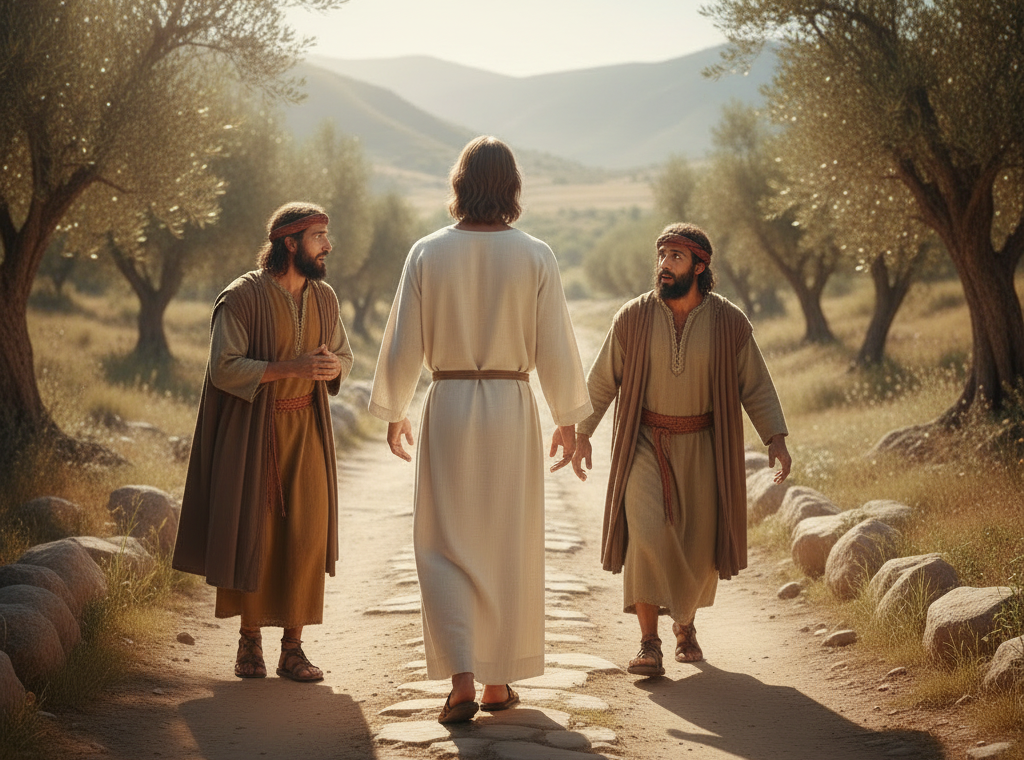
IV. 4th appearance to the disciples on the road to Emmaus

4th appearance to the disciples on the road to Emmaus
(Mark 16.12-13, Luke 24.13-32)

Here are the texts that relate this event:

The two texts noted relate this event. Luke 24.13-32 reuses the passage of Mark 16.12-13 and enriches it with many additional details. Luke devotes 23 verses, that is, a very long text, to relate what happened on the road to Emmaus. This shows the importance of this event in Luke’s eyes. It seems evident that he met Cleopas or his spouse in order to obtain such a thorough understanding of this story. For the security reasons mentioned earlier, Mark remains vague on this subject, whereas Luke, writing about eleven years later, can disclose all the details. It also seems likely that Matthew, Peter and perhaps Mark were informed of this testimony, since they were present when Cleopas and his companion arrived in Jerusalem, at the house of Mary, the mother of Mark.

Comparison of Mark 16.12-13 with Luke 24.13-35

Context and Recipients

Mark 16.12-13 : Jesus appears to two disciples who were heading into the countryside. The text does not directly specify the place or the names of the disciples.

Luke 24.13-35 : Jesus appears to two disciples, one named Cleopas and another unnamed disciple, on the road to Emmaus. The account is much more detailed, describing their conversation with Jesus and their recognition of him in the breaking of the bread.

Reaction of the Characters

Mark 16.12-13 : The two disciples return to inform the other disciples, who do not believe them.

Luke 24.13-35 : The disciples are at first downcast and perplexed by the events. After recognizing Jesus in the breaking of the bread, they return immediately to Jerusalem to inform the other disciples with enthusiasm.

Details of the Encounter

Mark 16.12-13 : The encounter is described very briefly, without going into the details of the dialogue or of specific events.

Luke 24.13-35 : The account includes a long dialogue between Jesus and the disciples, in which Jesus explains the Scriptures to them and the necessity of his suffering and resurrection. The recognition of Jesus in the breaking of the bread is a key moment of the account.

These two passages complement each other to provide a fuller picture of the appearance of Jesus to the disciples on the road to Emmaus.

Conclusion

This fourth appearance is intended for anonymous people, committed and devoted Christians who are nevertheless unknown. Indeed, Cleopas is mentioned in the Bible only in this passage of Luke. His testimony remains crucial, because it reveals the work of the risen Messiah, Jesus. He teaches his disciples and helps them understand that all the recent events are neither fortuitous nor accidental, but fit perfectly into the divine plan announced by the prophets.

We note that, like Mary Magdalene, they did not physically recognize their Master. Moreover, it appears that the risen Messiah Jesus bears no aftereffects of the events that took place three days earlier.

Following this encounter, the two disciples will strive to return to Jerusalem before the closing of the city gates, scheduled around 7:30 p.m. with sunset. They will arrive in time, but their testimony will not be taken into account by their brothers.

In the appendix ANN107 : Harmony of the texts on the resurrection, in the chapter: the synthesis of the four Gospels, and at point No. 18, we present an analysis of this event; these conclusions will not be repeated here.

V. 5th appearance to the apostles and the disciples in Jerusalem

5th appearance to the apostles and the disciples in Jerusalem, in the house of Mary, the mother of Mark
(Mark 16.14, Luke 24.36-37, John 20.19-23, 1 Corinthians 15.5).

Here are the texts that relate this event:

According to Luke, Cleopas and his companion, perhaps his wife, decide to return to Jerusalem despite the falling night. They must arrive before the closing of the gates of the city of Jerusalem around 7:30 p.m., and so they quicken their pace to get there in time.

It is known that the roads were not safe at night, and few people dared venture onto them. They consider that the announcement of the resurrection of the Messiah Jesus justifies taking this risk.

They report their testimony, but find that their friends do not believe them. A similar situation occurs with Mary Magdalene, the other women and the apostle Peter. The disciples and the apostles have difficulty accepting the resurrection. John, for his part, believes, but does not speak up (John 20.8). Peter also reported having witnessed a personal appearance (Luke 24.34).

At this point, the disciples knew the prophetic words of their Master, had heard the testimony of Mary Magdalene corroborated by the women accompanying her, as well as that of Simon Peter. They were now receiving further confirmation of the resurrection of their Master. However, they remained skeptical about this information.

Nevertheless, the most remarkable event takes place at this moment. Jesus, the Messiah, appears alive among them, but despite this manifestation, they still do not believe (Luke 24.41). The Master is therefore compelled to prove his identity. He shows them his hands and his feet, thus confirming that he was nailed to the cross, probably also bound. The disciples think they see a spirit or a ghost. They can touch him, offer him food and listen to his teaching.

The Messiah Jesus had to open their minds (Luke 24.45) so that they could finally understand. Matthew, Peter, who would later write the second Gospel with Mark, and John were indeed present, and so able to bear witness to the reality of this extraordinary event. Nevertheless, it was not they but Luke, after carrying out thorough research (Luke 10.3), who reported this episode, although he was not a direct witness of it. Were they ashamed of this glaring lack of faith? Perhaps this is also the reason why John adds that he believed (John 20.8).

We know, as John specifies, that one apostle was missing, Thomas (John 20.24). He did not believe despite all the concordant testimonies; he wanted to see and touch in order to be convinced. This will happen on Sunday, April 10, AD 33.

In the appendix ANN107 : Harmony of the texts on the resurrection, in the chapter: the synthesis of the four Gospels, and at point No. 19, we present an analysis of this event; not all of these conclusions will be repeated here.

VI. 6th appearance to the apostles in Jerusalem on Sunday, April 10, AD 33

6th appearance to the apostles in Jerusalem on Sunday, April 10, AD 33.
(John 20.26-29, Mark 16.14 and 1 Corinthians 15.5)

Here are the texts that relate this event:

The text of Mark 16.14 has been included again, because it does not specify whether it concerns the appearance of April 3 or that of April 10. It is probably the first. A problem arises when it says that he appeared to the eleven apostles, whereas we know that Thomas was absent on April 3. For this reason, this passage has been moved a week later. However, it is possible to regard the terms “the eleven” and “the twelve” as generic expressions designating the group of the apostles, regardless of their exact number.

This Sunday, April 10, recalls that of April 3, with the difference that all the apostles, including Thomas, are present. This episode mainly highlights the figure of Thomas. Over time, Thomas has become the classic example of unbelief. However, it is important to note that he did not show more unbelief than his fellow apostles. In reality, he is the only one, with perhaps Mary Magdalene (John 20.16), after having understood and believed, to worship the Messiah Jesus (John 20.28).

We mention the text of Paul, 1 Corinthians 15.5, which could be relevant for this appearance.

We note that after this fourth appearance the apostles and the disciples still have difficulty recognizing their Master. It seems that his physical appearance was different; his serious wounds were healed, but the marks were still clearly present. Such a situation is the result of a great miracle, and man has difficulty accepting what he cannot explain.

VII. 7th appearance to the apostles on the shores of the Lake Tiberias

7th appearance to the apostles on the shores of the .
(John 21.1-14).

According to John 21.14, this appearance is the third. Note that he speaks only of appearances to his disciples. The first two are those of April 3 in Jerusalem, the day of the resurrection, and that of April 10, a week later, with Thomas. It appears that this list is not complete, since it does not mention the appearances to other people, such as the women and the disciple on the road to Emmaus.

Here are the texts that relate this event:

John, Peter’s friend, will report a particular episode: a personal conversation between the risen Messiah Jesus and Peter.

This is the third appearance of the risen Messiah Jesus to his disciples (John 21.14). It refers to the appearances that took place in Jerusalem on April 3 and April 10. The individual appearance to Simon Peter is not included in this count.

Within the scope of this study, we cannot detail the various events associated with this appearance, even though we have quoted the texts in full. You will find commentary in the synopsis.

This meeting in Galilee had been announced by the angels who rolled away the stone of the empty tomb (Matthew 28.7, Matthew 28.10). Matthew indicates that the disciples left, so during this period of 40 days in Galilee they made a round trip (Matthew 28.16). They seem to have left around April 11, after the appearance of the risen Jesus in Jerusalem the day before.

This appearance is therefore the most important since April 3, AD 33, the day of the resurrection. We find an event similar to those performed during the ministry of the Messiah Jesus. This exceptional catch of fish is reminiscent of the one already reported by Luke 5.1-11.

We know from the events related in the Gospels that miracles always have a reason, and none took place merely to evoke the amazement of the onlookers. The first miraculous catch of fish made it possible to provide for the needs of the families of the apostles who were going to follow the Messiah Jesus. But for what particular reason does the Master perform this new miracle, related by John alone?

This second miraculous catch of fish can be seen as a repetition of the first, whose purpose was to show the disciples that the Messiah Jesus provided for the needs of his disciples and their families. This second catch seems to indicate that, although he is now physically absent, nothing will change; he will continue to provide for his disciples. In reality, the message is this: do not worry, I will always be at your side.

VIII. 8th appearance to the apostles on the mountain in Galilee

8th appearance to the apostles on the mountain in Galilee.
(Matthew 28.16-20).

According to John 21.14, the appearance of the risen Messiah Jesus to the disciples on the shore of the was the third. Consequently, this new appearance to the eleven disciples is considered the fourth.

Here is the text that relates this event:

This appearance takes place when the disciples have returned to Galilee, in accordance with the instructions given by the angels and passed on by Mary Magdalene and the other women.

It seems that this time the eleven disciples are present, unlike in the episode of the miraculous catch of fish described by John. Two meetings in Galilee are reported, but it is not certain that there were other appearances of the Master to his apostles during this period in Galilee.

It is probable that the mountain mentioned was well known to the apostles, perhaps the one where some of them witnessed the transfiguration. It therefore seems that the apostles had precise information, which has not come down to us, defining this particular place for meeting their Master.

We have placed this event after that of the miraculous catch of fish because of the precision provided by John, who mentions a third appearance when he speaks of the one on the shore of the and the miraculous catch of fish.

Let us move on to the analysis of the Master’s words to his eleven apostles. The situation has changed: there is no longer any fear or uncertainty. On seeing him arrive, they bowed down. Some, probably those who had not been present at the miraculous catch of fish, still had doubts.

The apostles receive clear directives from their Master, a road map detailing the objective of their mission. Although the task seems arduous, in the absence of Jesus on the front line, he states that he holds all authority in heaven and on earth, and that he will be with them in spirit. These words reassure the apostles about the accomplishment of their mission.

We observe that this presence is not limited to the apostles, but clearly extends to all their successors down the years, as indicated by the expression: to the end of the age.

We find these directives in other words in the texts of Mark 16.15-16, Luke 24.47-49 and John 20.21-23. Each of these passages presents one aspect of the commission that Jesus gave to his disciples, but Matthew 28.18-20 remains unique in its complete formulation of the mission and of the accompaniment promised by Jesus.

Thus ends the Gospel according to Matthew.

Can the meeting of the eleven apostles on the mountain in Galilee be identified with the appearance of the Risen One to the five hundred brothers?

IX. 9th appearance to more than 500 brothers at once

9th appearance to more than 500 brothers at once.
(1 Corinthians 15.5-8).

Here is the text that relates this event:

The apostle Paul recalls facts without giving the slightest explanation. We therefore have no details about this appearance to more than 500 brothers at once. Should the term brothers be regarded as generic, thus including sisters? Should they be added to this number? Where did this event take place? In Galilee or near Jerusalem? We think it more likely to have been in Galilee, because of its calm. Christians had to hide in Jerusalem because of the persecutions.

We know that Paul had privileged contacts with Peter (Galatians 1.18-19), who could well be his source. What emerges from this text is that a great number of people saw and recognized the risen Messiah Jesus and that they were still able to bear witness when Paul wrote these lines.

This event therefore took place, according to our conclusions, during the short period the apostles spent in Galilee, certainly between April 15 and the end of April AD 33, since the apostles then returned to Jerusalem, where the ascension would take place. On April 10 they were still in Jerusalem, and five days of travel must be allowed to get back to Galilee.

Can the meeting of the eleven apostles on the mountain in Galilee be identified with the appearance of the Risen One to the five hundred brothers?

X. 10th appearance to James

10th appearance to James.
(1 Corinthians 15.5-8).

Here is the text that relates this event:

This appearance of the risen Messiah Jesus to James, his half-brother, finds no trace in the Gospels. Nevertheless, the event appears to have been known, since the apostle Paul cites it in his epistle.

If we follow Paul’s chronology, it appears that this appearance took place before another to all the apostles.

We know of five appearances to the apostles, and only three took place in the presence of all the apostles. These are the one on the mountain in Galilee, the one of April 10 in Jerusalem, and finally the one at the ascension in Jerusalem. On the other two, the group was not complete.

Paul certainly had this information from James himself, because he met him in Jerusalem when James was the head of the Church of Jerusalem (Galatians 1.18-19).

If we respect Paul’s chronology, we obtain the following order:

  • Peter (Cephas)
  • The twelve
  • 500 brothers
  • James
  • The apostles
  • Paul

The appearance to James could have taken place in Galilee, where the Lord’s half-brother would have accompanied the apostles, or else in Jerusalem shortly before the ascension. This second hypothesis seems more plausible.

It is established that the Messiah Jesus appeared to James, his half-brother. Was this appearance exclusive, or were others present? Indeed, it is surprising that the Lord did not meet his family in the presence of Mary, his mother.

It is plausible that Mary, present at the foot of the cross and in Jerusalem until May 22, AD 33, the day of Pentecost, chose to follow her friends. In this context, it is likely that her name was not disclosed for security reasons. It is therefore reasonable to suppose that James was accompanied by Mary as well as by several of his half-brothers and half-sisters.

Another essential point is that our list of appearances is probably not exhaustive. As with the miracles, the authors chose to mention those they considered the most convincing. We should also not underestimate the influence of the Holy Spirit in the writing of these documents.

Appearance to Paul.
(1 Corinthians 15.5-8).

Here is the text that relates this event:

We cannot consider this appearance as one of those just cited. Indeed, for chronological reasons it is inconceivable that the risen Messiah Jesus met Paul as he did Mary Magdalene, for example.

We know that Paul had not converted to Christianity at that precise moment and that he was hunting down Christians (Acts 8.1, Acts 8.3 and Acts 9.1-2) in order to imprison them.

This appearance thus takes on a different character, which we can understand by reading the passage:

For this reason we do not take this appearance into account within the scope of this study.

XII. 11th appearance to the disciples at the ascension

11th appearance to the disciples at the ascension.
(Acts 1.3-14, Luke 24.50-53 and Mark 16.19-20).

Here are the texts that relate this event:

The Gospels of Mark and Luke merely stress the fact that the Messiah Jesus was taken up into heaven, without giving details. It is, moreover, with these words that they end their accounts; they are therefore their conclusion.

Luke possessed information that he would disclose in his second volume, the Acts of the Apostles.

This is therefore the fifth appearance to the disciples. It seems to last for some time, and moreover they move (Luke 24.50) toward the road to Bethany, but they will stop on the Mount of Olives (Acts 1.12), less than a kilometer east of Jerusalem.

This movement took place discreetly, since no crowd is present; only the eleven apostles are there. It is near the place of his arrest that he will be taken up to heaven.

The Master teaches his apostles once more, then everything stops and he is taken up to heaven. He rises until a cloud hides him from their sight. The scene is extraordinary and astonishing. At that very moment two men dressed in white, like those who had rolled away the stone of the tomb, arrive and speak to them.

According to our analyses, this event takes place on Thursday, May 12, AD 33. It seems that the apostles stayed on the spot for some time and did not know what to do. It is these two angels who bring them the solution. There is no point in staying there any longer; everything is over now. They announce a very important point: “This Jesus, who was taken up from you into heaven, will come in the same way as you saw him go into heaven.”

Luke specifies in his text that they will depart and that they are a away, which leads us to suppose that they returned when the had already begun, that is, after Friday, May 13, at 6:30 p.m.

Conclusion

Here is a rewrite in a more academic and fluid style:

Our study leads us to distinguish eleven appearances of the Risen One mentioned in the Gospels and in Paul’s first epistle to the Corinthians. This number could, however, be reduced to ten if one adopts the hypothesis that the appearance to the eleven disciples on the mountain in Galilee corresponds to that of the five hundred brothers mentioned by Paul (1 Corinthians 15.6 ; Matthew 28.16-20).

As we have stressed, these accounts were written in a context of growing tensions and persecutions. It is therefore possible that certain names, places or details were deliberately passed over in silence in order to protect the people concerned. Moreover, no author claims that the list of reported appearances is exhaustive. Nothing therefore prevents us from thinking that other manifestations of the Risen One took place without having been preserved in the biblical texts.

The main aim of the evangelists and of Paul was not to draw up a complete inventory of the appearances, but to demonstrate the historical reality of the resurrection. They thus insist on the multiplicity of the witnesses, answering indirectly the objections and rumors spread by the religious authorities of Jerusalem and by some of the soldiers charged with guarding the tomb (Matthew 28.11-15).

The Gospel accounts are also distinguished by their psychological authenticity. The authors do not seek to embellish the events: on the contrary, they describe their confusion, their hesitations, their doubts, their difficulty in recognizing Jesus and sometimes even their unbelief (Luke 24.11 ; John 20.24-29). These reactions reflect the difficulty the witnesses had in putting into words an event as extraordinary as it was unexpected.

Thus, when the Emmaus disciples declare: “The Lord has risen indeed, and has appeared to Simon” (Luke 24.34), this statement sums up a conviction that would only grow stronger as the days went by. Jesus did not appear to Simon alone, but to many men and women, individually or in groups, thus offering a body of converging testimonies in favor of the reality of his resurrection.