ANN027

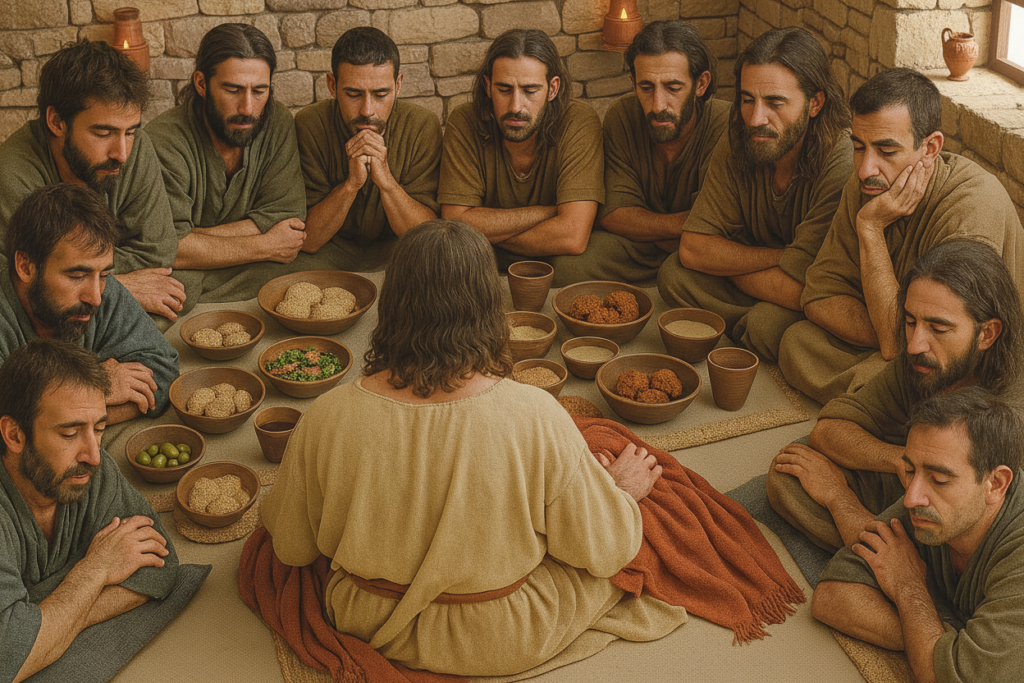
The Last Passover Meal

The article analyzes the chronology of the last Passover according to the Gospels, stressing that Jesus was crucified on Friday, April 1, AD 33, in agreement with the Jewish Passover sacrifice. This perspective demonstrates a perfect prophetic fulfillment in which Christ is seen as the Lamb of God, providing divine redemption.

46 min Passover crucifixion Jesus Gospels prophecy 27 verses 11 books

Further information

Introduction

John reports the crucifixion of the Messiah Jesus on a Passover Friday, without specifying the year, but according to astronomical calculations and historical landmarks, two possible dates emerge in the period concerned: April 7, AD 30 and April 1, AD 33. The study of the prophecy of the seventy weeks presented in Daniel 9.24-27, which announces with remarkable precision the time of the coming and the putting to death of the Messiah, leads us to rule out the first date. Everything indicates that Jesus died on the cross on a Passover Friday, April 1 of the year 33, thus fulfilling the prophecy and coinciding with the feast on which the Passover lamb was to be sacrificed.

Our aim is to understand how the Passover feast unfolded that year and to explain the apparent differences between the account of the apostle John and those of the Synoptic Gospels. John states that the crucifixion took place on the day of preparation for the Passover, that is, on the eve of the , whereas Matthew, Mark and Luke seem to place the Lord's last meal during the feast itself (Matthew 26.17; Mark 14.12; Luke 22.7; John 19.14). This divergence, often noted, is not a contradiction but reflects complementary viewpoints according to the Jewish calendar and the religious context of the time. The Jews of Judea sometimes followed a different reckoning from that of the Galileans, and it is quite possible that Jesus and his disciples celebrated the Passover meal one evening earlier, in keeping with the Galilean calendar, while the religious authorities of Jerusalem observed the feast the next day. Thus Jesus would have celebrated the Passover on Thursday evening and died at the hour when the priests were slaughtering the lambs in the Temple precincts on Friday afternoon, perfectly fulfilling the symbol of the Lamb of God offered for the salvation of the world (John 1.29; 1 Corinthians 5.7).

To clarify the situation, it is useful to go back to the law of Moses, which set out the precise regulations for celebrating the Passover (Exodus 12.1-14; Leviticus 23.5-8; Numbers 9.1-14). The lamb was to be chosen on the tenth day of the month of Nisan and sacrificed on the fourteenth, between the two evenings, that is, in the late afternoon. The Passover meal began at sunset, marking the fifteenth of Nisan, the first day of Unleavened Bread. It is this gap between the moment the lamb was slaughtered and that of the meal that may have given rise to different interpretations. By insisting that Jesus died on the very day of the preparation of the Passover, John underlines the parallel between the death of Christ and the ritual sacrifice commanded by the law. The expression “before the feast of the Passover” (John 13.1) therefore refers to the Thursday set aside for preparations, while the crucifixion takes place the next day, on the real day of the Passover according to the priestly calendar.

This perspective brings out a remarkable consistency between the Gospel accounts. Matthew and John were direct witnesses of the events: Matthew saw the course of the Passion with his own eyes, and John stood at the foot of the cross beside Mary, the mother of Jesus (John 19.25-27). Mark relies on the precise testimony of Peter, who was also present at the scene (Mark 14.54; Mark 15.39-41), and Luke, although he was not a direct witness, took care to gather the testimony of those who had seen and heard (Luke 1.1-4). These four evangelists agree on the essential point: the crucifixion took place on a Friday, the day of preparation preceding the , during the feast of the Passover (Mark 15.42).

The spiritual meaning of this coincidence is profound. By dying on the very day when the Passover lambs were slain, Jesus perfectly fulfilled the figure announced for centuries. He became the true Lamb, the one whose blood protects and redeems, no longer a single people, but all of humanity (Isaiah 53.5-7; John 3.16-17). The calendar, the rites and the prophecies converge in this unique moment where history and divine revelation meet. Friday, April 1, AD 33 is therefore not only a historical date, but the culminating point of the plan of salvation established by God from all eternity.

I. The Passover feast according to Jewish law

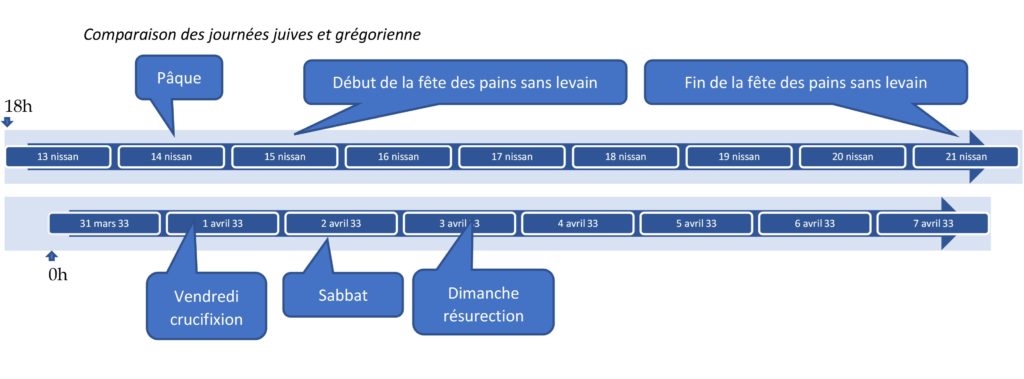
We notice that Moses specifies the date of Pesach (Passover): the 14th day of the first month, that is, 14 Nisan. The next day, the 15th, begins the Feast of Unleavened Bread, which lasts 7 days, until 21 Nisan.

– What does the sunset of 14 Nisan mean, since the days change over precisely at sunset?

– Are we already on the 15th, or at the end of the 13th?

– Is the day of 14 Nisan beginning or ending?

The Jewish day begins with the night Genesis 1.5, so 14 Nisan begins at sunset, which for us corresponds to March 31 at around 6 p.m. in the year 33.

The month of Nisan

The month of Nisan

It is important to understand that in the Jewish tradition, the expression "the fourteenth day of the first month, at sunset" designates the beginning of the day of 14 Nisan. According to the Hebrew calendar, a new day begins at sunset, and not at midnight as in the Gregorian system. Consequently, the feast of Pesach begins on the evening of 13 Nisan, at around 6 p.m., marking the passage to 14 Nisan.

If the sunset of the 14th day marked the end of the day, we would be entering the 15th day, which corresponds to the beginning of the Feast of Unleavened Bread. In that case, the celebration of Pesach would indeed be reduced to a few moments only, which is not consistent with the traditional duration of the feast.

Thus, we conclude that the beginning of the day of 14 Nisan, and therefore the start of Pesach, falls on the evening of 13 Nisan, when night begins, generally estimated at 6:00 p.m. This understanding is in line with Jewish practices and beliefs concerning the reckoning of days and religious feasts.

The last of the ten plagues of Egypt, the death of the firstborn, is the origin of the Passover feast. This plague struck Egypt in the middle of the night, around midnight. Meanwhile, the Hebrews, ready to depart, ate the roasted lamb and consumed unleavened bread, having had no time to let the dough rise.

The one-year-old lamb, which generally weighs about twenty kilograms and is slaughtered between 6 and 6:30 p.m., could only be eaten after about 4 to 5 hours of cooking. All the Jewish families had prepared the cooking of this lamb in anticipation of their departure.

The weight of the edible meat represents about 50% of the total weight of the animal. Considering an average portion of 250 g per person, we can estimate that about forty people could be fed from a single animal. The houses sheltered not only the parents and children, but often the grandparents as well, quickly increasing the number of guests. Some families, depending on their size, may have eaten the whole animal, while others, smaller, invited neighbors. The leftovers, reduced to a minimum, had to be burned.

The departure of the people of Israel could not begin before midnight, in keeping with the biblical account. It is important to note that Pharaoh summoned Moses that same night, after the death of the firstborn. The departure of the Hebrews was therefore probably not ordered before Moses' return, which could have taken place around 1 or 2 a.m.

This major event, the liberation of the Hebrews from Egypt, was to be commemorated every year. Thus, at the beginning of spring, the Hebrews celebrated the Passover in remembrance of this great deliverance orchestrated by .

The Passover is governed by very precise rules that all members of the people were to observe scrupulously. The preparation of the Passover begins on the 10th day of the month of Nisan. On that date, a lamb without blemish must be chosen and set apart for its sacrifice, which will take place on 14 Nisan.

The expression "between the two evenings" in the NEG translation () gives us an additional precision compared with the : at sunset.

We think that what is meant here is the span of time between dusk and sunset. Likewise in the morning, we observe a difference of about 30 minutes between dawn and sunrise; we could say, between the two mornings.

With the information given in these texts, we can establish the chronology of the events of this first Passover.

DateTask
10 Nisan (begins on the 9th at 6:00 p.m.)A lamb (or a kid) is set apart.
14 Nisan (begins on the 13th at 6:00 p.m.)The lamb is slaughtered.
13 Nisan at 6:00 p.m. and the 14th at 6:30 p.m.The precise time of the slaughter.
14 NisanThe Passover.
From 15 to 21 NisanThe Feast of Unleavened Bread.
21 NisanThe Feast of Firstfruits.

The law of Moses required the Jews to celebrate this feast, as well as two others, every year.

- The Feast of Unleavened Bread begins the day after Pesach, the Passover. It begins on the evening of 14 Nisan, which is the start of that day, and lasts 7 days, until 21 Nisan. It therefore encompasses the Passover.

- The Feast of Weeks, Shavuot or Pentecost, begins 50 days after Pesach; then comes the waving of the barley sheaf, the Feast of Firstfruits, on 6 Sivan, which celebrates the beginning of the harvests.

- The Feast of Tents or Tabernacles, , celebrates divine assistance; it takes place on 15 Tishri.

In this text we notice that Unleavened Bread begins with the start of the Passover, even though the feast itself only starts the next day.

II. The Jewish Passover feast today

The Jewish Passover feast of 2023, in Israel, runs from the evening of Wednesday, April 5 to the evening of Thursday, April 13. It ends on the 14th for the diaspora.

April 5 corresponds to 14 Nisan; the dates are matched on the daytime part of the day, but the Jewish date begins the evening before, at sunset.

The first two evenings are devoted to the Passover meal, the Seder. We therefore observe a first Passover meal on April 5 and a second on April 6, that is, on 14 Nisan and 15 Nisan. In Israel the Seder is held on the first evening, and in other countries on the second.

The evening of April 5, after 6 p.m., corresponds to 15 Nisan for the Jews. We therefore note that today the Jews eat the Seder at the end of the day of 14 Nisan.

This information is widely developed on the Internet so as to unify all the stages of this feast throughout the world.

But the application of the instructions governing this law in the time of the Messiah Jesus is of particular interest to us.

III. The practice in the time of the Messiah Jesus

The Jews, and in particular the Messiah Jesus, observed the Passover feast at least in the form of a pilgrimage to the temple in Jerusalem. This religious requirement appears, as a complement to the law, only much later, after the construction of the Temple.

The Jews who had the financial means were to go up to the temple in Jerusalem. The number of pilgrims, between 300,000 and 400,000 (Wikipedia), as we shall see a little further on, was therefore very large, and everyone tried to find lodging, because the feast lasted 7 days.

With this overcrowding, disorder became extreme. Some built themselves huts, others tents. Fortunately, the temperatures in this month of Nisan become mild.

The date of this feast, set on 14 Nisan, lasted 7 days. This period, called the days of Unleavened Bread, began on 14 Nisan, that is, at around 6 p.m. the evening before according to our Gregorian calendar.

IV. When was the Passover meal to take place?

According to our analysis of the texts of Moses, the Passover meal was to take place at the beginning of the day of 14 Nisan, with the slaughter of the lambs taking place between 6 and 6:30 p.m. The Jews therefore ate the Seder at around 11 p.m., the time needed to cook the meat.

However, this theoretical practice proved difficult to observe in the time of the Messiah Jesus. We observe that this meal, originally scheduled for 14 Nisan, was sometimes shifted to 15 Nisan by certain groups. Moreover, not all communities observed the same calendar. For example, the did not follow to the letter the prescriptions of the Jewish religious authorities in Jerusalem. The situation was similar among the .

It is therefore complex to state with certainty the exact time at which this meal was to take place. In Jerusalem, the High Priest, such as Caiaphas at that time, played a key role in determining the exact moment of the meal.

However, it is worth asking whether all the pilgrims strictly obeyed this man, especially when we consider that business was still going on, including with the merchants and money changers in the Temple courtyard.

We thus observe that there was a certain adaptation of practices, each group taking its meal according to government directives, its traditions and technical constraints. These variations will be explored in more detail in the rest of our study.

V. Where does the principle of sacrifice at the Temple come from?

The biblical text stipulates that each Jewish head of family was to slaughter a lamb or a kid between dusk and nightfall for the Passover, according to our interpretation of the Scriptures. Moses, following the divine directives, organized the religious system, notably the sacrifices. With the construction of the Tabernacle and later of Solomon's Temple, the Jews were able to regulate these sacrifices and offerings. The Levites were in charge of the religious service, and David had established 24 divisions of priests to structure the activities of the Temple 1 Chronicles 24.1-19.

The heads of Jewish families brought their offerings or sacrifices, and the priests officiated. A portion of these offerings went to the priests as their remuneration. In the time of Jesus, the sellers of animals for sacrifice had been set up on the Temple esplanade for about 60 years, whereas previously they had been on the other side of the Kidron Valley.

A major change occurred in 30 BC, when the religious authorities decided to control this trade by inviting the sellers to settle in the Temple court, in the space reserved for non-Jews. The surrounding colonnades offered shelter from the sun to the sellers and the animals, thus improving hygienic conditions.

According to John 2.20 the renovation work on the Temple lasted 46 years, beginning in 20 or 19 BC and ending around AD 28. During this period, the animal market was disrupted. However, with the approval of the High Priest Caiaphas, the merchants were able to return to a renovated esplanade in AD 30, developing their business further.

This new commercial dynamic stirred up reactions among pious Jews. Jesus intervenes in this political context, denouncing these practices during his visit to the Temple, as reported by John 2.13-22. These improved hygienic conditions and the priests' easier control of the animals justified this installation on the Temple esplanade. Nevertheless, the real motivation seems to have been financial profitability.

The Jewish religious authorities now controlled this entire lucrative market, with considerable financial returns for the Temple treasury and its notables. Pilgrims had to acquire shekels of Tyre for all transactions, the only currency accepted in the Temple, which resulted in the presence of numerous money changers.

The exchange rate favored the religious officials of the Temple, all the more so as pilgrims exchanged their remaining shekels for their original currency before leaving. Jesus, by acting against this practice, faced significant opposition. Three years later, in April AD 33, his action against the money changers would have dramatic consequences.

This context explains why the did not react immediately against Jesus, since Caiaphas' decision was not unanimously approved, especially among pious Jews.

VI. The technical requirements of such a feast

The Jews, at the Passover feast, came to the Temple in Jerusalem to commemorate this great deliverance wrought by .

Flavius Josephus (Jewish War 2 / 280) speaks of 3 million pilgrims. The number seems exaggerated, and we rather think of several hundred thousand. The population of Jerusalem swelled at this time, and we understand the worries of the prefect Pontius Pilate, who was responsible for security at the time. Each pilgrim had saved up to pay for the lamb for the sacrifice.

– How could so many animals be sacrificed?

– How long did it take the priests to kill all these animals?

The Temple did not turn into a mere slaughterhouse; the Jews had to observe various rules.

The animals had to pass through the Pool of Israel to be washed, and then entered the Temple esplanade through the Sheep Gate, located near the Antonia Fortress.

North of the altar was the slaughtering place. The animals intended for sacrifice had to be tied up beforehand. Four rows of six rings, anchored in the stone at the entrance to the house of the Temple, made this presentation before the Eternal Leviticus 1.11 possible.

The animals, slaughtered on 8 marble tables, were then hung on 8 pillars, which made it easier for the priest to prepare the animal. We easily understand that this whole ceremonial, at the Passover feast, with these thousands of pilgrims, lasted many hours.

We can specify this time without defining it exactly.

The one-year-old lamb, as specified by the law, normally weighs between 25 and 30 kg. Half of the weight, consisting of blood, bones and entrails, had to be burned. That leaves 15 kg of edible meat. If we count a consumption of 250 g per person, we think it would suit about 60 people.

The Seder, the family feast par excellence, requires the presence of the whole family, which considerably increases the number of participants. Taking into account a total population of 300,000 pilgrims, including the Jews residing in the city of Jerusalem, which seems a reasonable number, we arrive at a total population, with families, of at least 1.2 million people.

The priests had to sacrifice about 20,000 lambs! Blood flowed in torrents in the temple; a system of gutters with running water made it possible to drain it away toward the Kidron Valley, in our case about 32,000 liters, not counting the water!

We are seeking to demonstrate the impossibility of slaughtering this quantity of animals between 1 p.m. and 5 p.m. on the Friday of the Passover.

All the cleaning work had to be finished before 5 p.m., because the began around 6 p.m. that year, and there was no question of continuing to work on this solemn day.

We can imagine that servants helped with the preparation, but it seems hard to go below a time of 1 minute for the slaughter and dressing of one animal.

The 8 marble tables and the 8 pillars for hanging the animals considerably increase the time. Our calculation gives us 480 animals slaughtered per hour. Even counting only 10,000 lambs, we get 20 hours of work!

We are convinced that the priests, well practiced in this task, did not waste a minute, that they relieved one another regularly, and that they asked for the help of some Levites for menial tasks. Perhaps, exceptionally, they increased the number of tables and pillars in order to reduce this time as much as possible.

We have no historical information on these slaughtering conditions and we are only within the framework of a hypothesis; nevertheless, we can reasonably conclude that in the case of the Passover feast, the slaughter of the animals was spread over two days.

Let us also not forget that a whole part of the animal had to be burned!

It seems obvious to us that the work had to begin on Thursday and end on Friday.

Not all Jewish families could buy the lamb for the Passover at the same time, nor, surely, on the same day! They had to submit to these technical requirements.

We are convinced that the religious authorities of the time readily accepted time differences for the slaughter, in view of all the financial windfall brought in by this operation.

The Passover meal was the essential point of this feast; the details of hours, place and number of people came second!

Jewish families could, if they wished, keep the meat all day in order to respect the legal hour of the Seder set by the High Priest, Caiaphas.

VII. The last meal according to Matthew, Mark and Luke

We have reached an important point in this study, because, as we noted in the introduction, while the 3 Synoptic Gospels confirm a Passover meal, John does not mention it and thus seems to contradict his friends!

To begin with, the four authors of our Gospels agree in stating that the crucifixion took place on a Friday, therefore just after the meal! We can place this meal at the beginning of the day of 14 Nisan.

The expression "that same day" refers to verse 1.

Look at the NEG version of Luke 24.1.

We know that the , that is, Saturday, ends the Jewish week, which subsequently begins with Sunday, called here the first day of the week.

On Sunday, the disciples state that the death of the Messiah Jesus goes back 3 days; they say exactly: this is the third day!

This statement naturally rules out Wednesday or Thursday. The crucifixion indeed took place on Friday!

Matthew and Luke confirm this chronology.

Luke is clear that we have arrived at the day of the Passover feast. This meal is indeed presented as the Seder, and so it takes place on a Friday, at the beginning of this day of Passover.

Matthew confirms Luke's words.

The form used by Matthew remains surprising, because he could simply have said the day of the . All the same, by speaking of the next day, he confirms the crucifixion on Friday.

On the day of the , the meet Pilate.

Mark, for his part, also speaks of an eve of the , therefore indeed of Friday!

We have just seen that Matthew, Mark and Luke establish a similar chronology:

– A Passover meal on Thursday evening

– The crucifixion on Friday

– And the burial on Friday at the end of the day, before 6 p.m.

Does John contradict the statements of his friends?

VIII. What do John's words mean?

John confirms here that the crucifixion took place on Friday. The bodies of the condemned were not to remain hanging on the crosses during the day of the , Saturday.

On the day of the no one moved, and on Sunday morning the women returned to the tomb. John therefore confirms the facts described by Matthew, Mark and Luke.

Where, then, does the contradiction come from?

It appears when we try to determine whether the meal in question was a Passover meal or not!

In other words, does the Passover Seder fall on Friday, as John indicates, or on Thursday, as Matthew, Mark and Luke seem to specify?

IX. John's contradiction

Mark and Luke mention, just as Matthew does, the first day of Unleavened Bread, but they add the following detail: when the Passover lamb was sacrificed!

From these indications, we understand that it is the Friday of Passover and that the Seder will take place at the end of the day.

Luke adds in his account:

The Messiah Jesus, according to Luke, clearly states that they are eating the Passover meal and that it precedes the crucifixion!

John, for his part, states:

Why does the Messiah Jesus mention a Passover meal when, after his arrest, the are precisely getting ready for this meal?

Are there two Passover meals, the first at the beginning of 14 Nisan and the second at the end of that day?

Clearly, John wanted to clarify the course of this day, which did not seem clear enough to him in the account of his friends. He wishes to bring out clearly the concurrence of the sacrifice of the lambs and the death of his Master.

But in doing so, he seems to contradict the statements of his friends. What seemed obvious to everyone at the time emerges as a contradiction today simply because we lack historical information on Jewish customs.

Many scholars have tried to offer an explanation, but no historical document supports their theses.

X. How should we understand the text of Exodus 12.6?

Look at the NEG translation of Exodus 12.6.

Look at the Darby translation of Exodus 12.6.

The question remains the same: are we at the beginning of the 14th day, since it begins with the night, or at the end of that day, which would then correspond to the 15th day?

XI. Precise analysis of the texts

We are seeking to classify the information related to the Passover feast in the Synoptic Gospels and in John's Gospel.

Matthew

Theoretically, the first day of Unleavened Bread begins the day after the Passover. Here, we observe that we are before the Passover feast, so this Feast of Unleavened Bread takes into account the day of the Passover and perhaps also the one before it.

Jewish families had to clean their houses thoroughly and remove every trace of leaven. This work could surely begin on the eve of the Passover feast.

According to Matthew: the next day is indeed the . This implies that the crucifixion took place on Friday and that the , despite the , go to the prefect, Pontius Pilate, to ask for a guard around the tomb.

What does the expression "the first day of Unleavened Bread" mean?

We find part of the answer in the rest of the text: where do you want us to prepare the Passover meal for you?

We are therefore just before the Passover meal, the Seder.

At what time did the Jews eat the Seder in the time of the Messiah Jesus?

Many historians state that the animals were slaughtered on 14 Nisan, between 3 and 5 p.m., starting at 1 p.m. when the Passover fell on the eve of the .

This means that the Seder took place at the end of the day, therefore according to the Jewish reckoning, on 15 Nisan, hence the following interpretation:

Matthew does not specify the day of the Seder; in this analysis we conform to the habits most often observed in the time of the Messiah Jesus.

There is nevertheless no direct link between this meal and the Seder in Matthew's words. The only detail Matthew 26.17 mentions is that on the first day of Unleavened Bread, the disciples speak of its preparation without, however, stating that the meal that follows, the one with the Last Supper, corresponds to the Seder.

We can therefore envisage that the disciples are speaking of the true Passover meal, of 15 Nisan, but that the one described next takes place on 14 Nisan. This implies that Matthew calls the first day of Unleavened Bread the eve of Passover, therefore the afternoon of 13 Nisan.

Mark

Mark takes up Matthew's information, which leads us to the same conclusion. He clearly states that the day on which the Messiah Jesus asks his disciples to prepare the Passover is that of the Passover !

Luke

Luke also confirms the words of Matthew and Mark. If we follow the most common practices observed in the time of the Messiah Jesus, we reach the following conclusion:

Within the framework of this hypothesis, all the events take place the day after Passover, on 15 Nisan. This theory rests on the fact that the lambs are sacrificed on 14 Nisan.

John

Indeed, John confirms that the crucifixion took place on the eve of a Sabbath. Mary of Magdala therefore respected this special day, and on Sunday at first light she went to the tomb.

John, in chapters 13 to 17, relates the Master's last instructions to his disciples. This information does not appear in the Synoptic Gospels.

He places the last meal before the Passover feast. He therefore does not place this feast on the same day as his friends if we respect the hypothesis of the Seder on 15 Nisan.

The Jews had therefore not yet eaten the Seder; under these conditions it is 14 Nisan, and the meal of the Messiah Jesus with his disciples was eaten at the beginning of the day and not at the end, as was the custom.

John clearly specifies the date of the last meal: Thursday evening. The difference therefore appears clearly here!

Why is this last meal called a Passover meal in the Synoptic Gospels?

Under these conditions, where did they buy the lamb?

Following the Johannine chronology, the death of the Messiah Jesus corresponds exactly to the time of the sacrifices of the lambs at the Temple.

How should we understand the statements of Matthew, Mark and Luke?

XII. A self-evident fact

The author of the fourth Gospel, writing his text after those of Matthew, Mark and even Luke, aimed to complete the writings of his predecessors, which he had evidently studied carefully.

In this context, it would be hard to imagine that he wished to contradict their accounts. This idea seems implausible for at least two reasons.

First, Matthew, Peter (whose writings are relayed by Mark) and John were direct witnesses of the events they relate. How, then, could they be mistaken about facts at which they were personally present?

Second, John's intention was to provide additional information, not to call into question the accounts of his friends. It seems clear that John wanted to deepen certain important aspects of the life of the disciples with Christ, which he perhaps considered insufficiently detailed in the other Gospels.

If John had identified elements likely to create contradictions, he would probably have taken care to clarify them. Since this is not the case, we can deduce that, according to John, his additions and clarifications only confirm and enrich the accounts of his friends.

We must therefore look for an interpretation that resolves the apparent differences between the accounts, rather than considering them as contradictions.

XIII. Our explanation of this alleged contradiction

We follow the details given by John. This implies that the last meal of the Messiah Jesus with his disciples before the crucifixion does not correspond to an official Seder. This proposal seems more natural to us inasmuch as John seeks to document the real setting of this meal.

How, under these conditions, should we understand the various allusions to a Passover meal noted by Mark and Luke?

Our whole explanation rests on material constraints: the 10,000 lambs needed for this feast are sacrificed in about 20 hours, according to our calculations!

The religious leaders ate their Passover meal on Friday evening according to their interpretation of the texts of Moses, while a large part of the people had to either keep the meat all day or shift their Seder.

The priests who officiated at the Temple arranged to finish their work before the end of the day so as to hold the Seder with their families once night had fallen.

The texts of the Gospels therefore require us to conclude, even if no historical trace can confirm it, that the sacrifices of the lambs began the day before and that many Jews had to keep the meat until evening or eat this meal the day before.

History has preserved some information about these sacrifices, and Flavius Josephus writes that they took place on Friday afternoon from 3 to 5 p.m. In our view, he describes the most important part, the one that belongs to the decorum, the tip of the iceberg. The more prosaic reality requires two days of work to prepare all these lambs.

In our case, the Messiah Jesus, knowing that the religious authorities were planning to kill him, may very well have decided to bring this Passover meal forward.

He speaks, indeed, of the last Passover! This decision would explain the absence of the families and the hosts. We are in the context of a farewell meal on the day of Passover.

We conclude that two Passover meals must have taken place, the first in the night from Thursday to Friday with the Messiah Jesus and his disciples, and the second, the official Seder, with all the relatives, on Friday evening.

How, under these conditions, should we understand the day when the Passover lamb was sacrificed?

The explanation we propose, which allows us to reconcile these texts, consists in stating that the sacrifices of the lambs began on Thursday afternoon. We have seen that some twenty hours of work were needed to slaughter these 10,000 lambs.

Concretely, this means that some Jews ate the Seder at the beginning of the day of Passover, therefore on Thursday evening.

It even seems evident, given the disciples' lack of surprise, that this happened regularly.

Despite this explanation, we may wonder about the absence of the families!

XIV. The absence of the families

The absence of the families and relatives, when we know that they were on site in Jerusalem, remains incomprehensible in the context of the official Seder. Only a working meal could explain their absence. Everyone must have thought they would share the Seder together the next day. Despite the various warnings of the Messiah Jesus, no one at that moment imagined the terrible events that were about to occur.

To answer this question, we think that the families and relatives were planning a Passover meal in keeping with custom on Friday evening. But the Messiah Jesus, knowing that his arrest was near, decided to turn the Thursday evening meal into a Passover meal with his disciples. This explanation answers the various questions raised by the authors of the Gospels, as well as the astonishing absence of the families at this last meal.

Conclusion

We start from the following axiom: there is no error in the Gospels. Thus we are compelled to look for an explanation, in case of differences in the facts reported, that allows us to harmonize the whole.

The lack of historical information that could help us obliges us to put forward hypotheses, nevertheless based on the realities of the time. We have therefore proposed that the slaughter of the animals took place over two days, thus explaining this last Passover meal noted by Mark and Luke.

We followed John's chronology and then added the information of the Synoptics. This last dinner is not the official Seder, but a working meal, the day before.

The Messiah Jesus, foreseeing his imminent death, delivered various teachings such as the Holy Supper, the washing of the feet and the six points reported by John. It is a farewell meal.

The Messiah Jesus, knowing that his hour had come, deliberately turned this Thursday evening dinner into a Passover meal, surely having asked his hosts to prepare for him, exceptionally, a lamb and bitter herbs.