The article explores the discrepancies in the Gospels' timing of Jesus' crucifixion. The Synoptic Gospels and John give different hours, prompting debate about the consistency of the accounts. The article offers an analysis of the time-reckoning systems of the period in order to reconcile these accounts.
90 min
CrucifixionGospelsJesusTimes
144 verses
6 books
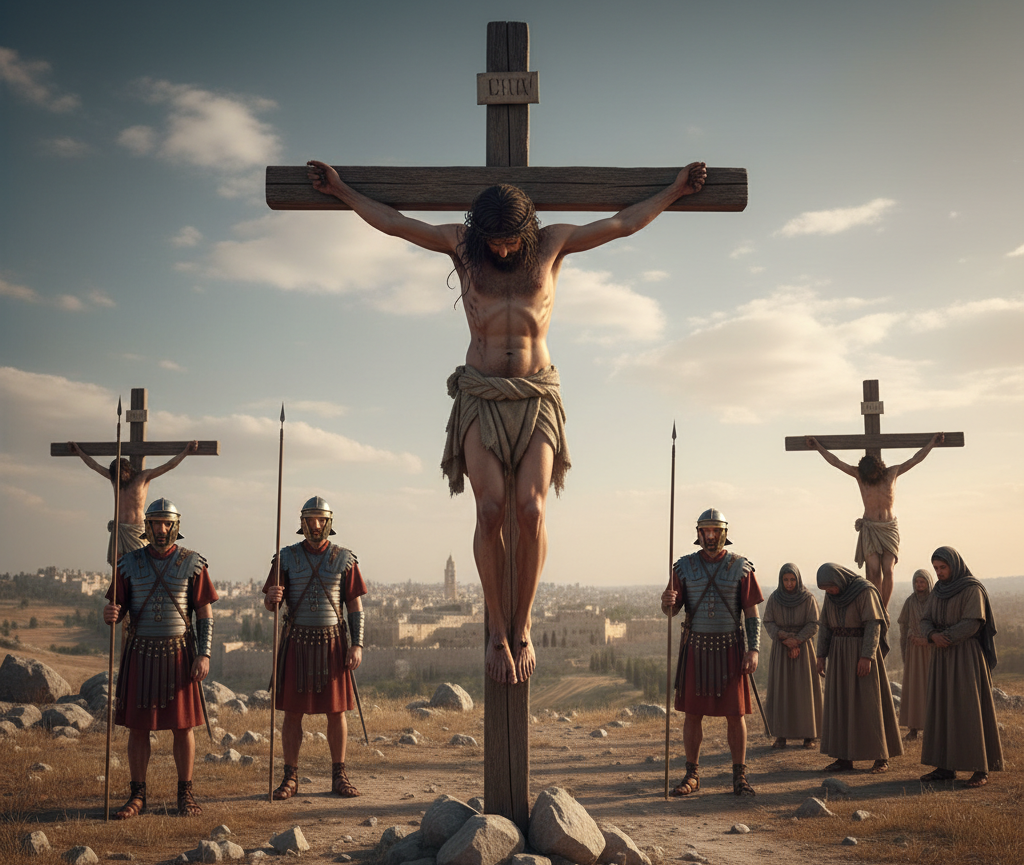
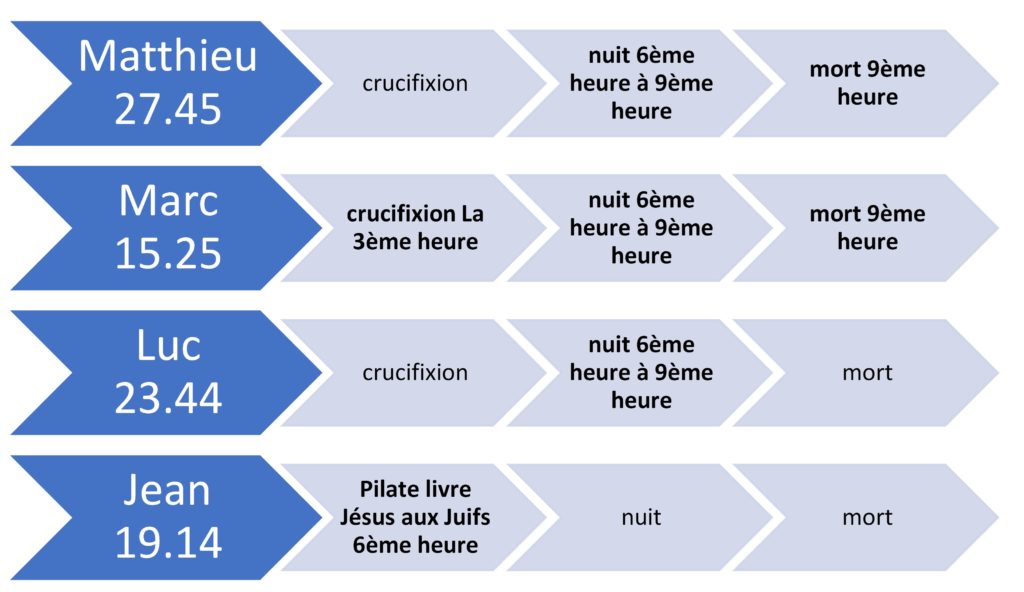
The four Gospels report the crucifixion of Jesus with remarkable precision for the period. Yet an apparent contradiction concerning the exact hour of the events has stirred much debate since antiquity. The Synoptic Gospels (Matthew, Mark and Luke) indicate that Jesus was crucified at the third hour, whereas John mentions the sixth hour at the trial before Pilate (John 19.14).
Does this discrepancy deserve to shake the reliability of the Gospel testimonies? Or is there a coherent explanation that reconciles these data?
To answer this question, we need to examine the systems of time measurement in use in the first century, the Jewish cultural and liturgical context, and the editorial intentions of each author. Our analysis will show that these accounts, far from contradicting one another, complement each other harmoniously.
I. The data of the Synoptic Gospels
1 - The hour of the crucifixion
Mark gives the most explicit indication of the start of the crucifixion:
Mark 15.25 (King James Version) :
And it was the third hour, and they crucified him.
King James Version (1769), domaine public — texte : eBible.org
Look at the Darby translation!
In the Jewish time system, the day begins at sunrise, around 6 a.m. The third hour therefore corresponds to 9 a.m. This indication marks the moment when the soldiers nailed Jesus to the cross.
2 - The supernatural darkness
The three Synoptic Gospels report an extraordinary phenomenon that occurred during the crucifixion:
Matthew 27.45 (King James Version) :
Now from the sixth hour there was darkness over all the land unto the ninth hour.
King James Version (1769), domaine public — texte : eBible.org
Look at the Darby translation! (Mark 15.33, Luke 23.44-45)
According to the Jewish system:
The sixth hour corresponds to noon
The ninth hour corresponds to 3 p.m.
This darkness in broad daylight is a major cosmic sign. Luke specifies that “the sun was darkened” (Luke 23.45), pointing to a supernatural event and not a mere eclipse, which is astronomically impossible at the Passover full moon.
3 - The hour of death
The death of Jesus occurred at the ninth hour, around 3 p.m.:
“At the ninth hour, Jesus cried out with a loud voice: ‘Eloi, Eloi, lama sabachthani?’ which means: ‘My God, my God, why have you forsaken me?’ [...] And Jesus, having uttered a loud cry, breathed his last.” (Mark 15.34-37; Matthew 27.46-50; Luke 23.44-46). Look at the Darby translation!
4 - Chronological summary of the Synoptics
Event
Jewish hour
Modern time
Crucifixion
3rd hour
~9h00
Start of the darkness
6th hour
~12h00
Death of Jesus
9th hour
~15h00
II. Comparison of the information in the Gospels
III. The difficulty posed by John
1 - The problematic verse
John introduces a datum that seems to contradict the Synoptics:
John 19.14 (King James Version) :
And it was the preparation of the passover, and about the sixth hour: and he saith unto the Jews, Behold your King!
King James Version (1769), domaine public — texte : eBible.org
Look at the Darby or NEG translation!
If John were using the Jewish system, the sixth hour would correspond to noon. Yet according to the Synoptics, Jesus had already been on the cross for three hours by then, and the darkness was beginning to cover the land. How could Pilate have pronounced his sentence when the crucifixion had already been under way for a long time?
2 - The proposed solutions
Several hypotheses have been put forward to resolve this difficulty:
a - The copyist's error
From the second century onward, some manuscripts have “third hour” instead of “sixth hour” in John 19.14. This variant is explained by the similarity between the Greek letters gamma (Γ = 3) and digamma/stigma (ϛ = 6). Eusebius of Caesarea mentions this possibility in his writings.
However, the majority of ancient manuscripts keep “sixth hour,” which makes this solution insufficient.
b - The system of day quarters
Some commentators propose that the Gospels use a system of “watches” or day quarters, each period covering three hours:
1st watch: 6–9 a.m.
2nd watch: 9 a.m.–12 p.m.
3rd watch: 12–3 p.m.
4th watch: 3–6 p.m.
In this system, any event occurring between 6 and 9 a.m. would be dated to the “third hour,” and any event between 9 a.m. and noon to the “sixth hour.” The two indications (Mark and John) could then refer to moments close to each other.
This hypothesis explains the use of the term “about” (ὡς/hōs), which indicates an approximation rather than clockwork precision.
c - John's use of the Roman system (preferred hypothesis)
The most satisfactory solution rests on the fact that John uses the Roman time system, which differs from the Jewish system.
IV. John uses the Roman system
1 - The two systems of time measurement
System
Start of the day
6ᵉ heure =
Jew
Sunrise (~6 a.m.)
Noon
Romans
Midnight
6 a.m.
The Roman system counted the hours from midnight, as we do today. The Roman sixth hour therefore corresponds to 6 a.m.
2 - Evidence of John's use of the Roman system
a - The mention of “the evening of Sunday”
In John 20.19, the author writes: “On the evening of that day, the first day of the week...” For a strict Jew, the “first day of the week” would already have begun the previous evening at sunset (Saturday evening). By describing Sunday evening as still belonging to the first day, John adopts the Roman convention.
b - The intended audience
John writes from Ephesus, in Asia Minor, for a predominantly Hellenistic-Roman audience. Using the local time system makes it easier for his readers to understand.
c - Narrative coherence
If John indicates 6 a.m. for the final appearance before Pilate, this fits perfectly with the Synoptics:
~6h00 : Pilate's sentence (John)
~9h00 : Crucifixion (Mark)
The three-hour interval allows for the intervening events: the flogging, the soldiers' mockery, the road to Golgotha, and the preparations for the crucifixion.
V. The parenthesis in John 19.14
The grammatical structure of the verse deserves attention. Several translations, including Darby's, place the time indication in parentheses:
“(Now it was the Preparation of the Passover, it was about the sixth hour;) and he said to the Jews: ‘Behold your king!’” (John 19.14, Darby)
This parenthesis suggests that John is inserting a contextual note rather than a chronological indication strictly tied to the following sentence. He specifies the time when Pilate began to sit in judgment that day, not the exact hour of each word.
VI. The liturgical context: the hours of prayer
1 - The three daily prayers
Jewish tradition establishes three daily times of prayer:
Shacharit (morning prayer): around the 3rd hour (9 a.m.)
Min'ha (afternoon prayer): around the 9th hour (3 p.m.)
Ma'ariv (evening prayer): after sunset
These hours structured religious life in Jerusalem. The shofar sounded from the Temple to call the faithful to prayer.
2 - Correspondence with the events of the Passion
Hour of prayer
Corresponding event
3rd hour (9 a.m.) - Shacharit
Crucifixion
6th hour (12 p.m.)
Start of the darkness
9th hour (3 p.m.) - Min'ha
Death of Jesus
This correspondence is probably not accidental. Matthew, an eyewitness and a devout Jew, naturally associated the events with the time markers that gave rhythm to his day. The sound of the shofar calling to the Min'ha prayer may have coincided with the last cry of Jesus.
3 - Confirmation in the Acts of the Apostles
The book of Acts confirms the importance of these hours:
Acts 3.1 (King James Version) :
Now Peter and John went up together into the temple at the hour of prayer, being the ninth hour.
King James Version (1769), domaine public — texte : eBible.org
Acts 10.9 (King James Version) :
On the morrow, as they went on their journey, and drew nigh unto the city, Peter went up upon the housetop to pray about the sixth hour:
King James Version (1769), domaine public — texte : eBible.org
Acts 10.30 (King James Version) :
And Cornelius said, Four days ago I was fasting until this hour; and at the ninth hour I prayed in my house, and, behold, a man stood before me in bright clothing,
King James Version (1769), domaine public — texte : eBible.org
VII. The meaning of “Preparation of the Passover”
1 - Terminological clarification
The expression “Preparation of the Passover” (John 19.14) has sometimes been interpreted as referring to Thursday, the eve of the Passover meal. This reading would place the crucifixion a day earlier than in the Synoptics.
However, this interpretation overlooks first-century linguistic usage. In the time of Jesus, the term “Passover” often encompassed the whole festival week, including the seven days of Unleavened Bread that immediately followed the Passover meal (Luke 22.1; Exodus 12.15-20).
2 - Friday as the day of preparation
The Greek word paraskeuē (παρασκευή), translated “preparation,” technically refers to Friday, the day before the . Mark confirms this explicitly:
Mark 15.42 (King James Version) :
And now when the even was come, because it was the preparation, that is, the day before the sabbath,
King James Version (1769), domaine public — texte : eBible.org
John himself uses this terminology:
John 19.31 (King James Version) :
The Jews therefore, because it was the preparation, that the bodies should not remain upon the cross on the sabbath day, (for that sabbath day was an high day,) besought Pilate that their legs might be broken, and that they might be taken away.
King James Version (1769), domaine public — texte : eBible.org
)
The “Preparation of the Passover” therefore designates the Friday of Passover week, not the Thursday before the meal.
VIII. Time precision in antiquity
1 - Approximation as the norm
It would be anachronistic to demand of ancient authors the clockwork precision of our own time. Measuring instruments — sundials, water clocks — were rare and imprecise. Most people took their bearings from the position of the sun, from meals, from the hours of prayer, or from the night watches.
The term “about” (ὡς or ὡσεί in Greek) appears frequently in the time indications of the Gospels, signaling an estimate rather than an exact measurement (John 19.14, Luke 23.44).
2 - The value of the time indications
Despite this approximation, the time data of the Gospels show remarkable coherence. They make it possible to reconstruct the course of events over a period of about twelve hours, from the arrest by night to the burial before the .
IX. Chronological reconstruction of Friday, April 1, AD 33
1 - From dawn to the crucifixion
Estimated time
Event
References
~3h00-4h00
Arrest in the garden of Gethsemane
Matthew 26.47-56 ; Mark 14.43-52 ; John 18.2-12
~4h00-4h30
Appearance before Annas
John 18.12-14,19-24
~4h30-6h00
Trial before Caiaphas and the
Matthew 26.57-68 ; Mark 14.53-65
~6h00-6h15
Rooster's crow, Peter's denial
Matthew 26.74-75 ; Mark 14.72 ; Luke 22.60-62
~6h00-6h30
Official condemnation at daybreak
Matthew 27.1 ; Mark 15.1 ; Luke 22.66-71
~6h00
Comparution devant Pilate (6ᵉ heure romaine)
John 19.14
~7h00-7h30
Sent to Herod Antipas
Luke 23.6-12
~7h30-8h30
Return to Pilate, flogging
Matthew 27.15-30 ; John 19.1-16
~8h30-9h00
Road to Golgotha
Matthew 27.32 ; Mark 15.21 ; Luke 23.26
2 - From the crucifixion to the burial
Estimated time
Event
References
~9h00
Mise en croix (3ᵉ heure juive)
Mark 15.25
9h00-12h00
Jesus on the cross, words, mockery
Matthew 27.35-44 ; Luke 23.33-43 ; John 19.18-27
~12h00
Début des ténèbres (6ᵉ heure juive)
Matthew 27.45 ; Mark 15.33
12h00-15h00
Darkness over the land
Luke 23.44-45
~15h00
Mort de Jésus (9ᵉ heure juive)
Matthew 27.46-50 ; Mark 15.34-37
~15h00-17h00
Joseph of Arimathea's efforts
Matthew 27.57-58 ; Mark 15.42-45
~17h00-18h00
Burial before the
Matthew 27.59-60 ; John 19.38-42
X. Additional arguments for harmonization
1 - The reliability of the witnesses
The authors of the Gospels were either direct witnesses (Matthew, John) or close associates of witnesses (Mark with Peter, Luke the meticulous investigator). They wrote at a time when other witnesses could challenge their claims. A glaring contradiction about so public an event would have been noticed immediately.
Luke 1.1-3 (King James Version) :
Forasmuch as many have taken in hand to set forth in order a declaration of those things which are most surely believed among us,Even as they delivered them unto us, which from the beginning were eyewitnesses, and ministers of the word;It seemed good to me also, having had perfect understanding of all things from the very first, to write unto thee in order, most excellent Theophilus,
King James Version (1769), domaine public — texte : eBible.org
2 - The complementarity of the perspectives
Each evangelist writes for a specific audience with distinct concerns:
Matthew addresses the Jews and naturally uses the Jewish system
Mark, influenced by Peter, keeps the Jewish time markers
Luke, a Greek physician, keeps the Jewish system out of fidelity to his sources
John, writing late from Asia Minor for a Hellenistic-Roman audience, adopts their conventions
This diversity enriches the testimony rather than compromising it.
3 - The absence of any attempt at harmonization
Had the authors invented their accounts or copied mechanically, they would probably have made the details uniform. The presence of these variations points to independent testimonies authentically reporting their observations.
XI. Summary of the facts
We offer a sequence of events that follows from the conclusions of our various studies, developed in the synopsis and in several appendices.
_1 The slaughter of the lambs begins on Thursday and continues on Friday. – appendix ANN027: The last Passover meal.
_2 The search for and preparation of the place for the Passover take place on Thursday afternoon. Mark 14.12-16; Matthew 26.17-19; Luke 22.7-13.
_3 The house is, in our view, that of Mary, the mother of John, surnamed Mark. Acts 12.12.
_4 The Passover meal begins on Thursday evening, after 6 p.m. It is already Friday for the Jews. Mark 14.17; Matthew 26.20; Luke 22.14-18. It is therefore not the official Seder, which will take place on the evening of Friday John 18.28.
_5 The meal ends on Friday morning before dawn, between midnight and 2:30 a.m.
_6 Judas Iscariot left before the end of this meal. John 13.30.
_7 The Messiah Jesus and the disciples leave for the Mount of Olives garden between midnight and 2:30 a.m., before dawn on Friday. The young man Mark follows them. Mark 14.26; Mark 14.32-42; Matthew 26.30; Matthew 26.36-46; Luke 22.39-46; John 18.1.
_8 They stop at the foot of the , in the Garden of Gethsemane. Matthew 26.36; Mark 14.32.
_9 They spend an hour in prayer, from 2 a.m. to 3 a.m. Matthew 26.40.
_10 The troop led by Judas Iscariot arrives. It is still Thursday night, before dawn on Friday, around 3 a.m. Mark 14.43-52; Matthew 26.47-56; Luke 22.47-53; John 18.2-12.
_11 The arrest takes place at that moment, around 3:30 a.m. We are about 1 km from the Temple. Matthew 26.47; Mark 14.43; Luke 22.47; John 18.3.
_12 The appearance before the High Priest Anna, who holds this distinction as an honorary title because he is no longer in office, takes place quickly before dawn on Friday, around 4 a.m. His residence is near the Temple. John 18.12-14.
_13 Several disciples, and in particular Simon Peter and John, follow the procession from a distance. They go into the courtyard of the house of the High Priest Caiaphas. Matthew 26.58; Mark 14.54.
_14 The Messiah Jesus is led to the incumbent High Priest, Caiaphas, who also lives near the Temple, at about 4:30 a.m. Luke notes that Peter and John remained in the courtyard for more than an hour. Mark 14.53-72; Matthew 26.57-75; Luke 22.54-62; John 18.15-27.
_15 The Messiah Jesus is questioned for two hours, from 4:30 to 6:30 a.m. Matthew 26.59-68; Mark 14.55-65; Luke 22.67-71; John 18.19-24.
_16 The rooster crows at about 6:15 a.m., a little before sunrise. Matthew 26.74; Mark 14.72; Luke 22.61-62; John 18.27.
_17 The appearance before the should take place after sunrise at 6:38 a.m. But this was not the case, because at the moment the rooster crows the Master is, according to our interpretation of Luke’s text, taken to Pilate right after the verdict of the , which therefore waited for daybreak to pronounce it. Luke 22.66-71; Mark 15.1; Matthew 27.1-2.
_18 The first appearance before Pontius Pilate begins around 6:45 a.m. Mark 15.1-5; Matthew 27.2-14; Luke 23.1-5; John 18.28-38.
_19 We place the appearance before Herod Antipas at around 7:30 a.m. Luke 23.6-12.
_20 The return to Pontius Pilate takes place around 8 a.m. Mark 15.6-19; Matthew 27.15-30; Luke 23.13-25; John 18.39-40; John 19.1-16.
_21 The crowd, gathered in front of Pontius Pilate’s palace, demands the crucifixion. Matthew 27.22 ; Mark 14.11-15 ; Luke 23.23 ; John 19.15.
_22 The departure for Mount Golgotha begins before 9 a.m. Matthew 27.32 ; Mark 15.21-22 ; Luke 23.26-33 ; John 19.17.
_23 The placing on the cross therefore takes place around 9 a.m. according to Mark's text. The imprecision of the measurement allows for the time needed to travel to Mount Golgotha. Mark 15.20-41 ; Matthew 27.31-56 ; Luke 23.26-49 ; John 18.17-30.
_24 All these members of the can now take part in the family Passover feast, rested in spirit after what they regard as a magnificent victory. But events are not going to unfold as they imagined!
_25 From about noon until 3 p.m., there is darkness over the region of Jerusalem. Matthew 27.45 ; Mark 15.33 ; Luke 23.44.
_26 Death on the cross takes place on Friday, April 1, AD 33, around 3 p.m., according to the Gospels. It occurs before the end of this extraordinary night. The three days and three nights begin with this night, as the Jewish calendar requires.
_27 The burial is thought to take place around 5 p.m., while it is still daylight. It is still Friday, which ends around 6 p.m. for the Jews. The normally begins a little earlier, around 5:50 p.m. Everything is finished by the time the begins. Matthew 27.57-61 ; Mark 15.42-47 ; Luke 23.50-56 ; John 19.31-42.
_28 In everyone’s eyes, this matter is now definitively settled and the outcome is rather positive for these leaders; there was no commotion among the crowds.
_29 One last small point remains to be dealt with: the Messiah Jesus had spoken of resurrection, so it is safer to place guards in front of the tomb. This is the request made to Pilate on the very day of the ; nothing stops these devout men. Matthew 27.62-66.
_30 The resurrection takes place on Sunday morning at dawn. We indeed have the 3 days and 3 nights according to the Jewish inclusive reckoning. Matthew 28.2-4 ; Mark 16.2-4 ; Luke 24.1-3. We take into account the night at midday.
_31 Now come the various appearances of the living Messiah Jesus, starting on Sunday, April 3, AD 33, early in the morning. John 20.11-18 ; Matthew 28.8-10 ; Mark 16.8 ; John 20.24-34 ; Mark 16.13-14 ; Luke 24.13-35 ; Mark 16.14 ; Luke 24.36-49 ; John 20.26-31 ; John 21.1-14.
This list is a brief summary of the synopsis, where we examine these events in greater depth to make them easier to understand. All the details supporting our hypothesis are set out either directly in the synopsis or in various appendices.
The apparent contradiction between John and the Synoptics concerning the hour of the crucifixion finds a satisfying resolution in the distinction between the time systems used. John, writing for a Roman audience, uses their convention (sixth hour = 6 a.m.), whereas the Synoptics use the Jewish system (third hour = 9 a.m.).
This explanation makes it possible to establish a coherent chronology:
~6h00 : Pilate's final sentence (John, Roman system)
~9h00 : Actual crucifixion (Synoptics, Jewish system)
~12h00-15h00 : Supernatural darkness
~15h00 : Death of Jesus
Far from invalidating the reliability of the Gospels, this diversity of perspectives attests to the authenticity of accounts coming from different witnesses, each reporting the events according to his own cultural and temporal markers.
The darkness at high noon, reported unanimously by the three Synoptics, is a cosmic sign underscoring the universal significance of this event. The death of the Messiah at in the afternoon (Min'ha), at the very moment when the Passover lambs were being finished off in the Temple, reveals the deep theological coherence of these historical accounts.
The condemnation of Jesus was not the act of the Jewish people as a whole, but of religious leaders attached to their traditions and privileges. Many of them would later recognize in this “dangerous revolutionary” the Messiah announced by their prophets (Acts 6.7).
A title, a person, a place, a reference (“Luke 15”)…
opens in a new window
Bible reference
INF328
Information note
INF328 - The Hour of Prayer
The Hour of Prayer
There probably existed in the Temple at Jerusalem a system of sound signals marking the rhythm of the main religious activities of the day. Several biblical, historical and rabbinic clues point in this direction.
The Law already prescribed the use of silver trumpets to summon the assembly and to mark certain acts of worship (Numbers 10.1-10). The priests used them at the sacrifices and the great feasts (2 Chronicles 29.26-28).
The Jewish historian Flavius Josephus reports that a priest stood at the top of the Temple to announce, by blasts of the trumpet, the beginning and the end of the Sabbath. Archaeological excavations have moreover uncovered a stone bearing the inscription “place of the trumpeting,” which seems to correspond to the spot where this priest stood.
Rabbinic literature, notably the Mishnah (Sukkah 5.5), also mentions several series of blasts accompanying the opening of the Temple gates, the libations and certain moments of the daily worship. A devout Jew who regularly attended the Temple could thus know the main moments of the day thanks to these signals.
The hours of prayer were closely associated with the daily sacrifices: the morning sacrifice took place around the third hour, that is, approximately nine o’clock (Acts 2.15), while the evening sacrifice took place around the ninth hour, that is, around three in the afternoon (Acts 3.1). The faithful naturally gathered around these important moments of worship (Luke 1.10).
It is therefore very likely that Peter and John, going up to the Temple “at the hour of prayer” (Acts 3.1), were guided not only by their knowledge of the liturgical rhythm, but also by the sound signals given at the Temple. When Luke specifies that they were going to the Temple “at the ninth hour,” it is probably not a mere estimate, but an hour known to all and regularly marked by the course of worship and by the sounding of the priestly trumpets.
These liturgical and time markers also explain why the evangelists were able to specify the various hours at which the main events of the day of the crucifixion took place, on April 1, AD 33.
INF305
Information note
INF305 - The Mount of Olives
The Mount of Olives
The Mount of Olives is one of the most important places in biblical geography. Located east of Jerusalem, it is separated from the city by the Kidron Valley (2 Samuel 15.30 ; John 18.1). Its name comes from the many olive trees that once covered its slopes.
Geographical Setting
The Mount of Olives forms a long ridge running north to south, reaching about 820 meters in elevation, slightly higher than Jerusalem. From its summit one enjoys a remarkable view of the city and of the site of the Temple.
Its proximity to Jerusalem explains why Jesus and his disciples went there frequently (Luke 21.37). According to Luke, the place of the ascension was about one “Sabbath day’s journey” from Jerusalem, or approximately one kilometer (Acts 1.12).
A Place Associated with Many Biblical Events
In the Old Testament
David crossed the Kidron brook and climbed the Mount of Olives weeping as he fled from his son Absalom (2 Samuel 15.30).
The prophet Ezekiel describes the glory of God leaving Jerusalem and stopping on the mountain east of the city, generally identified with the Mount of Olives (Ezekiel 11.23).
The prophet Zechariah announces that on the day of the Lord, the feet of the Eternal will stand on the Mount of Olives (Zechariah 14.4).
In the Life of the Messiah Jesus
The Mount of Olives holds a special place in the Gospels:
Jesus stays there frequently (Luke 22.39);
he gazes upon Jerusalem and weeps over the city (Luke 19.41-44);
there he delivers the eschatological discourse on the end of the age (Matthew 24.3 ; Mark 13.3);
he spends his nights on this mountain during the last days before his death (Luke 21.37);
at the foot of the mountain lies the garden of Gethsemane, where he prays before his arrest (Matthew 26.36 ; Luke 22.39-46);
it is also from the area around Bethany, on the eastern slope of the mountain, that he blesses his disciples and is taken up into heaven (Luke 24.50-51 ; Acts 1.9-12).
The Mount of Olives and the Ascension
Acts indicates that the disciples returned to Jerusalem “from the mount called Olivet” after the ascension (Acts 1.12). Luke specifies in his Gospel that Jesus led them as far as Bethany before leaving them (Luke 24.50).
These two indications are perfectly compatible, since Bethany is located on the eastern slope of the Mount of Olives, about three kilometers from Jerusalem (John 11.18).
A Prophetic Dimension
For several interpreters, the choice of the Mount of Olives as the place of the ascension is probably no accident. The prophet Zechariah already announced that on the day of the Eternal, he would stand on this mountain (Zechariah 14.4). Thus, the place from which Jesus leaves his disciples could also be the one associated with his glorious return, in keeping with the words of the angels:
“This same Jesus, who was taken up from you into heaven, will come in the same way as you saw him go into heaven” (Acts 1.11).
Thus, the Mount of Olives appears as a place steeped in history and symbolism. It is at once the stage of the Messiah’s sufferings, of his teaching about the times to come, of his ascension and, according to several prophetic interpretations, of the place associated with his future return.
INF003
Information note
INF003 - The Sanhedrin
The Sanhedrin
The Sanhedrin was a key institution in ancient Judaism, with legislative, judicial, and religious functions. Here are some key points about it:
The Sanhedrin (or Jewish Sanhedrin) refers, in the Second Temple period (c. 2nd century BC – AD 70), to the supreme authority of religious, legal, and at times political life of Judaism in Judea.
Key points
Composition and seat: traditionally 71 members (the Nasi/president, the Av Beit Din/vice-president, and judges/sages). It sat in Jerusalem, near the Temple, probably in a hall called the “Chamber of Hewn Stone.”
Powers: interpretation of the Law (Torah), setting of religious norms, arbitration of important disputes, oversight of the calendar (sanctification of months and intercalations), validation of community ordinances, and, in theory, judgment of the gravest cases. Under Roman rule, its criminal powers were limited.
Historical sources: echoes of it are found in the Gospels (the trial of Jesus mentioning a Jewish council) and especially in rabbinic literature (Mishnah, Talmud), which describes its ideal functioning and its rules of procedure.
Procedure: testimonies examined by a panel, a strong requirement for the credibility of witnesses, a necessary quorum, votes beginning with the youngest judges to avoid the influence of the elders, a preference for acquittal in case of doubt; for capital cases, even stricter rules.
After AD 70: the destruction of the Temple by the Romans put an end to the Sanhedrin as it existed in Jerusalem. A rabbinic authority was reconstituted in Galilee (Yavneh, then Usha, Sepphoris, Tiberias), sometimes called the “Sanhedrin” by analogy, centered on study, halakha, and community organization; it declined around the 4th–5th century.
Legacy: the Sanhedrin symbolizes the ideal of a learned collegial authority in Judaism. Talmudic tractates (notably Sanhedrin, Makkot) preserve its theoretical rules, which have influenced Jewish legal thought. In the modern era, the term has been revived by analogy (e.g., the “Grand Sanhedrin” convened by Napoleon in 1807), with no ancient institutional continuity.
Key terms
Nasi: president of the Sanhedrin; traditions attribute this role to Hillel the Elder and his descendants in the later period.
Av Beit Din: “father of the court,” second to the Nasi.
Beit Din: rabbinic court; in the plural, it also refers to local courts of 23 judges (for serious cases) or 3 (for civil cases).
Limits and debates
History vs. normative ideal: Talmudic descriptions blend historical memories with legal models; historians debate the real extent of its powers in each period.
Criminal jurisdiction under Rome: the ability to carry out the death penalty is especially debated; it was probably very restricted at the end of the period.
In brief: the Sanhedrin was the highest scholarly and judicial authority of Second Temple Judaism, with a central role in the interpretation of the law and in community cohesion; its ancient form disappears after AD 70, but its model continues to inspire rabbinic organization and Jewish legal thought.
INF004
Information note
INF004 - The Romans
The Romans
In 63 BC the Roman general Pompey invaded the territory of Israel and took Jerusalem. In 45 BC, thanks to Julius Caesar, Judaism became a legal religion.
Five years later, in 40 BC, Emperor Augustus put an end to the Hasmonean dynasty and appointed Herod the Great, an Idumean and therefore not of royal descent, king of the Jews.
A few years after the death of Herod the Great, in AD 6, Rome changed the status of Judea, together with Samaria and Idumea (the biblical Edom), turning them into Roman provinces placed under the responsibility of Roman procurators.
The sons of King Herod were promoted by the Roman authority to the rank of tetrarchs and governed these various provinces under the aegis of the procurators.
So during the ministry of the Messiah Jesus, a prefect, Pontius Pilate, and a tetrarch, Herod Antipas, shared power. The two men hated each other until the day of the condemnation of the Messiah Jesus (Luke 23.12).
Forty years after the crucifixion of the Messiah Jesus, the Jewish uprising, which began in AD 66, was crushed. Titus destroyed the Temple of Jerusalem in AD 70, and it all ended with the fall of Masada on May 2, AD 73.
Other revolts followed until AD 135.
In AD 130, Emperor Hadrian once again changed the status of the land of Israel by founding a new Roman colony; the name of Jerusalem was replaced by Aelia Capitolina.
The Messiah Jesus carried out His ministry in a territory occupied by the Romans, with a governor appointed by Rome.
At this point in history, three men therefore shared the leadership of the land of Israel:
Pontius Pilate, the Roman prefect, held all powers, particularly over Judea.
Herod Antipas ruled over Galilee and Perea.
The High Priest, Caiaphas, was responsible for religious matters.
INF089
Information note
INF089 - The Sabbath
The Sabbath
The Sabbath is a day of rest and sanctification in Jewish tradition, observed from Friday evening to Saturday evening. Here are some important points to know about the Sabbath:
Origins and meaning
Biblical commandment: The Sabbath is one of the Ten Commandments given by God to Moses on Mount Sinai. It is mentioned several times in the Torah, notably in Exodus 20.8-11 and Deuteronomy 5.12-15. Creation: The Sabbath commemorates God's day of rest after the six days of creation, as described in Genesis 2.2-3. Deliverance from Egypt: In addition to creation, the Sabbath also recalls the Israelites' deliverance from slavery in Egypt, symbolising freedom and sanctification.
Observance and practices
Rest: The Sabbath is a day of complete rest on which creative work (called ‘melakhot’) is forbidden. This includes activities such as cooking, writing, lighting a fire and more. Celebration: The Sabbath begins on Friday evening with a festive meal, often preceded by the lighting of Sabbath candles. Special prayers, such as Kiddush (sanctification), are recited. Religious services: Observant Jews attend services in synagogues, where special readings from the Torah and prayers take place.
Family time and spirituality: The Sabbath is also a time for family gatherings, study of the Torah and spiritual reflection.
Spiritual importance
Relationship with God: The Sabbath is a time devoted to spirituality and strengthening one's relationship with God, a time of physical and spiritual rest. Community: The Sabbath encourages community and family gatherings, strengthening social and religious ties.
The meaning of the Sabbath for Jews
For Jews, the Sabbath is far more than simply a day of rest. It is a weekly reminder of the creation of the world and a symbol of the covenant between God and the people of Israel. The Sabbath is a sacred time devoted to prayer, spiritual reflection, and fellowship with family and community.
Observing the Sabbath involves refraining from all work, attending religious services at the synagogue, preparing special meals and celebrating with family. It is a time to step away from material concerns and focus on spiritual matters, thereby strengthening ties with God and loved ones.
Sabbath observance in Jesus' time
In Jesus' time, the Sabbath had great religious and social importance. Sabbath laws were scrupulously observed, and the Pharisees, along with the scribes, were particularly vigilant about their strict observance. They had developed a detailed set of rules to determine what was considered ‘work’ forbidden on the Sabbath.
Jesus, however, often challenged these rigid interpretations of Sabbath laws. For example, he healed the sick on the Sabbath, which provoked controversy with the religious authorities of his time. Jesus taught that the Sabbath was made for humanity, not humanity for the Sabbath (Mark 2.27), thus emphasising the importance of compassion and humanity over strict rules.
Jesus' approach to the Sabbath highlighted the idea that religious laws should serve people's well-being rather than become oppressive burdens. This perspective contributed to tensions between him and the religious authorities and played a part in the conflicts that ultimately led to his crucifixion.
The Sabbath is a central institution of Judaism, symbolising rest, sanctification and the relationship with God. It plays an essential role in Jewish religious and social life, offering a weekly pause devoted to reflection, prayer and fellowship with loved ones.