

_28 In everyone’s eyes, this matter is now definitively settled and the outcome is rather positive for these leaders; there was no commotion among the crowds.
_29 One last small point remains to be dealt with: the Messiah Jesus had spoken of resurrection, so it is safer to place guards in front of the tomb. This is the request made to Pilate on the very day of the ; nothing stops these devout men. Matthew 27.62-66.
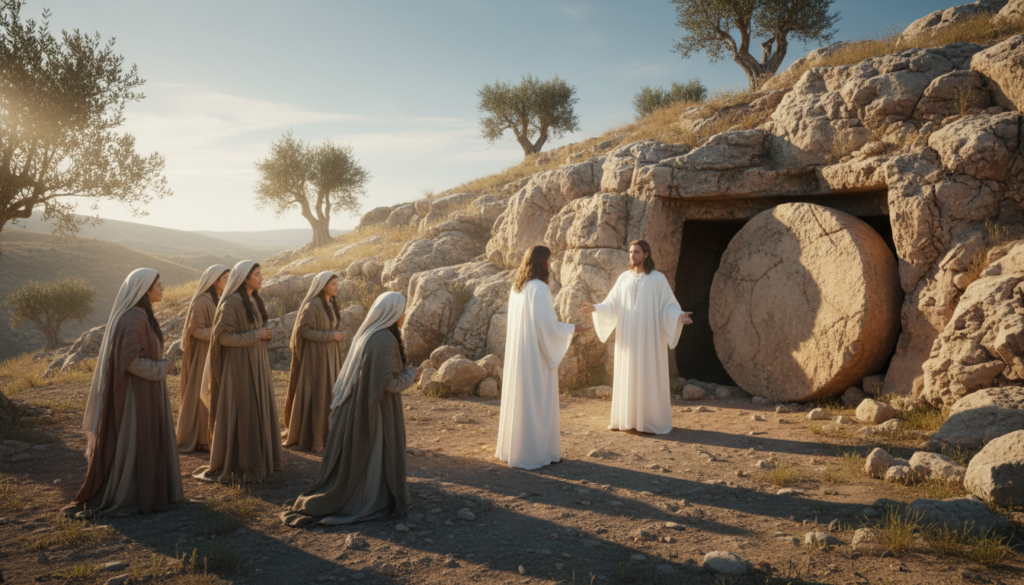
_30 The resurrection takes place on Sunday morning at dawn. We indeed have the 3 days and 3 nights according to the Jewish inclusive reckoning. Matthew 28.2-4 ; Mark 16.2-4 ; Luke 24.1-3. We take into account the night at midday.
You can consult the complete chronology in the study ANN026 : The hour of the crucifixion.
Commentary:
1- The first witnesses of the resurrection
The three Synoptic Gospels report the appearance of heavenly messengers to the women who came to the tomb. Matthew speaks explicitly of an (Matthew 28.2), whereas Mark and Luke use the more general term “men” (Mark 16.5; Luke 24.4). This way of speaking is nothing unusual in Scripture, where angels frequently appear in human form (Genesis 18.2; Genesis 19.1; Hebrews 13.2). Whatever the nuances of the vocabulary used, these figures are manifestly of heavenly origin, and their presence provokes deep fear in the women (Matthew 28.5; Luke 24.5).
2- Women faithful to the end
These same women, who had followed Jesus during his ministry, witnessed his crucifixion and observed his burial, are the first to receive the announcement of the resurrection (Luke 8.1-3; Luke 23.49; Luke 23.55-56). While most of the disciples had scattered after the Master’s arrest (Matthew 26.56), they remained faithful even in the darkest hours.
In the context of first-century Judaism, the testimony of women generally did not carry the same legal value as that of men. It is therefore remarkable that the Gospels place these very women in the foreground of the events connected with the resurrection. This detail is often regarded as an indicator of historical authenticity, since authors seeking to make their account more convincing in the eyes of their contemporaries would likely have chosen male witnesses.
3- One angel or two?
Matthew and Mark mainly emphasize a single figure who speaks (Matthew 28.5; Mark 16.5), whereas Luke specifies that there were two (Luke 24.4). This difference is not a contradiction. The presence of two angels in no way excludes that only one of them took the initiative to address the women.
Such differences in presentation are common in eyewitness accounts and testify more to the editorial freedom of the evangelists than to any real divergence between their accounts.
4- The announcement of the resurrection
The women first discover that the tomb is empty. This finding is then interpreted in the light of the angels’ words. Matthew and Mark report the fundamental declaration that is the heart of the Christian message: “He is not here; he is risen” (Matthew 28.6; Mark 16.6).
The angels also urge the women to announce this news to the disciples and remind them that Jesus will go before them into Galilee, in keeping with the words he himself had spoken before his arrest (Matthew 26.32; Matthew 28.7; Mark 16.7). Thus the events of Easter morning are presented as the fulfillment of the Master’s words.
5- The hypothesis of Mary Magdalene’s early departure
The Gospel of John reports that Mary Magdalene tells Peter and John: “They have taken away the Lord out of the tomb, and we know not where they have laid him” (John 20.2). This statement contains no allusion to the resurrection or to the appearance of the angels.
Several attempts at harmonization therefore lead us to consider that Mary Magdalene left the place almost immediately after seeing that the stone had been rolled away, even before receiving the angelic message. She would then have gone to warn Peter and John, leaving the other women to continue their visit to the tomb.
This hypothesis, although it cannot be proven with certainty, helps explain why Mary still seems convinced that the body of Jesus had been moved and why she mentions no announcement concerning the resurrection.
6- The reminder of the Master’s words
Luke takes a particular perspective. Unlike Matthew and Mark, he does not emphasize the future meeting in Galilee, but the reminder of Jesus’ words: “Remember how he spoke unto you when he was yet in Galilee” (Luke 24.6-7).
The angels thus recall that the Passion and the resurrection are not unexpected events. Jesus himself had announced that he must be delivered into the hands of sinful men, be crucified, and rise on the third day (Luke 9.22; Luke 18.31-33).
More broadly, Luke will stress at the end of his Gospel that these events are part of the fulfillment of God’s plan revealed in the Scriptures (Luke 24.25-27; Luke 24.44-46). The sufferings of the Messiah and his glorification had been announced in advance (Isaiah 53.3-11; Psalms 16.10; Psalms 22.1-32).
7- Galilee and the first appearances in Jerusalem
The angels announce that Jesus will be seen again in Galilee (Matthew 28.7; Mark 16.7). Located several days’ walk from Jerusalem, this region will indeed play an important role in the appearances of the Risen One (Matthew 28.16-20; John 21.1-14).
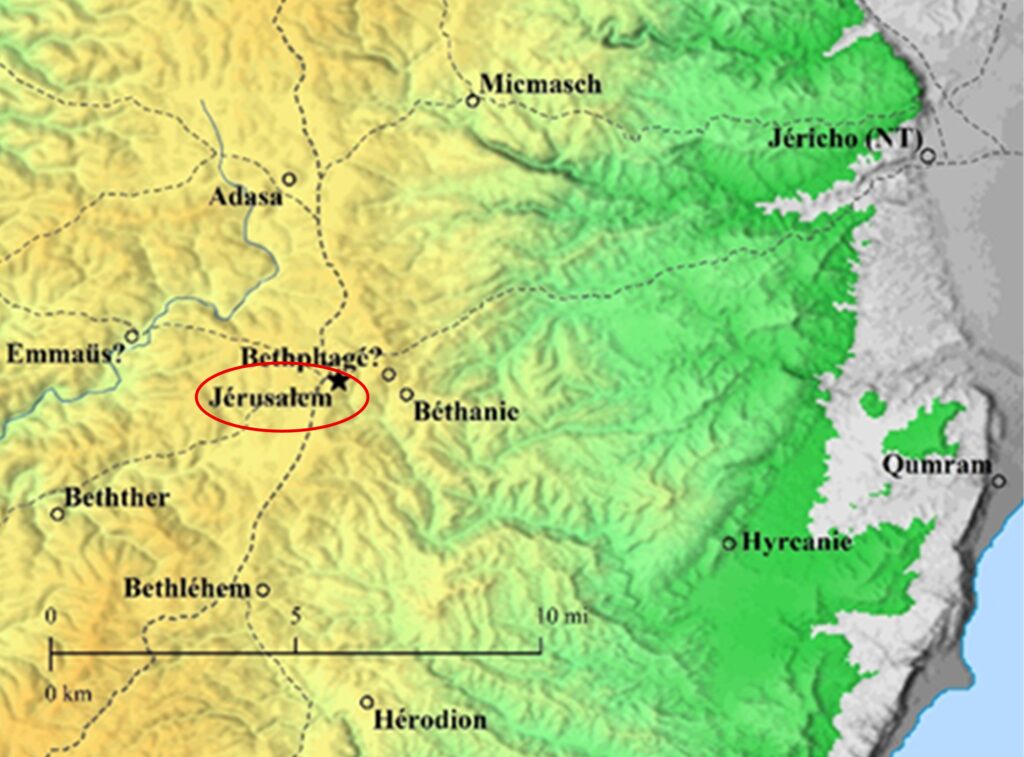
However, several appearances will take place beforehand in Jerusalem itself. John reports in particular the appearances to Mary Magdalene (John 20.14-18), to the disciples gathered behind closed doors (John 20.19-23) and, eight days later, to Thomas (John 20.26-29). Luke also mentions the disciples at Emmaus and the appearance to the Eleven gathered in Jerusalem (Luke 24.13-35; Luke 24.36-49).
8- A gradual transformation of the disciples
These successive appearances show that the resurrection is not only a historical event, but also a reality experienced by many witnesses (1 Corinthians 15.3-8). Gradually, the disciples move from fear and doubt to unshakable conviction.
A few weeks later, those who had shut themselves in for fear of the (John 20.19) will publicly proclaim the resurrection of Jesus with remarkable assurance (Acts 2.22-24; Acts 4.19-20). This profound transformation is one of the most remarkable consequences of the appearances of the risen Christ.