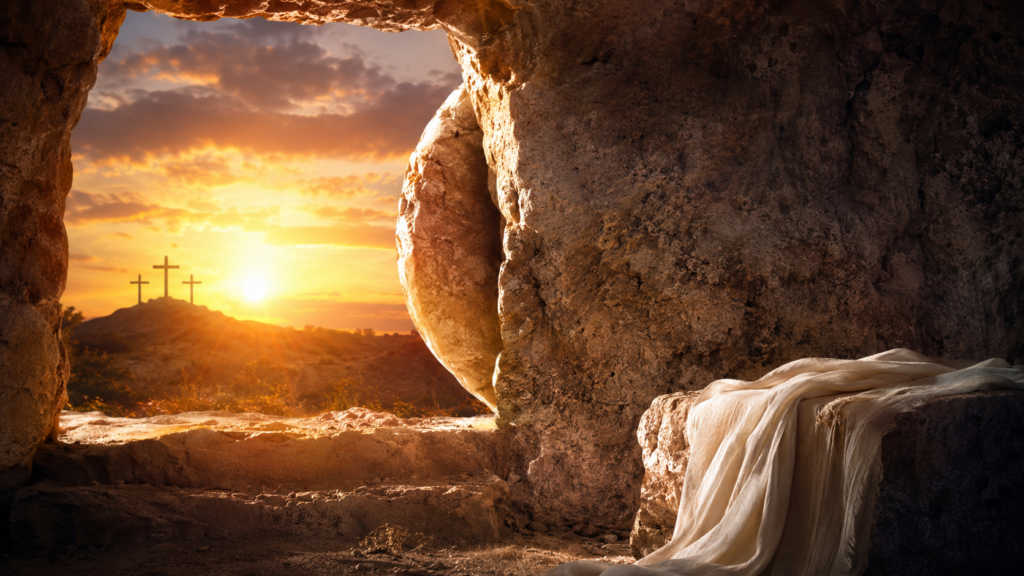
Detailed chronology of the events related to the resurrection
The article examines in depth the chronology of the events surrounding the resurrection of Jesus, harmonizing the Gospel accounts. It relies on artificial intelligence to verify and formulate hypotheses, ranging from the crucifixion to the burial of Jesus, including the role of the women in these events.
229 min
resurrectionJesusgospelsharmonizationchronology
359 verses
6 books
In the appendix ANN107 entitledHarmonization of the Texts on the Resurrection, we presented the conclusions of our research on the chronology of the events surrounding the resurrection of the Messiah Jesus. Some of the solutions adopted nevertheless remain hypothetical, because harmonizing the four Gospel accounts is a particularly complex exercise.
In our view, the accounts of Matthew, Mark, Luke and John do not contradict one another. Nevertheless, their complementarity sometimes allows several possible interpretations regarding the precise order of certain events or the movements of the various witnesses. In several cases, we therefore had to favor the hypothesis that seemed to us the most consistent with all the available biblical data.
In order to submit our work to an outside perspective and to test our conclusions, we requested a critical analysis carried out with the help of an . The aim was not to replace our study, but to identify possible weaknesses, examine alternative hypotheses and verify the soundness of our reasoning.
This appendix sets out the main observations, remarks and criticisms made at the end of this examination. The reader will thus be able to appreciate the strong points of our chronological reconstruction, but also the passages that remain debated or open to different interpretations.
I. The question to the AI
Here is the question we put to the AI: Are you able to take up all the elements described in the following passages: Matthew 27.57-66, Matthew 28.1-20, Mark 15.42-47, Mark 16.1-20, Luke 23.50-56, Luke 24.1-53, John 19.33-37, John 19.38-42, John 20.1-28 and John 21.1-23, and then to propose a point-by-point chronology integrating all the events reported?
Each step is to be presented in the form: Point No. 1, Point No. 2, etc.
II. Here is its answer
Yes. By harmonizing all the accounts and seeking to integrate all the events reported by Matthew, Mark, Luke and John, the following chronology can be proposed. Some points remain debated, but this reconstruction makes it possible to include all the information mentioned in the passages you cited.
Harmonized chronology of the events from the death of the Messiah Jesus to the appearances in Galilee
Friday, April 1, AD 33 – End of the crucifixion
Point No. 1
Jesus dies on the cross at about the ninth hour, that is, around 3 p.m. (Matthew 27.50 ; Mark 15.37 ; Luke 23.46 ; John 19.30).
Point No. 2
The soldiers break the legs of the two robbers crucified with Jesus in order to hasten their death (John 19.31-32).
Point No. 3
Seeing that Jesus is already dead, the soldiers do not break his legs (John 19.33).
Point No. 4
A soldier pierces Jesus' side with a spear, and blood and water come out (John 19.34-37).
Point No. 5
Joseph of Arimathea asks Pilate for permission to take the body of Jesus (Matthew 27.57-58 ; Mark 15.42-45 ; Luke 23.50-52 ; John 19.38).
Point No. 6
Pilate checks with the that Jesus is really dead (Mark 15.44-45).
Point No. 7
Pilate authorizes Joseph to take the body (Mark 15.45).
Point No. 8
Nicodemus joins Joseph with a mixture of myrrh and aloes (John 19.39).
Point No. 9
The body is taken down from the cross (John 19.38).
Point No. 10
Joseph and Nicodemus wrap the body in linen cloths with the spices, according to the Jewish custom (John 19.40).
Point No. 11
Jesus is laid in the new tomb belonging to Joseph of Arimathea (Matthew 27.59-60 ; Mark 15.46 ; Luke 23.53 ; John 19.41-42).
Point No. 12
A large stone is rolled against the entrance of the tomb (Matthew 27.60 ; Mark 15.46).
Point No. 13
Mary Magdalene and the other women observe where the tomb is located (Matthew 27.61 ; Mark 15.47 ; Luke 23.55).
Point No. 14
The women return to prepare spices and perfumes (Luke 23.56).
Point No. 15
The begins and they rest according to the commandment (Luke 23.56).
Saturday, April 2, AD 33
Point No. 16
The chief priests and the go to Pilate (Matthew 27.62-63).
Point No. 17
They ask that the tomb be made secure until the third day (Matthew 27.64).
Point No. 18
Pilate authorizes the setting of a guard (Matthew 27.65).
Point No. 19
The tomb is sealed and guarded by soldiers (Matthew 27.66).
Sunday, April 3, AD 33 – The day of the resurrection
Before the women arrive
Point No. 20
A violent earthquake occurs (Matthew 28.2).
Point No. 21
An angel comes down from heaven and rolls away the stone (Matthew 28.2).
Point No. 22
The guards are seized with fear and become like dead men (Matthew 28.4).
Point No. 23
Jesus has already risen (Matthew 28.6 ; Mark 16.6 ; Luke 24.6).
The women's visit
Point No. 24
Mary Magdalene, Mary the mother of James, Salome, Joanna and other women go to the tomb with the spices (Matthew 28.1 ; Mark 16.1 ; Luke 24.1,10 ; John 20.1).
Point No. 25
On the way they wonder who will roll away the stone (Mark 16.3).
Point No. 26
They find that the stone has already been moved (Mark 16.4 ; Luke 24.2 ; John 20.1).
Point No. 27
Mary Magdalene immediately leaves the group to inform Peter and John (John 20.2).
Point No. 28
The other women continue their visit to the tomb (Luke 24.3).
Point No. 29
They see the angels, who announce the resurrection (Matthew 28.5-7 ; Mark 16.5-7 ; Luke 24.4-8).
Point No. 30
The women leave the tomb to inform the disciples (Matthew 28.8 ; Luke 24.9).
Point No. 31
Jesus appears to the women on the way (Matthew 28.9-10).
The visit of Peter and John
Point No. 32
Mary Magdalene informs Peter and John that the tomb is empty (John 20.2).
Point No. 33
Peter and John run to the tomb (John 20.3-4).
Point No. 34
John arrives first (John 20.4).
Point No. 35
They see the linen cloths and the folded face cloth (John 20.5-7).
Point No. 36
John begins to believe in the resurrection (John 20.8).
Point No. 37
Peter and John depart (John 20.10 ; Luke 24.12).
Appearance to Mary Magdalene
Point No. 38
Mary stays near the tomb, weeping (John 20.11).
Point No. 39
She sees two angels sitting in the tomb (John 20.12-13).
Point No. 40
Jesus appears to her (John 20.14-17 ; Mark 16.9).
Point No. 41
Mary tells the disciples that she has seen the Lord (John 20.18).
Various reactions
Point No. 42
The women report all the events to the apostles (Luke 24.9-11).
Point No. 43
The disciples do not believe them (Mark 16.11 ; Luke 24.11).
Point No. 44
The guards report the events to the religious authorities (Matthew 28.11).
Point No. 45
The religious leaders bribe the guards in order to spread the theory that the body was stolen (Matthew 28.12-15).
Sunday appearances
Point No. 46
Jesus appears to Simon Peter (Luke 24.34 ; 1 Corinthians 15.5).
Point No. 47
Jesus appears to the two disciples on the road to Emmaus (Mark 16.12-13 ; Luke 24.13-32).
Point No. 48
The two disciples return to Jerusalem (Luke 24.33-35).
Point No. 49
Jesus appears to the disciples gathered together, without Thomas (Mark 16.14 ; Luke 24.36-49 ; John 20.19-23).
Eight days later
Point No. 50
Thomas is present with the other disciples (John 20.24-26).
Point No. 51
Jesus appears again and invites Thomas to examine his wounds (John 20.27).
Point No. 52
Thomas confesses: “My Lord and my God” (John 20.28).
Appearances in Galilee
Point No. 53
The disciples go to Galilee in accordance with the instructions they received (Matthew 28.10 ; Matthew 28.16).
Point No. 54
Jesus appears to seven disciples at the shore of (John 21.1-14).
Point No. 55
Miraculous catch of 153 fish (John 21.6-11).
Point No. 56
Meal with the risen Jesus (John 21.12-14).
Point No. 57
Conversation between Jesus and Peter: “Feed my sheep” (John 21.15-17).
Point No. 58
Announcement of Peter's future martyrdom (John 21.18-19).
Jesus appears to the eleven on the mountain appointed in Galilee (Matthew 28.16-17).
Point No. 61
He entrusts them with the mission of evangelizing all nations (Matthew 28.18-20 ; Mark 16.15-18).
This chronology contains all the events reported in the passages you cited. It is a solid basis for continuing with the additional appearances mentioned in (1 Corinthians 15.5-8) and for concluding with the ascension described in (Luke 24.50-53) and (Acts 1.1-11).
III. Comparison with our chronology
We are very close to the results we published in appendix ANN 107: Harmonization of the Texts on the Resurrection. It is in fact the most credible chronology according to our research, given the lack of information at certain moments in the Gospels.
Next we asked the AI the following question: Do some elements of this chronology raise difficulties of interpretation?
IV. The AI's second answer
Yes. Your chronology is broadly coherent and harmonizes the four Gospels well, but several points remain delicate from an exegetical standpoint. Some are relatively minor, while others are genuine chronological knots.
Does Mary Magdalene really leave the group before the angels? (Point No. 27)
This is probably the most important difficulty.
Your chronology rests on the following idea:
Mary sees the stone rolled away;
she immediately leaves to inform Peter and John (John 20.2);
the other women stay on the spot and see the angels (Matthew 28.5-7 ; Luke 24.4-8).
This solution is widely used because it harmonizes John fairly well with the Synoptics.
However:
John does not say explicitly that Mary leaves the group before the encounter with the angels.
Matthew seems rather to present Mary Magdalene as being present at the angel's message (Matthew 28.1-10).
Your hypothesis is plausible, but it is a reconstruction.
The appearance to the women (Point No. 31)
You place:
the message of the angels;
the departure of the women;
the appearance of Jesus to the women.
This is consistent with Matthew.
The difficulty is that John does not mention this collective appearance at all.
Two solutions exist:
Hypothesis A
Jesus appears:
first to the women;
then to Mary Magdalene.
Hypothesis B
The appearance to the women and the one to Mary are the same event told differently.
Your study seems rather to favor the distinction between the two events, which is today the most widespread hypothesis.
Appearance to Mary Magdalene: first or second appearance? (Points No. 31 and No. 40)
Mark states:
“Now when Jesus had risen early on the first day of the week, he appeared first to Mary Magdalene” (Mark 16.9).
The word “first” creates a tension.
If Jesus already appears to the other women in Matthew 28.9 before showing himself to Mary alone in John 20.14-17, then Mary is no longer the first.
This is one of the most debated problems.
Two main solutions:
Solution 1
Mary is present in the group of women.
Mark simply puts the emphasis on her.
Solution 2
The appearance in Matthew 28.9 concerns only the group that includes Mary.
John then develops this episode.
You have already explored this avenue in your work.
Do Peter and John see the angels? (Points No. 35-39)
Your chronology assumes:
Peter and John visit the tomb;
no angel is visible;
they leave;
the angels then appear to Mary.
John's text allows this reading.
However, some readers find it surprising:
that the angels were present beforehand;
absent during the apostles' visit;
then visible after their departure.
This is not impossible biblically, but it is a sensitive point.
The appearance to Peter (Point No. 46)
Luke simply states:
“The Lord has risen indeed, and has appeared to Simon” (Luke 24.34).
Paul also confirms this appearance (1 Corinthians 15.5).
The problem is that:
no Gospel recounts this episode.
We do not know:
the time;
the place;
the circumstances.
Your position is logical, but its exact place in the day remains hypothetical.
Mark 16.9-20
You have already identified this.
Mark summarizes:
Mary Magdalene;
the disciples of Emmaus;
the Eleven.
Without giving precise indications of time.
This makes it difficult to use Mark to build a detailed chronology.
John 21 and Matthew 28
The order between:
the appearance at the lakeshore (John 21);
the appearance on the mountain in Galilee (Matthew 28.16-20)
is not specified.
You place:
John 21 ;
Matthew 28.
This is probably the most natural order, but it remains a deduction.
The guards and the earthquake
Matthew is the only one to mention:
the guard;
the seal;
the earthquake;
the angel rolling away the stone.
Integrating these events does not pose a contradiction, but it depends on the idea that Matthew provides here information absent from the other evangelists.
My overall assessment
I would distinguish:
Very solid points (low level of uncertainty)
The burial.
The involvement of Joseph and Nicodemus.
The women's visit.
The visit of Peter and John.
The appearance to the disciples without Thomas.
The appearance with Thomas.
The appearances in Galilee.
Moderately uncertain points
The exact moment when Mary leaves the group.
The number of round trips made by Mary.
The precise place of the appearance to Peter.
The order John 21 / Matthew 28.
The most delicate point
The real crux of any harmonization remains the relationship between:
(Matthew 28.9-10): appearance to the women;
(Mark 16.9): appearance first to Mary;
(John 20.11-18): appearance to Mary alone.
It is around these three texts that most of the chronological reconstruction is decided. All the other difficulties are relatively secondary by comparison.
V. We then asked the AI to propose a more faithful chronology
Yes, there are at least two other major harmonizations that can be defended. However, each solves some problems while creating others. After examining all the texts, I am not certain that they are more faithful than your chronology; they are simply based on different interpretive choices.
Hypothesis No. 1: Mary Magdalene stays with the other women
This is probably the simplest harmonization at first sight.
Sequence of events
All the women arrive together at the tomb (Matthew 28.1 ; Mark 16.1 ; Luke 24.1 ; John 20.1).
They see the angels together (Matthew 28.5-7 ; Mark 16.5-7 ; Luke 24.4-8).
Jesus appears to the women (Matthew 28.9-10).
Mary Magdalene is part of this group.
John 20.11-18 would then be a flashback detailing Mary's personal experience.
Advantages
Matthew 28 is read in a very natural way.
Mary remains with the other women.
Mark 16.9 is explained by the fact that Mary is the main figure of the group.
Disadvantages
John 20.2 becomes difficult to explain:
“They have taken the Lord out of the tomb...”
Mary then seems to be completely unaware of the resurrection.
Yet in this hypothesis she would already have heard the angels.
This is a significant difficulty.
Hypothesis No. 2: John 20.11-18 is a flashback
This is very close to the hypothesis you are currently developing.
Sequence of events
The women arrive together.
They see the angels.
Jesus appears to the women.
Mary passes on the announcement.
Peter and John go to the tomb.
John 20.11-18 then goes back in time to tell in more detail what Mary experienced.
Advantages
Mark 16.9 (“he appeared first to Mary”) is easier to understand.
Matthew 28 and John 20 would essentially describe the same appearance.
Disadvantages
John 20.11 begins naturally after John 20.10:
“Mary stood outside...”
The text seems to continue the story rather than go back in time.
One must therefore assume an unsignaled chronological shift.
Hypothesis No. 3: Several groups of women
This solution is often adopted by the classical harmonists.
Sequence of events
Group 1:
Mary Magdalene.
Group 2:
Mary the mother of James.
Salome.
Joanna.
other women.
The groups set out at slightly different times and arrive at the tomb at different times.
Advantages
Solves several difficulties.
Explains the variations in the lists of women.
Disadvantages
The texts never explicitly speak of several groups.
The reconstruction becomes very complex.
One sometimes ends up multiplying the movements to resolve each difficulty.
In my opinion
Paradoxically, your current chronology probably remains the closest to the natural reading of John.
Why?
Because it takes three elements seriously:
John 20.2
Mary is still unaware of the resurrection.
John 20.11
Mary seems to return to the tomb after Peter and John have left.
John 20.18
Mary passes on a second announcement, different from the first.
These three verses form a very coherent sequence:
empty tomb;
announcement to the disciples;
visit of Peter and John;
encounter with Jesus;
second announcement.
This is precisely what makes your reconstruction solid.
The only point that remains truly problematic
It is Mark 16.9:
“Jesus appeared first to Mary Magdalene.”
and Matthew 28.9:
“Jesus met them.”
If Matthew is understood as an appearance to the whole group of women before John 20.14-17, then Mary is no longer the first person to see Jesus.
This is why many harmonizations end up concluding that:
Mary was present in Matthew's group;
Matthew summarizes the event collectively;
John then develops his personal testimony.
In other words, the real chronological choice lies not between John and the Synoptics, but in the way of connecting Matthew 28.9, Mark 16.9 and John 20.14-18. This is the point where no harmonization is entirely free of difficulties.
VI. Asking the AI to propose another chronology
Here is the AI's answer to our question: Then propose to me a general text on the best chronology, still with the various points and the biblical references.
Proposed harmonized chronology of the events of the day of the resurrection
The comparative analysis of the accounts of Matthew, Mark, Luke and John shows that the evangelists do not seek to provide a detailed chronology of every movement made during the day of the resurrection. Each author selects the elements he considers most significant and puts the emphasis on certain particular witnesses. A harmonization of the accounts is therefore necessary in order to reconstruct the most probable sequence of events.
The chronology proposed below rests on a reading that respects the natural order of John's account while integrating the complementary information provided by the Synoptic Gospels. This solution has the advantage of explaining most of the apparent difficulties without requiring significant flashbacks in the narrative.
Point No. 1: The earthquake and the intervention of the angel
Before the women arrive at the tomb, a violent earthquake occurs. An angel comes down from heaven, rolls away the stone closing the sepulcher and takes his place nearby. The guards are seized with fear and remain like dead men (Matthew 28.2-4).
Point No. 2: The arrival of the women
At dawn on the first day of the week, several women go to the tomb to complete the funeral rites begun before the . The group includes in particular Mary Magdalene, Mary the mother of James, Salome, Joanna and other women who had come from Galilee (Matthew 28.1 ; Mark 16.1 ; Luke 24.1,10 ; John 20.1).
Point No. 3: The discovery of the stone rolled away
As they approach the tomb, the women find that the stone has already been moved. Mary Magdalene then seems to leave the group quickly, before having received the angels' explanation. Her later testimony shows indeed that she still thinks of a disappearance of the body and not of a resurrection (John 20.2).
Point No. 4: Mary Magdalene warns the disciples
Mary Magdalene immediately returns to Jerusalem to inform Simon Peter and John. Her message is explicit: “They have taken the Lord out of the tomb, and we do not know where they have laid him” (John 20.2). This statement shows that she is still unaware of the meaning of the events.
Point No. 5: The other women receive the message of the angels
Meanwhile, the other women continue their visit to the tomb. They enter the sepulcher and receive the testimony of the angels announcing that Jesus has risen. The heavenly messengers ask them to pass this news on to the disciples (Matthew 28.5-7 ; Mark 16.5-7 ; Luke 24.3-8).
Point No. 6: Peter and John go to the tomb
After hearing Mary Magdalene's testimony, Peter and John run to the tomb (John 20.3-4 ; Luke 24.12). They discover the linen cloths carefully laid down as well as the face cloth rolled up separately (John 20.6-7). The tomb shows no sign of desecration or hasty theft.
Point No. 7: John begins to understand
Faced with these findings, John seems to grasp progressively the reality of the resurrection, even though the full understanding of the Scriptures has not yet been reached (John 20.8-9).
Point No. 8: Peter and John depart
After their visit, Peter and John return to Jerusalem (John 20.10 ; Luke 24.12). Neither of them reports having seen the angels, which suggests that these appeared only to the women.
Point No. 9: Mary Magdalene returns to the tomb
Mary Magdalene returns to the tomb after the two disciples have left. Left alone near the sepulcher, she weeps and looks inside (John 20.11).
Point No. 10: Mary sees the angels
Mary then sees two angels sitting where the body of Jesus had been laid (John 20.12-13). They ask her why she is weeping.
Point No. 11: First appearance of the risen Lord
After turning around, Mary sees Jesus without recognizing him immediately. When he calls her by name, she recognizes her Master (John 20.14-16). According to Mark, she is the first person explicitly mentioned as having seen the risen Lord (Mark 16.9).
Point No. 12: The women also meet Jesus
At the same time, the other women who are leaving the tomb also meet the risen Lord. Jesus greets them and confirms to them the mission of warning the disciples (Matthew 28.8-10).
Point No. 13: The women announce the resurrection
Mary Magdalene and the other women report to the disciples what they have seen and heard. The apostles at first receive their testimonies with disbelief (Mark 16.10-11 ; Luke 24.9-11 ; John 20.18).
Point No. 14: The guards testify before the authorities
Meanwhile, the guards go to the chief priests to report the events that took place at the tomb. The religious authorities then decide to spread the explanation of an alleged theft of the body by the disciples (Matthew 28.11-15).
Point No. 15: Appearance to Simon Peter
During this same day, the Lord appears personally to Simon Peter. This appearance is mentioned by Luke and confirmed by the apostle Paul (Luke 24.34 ; 1 Corinthians 15.5).
Point No. 16: Appearance to the disciples of Emmaus
Later in the day, Jesus joins two disciples traveling to Emmaus. After explaining the Scriptures to them, he makes himself known to them in the breaking of the bread (Luke 24.13-35 ; Mark 16.12-13).
Point No. 17: Appearance to the disciples gathered together
That same evening, while the disciples are gathered in Jerusalem, Jesus appears in their midst despite the closed doors. He shows them his hands and his side, eats before them and reminds them of the fulfillment of the Scriptures (Luke 24.36-49 ; John 20.19-23 ; Mark 16.14).
Point No. 18: Appearance to Thomas
Eight days later, Jesus appears again to the disciples while Thomas is present. He then acknowledges the reality of the resurrection and confesses: “My Lord and my God” (John 20.24-29).
Point No. 19: Appearances in Galilee
In accordance with the instructions they received, the disciples go to Galilee, where the Lord appears to them several times. He shows himself in particular to seven disciples on the shores of and performs a miraculous catch of fish (John 21.1-14). He then entrusts to Peter a particular pastoral responsibility and announces his future martyrdom (John 21.15-23).
Point No. 20: The mission entrusted to the disciples
Finally, Jesus meets the eleven on the mountain that he had appointed for them in Galilee. He entrusts them with the mission of making disciples of all nations and promises them his presence until the end of the world (Matthew 28.16-20 ; Mark 16.15-18).
This reconstruction remains a working hypothesis based on all the Gospel testimonies. It nevertheless has the advantage of respecting the natural order of the accounts, of integrating all the available information and of explaining most of the apparent difficulties without resorting to major modifications of the chronology reported by the evangelists.
VII. We then asked it to integrate all the details
If the goal is to take up all the details contained in Matthew 27.57–28.20, Mark 15.42–16.20, Luke 23.50–24.53, John 19.31–21.23, then it is necessary to go much further than the previous synthesis.
The main problem is not the general chronology (burial → empty tomb → appearances → Galilee → ascension), but the integration of every secondary detail:
the role of Joseph of Arimathea;
the intervention of Nicodemus;
Pilate's verification;
the presence of the women at the crucifixion;
the preparation of the spices;
the Roman guard;
the sealing of the tomb;
the earthquake;
the guards struck down;
the different groups of women;
the angels;
the two disciples of Emmaus;
the appearance to Peter;
Thomas;
the miraculous catch of fish;
the restoration of Peter;
the ascension.
For an academic study, I would advise you to adopt a chronology of this type:
PREPARATION DAY — FRIDAY, APRIL 1, AD 33
Point No. 1
Jesus dies on the cross at about the ninth hour (Matthew 27.50 ; Mark 15.37 ; Luke 23.46 ; John 19.30).
Point No. 2
The authorities ask Pilate to hasten the death of the condemned so that the bodies will not remain on the crosses during the great of the Passover (John 19.31).
Point No. 3
The soldiers break the legs of the two robbers (John 19.32).
Point No. 4
Seeing that Jesus is already dead, they do not break his legs (John 19.33).
Point No. 5
A soldier pierces his side with a spear; blood and water come out (John 19.34).
Point No. 6
John emphasizes the fulfillment of the Scriptures concerning the bones that were not broken and the one who was pierced (John 19.35-37).
Point No. 7
Joseph of Arimathea, a respected member of the , a secret disciple of Jesus, was waiting for the Kingdom of God (Matthew 27.57 ; Mark 15.43 ; Luke 23.50-51 ; John 19.38).
Point No. 8
Joseph courageously goes to Pilate to ask for the body of Jesus (Mark 15.43).
Point No. 9
Pilate is surprised at how quickly death has occurred and questions the (Mark 15.44).
Point No. 10
The confirms the death of Jesus (Mark 15.45).
Point No. 11
Pilate grants the body to Joseph (Mark 15.45).
Point No. 12
Nicodemus joins Joseph with about a hundred pounds of myrrh and aloes (John 19.39).
Point No. 13
The body is taken down from the cross (John 19.38).
Point No. 14
The body is wrapped in a clean linen shroud with the spices (Matthew 27.59 ; Mark 15.46 ; Luke 23.53 ; John 19.40).
Point No. 15
Jesus is laid in Joseph's new tomb hewn out of the rock (Matthew 27.60 ; Mark 15.46 ; Luke 23.53 ; John 19.41-42).
Point No. 16
A large stone is rolled against the entrance (Matthew 27.60 ; Mark 15.46).
Point No. 17
Mary Magdalene and the other Mary watch the burial (Matthew 27.61).
Point No. 18
Mary Magdalene and Mary the mother of Joses see where Jesus is laid (Mark 15.47).
Point No. 19
The women of Galilee observe the tomb and the way the body is placed (Luke 23.55).
Point No. 20
The women return to prepare spices and perfumes (Luke 23.56).
Point No. 21
The begins; they rest according to the commandment (Luke 23.56).
SAMEDI 2 AVRIL 33
Point No. 22
The chief priests and the go to Pilate (Matthew 27.62).
Point No. 23
They recall the prophecy of the three days (Matthew 27.63).
Point No. 24
They fear a theft of the body (Matthew 27.64).
Point No. 25
Pilate grants them a guard (Matthew 27.65).
Point No. 26
The tomb is sealed and guarded (Matthew 27.66).
DIMANCHE 3 AVRIL 33
Then we continue with:
the earthquake;
the angel;
the guards;
the departure of the women;
the question of the stone;
Mary who leaves again;
the angels;
the various announcements;
Peter and John;
Mary alone;
the two angels;
Jesus;
the guards;
Peter;
Emmaus;
the appearance to the Eleven;
which easily leads to 60 to 80 distinct points.
For a detailed chronological study like the ones you write, I think one should aim for about 70 numbered points, each point corresponding to a single event attested by at least one evangelist. This would make it possible not to lose absolutely any detail of the biblical text.
DIMANCHE 3 AVRIL 33 — JOUR DE LA RÉSURRECTION
Point No. 27
At dawn on the first day of the week, Mary Magdalene, the other Mary, Salome, Joanna and other women go to the tomb with the spices they have prepared in order to complete the funeral rites (Matthew 28.1 ; Mark 16.1-2 ; Luke 24.1,10 ; John 20.1).
Point No. 28
Before or at the time of their arrival, a great earthquake occurs. An comes down from heaven, rolls away the stone and sits on it (Matthew 28.2).
Point No. 29
The angel's appearance is dazzling, like lightning, and his clothing is white as snow (Matthew 28.3).
Point No. 30
The guards are seized with great fear and become like dead men (Matthew 28.4).
Point No. 31
On the way, the women wonder who will roll away for them the stone placed at the entrance of the tomb (Mark 16.3).
Point No. 32
On arriving, they find that the stone, though very large, has already been rolled away (Mark 16.4 ; Luke 24.2 ; John 20.1).
Point No. 33
Mary Magdalene, seeing the stone moved, quickly leaves to inform Simon Peter and the disciple whom Jesus loved. Her message shows that she still thinks the body has been taken away: “They have taken the Lord out of the tomb, and we do not know where they have laid him” (John 20.2).
Point No. 34
Meanwhile, the other women approach the tomb and enter it. They do not find the body of the Lord Jesus (Luke 24.3).
Point No. 35
They see a young man dressed in a sitting on the right, which frightens them (Mark 16.5).
Point No. 36
Luke specifies that two men in dazzling clothes stand beside them. The women, terrified, bow their faces to the ground (Luke 24.4-5).
Point No. 37
The angel announces to them that Jesus is not in the tomb, for he has risen as he said (Matthew 28.5-6 ; Mark 16.6 ; Luke 24.5-6).
Point No. 38
The women are invited to look at the place where the Lord had been laid, in order to see for themselves the absence of the body (Matthew 28.6 ; Mark 16.6).
Point No. 39
The angels remind the women of the words Jesus had spoken in Galilee concerning his being delivered into the hands of sinners, his crucifixion and his resurrection on the third day (Luke 24.6-8).
Point No. 40
The women receive the order to go and announce to the disciples, and particularly to Peter, that Jesus has risen and is going before them into Galilee (Matthew 28.7 ; Mark 16.7).
Point No. 41
The women quickly leave the tomb, with fear and great joy, in order to pass on the message they received (Matthew 28.8).
Point No. 42
Mark emphasizes that they come out of the tomb trembling and bewildered. In their immediate terror, they say nothing to anyone on the way (Mark 16.8).
Point No. 43
Jesus meets them and greets them. They approach, take hold of his feet and worship him (Matthew 28.9).
Point No. 44
Jesus tells them not to be afraid and confirms to them the mission of going to tell his brothers to go to Galilee, where they will see him (Matthew 28.10).
Point No. 45
Mary Magdalene reaches Peter and John and gives them her first announcement, focused not on the resurrection, but on the apparent disappearance of the body (John 20.2).
Point No. 46
Peter and the disciple whom Jesus loved set out at once toward the tomb. They both run, but John arrives first (John 20.3-4).
Point No. 47
John stoops down and looks into the tomb and sees the linen cloths lying there, but he does not go in immediately (John 20.5).
Point No. 48
Simon Peter arrives in his turn, goes into the tomb and observes the burial cloths (John 20.6).
Point No. 49
Peter also sees the face cloth that had been on Jesus' head, not lying with the linen cloths but rolled up by itself in another place (John 20.7).
Point No. 50
John then goes into the tomb. He sees and begins to believe, even though the disciples do not yet fully understand that, according to the Scripture, Jesus had to rise from the dead (John 20.8-9).
Point No. 51
Luke also mentions Peter's visit to the tomb. He observes the linen cloths and returns home, amazed at what has happened (Luke 24.12).
Point No. 52
Peter and John go back to where they are staying, leaving Mary Magdalene near the tomb (John 20.10-11).
Point No. 53
Mary Magdalene remains outside near the tomb and weeps. She stoops to look into the sepulcher (John 20.11).
Point No. 54
She sees two angels dressed in white, sitting where the body of Jesus had lain, one at the head and the other at the feet (John 20.12).
Point No. 55
The angels ask her why she is weeping. Mary answers that they have taken away her Lord and that she does not know where they have laid him (John 20.13).
Point No. 56
Turning around, Mary sees Jesus standing there, but she does not recognize him immediately (John 20.14).
Point No. 57
Jesus asks her why she is weeping and whom she is seeking. Thinking that he is the gardener, Mary asks him where he has put the body so that she can take it away (John 20.15).
Point No. 58
Jesus calls her by name: “Mary.” She then recognizes him and answers him: “Rabboni,” that is, Teacher (John 20.16).
Point No. 59
Jesus asks her not to hold on to him, for he has not yet ascended to the Father. He entrusts her with the mission of going to his brothers and telling them that he is ascending to his Father and their Father, to his God and their God (John 20.17).
Point No. 60
Mary Magdalene goes to announce to the disciples that she has seen the Lord and reports to them the words he said to her (John 20.18).
Point No. 61
Mark specifies that Jesus appears first to Mary Magdalene, from whom he had cast out seven demons (Mark 16.9).
Point No. 62
Mary goes to take the news to those who had been with Jesus, while they are in mourning and tears (Mark 16.10).
Point No. 63
The disciples hear that he is alive and that she has seen him, but they do not believe her testimony (Mark 16.11).
Point No. 64
The other women also report to the eleven and to all the others what they have seen and heard. Luke names Mary Magdalene, Joanna, Mary the mother of James, and the other women who were with them (Luke 24.9-10).
Point No. 65
The apostles regard their words as idle talk with no credibility and do not believe them (Luke 24.11).
Point No. 66
Meanwhile, some of the guards go into the city to report to the chief priests everything that had happened at the tomb (Matthew 28.11).
Point No. 67
The chief priests assemble with the elders and decide to give a large sum of money to the soldiers (Matthew 28.12).
Point No. 68
They tell the guards to say that the disciples came by night and stole the body while they were asleep (Matthew 28.13).
Point No. 69
The authorities promise to intervene with the governor if the matter comes to his ears, so as to spare the soldiers any punishment (Matthew 28.14).
Point No. 70
The soldiers accept the money and spread this version. Matthew specifies that this story spread among the Jews (Matthew 28.15).
Point No. 71
During this same day, Jesus appears personally to Simon Peter. Luke mentions this appearance without giving the circumstances, and Paul will also confirm it in his summary of the apostolic tradition (Luke 24.34 ; 1 Corinthians 15.5).
Point No. 72
Two disciples leave Jerusalem to go to Emmaus, a village about sixty stadia from Jerusalem. One of them is named (Luke 24.13,18).
Point No. 73
They are discussing among themselves all the events that have taken place in Jerusalem (Luke 24.14).
Point No. 74
Jesus draws near and walks with them, but their eyes are kept from recognizing him (Luke 24.15-16).
Point No. 75
Jesus asks them what they are discussing. The two disciples stop, their faces downcast (Luke 24.17).
Point No. 76
is astonished that this stranger seems unaware of the recent events concerning Jesus of Nazareth, a prophet mighty in word and deed before God and all the people (Luke 24.18-19).
Point No. 77
The two disciples recall that the chief priests and the rulers delivered Jesus up to be condemned to death and crucified (Luke 24.20).
Point No. 78
They express their disappointed hope: they had thought that Jesus would be the one who would redeem Israel. They add that it is now the third day since these events (Luke 24.21).
Point No. 79
They also report the testimony of the women, who went to the tomb very early in the morning and did not find the body (Luke 24.22-23).
Point No. 80
They mention that some of the disciples went to the tomb and found things just as the women had said, but that they did not see Jesus (Luke 24.24).
Point No. 81
Jesus rebukes them for being slow to believe all that the prophets have announced (Luke 24.25).
Point No. 82
He explains to them that it was necessary for the Christ to suffer these things and to enter into his glory (Luke 24.26).
Point No. 83
Beginning with Moses and all the Prophets, Jesus explains to them in all the Scriptures the things concerning himself (Luke 24.27).
Point No. 84
Having arrived near the village of Emmaus, Jesus appears to wish to go farther, but the two disciples urge him to stay with them because evening is coming (Luke 24.28-29).
Point No. 85
During the meal, Jesus takes the bread, blesses it, breaks it and gives it to them (Luke 24.30).
Point No. 86
Their eyes are then opened and they recognize him, but Jesus vanishes from their sight (Luke 24.31).
Point No. 87
The two disciples acknowledge that their hearts were burning within them while he was speaking to them on the road and explaining the Scriptures to them (Luke 24.32).
Point No. 88
They get up immediately and return to Jerusalem in order to join the eleven and the other disciples gathered together (Luke 24.33).
Point No. 89
On arriving, they learn that the Lord has indeed risen and that he has appeared to Simon (Luke 24.34).
Point No. 90
They in turn tell what happened to them on the road and how they recognized Jesus in the breaking of the bread (Luke 24.35).
Point No. 91
Mark summarizes this episode by indicating that Jesus appears in another form to two disciples who were going into the country, and that they return to announce it to the others, who do not believe them either (Mark 16.12-13).
Point No. 92
On the evening of the same day, the disciples are gathered in Jerusalem. The doors are shut for fear of the (John 20.19).
Point No. 93
Jesus stands among them and says to them: “Peace be with you” (Luke 24.36 ; John 20.19).
Point No. 94
The disciples are seized with fear and think they are seeing a spirit (Luke 24.37).
Point No. 95
Jesus rebukes them for their trouble and their doubts, then shows them his hands and his feet to prove his identity (Luke 24.38-40).
Point No. 96
John specifies that Jesus shows them his hands and his side. The disciples then rejoice when they see the Lord (John 20.20).
Point No. 97
As they still do not fully believe, because of their joy and amazement, Jesus asks them whether they have anything to eat (Luke 24.41).
Point No. 98
They give him a piece of broiled fish. Jesus takes it and eats it in front of them, thus confirming the bodily reality of his resurrection (Luke 24.42-43).
Point No. 99
Jesus reminds them that everything written about him in the Law of Moses, the Prophets and the Psalms had to be fulfilled (Luke 24.44).
Point No. 100
He opens their minds so that they may understand the Scriptures (Luke 24.45).
Point No. 101
He explains to them that the Christ had to suffer and rise from the dead on the third day, and that repentance and forgiveness of sins would be preached in his name to all nations, beginning from Jerusalem (Luke 24.46-47).
Point No. 102
Jesus declares to the disciples that they are witnesses of these things (Luke 24.48).
Point No. 103
He announces to them the sending of the promise of the Father and asks them to remain in the city until they are clothed with power from on high (Luke 24.49).
Point No. 104
Jesus says to them again: “Peace be with you,” and then he sends them as the Father has sent him (John 20.21).
Point No. 105
He breathes on them and says to them: “Receive the Holy Spirit” (John 20.22).
Point No. 106
He entrusts to them an authority linked to the proclamation of forgiveness and to apostolic testimony: the sins that are forgiven will be forgiven, and those that are retained will be retained (John 20.23).
Point No. 107
Mark summarizes this appearance by indicating that Jesus appears to the eleven while they are at table and rebukes them for their unbelief and hardness of heart, because they had not believed those who had seen him risen (Mark 16.14).
Point No. 108
Thomas, one of the Twelve, called Didymus, is not with the disciples at this evening appearance on the day of the resurrection (John 20.24).
HUIT JOURS PLUS TARD — APPARITION À THOMAS
Point No. 109
After this first appearance to the disciples gathered in Jerusalem, they tell Thomas that they have seen the Lord (John 20.25).
Point No. 110
Thomas refuses to believe their testimony. He declares that he will believe only if he himself sees the mark of the nails in Jesus' hands and can put his finger there, as well as his hand into his side (John 20.25).
Point No. 111
Eight days later, the disciples are again gathered in a house, and this time Thomas is present with them (John 20.26).
Point No. 112
Although the doors are shut, Jesus suddenly appears in their midst and addresses them with the greeting: “Peace be with you” (John 20.26).
Point No. 113
Jesus addresses Thomas directly and invites him to examine his hands and his side, thus showing that he knows the words Thomas had spoken earlier (John 20.27).
Point No. 114
Thomas then responds with one of the strongest confessions of faith in the Gospels: “My Lord and my God” (John 20.28).
Point No. 115
Jesus declares that Thomas has believed because he has seen, then pronounces a blessing on those who will believe without having seen (John 20.29).
Point No. 116
John recalls that Jesus performed many other signs that are not recorded in his Gospel (John 20.30).
Point No. 117
He specifies that his purpose is to lead readers to believe that Jesus is the Christ, the Son of God, so that by believing they may have life in his name (John 20.31).
APPARITIONS EN GALILÉE
Point No. 118
In accordance with the instructions transmitted by the angels and confirmed by Jesus himself, the disciples go to Galilee (Matthew 28.7 ; Matthew 28.10).
Point No. 119
At an unspecified time, Simon Peter, Thomas, Nathanael of , James, John and two other disciples are together near (John 21.1-2).
Point No. 120
Peter decides to go fishing. The other disciples choose to go with him (John 21.3).
Point No. 121
They spend the whole night fishing without catching anything (John 21.3).
Point No. 122
At daybreak, Jesus stands on the shore. The disciples do not immediately recognize that it is he (John 21.4).
Point No. 123
Jesus asks them whether they have anything to eat. They answer that they have caught nothing (John 21.5).
Point No. 124
Jesus tells them to cast the net on the right side of the boat (John 21.6).
Point No. 125
The disciples obey and make an exceptional catch, so abundant that they are no longer able to haul in the net (John 21.6).
Point No. 126
John then understands that the man on the shore is the Lord and points it out to Peter (John 21.7).
Point No. 127
Peter immediately throws himself into the sea in order to reach Jesus more quickly (John 21.7).
Point No. 128
The other disciples reach the shore in the boat, dragging the net full of fish (John 21.8).
Point No. 129
On arriving, they find a charcoal fire with fish and bread on it (John 21.9).
Point No. 130
Jesus asks them to bring some of the fish they have just caught (John 21.10).
Point No. 131
Peter hauls in the net, which contains one hundred and fifty-three large fish. Despite their number, the net is not torn (John 21.11).
Point No. 132
Jesus invites the disciples to come and have breakfast (John 21.12).
Point No. 133
None of the disciples dares to ask him who he is, for they all know that it is the Lord (John 21.12).
Point No. 134
Jesus himself distributes the bread and the fish to the disciples (John 21.13).
Point No. 135
John specifies that this is the third time Jesus has appeared to his disciples as a group since his resurrection (John 21.14).
RÉHABILITATION DE PIERRE
Point No. 136
After the meal, Jesus begins a personal dialogue with Simon Peter (John 21.15).
Point No. 137
He asks him a first time: “Simon, son of Jonah, do you love me more than these?” (John 21.15).
Point No. 138
Peter answers that he loves the Lord. Jesus then entrusts him with the responsibility of feeding his lambs (John 21.15).
Point No. 139
Jesus asks him the same question a second time (John 21.16).
Point No. 140
After , Jesus asks him to take care of his sheep (John 21.16).
Point No. 141
Jesus asks him the question a third time. Peter is grieved by this repetition, which probably recalls his three denials (John 21.17).
Point No. 142
Peter affirms that Jesus knows all things and knows that he loves him (John 21.17).
Point No. 143
Jesus then renews his pastoral mission to him: “Feed my sheep” (John 21.17).
ANNONCE DU MARTYRE DE PIERRE
Point No. 144
Jesus then announces to Peter that one day he will stretch out his hands and another will lead him where he does not wish to go (John 21.18).
Point No. 145
John specifies that this saying foretold the kind of death by which Peter would glorify God (John 21.19).
Point No. 146
Jesus concludes this conversation with the call: “Follow me” (John 21.19).
À PROPOS DE JEAN
Point No. 147
Peter notices behind him the disciple whom Jesus loved, the one who had leaned on his chest at the last supper (John 21.20).
Point No. 148
Peter then asks Jesus what will become of this disciple (John 21.21).
Point No. 149
Jesus answers him that John's future is no concern of his and that he must simply follow him (John 21.22).
Point No. 150
A rumor then spreads among the brothers that John would not die (John 21.23).
Point No. 151
John corrects this interpretation by specifying that Jesus had never said that he would not die, but had only said: “If I want him to remain until I come” (John 21.23).
APPARITION SUR LA MONTAGNE DE GALILÉE
Point No. 152
The eleven disciples then go to the mountain in Galilee that Jesus had appointed for them (Matthew 28.16).
Point No. 153
When they see Jesus, they worship him, even though some still have doubts (Matthew 28.17).
Point No. 154
Jesus declares that all authority in heaven and on earth has been given to him (Matthew 28.18).
Point No. 155
He commands his disciples to go and make disciples of all nations (Matthew 28.19 ; Mark 16.15).
Point No. 156
They are to baptize the new disciples in the name of the Father, the Son and the Holy Spirit (Matthew 28.19).
Point No. 157
They are to teach them to observe everything that Jesus has commanded them (Matthew 28.20).
Point No. 158
Jesus promises to be with them every day until the end of the world (Matthew 28.20).
Point No. 159
Mark also reports the universal mission of proclaiming the Gospel to all creation (Mark 16.15).
Point No. 160
Jesus declares that whoever believes and is baptized will be saved, while whoever does not believe will be condemned (Mark 16.16).
Point No. 161
He announces several signs that will accompany believers: casting out demons, new tongues, divine protection and healings (Mark 16.17-18).
LES DERNIERS JOURS ET L'ASCENSION
Point No. 162
For forty days after his resurrection, Jesus continues to appear to his disciples and to speak to them about the Kingdom of God (Acts 1.3).
Point No. 163
He finally leads his disciples toward Bethany, on the eastern slope of the (Luke 24.50).
Point No. 164
Jesus lifts up his hands and blesses his disciples (Luke 24.50).
Point No. 165
While he is blessing them, he is taken up into heaven and disappears from their sight (Luke 24.51 ; Mark 16.19 ; Acts 1.9).
Point No. 166
The disciples worship him and return to Jerusalem filled with great joy (Luke 24.52).
Point No. 167
Two angels announce that Jesus will one day return in the same way as he went up into heaven (Acts 1.10-11).
Point No. 168
The disciples are continually in the Temple, praising and blessing God (Luke 24.53).
Point No. 169
Mark concludes by indicating that the disciples went out and preached everywhere, the Lord confirming their testimony by the signs that accompanied it (Mark 16.20).
This version of 169 points integrates practically all the events mentioned in the passages you cited. For an academic study, however, I would point out as the most debated points numbers 33 to 60 (movements of Mary Magdalene, appearance to the women and exact order of the first appearances), which constitute the real crux of any harmonization of the resurrection accounts.
VIII. Analysis of the AI's answer
It is obvious that we were surprised by the precision of the answer obtained, but also by the speed with which it was produced. According to the checks we carried out, the list of 169 points seems to cover exhaustively all the events reported in the passages studied.
The result of this experiment, at times disconcerting, shows that can be a particularly valuable tool of assistance. Thanks to its ability to synthesize and organize a large amount of information from many sources, it offers remarkable help for the analysis, verification and contextualization of research work.
However, this experience also underscores the importance of having good prior knowledge of the subject studied. A sufficient mastery of the texts and of the issues addressed remains indispensable in order to evaluate the information offered critically, to distinguish facts from hypotheses and to check the relevance of the conclusions put forward.
thus appears less as a substitute for the researcher's work than as a complementary tool capable of enriching reflection, suggesting avenues of analysis and highlighting certain points that deserve particular attention.
Conclusion
The critical analysis carried out with the help of leads to a particularly interesting finding: the conclusions obtained are very close to those we had already reached. This convergence is not surprising. The sources examined are the same, namely the accounts of Matthew, Mark, Luke and John, and any researcher carrying out an in-depth study of these texts is naturally led to identify the same fundamental data.
Indeed, the Gospels present a solid and coherent general framework that almost all scholars consider historically reliable: the burial, the discovery of the empty tomb, the testimonies of the women, the various appearances of the risen Christ and the mission entrusted to the disciples. The main difficulties arise when it comes to specifying the exact order of certain events or the movements of the various witnesses. At this stage, the exegete inevitably enters the realm of hypothesis and chronological reconstruction.
It is precisely on these points that several solutions can be envisaged. The differences among researchers generally concern the facts themselves less than their chronological articulation. However, the analysis carried out acknowledges that the hypothesis adopted in our study has a high degree of coherence and makes it possible to explain most of the textual data with a minimum of difficulties. It thus appears as one of the most satisfactory solutions among those that can be proposed.
It should also be recalled that the conclusions set out in this study are by no means a new revelation. On many points they agree with the work of several researchers and harmonists who studied these texts before us. Our approach consists above all in gathering, analyzing and organizing the biblical information in order to propose a chronological reconstruction that is as coherent as possible.
Finally, it is important to recognize the limits inherent in this type of research. Certain questions cannot be resolved with absolute certainty because of the very nature of the available sources. We are therefore led to favor the hypotheses that seem to us best founded, while remaining aware that they remain hypotheses. These choices are, however, neither a matter of chance nor of gratuitous speculation; they rest on a methodical analysis of the texts, on the search for their internal coherence and on the desire to take into consideration all the Gospel testimonies.
A title, a person, a place, a reference (“Luke 15”)…
Bible reference
INF071
Information note
INF071 - Artificial Intelligence (AI)
Artificial Intelligence (AI)
Artificial intelligence (AI) is a field of computer science that aims to create systems capable of performing tasks that normally require human intelligence. Here are some key aspects of AI:
Definition and Goals
Definition: AI is the simulation of human intelligence processes by machines, especially computer systems. Goals: It aims to create machines capable of reasoning, learning, perceiving and acting autonomously.
Types of AI
Weak AI (or narrow AI): Designed to perform a specific task, such as virtual assistants (e.g. Siri, Alexa). Strong AI (or general AI): Hypothetically capable of understanding, learning and performing any intellectual task that a human can do (still in the research and development phase).
Techniques Used
Machine Learning:Machines learn from data to improve their performance over time. Neural Networks:Models inspired by the human brain, used for complex tasks such as image recognition and natural language understanding. Natural Language Processing (NLP): Enables machines to understand and respond to human language in a natural way.
Applications Virtual Assistants: Siri, Alexa, Microsoft Copilot. Image Recognition: Used in medicine to analyze X-rays. Autonomous Vehicles: Cars able to drive without human intervention.
Challenges and Ethics
Technical Challenges: These include creating more efficient algorithms and managing large amounts of data. Ethics: This involves questions about transparency, privacy, and algorithmic bias.
AI is a constantly evolving field that is transforming many aspects of our daily lives and opening up new prospects for the future.
INF094
Information note
INF094 - A Centurion
A Centurion
A centurion was an officer in the Roman army. The term "centurion" derives from the Latin word "centuria," which means "hundred," although the number of soldiers under a centurion's command was not always exactly one hundred. Here are some key points about the role and responsibilities of a centurion:
Role and Responsibilities
Command: A centurion commanded a century, a unit generally made up of 80 to 100 soldiers. In a Roman legion there were about 60 centuries, each led by a centurion. Discipline and Training: Centurions were responsible for the discipline, training and morale of their soldiers. They played a crucial role in maintaining the order and efficiency of the army. Military Experience:Centurions were often experienced veterans who had risen through the ranks thanks to their skill and their bravery in combat. Social Standing: Being a centurion was a position of prestige and authority. They were respected not only in the army but also in civil society.
Biblical Example
In the Gospels, a centurion is often mentioned in a favorable light, such as the centurion of Capernaum who asks for the healing of his servant (Matthew 8.5-13; Luke 7.1-10) or the centurion who recognizes the divinity of Jesus at the crucifixion (Matthew 27.54; Mark 15.39).
Centurions are important figures who illustrate the reach of the influence of Jesus beyond Jewish borders, touching even representatives of the Roman army.
INF087
Information note
INF087 - Lake Gennesaret
Lake Gennesaret
Lake Gennesaret, also known as the Sea of Galilee, Lake Tiberias or Lake Kinneret, is an important body of water in Israel, mentioned several times in the Gospels. Here are some key points about it:
Location and geography
Location: Lake Gennesaret is situated in northern Israel, in Galilee, near the Golan Heights. It lies approximately 200 metres below sea level, making it one of the lowest freshwater lakes in the world. Dimensions: The lake is about 21 kilometres long and 13 kilometres wide, with an area of 166 km². Its maximum depth is approximately 43 metres.
Names and meanings
Sea of Galilee: This name is frequently used in the New Testament. Lake Tiberias:Named after the city of Tiberias, on its western shore. Lake Kinneret: Derived from the Hebrew ‘Kinneret’ (meaning ‘harp’), because the lake's shape resembles an ancient harp.
Biblical importance
Jesus' ministry: Lake Gennesaret is a central location in the ministry of Jesus the Messiah. Many of Jesus' miracles and teachings took place around this lake, including walking on water (Matthew 14.22-33), calming the storm (Mark 4.35-41) and the miraculous catch of fish (Luke 5.1-11). Calling of the disciples: Jesus the Messiah's first disciples, such as Peter, Andrew, James and John, were fishermen working on this lake. Miracles and teachings: The lake is the setting for many of Jesus' miracles and teachings, illustrating his power over nature and his relationship with his disciples.
Historical and cultural importance
Local economy: Lake Gennesaret has always been an important source of livelihood for local fishermen and farmers. Tourism and pilgrimage: Today, the lake is a tourist destination and a place of pilgrimage for Christians from around the world, drawn by the biblical sites and the region's natural beauty.
Ecology and environment
Biodiversity:
The lake is home to a diverse array of marine life and migratory birds, making the region a rich and varied ecosystem. Environmental Challenges:
Like many bodies of water, the Sea of Galilee faces environmental challenges, including water management and pollution.
Israel has launched a project to replenish the Sea of Galilee (also known as Lake Gennesaret or Lake Tiberias) with desalinated water. This project aims to preserve the lake’s water level, which has been affected by years of drought, irregular rainfall, and water diversions.
The desalinated water comes from the Mediterranean Sea and is transported to the lake via a special pipeline. This is a one-of-a-kind initiative to ensure a sustainable water source for the region.
In summary, Lake Gennesaret is a place of great geographical, historical, cultural and biblical importance, playing a central role in many Gospel accounts and remaining an important site for pilgrims and tourists.
INF305
Information note
INF305 - Le Mont des Oliviers
Le Mont des Oliviers
Le mont des Oliviers constitue l'un des lieux les plus importants de la géographie biblique. Situé à l'est de Jérusalem, il est séparé de la ville par la vallée du Cédron (2 Samuel 15.30 ; John 18.1). Son nom provient des nombreux oliviers qui couvraient autrefois ses pentes.
Situation géographique
Le mont des Oliviers forme une longue crête orientée du nord au sud, culminant à environ 820 mètres d'altitude, soit légèrement plus haut que Jérusalem. Depuis son sommet, on bénéficie d'une vue remarquable sur la ville et sur l'emplacement du Temple.
Sa proximité avec Jérusalem explique pourquoi Jésus et ses disciples s'y rendaient fréquemment (Luke 21.37). Selon Luc, le lieu de l'ascension se trouvait à une distance d'environ un « chemin de sabbat » de Jérusalem, soit approximativement un kilomètre (Acts 1.12).
Un lieu associé à de nombreux événements bibliques
Sous l'Ancien Testament
David franchit le torrent du Cédron et gravit le mont des Oliviers en pleurant lorsqu'il fuit devant son fils Absalom (2 Samuel 15.30).
Le prophète Ézéchiel décrit la gloire de Dieu quittant Jérusalem et s'arrêtant sur la montagne située à l'est de la ville, généralement identifiée au mont des Oliviers (Ezekiel 11.23).
Le prophète Zacharie annonce qu'au jour du Seigneur, les pieds de l'Éternel se poseront sur le mont des Oliviers (Zechariah 14.4).
Dans la vie du Messie Jésus
Le mont des Oliviers occupe une place particulière dans les Évangiles :
Jésus y séjourne fréquemment (Luke 22.39) ;
il contemple Jérusalem et pleure sur la ville (Luke 19.41-44) ;
il y prononce le discours eschatologique sur la fin des temps (Matthew 24.3 ; Mark 13.3) ;
il passe ses nuits sur cette montagne pendant les derniers jours précédant sa mort (Luke 21.37) ;
au pied du mont se trouve le jardin de Gethsémané où il prie avant son arrestation (Matthew 26.36 ; Luke 22.39-46) ;
c'est également depuis les environs de Béthanie, sur le versant oriental du mont, qu'il bénit ses disciples et s'élève au ciel (Luke 24.50-51 ; Acts 1.9-12).
Le mont des Oliviers et l'ascension
Les Actes indiquent que les disciples revinrent à Jérusalem « de la montagne appelée des Oliviers » après l'ascension (Acts 1.12). Luc précise dans son Évangile que Jésus les conduisit jusque vers Béthanie avant de les quitter (Luke 24.50).
Ces deux indications sont parfaitement compatibles puisque Béthanie se situe sur le versant oriental du mont des Oliviers, à environ trois kilomètres de Jérusalem (John 11.18).
Une dimension prophétique
Pour plusieurs interprètes, le choix du mont des Oliviers comme lieu de l'ascension n'est probablement pas fortuit. Le prophète Zacharie annonçait déjà qu'au jour de l'Éternel, celui-ci se tiendrait sur cette montagne (Zechariah 14.4). Ainsi, le lieu depuis lequel Jésus quitte ses disciples pourrait également être celui associé à son retour glorieux, conformément à la parole des anges :
« Ce Jésus, qui a été enlevé au ciel du milieu de vous, viendra de la même manière que vous l'avez vu allant au ciel » (Acts 1.11).
Ainsi, le mont des Oliviers apparaît comme un lieu chargé d'histoire et de symbolisme. Il est à la fois le théâtre des souffrances du Messie, de son enseignement sur les temps futurs, de son ascension et, selon plusieurs interprétations prophétiques, du lieu associé à son retour futur.
INF336
Information note
INF336 - La réponse de Pierre
La réponse de Pierre
En étudiant attentivement la réponse de Pierre devant le Sanhédrin (Acts 4.8-12), on constate qu'elle présente de nombreuses ressemblances avec la manière dont Jésus lui-même répondait aux autorités religieuses. Il ne s'agit probablement pas d'une simple coïncidence. Pierre a vécu plusieurs années aux côtés de son Maître et a été profondément marqué par son enseignement et sa manière de s'exprimer.
Voici quelques parallèles remarquables.
Une réponse calme et directe
Comme Jésus devant le Sanhédrin (Matthew 26.57-68), Pierre ne se laisse pas intimider par le prestige de ses interlocuteurs. Il répond avec respect mais sans aucune soumission servile :
« Chefs du peuple et anciens d'Israël » (Acts 4.8).
On retrouve ici l'assurance que Jésus avait promise à ses disciples :
« Ce que vous aurez à dire vous sera donné à l'heure même » (Matthew 10.19-20).
Luc souligne d'ailleurs :
« Alors Pierre, rempli du Saint-Esprit, leur dit… » (Acts 4.8).
Le miracle devient un point de départ pour annoncer Jésus
Le Sanhédrin pose une question technique :
« Par quel pouvoir ou au nom de qui avez-vous fait cela ? » (Acts 4.7).
À l'image de Jésus, Pierre dépasse la question immédiate et ramène toute la discussion vers sa personne centrale :
« C'est par le nom de Jésus-Christ de Nazareth » (Acts 4.10).
Jésus lui-même avait souvent utilisé les questions ou les circonstances pour conduire ses auditeurs vers des vérités plus profondes (Matthew 22.41-46 ; John 5.19-47).
Une accusation renvoyée aux accusateurs
Pierre déclare :
« Jésus-Christ de Nazareth, que vous avez crucifié, et que Dieu a ressuscité des morts » (Acts 4.10).
Cette formule rappelle les nombreuses confrontations de Jésus avec les chefs religieux, lorsqu'il dévoilait leur responsabilité spirituelle (Matthew 21.33-46 ; Matthew 23.13-36).
Comme son Maître, Pierre ne cherche pas à se défendre lui-même. Il place ses juges face à leur propre responsabilité.
Le recours aux Écritures
Pierre cite :
« La pierre rejetée par vous qui bâtissez est devenue la principale de l'angle » (Acts 4.11).
Il s'agit du Psalms 118.22.
Or Jésus avait lui-même appliqué ce passage à sa personne devant ces mêmes dirigeants :
« N'avez-vous jamais lu dans les Écritures : La pierre qu'ont rejetée ceux qui bâtissaient est devenue la principale de l'angle ? » (Matthew 21.42).
Il est difficile de ne pas voir ici un souvenir direct des paroles du Maître.
Une affirmation exclusive du salut
Pierre conclut :
« Il n'y a de salut en aucun autre » (Acts 4.12).
Cette exclusivité rappelle les affirmations de Jésus :
« Je suis le chemin, la vérité et la vie » (John 14.6).
« Je suis la porte » (John 10.9).
Le centre du message de Pierre demeure exactement celui de Jésus.
Les mêmes adversaires
Le parallèle est encore plus frappant lorsque l'on remarque que Pierre s'adresse probablement à plusieurs hommes qui avaient participé au procès de Jésus :
Anne (John 18.13) ;
Caïphe (Matthew 26.57) ;
les anciens et les scribes (Matthew 26.59).
Quelques semaines auparavant, Pierre suivait Jésus de loin et le reniait (Matthew 26.69-75). Désormais, il reprend devant ces mêmes hommes les arguments mêmes de son Maître.
Conclusion
Il existe donc de profondes similitudes entre la défense de Pierre et celle de Jésus. La structure de son argumentation, son recours aux Écritures, sa manière de renvoyer ses accusateurs à leur responsabilité et surtout la place centrale accordée à la personne du Messie rappellent fortement l'enseignement de Jésus lui-même. On a véritablement l'impression que Pierre a assimilé la manière de penser et de témoigner de son Maître.
Cette ressemblance constitue peut-être l'un des premiers accomplissements de la promesse de Jésus :
« Le disciple n'est pas au-dessus du maître ; mais tout disciple accompli sera comme son maître » (Luke 6.40).
Ainsi, derrière les paroles de Pierre, c'est en quelque sorte la voix de son Maître qui continue de résonner devant le Sanhédrin, sous l'action du Saint-Esprit (John 14.26 ; Acts 4.8).
INF353
Information note
INF353 - An Angel of the Lord
An Angel of the Lord
Luke’s precise wording: “But an angel of the Lord opened the prison doors during the night…” (Acts 5.19) is certainly no accident. It serves several theological and historical purposes.
Emphasize the divine origin of deliverance
Luke wants to show that the apostles’ release was neither an organized escape nor the result of human complicity. It is God Himself who intervenes through one of His messengers. This clarification emphasizes that religious authorities may imprison God’s servants, but they cannot prevent the fulfillment of His will (Psalms 34.8 ; Psalms 91.11).
One Angel Among Many
L'expression est indéfinie : « un ange » et non « l'ange du Seigneur ». Luc ne cherche donc pas à identifier cet être céleste. Son identité importe peu ; ce qui compte est son origine : il vient du Seigneur et agit sur son ordre.
The Book of Acts records several instances of angelic intervention:
from Philippe (Acts 8.26);
from Corneille (Acts 10.3);
with Pierre during another rescue (Acts 12.7) ;
with Paul during the storm (Acts 27.23-24).
Luke thus presents angels as God's servants charged with assisting His people (Hebrews 1.14).
A different expression for “the Angel of the Lord”
In the Old Testament, the phrase “the Angel of the Lord” sometimes refers to a mysterious figure who speaks as if he were God himself (Genesis 16.7-13 ; Exodus 3.2-6). Some theologians see this as a pre-incarnate manifestation of the Messiah.
Or, Luc n'emploie pas cette formule particulière. Il écrit simplement « un ange du Seigneur », ce qui suggère un ange ordinaire appartenant à la cour céleste.
Focus on the message rather than the miracle
It is remarkable that the angel does not simply open the doors. He gives a command:
“Come, stand in the temple and proclaim to the people all the words of this life” (Acts 5.20).
Thus, the miracle is not an end in itself. God does not deliver the apostles to ensure them a more comfortable life, but so that they may continue their mission. This idea is reflected later in the deliverance of Peter (Acts 12.7-11) and in that of Paul and Silas in Philippi (Acts 16.25-34).
A contrast with the religious authorities
The high priest and the Sanhedrin wield human power; but the apostles are supported by the heavenly hosts. Luke thus draws a contrast between earthly powers and God’s sovereign authority (Psalms 2.1-4 ; Acts 4.29-31).
Ultimately, the phrase “an angel of the Lord” is intended less to satisfy the reader’s curiosity about the identity of this heavenly messenger than to remind us that the early Church moved forward under the protection and guidance of God Himself. Luke draws attention not to the angel, but to the Lord who sends him.
INF380
Information note
INF380 - Les autorités juives
Jewish authorities
Les autorités qui ordonnent l'arrestation de Pierre et Jean en Acts 4.1-3 constituent un ensemble de responsables religieux particulièrement influents. Luc mentionne trois groupes distincts : les sacrificateurs, le commandant du Temple et les sadducéens. Leur intervention permet de mieux comprendre les rapports de force qui existaient à Jérusalem au début de l'Église.
1- Les sacrificateurs
Les « sacrificateurs » désignent les prêtres qui assuraient le culte quotidien du Temple. Certains appartenaient aux familles sacerdotales les plus influentes et plusieurs siégeaient au Sanhédrin. Leur fonction leur conférait une autorité considérable sur la vie religieuse du peuple.
Le Temple constituait le centre de la vie juive. Voir deux Galiléens enseigner publiquement dans ses enceintes, attirer les foules et accomplir des miracles pouvait être perçu comme une remise en cause de leur autorité. Les chefs sacerdotaux avaient déjà joué un rôle déterminant dans le procès de Jésus (John 11.47-53 ; John 18.13-14) et se trouvaient maintenant confrontés à ses disciples.
2- Le commandant du Temple
Luc mentionne également « le commandant du Temple » (Acts 4.1). Il s'agissait probablement du chef de la garde du Temple, personnage très important dans la hiérarchie juive. Selon les sources juives, notamment la Mishna, ce responsable supervisait les lévites chargés de la sécurité et du maintien de l'ordre dans l'enceinte sacrée.
Il ne s'agissait pas d'un officier romain, mais d'un responsable juif. Sa fonction consistait à prévenir tout désordre susceptible d'attirer l'intervention des autorités romaines. Son rang était particulièrement élevé, immédiatement après celui du souverain sacrificateur.
L'arrestation de Pierre et de Jean ne fut donc pas une initiative improvisée, mais une opération officielle menée par les autorités reconnues du Temple.
3- Les sadducéens
Luc souligne surtout la présence des sadducéens (Acts 4.1-2). Ce groupe était composé en grande partie des familles sacerdotales les plus riches et les plus influentes. Ils entretenaient généralement de bonnes relations avec les autorités romaines afin de préserver leur position privilégiée.
Contrairement aux pharisiens, les sadducéens rejetaient plusieurs doctrines importantes :
la résurrection des morts (Matthew 22.23) ;
l'existence des anges et des esprits (Acts 23.8) ;
certaines traditions orales développées par les pharisiens.
La prédication apostolique heurtait directement leurs convictions. Annoncer que Jésus était ressuscité revenait à confirmer la doctrine même qu'ils combattaient. Il n'est donc pas surprenant que Luc insiste sur leur irritation (Acts 4.2).
4- Une opposition déjà rencontrée par Jésus
Il est frappant de constater que les mêmes groupes qui avaient contribué à la condamnation de Jésus se retrouvent maintenant face à ses disciples. En un sens, Pierre et Jean poursuivent le ministère de leur Maître et rencontrent les mêmes adversaires.
Cette continuité apparaît clairement dans le récit des Évangiles. Les chefs religieux avaient cherché à réduire Jésus au silence (Mark 14.53-65) ; ils tentent désormais de faire taire ses témoins.
5- Le Sanhédrin en arrière-plan
Bien que le Sanhédrin ne soit pas encore mentionné explicitement en Acts 4.1-3, il se profile déjà derrière cette arrestation. Le lendemain, Pierre et Jean seront effectivement conduits devant cette assemblée suprême (Acts 4.5-6).
Le Sanhédrin était composé d'environ soixante-dix membres, parmi lesquels se trouvaient :
le souverain sacrificateur ;
les anciens du peuple ;
les principaux sacrificateurs ;
les scribes et docteurs de la Loi ;
des représentants des partis sadducéen et pharisien.
Sous la domination romaine, cette institution conservait une large autorité religieuse et judiciaire, même si le pouvoir d'exécuter une condamnation capitale était fortement limité.
6- Une inquiétude plus qu'une simple hostilité doctrinale
L'opposition des autorités juives ne s'explique pas uniquement par des divergences théologiques. Plusieurs éléments devaient les inquiéter :
la croissance rapide du mouvement chrétien (Acts 2.41) ;
l'influence grandissante des apôtres sur la population ;
les miracles accomplis publiquement (Acts 4.16) ;
le risque d'agitation populaire susceptible d'entraîner une intervention romaine ;
la remise en question implicite de leur propre autorité religieuse.
Quelques semaines auparavant, elles avaient probablement pensé que la crucifixion de Jésus mettrait un terme définitif à son mouvement. Or elles découvrent avec surprise que ses disciples poursuivent son œuvre avec une assurance nouvelle.
7- Une première confrontation appelée à se répéter
Cette arrestation inaugure une longue série d'affrontements entre les autorités juives et les apôtres. Pierre et Jean comparaîtront plusieurs fois devant le Sanhédrin (Acts 4.5-22 ; Acts 5.27-40), Étienne sera condamné à mort (Acts 7.54-60), et Saul de Tarse deviendra l'un des principaux persécuteurs de l'Église avant sa conversion (Acts 8.1-3).
Paradoxalement, cette opposition ne fera que contribuer à la diffusion du christianisme, conformément au programme annoncé par le Seigneur : « Vous serez mes témoins à Jérusalem, dans toute la Judée, dans la Samarie et jusqu'aux extrémités de la terre » (Acts 1.8).
8- Une remarque intéressante
Luc ne mentionne pas ici les pharisiens. Ce silence est probablement significatif. Les principaux adversaires des apôtres dans les premiers chapitres des Actes semblent être les sadducéens et les familles sacerdotales qui contrôlaient le Temple. Les pharisiens, bien qu'opposés au mouvement chrétien sur plusieurs points, apparaissent parfois plus modérés, comme le montrera plus tard l'intervention de Gamaliel (Acts 5.34-39). Cette nuance est importante pour comprendre la diversité du judaïsme du premier siècle.
INF200
Information note
INF200 - Un vêtement blanc
Un vêtement blanc
Le vêtement blanc que les chrétiens recevront symbolise la pureté, la justice, la victoire et la participation à la gloire céleste. Il est un signe de transformation spirituelle et d’appartenance au Christ.
Origine biblique du vêtement blanc
Le vêtement blanc apparaît à plusieurs reprises dans la Bible, notamment dans le livre de l’Apocalypse, où il est associé aux croyants fidèles :
_Revelation 3.5 : « Celui qui vaincra sera revêtu de vêtements blancs ; je n’effacerai point son nom du livre de vie. »
_Revelation 7.13-14 : Les élus sont décrits comme ayant « lavé leurs robes et les ont blanchies dans le sang de l’Agneau ».
_Revelation 19.8 : L’Épouse de l’Agneau (l’Église) reçoit un vêtement de fin lin, « symbole des œuvres justes des saints ».
Signification spirituelle
Le vêtement blanc représente :
_La pureté et la sainteté : Il symbolise une vie purifiée du péché par le sacrifice du Christ.
_La justice reçue de Dieu : Ce n’est pas une justice humaine, mais celle que Dieu accorde à ceux qui croient en Jésus.
_La victoire sur le mal : Il est promis à ceux qui « vaincront », c’est-à-dire qui persévèrent dans la foi jusqu’à la fin.
_La résurrection et la gloire : Il évoque l’état glorifié des croyants dans la vie éternelle.
Dans la tradition chrétienne
_Au baptême, les nouveaux chrétiens reçoivent souvent un vêtement blanc, signe de leur nouvelle naissance spirituelle.
_Dans la liturgie, les prêtres portent des vêtements blancs lors des fêtes de résurrection, rappelant la victoire du Christ.
_Dans l’art chrétien, les saints et les anges sont souvent représentés en blanc, reflet de leur état céleste.
Un appel à la préparation
Le vêtement blanc n’est pas seulement un don, c’est aussi un appel à vivre dans la fidélité :
« Heureux ceux qui lavent leurs robes, afin d’avoir droit à l’arbre de vie » (Revelation 22.14)
Cela signifie que les croyants sont invités à vivre dans la lumière, à se détourner du péché, et à se préparer pour les noces de l’Agneau.
Ce vêtement blanc est indispensable pour participer aux noces de l’agneau et toute personne qui arriverait à entrer sans ce vêtement, si cela était possible, serait immanquablement chassée dehors
INF002
Information note
INF002 - Les pharisiens
The Pharisees
Les Pharisiens étaient un groupe religieux et social important dans le judaïsme antique, particulièrement pendant la période du Second Temple. Voici quelques points clés à leur sujet :
Origins and history
Origines : Les Pharisiens ont émergé comme un groupe distinct après la révolte des Maccabées, vers 165-160 av. J.-C. Ils étaient souvent considérés comme les descendants spirituels des Hasidéens.
Période : Ils ont prospéré jusqu'à la destruction du Second Temple en 70 ap. J.-C. Après cette date, leurs enseignements ont formé la base de ce qui est devenu le judaïsme rabbinique.
Beliefs and practices
Textes Sacrés : Contrairement aux Sadducéens, qui se concentraient uniquement sur la loi écrite (le Pentateuque), les Pharisiens croyaient en une loi écrite et une loi orale (la Torah orale). Résurrection : Les Pharisiens croyaient en la résurrection des morts et en l'immortalité de l'âme. Rites et Lois : Ils insistaient sur l'importance des traditions orales et des interprétations adaptées aux circonstances contemporaines.
Influence et Héritage Influence : Les Pharisiens ont eu une grande influence sur la liturgie et la pratique religieuse juive. Leurs enseignements ont été incorporés dans la Mishna, une compilation de la tradition orale juive, vers 200 ap. J.-C. Héritage : Après la destruction du Second Temple, les enseignements des Pharisiens ont formé la base du judaïsme rabbinique, qui continue d'influencer le judaïsme moderne.
Les Pharisiens sont souvent mentionnés dans le Nouveau Testament, notamment dans les Évangiles et les Actes des Apôtres, où ils sont souvent en conflit avec Jésus et les autres figures religieuses de l'époque.
Les Pharisiens dans la Bible
Ils constituent le groupe le plus représentatif du judaïsme. Ses membres, originaires du peuple, s’opposent aux compromis, avec l’envahisseur Romain, mais aussi avec l’hellénisme. Nous les voyons plus proches de la population que les sadducéens.
Ils sont cités à cent trois reprises dans le Nouveau Testament, quatre vint treize fois dans les Évangiles, neuf fois dans les Actes des apôtres et une fois dans l’épître aux Philippiens.
Leurs rapports avec le Messie Jésus apparaissent fréquemment tendus, conflictuels. Il les reprendra à certains moments avec des termes violents, comme, « malheur à vous », « hypocrites » ce qui démontre bien cette opposition. Ils n’ont pas accès aux postes de hautes responsabilités, contrôlés par les Romains, et donc réservés aux sadducéens sympathisants, mais forment le groupe le plus important du Sanhédrin.
Ils se considèrent comme les grands défenseurs de la loi de Moïse qu’ils commentent. Leur interprétation devient la règle à suivre pour le peuple. Le Messie Jésus condamnera ces dérives à diverses occasions (Matthew 23.13-29).
Ils sont souvent en désaccord avec leurs collègues sadducéens sur des points de doctrine tels que la vie éternelle ou les anges. Ils ont ajouté à la Loi écrite de Moïse, des principes oraux, qui leur permettent de contourner ses prescriptions. Jésus ne manquera pas de le signaler (Matthew 23.23).
Nicodème et Joseph d’Arimathée appartenaient à ce groupe politico-religieux ce qui ne les a pas empêchés de se convertir au christianisme.
INF003
Information note
INF003 - The Sanhedrin
The Sanhedrin
Le Sanhédrin était une institution clé dans le judaïsme antique, ayant des fonctions législatives, judiciaires et religieuses. Voici quelques points clés à son sujet :
Le Sanhédrin (ou Sanhédrin juif) désigne, à l’époque du Second Temple (env. IIe s. av. J.C. – 70 ap J.C.), l’instance suprême d’autorité religieuse, juridique et parfois politique du judaïsme en Judée.
Points essentiels
Composition et siège : traditionnellement 71 membres (le Nassi/président, l’Av Beit Din/vice‑président, et des juges/sages). Il siégeait à Jérusalem, près du Temple, probablement dans une salle appelée la « Salle des Pierres taillées ».
Compétences : interprétation de la Loi (Torah), fixation de normes religieuses, arbitrage de litiges importants, supervision du calendrier (sanctification des mois et intercalations), validation d’ordonnances communautaires, et, en théorie, jugement des affaires les plus graves. Sous domination romaine, ses pouvoirs pénaux étaient limités.
Sources historiques : on en trouve des échos dans les Évangiles (procès de Jésus mentionnant un conseil juif) et surtout dans la littérature rabbinique (Mishnah, Talmud), qui décrit son fonctionnement idéal et ses règles de procédure.
Fonctionnement procédural : témoignages examinés par un collège, forte exigence de crédibilité des témoins, quorum nécessaire, votes commençant par les plus jeunes juges pour éviter l’influence des plus anciens, préférence pour l’acquittement en cas de doute ; pour les affaires capitales, des règles plus strictes encore.
Après 70: la destruction du Temple par les Romains met fin au Sanhédrin tel qu’il existait à Jérusalem. Une autorité rabbinique se reconstitue en Galilée (Yavné, puis Ousha, Sepphoris, Tibériade), parfois appelée « Sanhédrin » par analogie, centrée sur l’étude, la halakha et l’organisation communautaire ; elle décline vers le IVe–Ve siècle.
Héritage : le Sanhédrin symbolise l’idéal d’une autorité collégiale savante dans le judaïsme. Des traités talmudiques (notamment Sanhédrin, Makkot) conservent ses règles théoriques, qui ont influencé la pensée juridique juive. À l’époque moderne, le terme a été repris par analogie (par ex. le « Grand Sanhédrin » convoqué par Napoléon en 1807), sans continuité institutionnelle antique.
Repères terminologiques
Nassi : président du Sanhédrin ; des traditions attribuent ce rôle à Hillel l’Ancien et à ses descendants pendant la période tardive.
Av Beit Din : « père du tribunal », second du Nassi.
Beit Din : tribunal rabbinique ; au pluriel, désigne aussi des cours locales de 23 juges (pour affaires graves) ou de 3 (pour affaires civiles).
Limites et débats
Histoire vs. idéal normatif : les descriptions talmudiques mélangent souvenirs historiques et modèles juridiques ; les historiens discutent l’ampleur réelle de ses pouvoirs à chaque période.
Compétence pénale sous Rome : la capacité d’appliquer la peine capitale est particulièrement débattue ; elle fut probablement très restreinte à la fin de la période.
En bref : le Sanhédrin fut la plus haute instance savante et judiciaire du judaïsme du Second Temple, avec un rôle central dans l’interprétation de la loi et la cohésion communautaire ; sa forme antique disparaît après 70, mais son modèle continue d’inspirer l’organisation rabbinique et la pensée juridique juive.
INF004
Information note
INF004 - The Romans
The Romans
En l’an -63 av. J.-C. le général romain Pompée, envahi le territoire d’Israël et prend Jérusalem. Le judaïsme grâce à Jule César devient en l’an -45 av. J.-C. une religion légale.
Cinq ans plus tard, en -40 av. J.-C. L’empereur Auguste met un terme à la dynastie hasmonéenne et nomme Hérode le Grand, un Iduméen, donc, pas de lignée royale, roi des Juifs.
Quelques années, après la mort d’Hérode le Grand, en l’an 6, Rome change le statut de la Judée ainsi que de la Samarie et de l’Idumée (l’Edom biblique) pour le transformer en provinces romaines placées sous la responsabilité de procurateurs romains.
Les fils du monarque Hérode seront promus par l’autorité romaine, tétrarques, et gouverneront ces différentes provinces sous l’égide de ces procurateurs.
Nous sommes par conséquent, pendant le ministère du Messie Jésus avec un préfet, Ponce Pilate et un tétrarque, Hérode Antipas qui se partagent le pouvoir. Les deux hommes se haïssent jusqu’au jour de la condamnation du Messie Jésus (Luke 23.12).
Quarante ans après la crucifixion du Messie Jésus, l’insurrection des Juifs, commencée en 66, est jugulée, Titus détruit le temple de Jérusalem en l’an 70 et tout se termine avec la chute de Massada le 2 mai 73.
D’autres révoltes suivront jusqu’en 135.
En 130, l’empereur Hadrien change de nouveau le statut du pays d’Israël, en créant une nouvelle colonie romaine, le nom de Jérusalem est remplacé par Aelia Capitolina.
Le Messie Jésus exercera son ministère dans un territoire occupé par les Romains, avec un gouverneur désigné par Rome.
Trois hommes se partagent donc à ce moment de l’histoire, la direction du pays d’Israël :
Ponce Pilate, le préfet romain, il détient tous les pouvoirs en particulier sur la Judée.
Hérode Antipas, règne sur la Galilée et la Pérée.
Le Souverain Sacrificateur, Caïphe, responsable des problèmes religieux.
INF118
Information note
INF118 - Cléopas
Cleopas
Cléopas est l'un des deux disciples que Jésus rencontra sur le chemin d'Emmaüs après sa résurrection. Voici quelques détails sur lui :
Cléopas dans les Écritures
Luke 24.18 : Cléopas est mentionné comme l'un des deux disciples qui parlaient avec Jésus ressuscité sur le chemin d'Emmaüs. Le nom de l'autre disciple n'est pas mentionné2. Mark 16.12-13 : Ce passage fait également référence à Cléopas et à un autre disciple rencontrant Jésus ressuscité.
Tradition Chrétienne
Mariage et Descendance : Selon la tradition chrétienne, Cléopas est marié à Marie Jacobé, l'une des Trois Maries. Ensemble, ils ont deux fils : Jacques le Mineur et Joset. Parenté avec Jésus : Cléopas est souvent identifié comme le frère de Joseph, le père adoptif de Jésus, ce qui en ferait l'oncle de Jésus. Autres Noms : Le nom Cléopas est parfois associé à Clopas, et il est possible qu'il soit le même personnage.
Le compagnon de Cléopas sur le chemin d'Emmaüs : Certains chercheurs considèrent que ce compagnon pourrait être son épouse, ce qui signifierait qu'ils repartaient chez eux.
Ces détails montrent que Cléopas joue un rôle important dans les récits de la résurrection de Jésus et dans la tradition chrétienne.
INF089
Information note
INF089 - The Sabbath
The Sabbath
The Sabbath is a day of rest and sanctification in Jewish tradition, observed from Friday evening to Saturday evening. Here are some important points to know about the Sabbath:
Origins and meaning
Commandement Biblique : Le sabbat est l'un des Dix Commandements donnés par Dieu à Moïse sur le mont Sinaï. Il est mentionné à plusieurs reprises dans la Torah, notamment dans Exode 20.8-11 et Deutéronome 5.12-15. Création : Le sabbat commémore le jour de repos de Dieu après les six jours de la création, tel que décrit dans Genèse 2.2-3. Libération d'Égypte : En plus de la création, le sabbat est aussi un rappel de la libération des Israélites de l'esclavage en Égypte, symbolisant la liberté et la sanctification.
Observance and practices
Repos : Le sabbat est un jour de repos complet où les travaux créatifs (appelés "melakhot") sont interdits. Cela inclut des activités comme cuisiner, écrire, allumer un feu, et plus encore. Célébration : Le sabbat commence le vendredi soir avec un repas festif, souvent précédé par l'allumage des bougies du sabbat. Des prières spéciales, comme le Kiddouch (sanctification), sont récitées. Services Religieux : Les juifs pratiquants assistent aux services religieux dans les synagogues, où des lectures spéciales de la Torah et des prières sont effectuées.
Temps en Famille et Spiritualité : Le sabbat est aussi un moment de rassemblement familial, d'étude de la Torah, et de réflexion spirituelle.
Spiritual importance
Relationship with God: The Sabbath is a time devoted to spirituality and strengthening one's relationship with God, a time of physical and spiritual rest. Community: The Sabbath encourages community and family gatherings, strengthening social and religious ties.
The meaning of the Sabbath for Jews
Pour les Juifs, le sabbat est bien plus qu'un simple jour de repos. Il est un rappel hebdomadaire de la création du monde et un symbole du pacte entre Dieu et le peuple d'Israël. Le sabbat est un temps sacré dédié à la prière, à la réflexion spirituelle, et à la communion familiale et communautaire.
L'observation du sabbat implique l'abstention de tout travail, la participation à des services religieux à la synagogue, la préparation de repas spéciaux et la célébration en famille. C'est un moment pour se détacher des préoccupations matérielles et se concentrer sur le spirituel, renforçant ainsi les liens avec Dieu et avec les proches.
Sabbath observance in Jesus' time
Au temps de Jésus, le sabbat avait une grande importance religieuse et sociale. Les lois du sabbat étaient scrupuleusement observées, et les pharisiens, ainsi que les scribes, étaient particulièrement vigilants quant au respect strict de ces lois. Ils avaient élaboré un ensemble détaillé de règles pour déterminer ce qui était considéré comme un "travail" interdit le jour du sabbat.
Jésus, cependant, a souvent défié ces interprétations rigides des lois du sabbat. Par exemple, il a guéri des malades le jour du sabbat, ce qui a provoqué des controverses avec les autorités religieuses de son temps. Jésus a enseigné que le sabbat a été fait pour l'homme, et non l'homme pour le sabbat (Marc 2.27), soulignant ainsi l'importance de la compassion et de l'humanité par rapport aux règles strictes.
L'approche de Jésus vis-à-vis du sabbat mettait en lumière l'idée que les lois religieuses devaient servir le bien-être des gens, plutôt que devenir des fardeaux oppressifs. Cette perspective a contribué à des tensions entre lui et les autorités religieuses, et a joué un rôle dans les conflits qui ont finalement conduit à sa crucifixion.
The Sabbath is a central institution of Judaism, symbolising rest, sanctification and the relationship with God. It plays an essential role in Jewish religious and social life, offering a weekly pause devoted to reflection, prayer and fellowship with loved ones.
INF088
Information note
INF088 - Cana
Cana
Cana est une ville mentionnée dans le Nouveau Testament de la Bible, principalement connue pour le premier miracle de Jésus, le Messie, lors des noces de Cana en Galilée (John 2.1-11).
Here is some further information about Cana:
Historical and geographical background
Location: Cana is situated in the region of Galilee, in northern Israel, near the town of Nazareth. Meaning: The name ‘Cana’ means ‘queen’ in Hebrew, which could symbolise the town's importance in the biblical context.
Jesus' first miracle
Lieu : Les noces de Cana en Galilée (John 2.1-11). Description : Lors de cette fête, le Messie Jésus transforme l'eau en vin après que Marie, sa mère, a informé Jésus du manque de vin. Ce miracle est souvent interprété comme une métaphore de la transformation spirituelle et de la nouvelle alliance apportée par Jésus.
Theological importance
Symbol of Jesus' glory: This miracle is Jesus' first in the Gospels and reveals his glory and divine power. Faith and obedience: Mary plays a crucial role by informing Jesus and obeying his instructions, demonstrating faith and trust in Jesus.
Bible references
John 2.1-11 : Ce passage décrit en détail le miracle de la transformation de l'eau en vin lors des noces de Cana.
Cana remains a symbolic town in Christian tradition, recalling the beginning of Jesus' public ministry and the manifestation of his divine power.