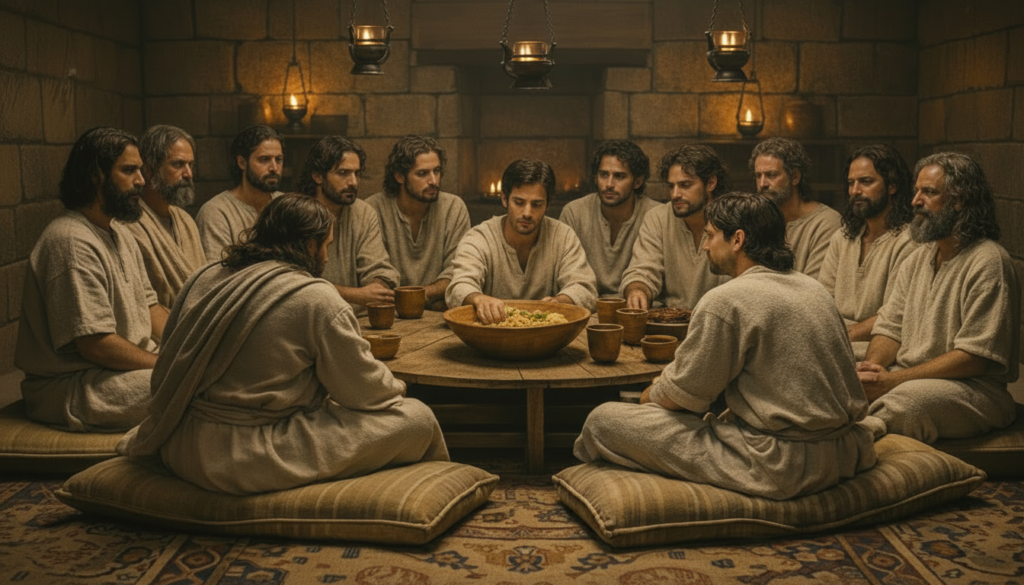

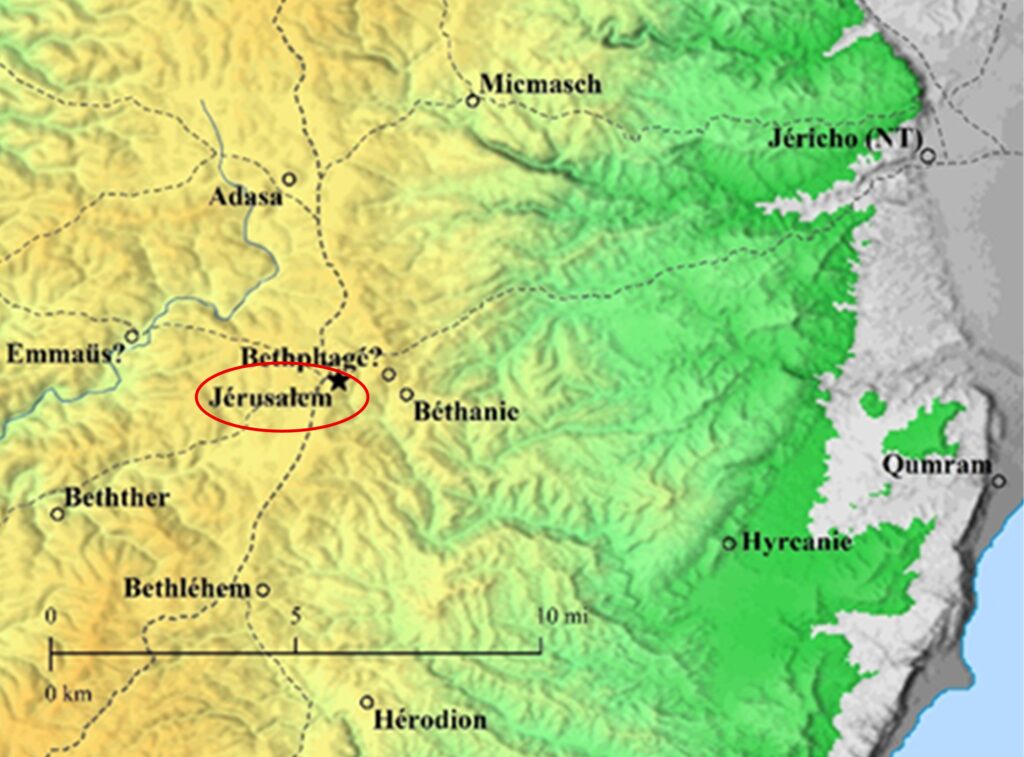

_3 The house is, in our view, that of Mary, the mother of John, surnamed Mark. Acts 12.12.
_4 The Passover meal begins on Thursday evening, after 6 p.m. It is already Friday for the Jews (Mark 14.17, Matthew 26.20, Luke 22.14-18). It is therefore not the official Seder, which will take place on Friday evening John 18.28.
You can consult the complete chronology in the study ANN026 : The hour of the crucifixion.
Commentary:
1- A terminological clarification: the “last meal” reconsidered
An important terminological nuance is called for: we cannot describe this meal as the “last” in the absolute sense of the word. After his resurrection, the Messiah Jesus again shared meals with his disciples. The evangelist John notably recounts the memorable scene on the shore of the Sea of Tiberias, where the risen Lord had prepared grilled fish and bread for the Seven (John 21.9-13). Luke also mentions that the Risen One ate in front of his disciples to attest to the bodily reality of his resurrection (Luke 24.41-43).
Nevertheless, this Thursday evening meal remains unique in its nature and its theological significance: it is the last Passover meal celebrated before the Passion, and above all the setting for the institution of the Lord’s Supper. This is why Christian tradition rightly calls it “the Supper” or “the Lord’s meal” (1 Corinthians 11.20).
2- The time frame: the evening of Thursday, 14 Nisan
It is the evening of Thursday, 31 March of the year AD 33, according to the chronology most commonly accepted by historians. In keeping with the Hebrew way of counting days, the new liturgical day begins at sunset, around six o’clock in the evening (Genesis 1.5; Leviticus 23.32). Thus, although it is still Thursday according to the civil calendar, we have already entered, according to the Jewish calendar, the 14th of Nisan, the day of the Passover.
This chronological detail is essential for understanding how the events of the Passion fit together and their typological significance: the Messiah Jesus celebrates the Passover at the very moment when he is about to become its definitive fulfillment.
3- The presence of the Twelve and the departure of Judas
The evangelist Luke states explicitly that the Twelve are present at the beginning of the meal: “When the hour had come, he reclined at table, and the apostles with him” (Luke 22.14). This symbolic number of the Twelve, representing the twelve tribes of Israel (Matthew 19.28; Revelation 21.12-14), underscores the ecclesial dimension of this gathering: the Messiah gathers around him the founding core of the renewed Israel.
However, Judas Iscariot will not remain until the end of the meal. After receiving the dipped morsel from the Master’s hands, Satan entered into him, and he immediately went out into the night to carry out his betrayal (John 13.26-30). John notes with poignant restraint: “And it was night” (John 13.30), signaling by this temporal remark the entry into the spiritual darkness that surrounds the act of betrayal (Luke 22.53).
4- A Passover meal according to the Synoptics
The three Synoptic Gospels are categorical and unanimous: this was indeed a Passover meal, celebrated according to the prescriptions of the (Matthew 26.17-19; Mark 14.12-16; Luke 22.7-13). Luke insists on this point in particular: “Then came the day of Unleavened Bread, on which the Passover lamb had to be sacrificed” (Luke 22.7).
The constituent elements of the Passover Seder come through in the account: the unleavened bread (the matzah), the ritual cups of wine, the words of interpretation spoken by the head of the household, and the atmosphere of commemoration of the exodus from Egypt (Exodus 12.14; Exodus 13.8-10). The Messiah Jesus thus performs the ancient gestures while giving them a radically new meaning.
5- The Johannine chronology: an apparent tension
Yet the evangelist John introduces an apparently discordant chronological detail. He states that Jesus’ accusers, at his trial before Pilate, “did not enter the praetorium, so that they would not be defiled and could eat the Passover” (John 18.28). This indication suggests that the official Seder had not yet taken place at the time of the judgment, on Friday morning.
John confirms this chronology by designating the day of the crucifixion as “the day of Preparation of the Passover” (John 19.14). Thus, from the Johannine perspective, the Messiah Jesus was crucified at the very moment when the Passover lambs were being sacrificed in the Temple, masterfully reinforcing the typology of the Lamb of God (John 1.29; John 1.36).
6- Harmonizing the calendar traditions
This apparent difference between John and the Synoptics is explained by the coexistence, in the Second Temple period, of several calendar traditions within Judaism. Historical research, notably that based on the manuscripts of , has revealed that the followed a solar calendar of 364 days, distinct from the official lunar calendar observed by the Temple authorities.
Furthermore, the Galileans and certain circles sometimes observed calendar traditions different from those of the Jerusalemite . Thus, the Messiah Jesus and his disciples, who came from Galilee, would have celebrated the Passover according to their regional custom, one day before the official Seder of the Temple. This hypothesis, defended by several contemporary exegetes, makes it possible to reconcile the Synoptic and Johannine data without postulating a contradiction.
7- Divine providence in the choice of the moment
This calendar explanation also reveals the depth of divine providence. The Messiah Jesus, fully aware of the “hour” set by the Father (John 13.1; John 17.1), chose to celebrate this anticipated Passover meal in order to share a moment of intimacy with his own before his Passion. He knew that the next day, at the precise hour when the lambs would be slaughtered in the courts of the Temple, he himself would be offered on the cross as an atoning sacrifice for the sins of the world.
This typological coincidence is no accident: it manifests the fulfillment of the figures of the old covenant. Christ is “our Passover” who “has been sacrificed” (1 Corinthians 5.7), the true Passover Lamb “without blemish or spot, foreknown before the foundation of the world” (1 Peter 1.19-20).
8- The institution of the Lord’s Supper: sign of the new covenant
This Thursday evening meal constitutes the solemn setting for the institution of the Lord’s Supper. The Messiah Jesus, taking the bread, gave thanks, broke it and gave it to his disciples, saying: “This is my body, given for you; do this in remembrance of me” (Luke 22.19; 1 Corinthians 11.24). Likewise, after supper, he took the cup, saying: “This cup is the new covenant in my blood, which is poured out for you” (Luke 22.20; 1 Corinthians 11.25).
The bread and the wine thus become the visible signs of a total gift: that of his life offered for the salvation of humanity. This institution fulfills Jeremiah’s prophetic promise of the new covenant written on hearts (Jeremiah 31.31-34; Hebrews 8.8-12) and Ezekiel’s promise of inner renewal by the Spirit (Ezekiel 36.26-27).
9- The solemn character of the farewell discourse
The exceptionally solemn character of this evening shows in the very tone of the Messiah Jesus’ discourse. He no longer addresses the crowd as a teaching rabbi, but speaks as an intimate friend and a caring shepherd who is about to leave his sheep for a time (John 10.11-18; John 15.13-15). The atmosphere of the meal is marked at once by prophetic gravity and pastoral tenderness.
The farewell discourses recorded by John (chapters 13 to 17) are among the most profound pages of New Testament revelation. There the Messiah announces his departure to the Father (John 14.1-3; John 16.28), promises the sending of the Paraclete, the Spirit of truth (John 14.16-17; John 16.7-15), and calls his disciples to abide in his love as the branches remain attached to the vine (John 15.1-11).
10- The exhortation to brotherly love
At the heart of these farewells, the Messiah Jesus leaves his disciples a new commandment: “Love one another; as I have loved you, so you also must love one another. By this all will know that you are my disciples, if you have love for one another” (John 13.34-35; John 15.12-17).
This commandment of brotherly love is the distinguishing mark of the messianic community. It is no longer only a matter of loving one’s neighbor as oneself (Leviticus 19.18), but of loving “as” the Messiah loved, that is, to the point of total self-giving (Ephesians 5.2; 1 John 3.16). The measure of this new love is the cross itself.
11- The prophetic awareness of the Messiah
The Messiah Jesus knows with perfect clarity that suffering is imminent, that the cross awaits him the very next day. But far from fleeing or showing anguish before others, he displays a sovereign peace that surpasses understanding (John 14.27; Philippians 4.7). This serenity stems from his perfect obedience to the Father’s will, expressed notably in the prayer at Gethsemane: “My Father, if it is possible, let this cup pass from me! Yet not as I will, but as you will” (Matthew 26.39; Mark 14.36; Luke 22.42).
The high priestly prayer of John 17 reveals the depth of this communion between the Son and the Father on the threshold of the Passion. The Messiah prays for his own glorification through the cross (John 17.1-5), for the protection and sanctification of his disciples (John 17.6-19), and for the unity of all believers to come (John 17.20-26).
12- The spiritual legacy handed on to the disciples
In this meal on the eve of his Passion, the Messiah Jesus passes on his spiritual legacy to his disciples. He entrusts to them the words of the Father (John 17.8; John 17.14), urges them to remain faithful amid the persecutions to come (John 15.18-21; John 16.1-4), and assures them that their present sorrow will be turned into joy at his return (John 16.20-24).
Thus, in the intimacy of the upper room, he seals the eternal communion between God and human beings, inaugurating the new covenant prophesied for centuries. The disciples, still troubled and not fully grasping the import of these words (John 16.17-18), will receive the illumination of the Holy Spirit after Pentecost (John 14.26; Acts 2.1-4).
13- Cross-reference to the appendix ANN027: The Passover meal
We present our detailed conclusions concerning this apparent chronological contradiction on the date of the Passover meal in appendix ANN027: The Last Passover Meal. It examines in greater depth the historical data (Second Temple calendars, Galilean practices, the testimonies of Flavius Josephus and of the Mishnah), the classical and contemporary exegetical positions, and the theological implications of each hypothesis.
Far from being a mere chronological curiosity, this question touches the heart of Christology: it determines the typological relationship between the Passover lamb and the sacrifice of the Messiah, and sheds light on the meaning of the institution of the Eucharist.
14- Conclusion: the meal that opens the way to redemption
Far from being a mere ritual observance or customary practice, this meal remains one of the most significant acts of the Messiah Jesus’ entire earthly ministry. It recapitulates the history of salvation since the Exodus, fulfills the prophetic figures of the old covenant, and inaugurates the new covenant founded on the redeeming love of the Savior.
By instituting the Lord’s Supper, the Messiah opens the way to the redemption accomplished on the cross and to the perpetual communion between God and his people. “For God so loved the world that he gave his only Son, so that everyone who believes in him may not perish but have eternal life” (John 3.16-17). This word, spoken earlier in Jesus’ ministry, finds in this Passover meal its most eloquent illustration and its nearest fulfillment.