
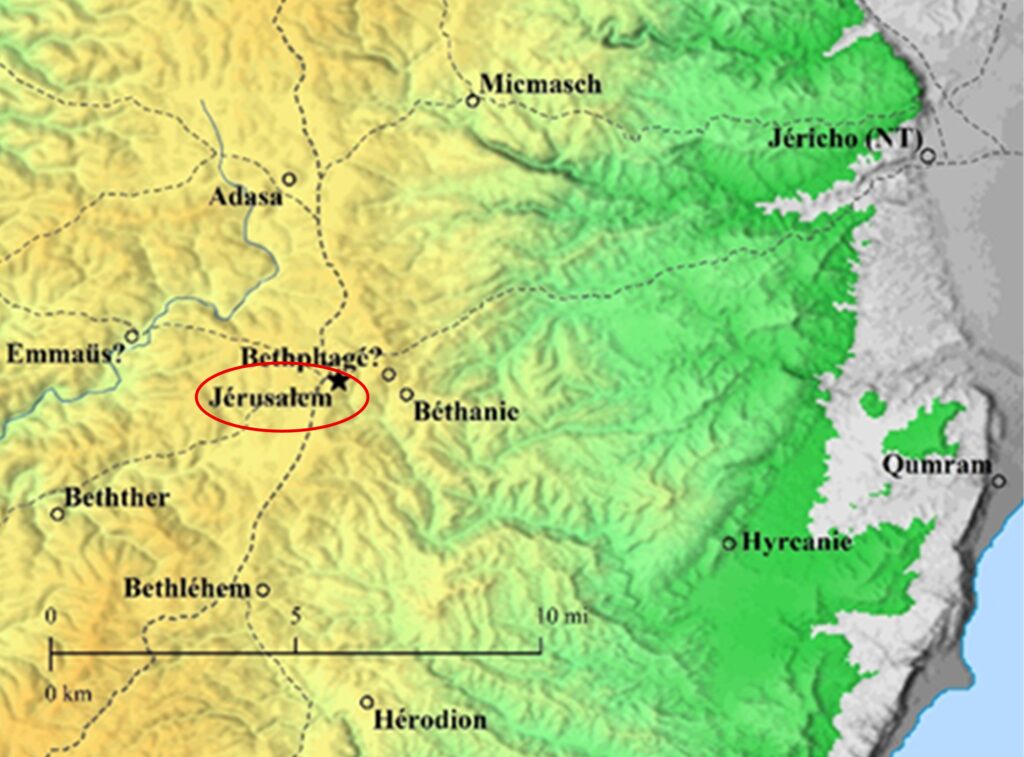

_3 The house is, in our view, that of Mary, the mother of John, surnamed Mark. Acts 12.12.
_4 The Passover meal begins on Thursday evening, after 6 p.m. It is already Friday for the Jews (Mark 14.17, Matthew 26.20, Luke 22.14-18). It is therefore not the official Seder, which will take place on Friday evening John 18.28.
You can consult the complete chronology in the study ANN026 : The hour of the crucifixion.
Commentary:
1- The institution of the Lord’s Supper: a moment of immense spiritual significance
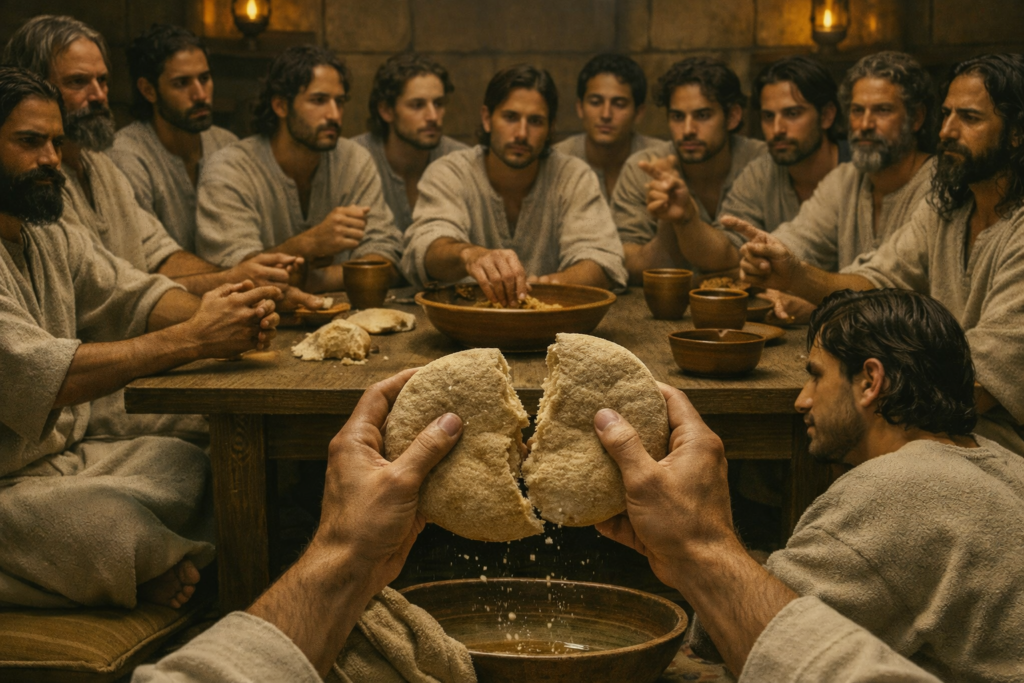
The institution of the Lord’s Supper during the Passover meal carries immense spiritual and theological significance. The Messiah Jesus, at the very moment he shares this last Passover meal with his disciples, gives a radically new meaning to ancient symbols deeply rooted in the memory of Israel. The unleavened bread (matza) and the cup of wine, familiar and ritually prescribed elements of the Passover meal (Exodus 12.8 ; Exodus 12.14-20), now become the visible and effective signs of his body given and his blood shed for the salvation of the world (Matthew 26.26-28 ; Mark 14.22-24 ; Luke 22.19-20).
This institutional act stands in continuity with the Hebrew Passover while fulfilling it once and for all. The Messiah no longer merely commemorates the exodus from Egypt; he inaugurates a new and definitive liberation, from sin and death (Romans 6.22-23 ; Hebrews 9.12).
2- The christological reinterpretation of the Passover lamb
The Messiah Jesus no longer interprets the Passover lamb as the mere memory of a historical deliverance in the past, but as the prophetic announcement and fulfillment of a definitive spiritual deliverance. Through his imminent death on the cross, he brings the forgiveness of sins and seals a new covenant between God and humanity, in keeping with the prophetic promise: “Behold, the days are coming, declares the , when I will make with the house of Israel and the house of Judah a new covenant” (Jeremiah 31.31-34 ; Hebrews 8.8-12).
This new covenant, unlike the old one engraved on tablets of stone, will be written on hearts by the Holy Spirit (Ezekiel 36.26-27 ; 2 Corinthians 3.3). It rests not on the blood of bulls and goats, which cannot truly take away sins (Hebrews 10.4), but on the precious blood of the Messiah, “a lamb without blemish or spot” (1 Peter 1.18-19). Thus the word of John the Baptist is fulfilled: “Behold, the Lamb of God, who takes away the sin of the world!” (John 1.29).
3- The explicit announcement of the Messiah’s death
This scene should have made things perfectly clear to the disciples. The Messiah Jesus speaks plainly, without any allegorical veil: “This is my body, which is given for you” (Luke 22.19); “This is my blood of the covenant, which is poured out for many for the forgiveness of sins” (Matthew 26.28). The vocabulary used — a body given, blood shed — explicitly points to a violent and sacrificial death.
The testamentary character of these words is evident: the Messiah disposes of his body and his blood as a man disposes of his possessions before his death. He institutes a perpetual memorial (Luke 22.19 ; 1 Corinthians 11.24-25) that presupposes his imminent physical absence. Everything in these gestures and words openly announces his approaching death.
4- The disciples’ persistent lack of understanding
Yet, despite the clarity of these words, the disciples remain in deep incomprehension. This passivity surprises the modern reader, particularly that of Simon Peter, a disciple of such impetuous temperament and so quick to react. He who had vigorously opposed the Master washing his feet — “You shall never wash my feet!” (John 13.8) —, he who would later draw the sword in the garden of Gethsemane (John 18.10), does not say a word when the Messiah announces his imminent death so explicitly.
This silence of the disciples bears witness to the depth of their spiritual blindness. Their hearts viscerally refuse the idea that the one they had recognized as the Messiah, the Son of the living God (Matthew 16.16), could suffer and die an ignominious death. This lack of understanding had been explicitly noted by Luke: “But they understood none of these things. This saying was hidden from them, and they did not grasp what was said” (Luke 18.31-34).
5- The unconscious rejection of the prospect of the cross
We believe that at no point during this meal did the disciples truly imagine a death occurring so quickly and so cruelly. Their messianic hope, nourished by popular expectations of a glorious and triumphant kingdom, formed a psychological screen that prevented them from taking in the prospect of the cross (Luke 24.21 ; Acts 1.6).
Had this reality been fully conscious to them, they would surely have tried to prevent their Master’s arrest. Peter would moreover give proof of it a few hours later by striking the high priest’s servant (John 18.10-11). But at this moment of the meal, the Messiah’s announcement remains for them an obscure word, a language they hear without understanding (Mark 9.32).
6- The troubling presence of Judas at the table
Luke gives a startling detail that heightens the dramatic tension of the scene: Judas Iscariot is still present at this sacred table at the moment the Supper is instituted. The Messiah Jesus declares explicitly: “But behold, the hand of him who betrays me is with me on the table” (Luke 22.21). This indication from Luke differs from the narrative order suggested by John, who seems to place Judas’s departure before the institution of the rite (John 13.30).
The question of the precise chronological order of events is the subject of exegetical discussion. Be that as it may, the presence of the betrayer at the meal of the new covenant underscores the unfathomable depth of divine grace: the Messiah offers the sign of his love even to the one who is about to betray him. Light and darkness sit side by side at the same table, illustrating that grace is offered to all, even to those who ultimately turn away from it (John 13.10-11 ; Matthew 5.45).
7- The post-Easter writing of the Gospel accounts
It should be noted that these Gospel texts were written after the crucifixion and resurrection of the Messiah. It is in the light of these saving events that the disciples understood, in retrospect, the significance of their Master’s words and gestures at this meal. The Holy Spirit, promised by the Messiah, reminded them of everything and explained it to them (John 14.26 ; John 16.13).
The death and resurrection of the Master were the hermeneutical trigger that illuminated their understanding. The Risen One himself had to open their minds to understand the Scriptures (Luke 24.45). Only in the light of the cross and the empty tomb do these gestures find their full meaning: the broken bread becomes the effective sign of the body offered in sacrifice, the cup that of the blood of the eternal covenant sealing the reconciliation between God and humanity (Romans 5.8-11 ; Hebrews 9.14-15).
8- Paul’s apostolic testimony: a direct revelation
The apostle Paul, although he was not physically present at this meal — not yet being a disciple of the Messiah at that time —, nevertheless passes on its account with remarkable authority:
This Pauline testimony may seem astonishing at first: how can the apostle describe this scene as if he had been a direct witness of it? The answer lies in his own words: “I received from the Lord what I also delivered to you” (1 Corinthians 11.23). Paul explicitly affirms that this tradition was communicated to him by direct revelation from the risen Lord, and not merely by human transmission (Galatians 1.11-12).
9- The nature of Paul’s revelation
This statement raises an important exegetical question: did Paul receive this knowledge solely through mystical revelation, or also through the apostolic tradition handed down by eyewitnesses? The two paths are not mutually exclusive. Paul certainly met the apostles in Jerusalem (Galatians 1.18-19 ; Galatians 2.1-2) and received from them the traditions concerning the Messiah Jesus.
However, the expression “from the Lord” (apo tou Kyriou) suggests that Paul regards this tradition as ultimately authorized by the Lord himself, whether through direct revelation in his mystical experiences (2 Corinthians 12.1-4) or through divine confirmation of the tradition received. Be that as it may, Paul speaks with a spiritual authority that goes beyond that of a mere reporter: he passes on a word of the Lord for the Church of all ages.
10- The eschatological dimension of the Lord’s Supper
Paul concludes his teaching with a statement of considerable eschatological weight: “For as often as you eat this bread and drink the cup, you proclaim the Lord’s death until he comes” (1 Corinthians 11.26). The Lord’s Supper is therefore not only a memorial turned toward the past; it is also a present proclamation and an expectation turned toward the future.
Each time the Church shares this bread and this cup, it performs three simultaneous spiritual acts: it commemorates the sacrificial death of the Messiah (the past dimension), it proclaims this death as the foundation of salvation (the present dimension), and it awaits the glorious return of the Lord (the future dimension). The Supper is thus the sacrament par excellence of the eschatological “in-between time,” between the first and the second coming of the Messiah (Titus 2.13 ; Revelation 22.20).
11- The Supper as anticipation of the messianic banquet
The Messiah Jesus himself had stressed this eschatological dimension at the institution: “I tell you, I will not drink again from this fruit of the vine until that day when I drink it new with you in my Father’s kingdom” (Matthew 26.29 ; Mark 14.25 ; Luke 22.18). This word opens up the perspective of the messianic banquet, that eschatological feast announced by the prophets where God will gather his people in perfect communion (Isaiah 25.6-8 ; Revelation 19.9).
The earthly Supper is thus a sacramental anticipation of this heavenly feast. It unites believers of all times in one communion with the crucified and risen Messiah, in expectation of his glorious appearing.
12- Conclusion: the sign of a perfect love and an eternal communion
Thus the Lord’s Supper instituted by the Messiah Jesus that evening transcends the mere ritual commemoration of a past event. It is a living and effective proclamation: it announces the redemptive death of the Savior, celebrates his definitive victory over death through the resurrection, and awaits with hope his glorious return to establish the Kingdom of God in its fullness (1 Corinthians 15.54-57).
By breaking the bread and sharing the cup on this Passover evening, the Messiah Jesus offers his own the tangible sign of a perfect love — that love which led him to lay down his life for those he loves (John 15.13) — and the pledge of an eternal communion with God the Father. “For God so loved the world, that he gave his only Son, that whoever believes in him should not perish but have eternal life” (John 3.16-17). In this sacred meal, divine love finds its highest expression and its most intimate communication to believers of all times.