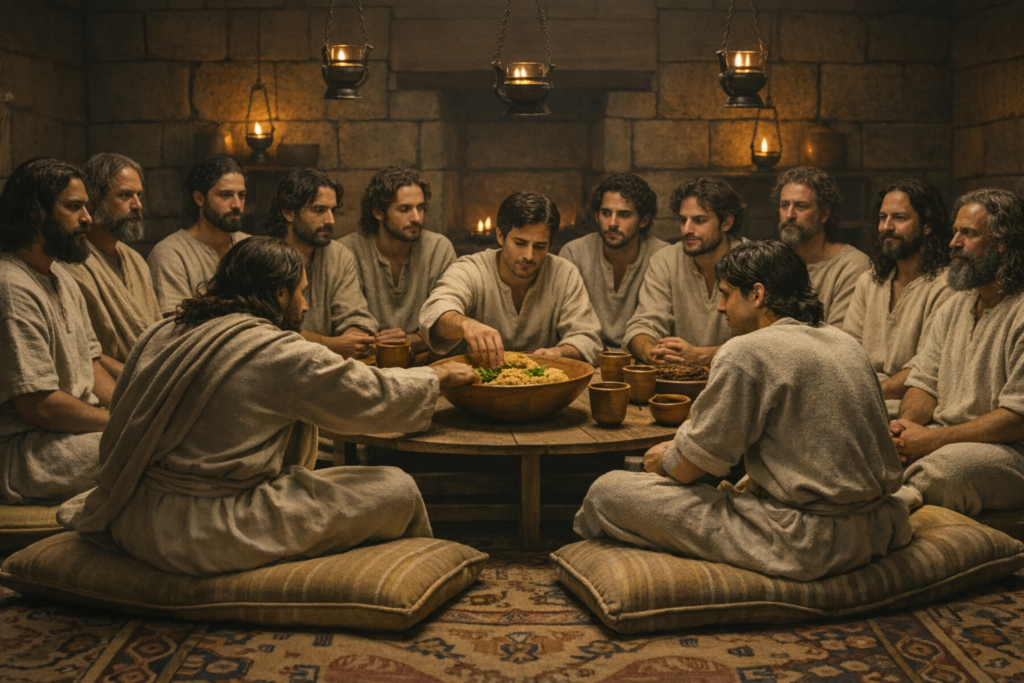

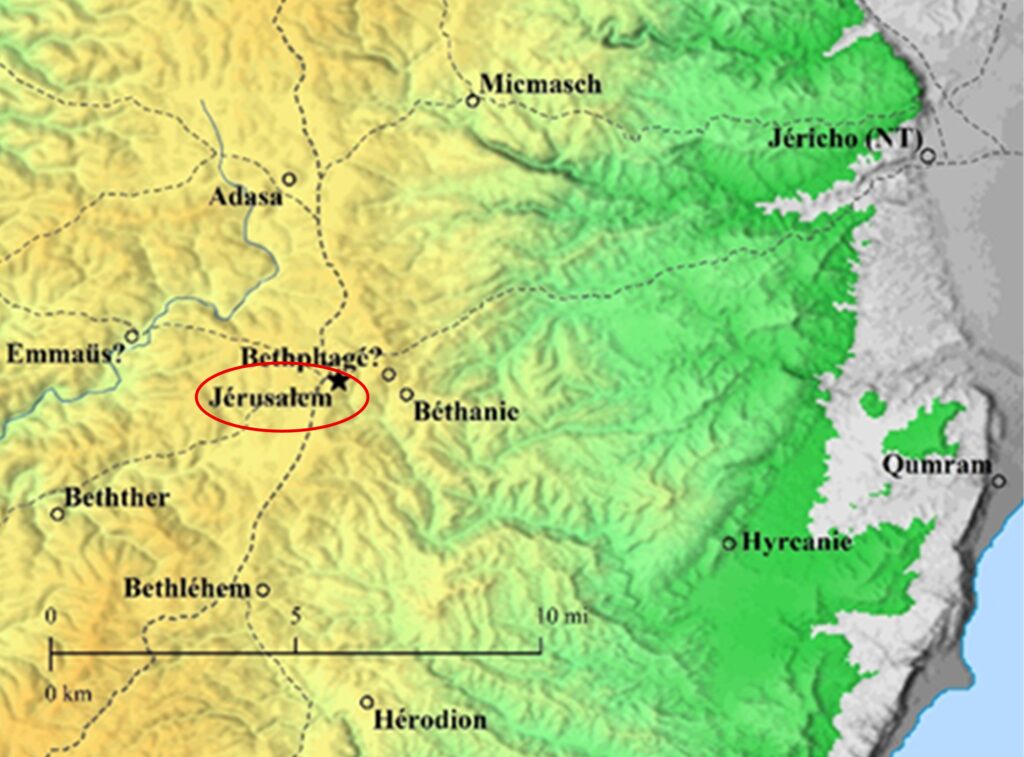

_3 The house is, in our view, that of Mary, the mother of John, surnamed Mark. Acts 12.12.
_4 The Passover meal begins on Thursday evening, after 6 p.m. It is already Friday for the Jews (Mark 14.17, Matthew 26.20, Luke 22.14-18). It is therefore not the official Seder, which will take place on Friday evening John 18.28.
You can consult the complete chronology in the study ANN026 : The hour of the crucifixion.
Commentary:
1- The solemn announcement of the betrayal
During the Passover meal, the Messiah Jesus speaks words of exceptional gravity, suddenly shattering the atmosphere of fellowship:
This prophetic declaration plunges the disciples into stupor and distress. Mark reports their immediate reaction: “They began to be sorrowful, and to say to him one by one, Is it I?” (Mark 14.18-19). This question, repeated by each of the Twelve, reveals both their sincere attachment to the Master and their inability to identify the traitor among them. Their baffled silence, in particular that of Simon Peter—yet so quick to speak up on other occasions (Matthew 16.16; Matthew 16.22)—shows that they do not yet grasp the dramatic import of this revelation.
2- The contrast between intimacy and betrayal
The evangelist Luke adds a detail that heightens the poignancy of the scene:
This statement—“the hand of him who betrays me is with me on the table”—underscores the striking contrast between the sacred intimacy of the Passover meal and the imminent betrayal. In ancient Eastern culture, sharing bread with someone established a bond of trust and mutual protection (Psalms 41.10). The betrayal of a table companion was therefore a particularly odious violation of hospitality and of fraternal covenant. The psalmist had prophetically foretold this wound: “Even the man with whom I was at peace, in whom I trusted, who ate my bread, has lifted his heel against me” (Psalms 41.10; John 13.18).
3- Judas leaves the table: entering the darkness
Unlike the other disciples, who remain in incomprehension, Judas Iscariot fully grasps the meaning of the Master’s words. The evangelist John describes the decisive moment with dramatic restraint: after receiving the dipped morsel from Jesus’ hands, “Satan entered into him,” and the Lord said to him: “What you are doing, do quickly” (John 13.26-27).
Troubled and exposed, Judas then leaves the table before the end of the meal to carry out what he had already conceived in his heart, corrupted by greed (John 12.4-6). John notes with a conciseness full of meaning: “Having received the morsel, he immediately went out. And it was night” (John 13.30). This time reference goes beyond a mere chronological remark: it signals Judas’s entry into spiritual darkness, as he walks away from the One who is the Light of the world (John 8.12; John 12.35-36).
4- The disciples’ lack of understanding and the providential design
Had Simon Peter understood at that moment the gravity of Judas’s act and the imminence of the arrest, his fiery and impetuous temperament would no doubt have driven him to intervene violently, as he would do a few hours later in the garden of Gethsemane by striking Malchus, the high priest’s servant (John 18.10-11; Matthew 26.51-54). But the Messiah Jesus, sovereign master of events, does not allow such a premature intervention: the hour of the betrayal had to run its course according to the divine plan determined from all eternity (Acts 2.23; Acts 4.27-28).
Despite the Messiah’s repeated warnings about his imminent passion (Matthew 16.21; Matthew 17.22-23; Matthew 20.17-19), the disciples remain unable to imagine a tragic outcome. Their hope for a visible and glorious messianic kingdom, in keeping with the popular expectations of the time, prevents them from accepting the prospect of the cross and the ignominious death of their Master (Luke 18.31-34; Luke 24.21).
5- The spiritual blindness of the Twelve
This lack of understanding on the part of the disciples is not due to a lack of intelligence, but to a temporary spiritual blindness, permitted by God in his unfathomable wisdom. Luke states explicitly: “But they understood none of these things; this saying was hidden from them, and they did not grasp what was said” (Luke 18.34). The disciples’ mental categories, shaped by the expectation of a political and triumphant Messiah, could not accommodate the idea of a suffering Messiah, servant of , delivered to death for the sins of the people (Isaiah 53.1-12).
Even the two disciples on the road to Emmaus, after the crucifixion, will confess their disillusionment: “We had hoped that he was the one who would redeem Israel” (Luke 24.21). This hope of an immediate national deliverance veiled from their eyes the necessity of the redemptive sacrifice.
6- Post-Passover understanding: illumination by the Spirit
It is only after the crucifixion and the resurrection that the disciples will fully grasp the meaning of these words spoken at the last meal. John honestly notes that, until then, “they did not yet understand the Scripture, that he must rise from the dead” (John 20.9). The resurrection on the third day was the hermeneutical trigger that opened their minds to the Scriptures (Luke 24.45).
The Risen One himself had to explain to them, beginning with Moses and all the prophets, what concerned him in all the Scriptures (Luke 24.27; Luke 24.44-47). They then understood that the death of the Messiah Jesus was not a tragic failure, but the necessary passage to the redemption of humanity, the fulfillment of the Father’s plan of love: “For God so loved the world that he gave his only Son, that whoever believes in him should not perish but have eternal life” (John 3.16-17).
7- The role of the Holy Spirit in the disciples’ illumination
The Messiah Jesus had moreover foretold this future illumination through the work of the Paraclete: “The Helper, the Holy Spirit, whom the Father will send in my name, will teach you all things and bring to your remembrance all that I have said to you” (John 14.26). It was only after Pentecost, when the Spirit descended on the disciples gathered in the upper room (Acts 2.1-4), that Peter was able to proclaim with confidence the mystery of the cross and the resurrection before the crowds of Jerusalem (Acts 2.22-36).
The disciples’ lack of understanding during the Passion is thus an integral part of the divine plan: it highlights the necessity of revelation by the Spirit and underscores that true faith does not come from human wisdom but from divine illumination (1 Corinthians 2.10-14; Matthew 16.17).
8- The gravity of the last meal: a moment of eschatological tension
Thus, the scene of the last meal in no way has the character of a joyful feast or a carefree celebration. It is a moment of intense eschatological tension, in which the traditional Passover joy is veiled under the weight of the prophetic announcement. The Messiah Jesus, fully aware of what awaits him (John 13.1; John 18.4), conducts this meal with sovereign mastery, while the plan of salvation is fulfilled in the troubled silence and incomprehension of his closest disciples.
This dramatic tension between the Messiah’s perfect awareness and his disciples’ blindness gives the account a remarkable theological depth. The Son of God walks toward the cross with open eyes, freely and out of love (John 10.17-18; Galatians 2.20), while those he loves do not yet perceive the glory that will spring from this apparent defeat.
9- Conclusion: the silence that bears the redemptive mystery
The last meal thus remains one of the dramatic summits of the Passion narratives. In the contrast between the Messiah’s clear announcement and the disciples’ persistent incomprehension, the mystery of redemption is revealed: what human wisdom could not conceive, God accomplished through the apparent foolishness of the cross (1 Corinthians 1.18-25).
The disciples’ silence, their inability to grasp the imminence of the drama, their anxious questioning—“Is it I, Lord?”—are all testimonies to their fragile humanity, but also to the divine pedagogy that was preparing their hearts to receive, after Easter, the full : “Christ in you, the hope of glory” (Colossians 1.26-27).