
PER031

The temptation of Jesus the Messiah

This article examines Jesus’ temptation in the wilderness, drawing on the Gospels of Matthew, Mark and Luke. Jesus faces three symbolic trials, highlighting his struggle against temptations similar to Eve’s. After this period of fasting, he returns to Galilee, marking a crucial stage in his ministry.

11 min Jesus temptation wilderness Gospels symbolism 16 verses 5 books

Resources

Biblical texts

Matthew
Matthew 4.1-11 (King James Version)

Then was Jesus led up of the Spirit into the wilderness to be tempted of the devil.

And when he had fasted forty days and forty nights, he was afterward an hungred.

And when the tempter came to him, he said, If thou be the Son of God, command that these stones be made bread.

But he answered and said, It is written, Man shall not live by bread alone, but by every word that proceedeth out of the mouth of God.

Then the devil taketh him up into the holy city, and setteth him on a pinnacle of the temple,

And saith unto him, If thou be the Son of God, cast thyself down: for it is written, He shall give his angels charge concerning thee: and in their hands they shall bear thee up, lest at any time thou dash thy foot against a stone.

Jesus said unto him, It is written again, Thou shalt not tempt the Lord thy God.

Again, the devil taketh him up into an exceeding high mountain, and sheweth him all the kingdoms of the world, and the glory of them;

And saith unto him, All these things will I give thee, if thou wilt fall down and worship me.

Then saith Jesus unto him, Get thee hence, Satan: for it is written, Thou shalt worship the Lord thy God, and him only shalt thou serve.

Then the devil leaveth him, and, behold, angels came and ministered unto him.

Mark
Mark 1.12-13 (King James Version)

And immediately the Spirit driveth him into the wilderness.

And he was there in the wilderness forty days, tempted of Satan; and was with the wild beasts; and the angels ministered unto him.

Luke
Luke 4.1-13 (King James Version)

And Jesus being full of the Holy Ghost returned from Jordan, and was led by the Spirit into the wilderness,

Being forty days tempted of the devil. And in those days he did eat nothing: and when they were ended, he afterward hungered.

And the devil said unto him, If thou be the Son of God, command this stone that it be made bread.

And Jesus answered him, saying, It is written, That man shall not live by bread alone, but by every word of God.

And the devil, taking him up into an high mountain, shewed unto him all the kingdoms of the world in a moment of time.

And the devil said unto him, All this power will I give thee, and the glory of them: for that is delivered unto me; and to whomsoever I will I give it.

If thou therefore wilt worship me, all shall be thine.

And Jesus answered and said unto him, Get thee behind me, Satan: for it is written, Thou shalt worship the Lord thy God, and him only shalt thou serve.

And he brought him to Jerusalem, and set him on a pinnacle of the temple, and said unto him, If thou be the Son of God, cast thyself down from hence:

For it is written, He shall give his angels charge over thee, to keep thee:

And in their hands they shall bear thee up, lest at any time thou dash thy foot against a stone.

And Jesus answering said unto him, It is said, Thou shalt not tempt the Lord thy God.

And when the devil had ended all the temptation, he departed from him for a season.

John
John (King James Version) not cited in the book

Technical details

Bar chart for the year 29

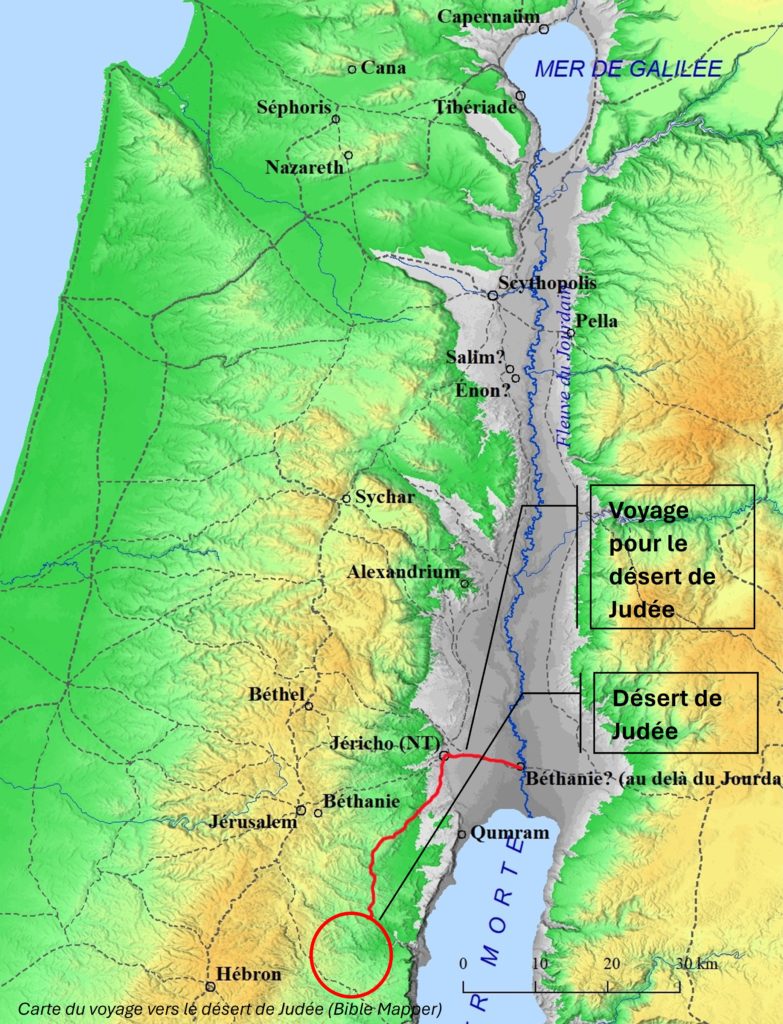
Location: The Judean wilderness near Jerusalem

Date: From 10 October to 19 November 29

Method: We continue with Mark

Note on the method: Mark’s chronology is more precise

Map of the journey from Bethany to the Judean wilderness

The forty-day period of temptation takes place about six days after the baptism.

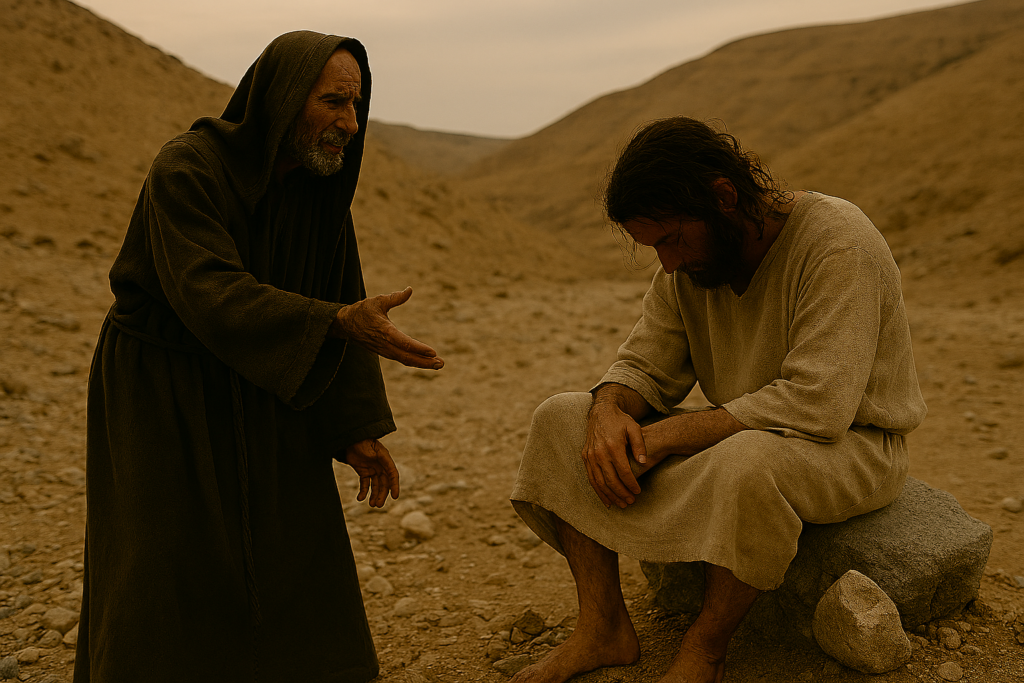
The temptation of Jesus the Messiah in the wilderness

The temptation of Jesus

Comments

The three evangelists give similar accounts of Jesus the Messiah’s period of temptation. According to Mark, it lasted forty days. Adding travel time and a day of recovery, during which angels serve Jesus, gives us a period from 7 October to 20 November 29.

All the authors emphasise Jesus’ abstinence from food during this period. This is plausible, since going without water for so long would be physically unbearable for a human being.

These forty days recall the Jewish people’s forty years of wandering in the wilderness. This does not mean, however, that the event is purely symbolic. Matthew explicitly mentions ‘forty nights’, affirming Jesus’ physical presence in the Judean wilderness and showing that symbolism does not exclude historical reality.

Few details are given about the dialogue between the Tempter and Jesus. Although Jesus’ physical presence is certain, the nature of the Devil’s appearance remains unknown. It is assumed that the Tempter influenced Jesus’ thoughts, prompting this dialogue.

The three temptations described are identical in the accounts, although Luke reverses the order of the last two. Matthew, addressing a Jewish audience, ends with worship of God alone, whereas Luke, addressing Gentiles, concludes with the provocation to suicide, which would have ended humanity’s salvation.

According to these deductions, Jesus was in Jerusalem for the festival of (Tabernacles) on 9 October 29 and began fasting the next day. John the Baptist and his disciples probably did not accompany him.

For financial reasons, not all Jews could make the three annual pilgrimages, often giving priority to Passover. Jesus seems to have made this journey alone, while John and his disciples celebrated the festival at Bethany beyond the Jordan.

After the festival, Jesus heads into the Judean wilderness near Jerusalem and enters a period of fasting and temptation. The comparison with Eve’s temptation in the Garden of Eden is striking, revealing three points in common:

The Devil appeals to the need for food (Genesis 3.1-3 and Matthew 4.3 or Luke 4.3).
The Devil offers personal gain (Genesis 3.4-5 and Matthew 4.6 or Luke 4.9).
The Devil offers power or glory (Genesis 3.5 and Matthew 4.8-9 or Luke 4.5-7).

This similarity reveals Satan’s hallmark (1 John 2.16): distorting God’s Word (Genesis 3.4 and Matthew 4.6 or Luke 4.9).

After forty-four days, Jesus goes to Galilee and meets a fifth disciple.