ANN064

The “next days” noted by John

The article examines the chronology of the events surrounding Jesus’ baptism in John’s Gospel, which differs from the Synoptic Gospels. It seeks to harmonize these accounts by offering a detailed analysis in order to better understand John’s perspective. A hypothetical date for the baptism is set at 4 October AD 29.

125 min baptism chronology Jesus John gospels 176 verses 17 books

Further information

Introduction

This study is one of the elements of our research devoted to establishing a chronology of the life of Jesus the Messiah on the basis of Daniel’s prophecy of the seventy weeks (Daniel 9.24-27). It should be understood in connection with the other studies in this series, each of which contributes complementary historical, calendrical and biblical data. Together, these works form a coherent analysis aimed at reconstructing, as precisely as possible, the sequence of events reported in the Gospels.

La liste complète des neuf études, accompagnée des différents liens, est proposée ci-dessous. Cette série est également disponible dans la catégorie « Chronologie », accessible depuis la page d’accueil.

The Gospel according to John presents a succession of events related to the beginning of Jesus’ public ministry, built around the testimony of John the Baptist and the calling of the first disciples. Unlike the Synoptic Gospels, the fourth Gospel does not directly describe Jesus’ baptism or the forty days of temptation in the wilderness. Its account nevertheless opens with a series of precise time indications, notably through the recurring expression “the next day” (John 1.29 ; John 1.35 ; John 1.43), which structures several consecutive days before the (John 2.1).

The exact meaning of these chronological markers has given rise to much discussion among biblical scholars. Some consider that the order of the events reported by John differs significantly from that of the Synoptics, particularly concerning the place of the temptation after the baptism (Matthew 4.1-11 ; Mark 1.12-13 ; Luke 4.1-13). This apparent divergence raises a fundamental question: how can the Johannine data be harmonized with those of Matthew, Mark and Luke in order to obtain a coherent reconstruction of the beginnings of Jesus’ ministry?

In this study, we will carry out a detailed analysis of all the texts concerned, carefully examining the temporal, geographical and narrative indications provided by the different authors. We will then propose a chronological reconstruction that makes it possible to integrate John’s information with that of the Synoptic Gospels.

The proposed chronology remains hypothetical and rests on our analyses as well as on the use of contemporary calendar converters. Within this framework, we place Jesus’ baptism on Thursday 4 October AD 29 and will propose a harmonization that includes both John’s chronological data and the period of temptation in the wilderness.

I. John’s four time markers

John introduces the beginning of the public ministry of Jesus the Messiah by means of several successive chronological indications.

John 1.29 (King James Version)

The next day John seeth Jesus coming unto him, and saith, Behold the Lamb of God, which taketh away the sin of the world.

John 1.35-36 (King James Version)

Again the next day after John stood, and two of his disciples;

And looking upon Jesus as he walked, he saith, Behold the Lamb of God!

John 1.43 (King James Version)

The day following Jesus would go forth into Galilee, and findeth Philip, and saith unto him, Follow me.

John 2.1 (King James Version)

And the third day there was a marriage in of Galilee; and the mother of Jesus was there:

These passages therefore provide four time indications that structure John’s account of the beginnings of Jesus’ ministry. While this succession of events was probably clear to John’s first readers, it raises several difficulties of interpretation today, especially when one tries to compare it with the accounts of the Synoptic Gospels.

In order to better understand the author’s thought, it is appropriate to examine carefully the order of the events he reports as well as the function of the time expressions he uses. When he wrote his Gospel, John most likely knew the traditions already reported by Matthew, Mark and probably Luke. The differences observed should therefore not be interpreted as contradictions, but rather as the result of a particular selection and arrangement of events according to John’s own theological and narrative purpose.

It is also important to stress that John describes neither the baptism of Jesus the Messiah nor the period of temptation in the wilderness. This absence opens the possibility that the events reported in John 1.19-51 and John 2.1 — notably the visit of the delegation sent to John the Baptist and the calling of the first disciples — took place after the forty days of temptation mentioned by the Synoptic Gospels (Matthew 4.1-11 ; Mark 1.12-13 ; Luke 4.1-13).

II. Chronology of the period from the baptism to the calling of the first disciples

1- The baptism and its manifestations

The Synoptic Gospels provide several indications that make it possible to reconstruct the general chronology of the events between Jesus’ baptism, the period of temptation in the wilderness and the calling of the first disciples. The Gospel according to John then completes this sequence with a series of time markers centered on the testimony of John the Baptist and the first encounters between Jesus and his disciples.

Luke 3.21-22 indicates that Jesus presented himself for baptism in a setting where many people were coming to receive John’s baptism. The text thus suggests a public scene, in the presence of several witnesses. Matthew specifies that Jesus came from Galilee to be baptized by John (Matthew 3.13) and stresses John the Baptist’s initial hesitation, aware of the spiritual superiority of the one he was receiving (Matthew 3.14). Mark reports that this baptism took place in the Jordan (Mark 1.9), probably at Bethany on the other side of the Jordan, according to the indications of John 1.28.

During the baptism, an extraordinary event took place. The three Synoptic Gospels report that a heavenly voice was heard after Jesus came up out of the water (Matthew 3.17 ; Mark 1.11 ; Luke 3.22). The differences in wording can naturally be explained as two complementary ways of reporting the same divine proclamation. Matthew preserves a wording addressed to the witnesses: “This is my beloved Son, with whom I am well pleased” (Matthew 3.17), whereas Mark and Luke convey a word addressed directly to Jesus: “You are my beloved Son; with you I am well pleased” (Mark 1.11 ; Luke 3.22). It remains possible that these words were heard by several people present on the spot.

2- The temptation in the wilderness

Immediately after this event the period of temptation in the wilderness begins. Mark specifies that “immediately” the Spirit drove Jesus out into the wilderness (Mark 1.12), while Matthew indicates that he was led there to be tempted by the devil (Matthew 4.1). Luke also reports this period of forty days (Luke 4.1-2). These indications lead us to place the temptation immediately after the baptism.

This period of forty days carries strong biblical significance. It recalls Israel’s forty years in the wilderness (Numbers 14.33-34), but also Moses’ forty days on the mountain (Exodus 34.28) and Elijah’s forty days of travel toward Horeb (1 Kings 19.8). Where Israel failed in the wilderness, the Messiah remains perfectly faithful to the word of God. His answers to the tempter all rest on Scripture, mainly on the book of Deuteronomy (Deuteronomy 8.3 ; Deuteronomy 6.16 ; Deuteronomy 6.13).

After leaving the Jordan region, Jesus presumably withdraws to a desert region of Judea, favorable to solitude and prayer. For forty days he fasts and undergoes the devil’s temptations (Matthew 4.2 ; Mark 1.13 ; Luke 4.2). The Gospels seem to indicate that the temptations reach their climax at the end of this period of fasting, when physical weakness becomes extreme. At the end of this ordeal, angels come to serve him (Matthew 4.11 ; Mark 1.13). It is likely that Jesus himself later recounted this episode to his disciples, since no other human witness could have been present in the wilderness.

3- The return and the visit of the delegation

After this period of withdrawal, Jesus returns to the region where John the Baptist carries out his ministry. It is in this context that the Gospel according to John places the arrival of the delegation sent by the religious authorities of Jerusalem (John 1.19-28). According to this chronological reconstruction, John the Baptist had therefore already baptized Jesus when this delegation came to question him. John’s declaration: “Among you stands one you do not know” (John 1.26) then takes on its full meaning: the Messiah was already present among the people, although he was not yet publicly recognized.

4- The sequence of encounters

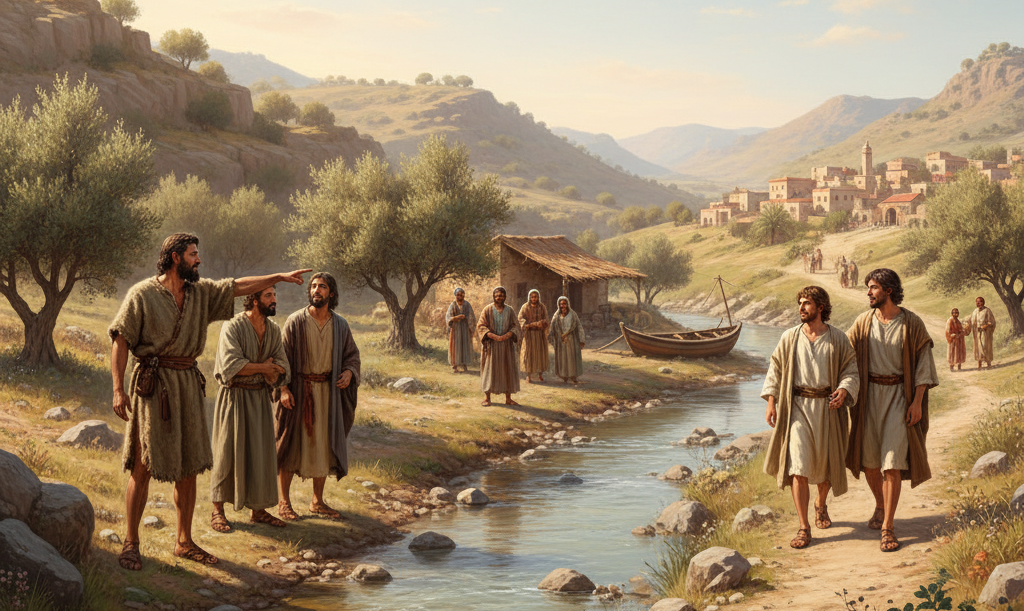
The day after this encounter with the delegation, John sees Jesus approaching and declares publicly: “Behold, the Lamb of God, who takes away the sin of the world” (John 1.29). He then testifies that he saw the Spirit descend on him at the baptism (John 1.32-34).

The next day again, John is with two of his disciples when he once more points to Jesus as “the Lamb of God” (John 1.35-36). Following this testimony, the two disciples begin to follow Jesus (John 1.37). One of them is explicitly identified as Andrew, the brother of Simon Peter (John 1.40). The other disciple is not named, but several biblical scholars consider that it could be the apostle John himself, in keeping with his habit in his Gospel of not naming himself directly.

Andrew then goes to find his brother Simon and tells him: “We have found the Messiah” (John 1.41). Simon is then brought to Jesus, who gives him the name Cephas, translated Peter (John 1.42).

The next day, Jesus decides to go to Galilee (John 1.43). He meets Philip and calls him directly: “Follow me” (John 1.43). Philip, who came from like Andrew and Peter (John 1.44), immediately joins the group of disciples.

Soon afterward, Philip meets Nathanael and tells him that he has found the one of whom Moses and the prophets spoke: Jesus of Nazareth (John 1.45). Nathanael at first expresses reservations about Nazareth (John 1.46), but finally agrees to meet Jesus. When Jesus reveals a supernatural knowledge about him, Nathanael recognizes in him the Son of God and the King of Israel (John 1.47-49).

This succession of events finally leads to the mentioned in John 2.1, which marks the public beginning of the signs performed by Jesus in Galilee.

III. Tableau récapitulatif des événements

OrderEventReferences
1Baptism of Jesus the Messiah in the Jordan, probably at Bethany on the other side of the Jordan(Matthew 3.13-17) ; (Mark 1.9-11) ; (Luke 3.21-22) ; (John 1.28)
2Heavenly declaration identifying Jesus as the beloved Son(Matthew 3.17) ; (Mark 1.11) ; (Luke 3.22)
3Immediate departure for the Judean wilderness(Matthew 4.1) ; (Mark 1.12) ; (Luke 4.1)
4Forty-day period of fasting and temptation(Matthew 4.2-10) ; (Mark 1.13) ; (Luke 4.2-13)
5The angels serve Jesus after the temptation(Matthew 4.11) ; (Mark 1.13)
6Jesus’ return to the region where John was baptizingHarmonization of the Synoptic and Johannine accounts
7Visit of the delegation sent from Jerusalem to John the Baptist(John 1.19-28)
8John announces that the Messiah is already present: “Among you stands one you do not know”(John 1.26)
9First “next day”: John points to Jesus as “the Lamb of God”(John 1.29-34)
10Second “next day”: two disciples of John begin to follow Jesus(John 1.35-39)
11Andrew brings Simon to Jesus; Simon receives the name Cephas (Peter)(John 1.40-42)
12Third “next day”: departure for Galilee and calling of Philip(John 1.43-44)
13Meeting between Jesus and Nathanael(John 1.45-49)
14“Three days later”: in Galilee(John 2.1-11)

IV. The date of Jesus’ baptism

1- The prophetic framework

Daniel’s prophecy of the seventy weeks (Daniel 9.24-27) makes it possible, according to our study, to locate with relative precision the last “week” of years mentioned by the prophet. This period of seven years seems to divide into two equal parts of three and a half years:

  • The first part would correspond to the ministry of a prophet preparing for the coming of the Messiah. The Gospels clearly identify this figure as John the Baptist (Isaiah 40.3 ; Malachi 3.1 ; Matthew 3.1-3).
  • The second part would concern the public ministry of the Messiah until his death and resurrection.

According to this reconstruction, the beginning of the Messiah’s ministry would take place in the middle of the seventieth week, around the month of Tishri of the Jewish year 3790. Jesus’ baptism would thus be the official starting point of his public ministry (Luke 3.21-23).

2- The Jewish feasts of the month of Tishri

Three major Jewish feasts follow one another precisely during this period:

Feast Hebrew date Julian equivalent
Rosh Hashanah (civil New Year) 3790 About 25 September AD 29
Yom Kippur (the Day of Atonement) 10 Tishri 3790 4 October AD 29
(Feast of Tabernacles) 15 Tishri 3790 9 October AD 29

The question therefore arises naturally: which feast best suits Jesus’ baptism?

3- The Yom Kippur hypothesis

The feast of carries strong symbolic significance. Together with Passover and Shavuot, it is one of the three great pilgrimage feasts of Judaism (Exodus 23.14-17 ; Deuteronomy 16.16). It celebrates in particular God’s presence in the midst of his people during the journey through the wilderness (Leviticus 23.42-43). This symbolism fits especially well with the incarnation of the Messiah (John 1.14).

However, several elements lead us rather to consider the feast of Yom Kippur.

Luke indeed specifies that Jesus was “about thirty years old” when he began his ministry (Luke 3.23). If the baptism had taken place exactly during , a few days later, Jesus would probably have reached precisely his thirtieth birthday. In that case, Luke’s use of the word “about” seems less natural. Conversely, a baptism at the time of Yom Kippur, a few days before his exact thirtieth birthday according to our chronology, would better fit Luke’s cautious wording.

The choice of Yom Kippur also presents strong theological coherence. This feast of the Day of Atonement centered on:

  • the atonement for sins;
  • the sacrifice;
  • the purification of the people;
  • and the intervention of the high priest (Leviticus 16.29-34).

Now Jesus’ baptism precisely inaugurates the ministry of the one whom John will later call “the Lamb of God who takes away the sin of the world” (John 1.29). This typological correspondence between the feast of atonement and the Messiah’s redemptive mission strengthens the plausibility of this dating.

We therefore propose that Jesus’ baptism most likely took place on 10 Tishri 3790, corresponding approximately to 4 October AD 29.

4- The absence of the disciples at the baptism

This hypothesis could also explain the apparent absence of the first disciples at the very moment of the baptism. During Yom Kippur, Jewish families observed this day with great solemnity. It is therefore possible that several disciples of John the Baptist were temporarily away to be with their relatives.

The Gospel according to John seems to confirm this situation indirectly. When John points to Jesus as “the Lamb of God” (John 1.35-37), his disciples appear to be gradually discovering the identity of the Messiah. Had they personally attended the baptism and the heavenly manifestation reported by the Synoptics (Matthew 3.16-17 ; Mark 1.10-11 ; Luke 3.21-22), John the Baptist’s repeated explanations would have been less necessary.

According to this chronological reconstruction, the disciples would have joined John the Baptist in the following days, probably after traveling from Galilee to the region where he carried out his ministry. We believe it was Bethany beyond the Jordan, mentioned in John 1.28.

V. Visit of the religious authorities sent from Jerusalem

We cannot date precisely the visit of the delegation sent from Jerusalem to John the Baptist (John 1.19-28). However, several elements lead us to place this event after Jesus’ baptism and after the period of temptation in the wilderness.

The Synoptic Gospels indeed indicate that immediately after his baptism, Jesus was led into the wilderness to be tempted by the devil (Matthew 4.1 ; Mark 1.12-13 ; Luke 4.1-13). This period is a fundamental stage at the beginning of his public ministry. There Jesus demonstrates his perfect obedience to God and his victory over evil. To each of the temptations he responds with the Scriptures, thus underlining the authority and power of the Word of God in the face of Satan’s attacks.

At the end of this ordeal, Jesus returns to the region where John the Baptist carries out his ministry. According to our chronological reconstruction, it is in this context that the visit of the delegation, mentioned only by the apostle John (John 1.19-28), takes place. Unlike Matthew 3.7-12, which simply mentions the presence of and coming to John, John’s account describes a genuine official inquiry conducted by religious representatives sent from Jerusalem.

It is therefore possible that the and mentioned by Matthew do not necessarily correspond to the official envoys described by John. Some may have been present on their own initiative, attracted by the growing importance of John the Baptist’s ministry, whereas the delegation mentioned in the fourth Gospel was rather an institutional undertaking of the religious authorities of Jerusalem.

The interview reported in John 1.19-28 is mainly centered on the identity and mission of John the Baptist. No detail is given concerning Jesus’ baptism or the temptation in the wilderness. This absence is naturally explained if these events had already taken place at the time of this meeting. John’s declaration: “Among you stands one you do not know” (John 1.26) then takes on its full meaning, since John already knew the identity of the Messiah following the baptism.

VI. The first “next day”

John 1.29 (King James Version)

The next day John seeth Jesus coming unto him, and saith, Behold the Lamb of God, which taketh away the sin of the world.

This chronological marker directly follows the testimony given by John the Baptist before the delegation sent from Jerusalem (John 1.19-28). At that time, John’s reputation kept growing throughout Judea. His activity on the banks of the Jordan attracted large crowds, so that the religious authorities decided to send priests and Levites to investigate his identity and his claims.

Their objective was probably to determine:

  • who John the Baptist really was;
  • whether he claimed prophetic authority;
  • whether he represented a religious or political threat;
  • and above all whether he could be the Messiah announced by the prophets.

John answered unambiguously: “I am not the Christ” (John 1.20). The interview takes place at Bethany, on the other side of the Jordan, where John was baptizing (John 1.28). Unlike the testimony he gives afterward about Jesus, John remains particularly cautious here. Facing these often hostile religious authorities, he essentially limits himself to defining his own mission as that of “the voice of one crying in the wilderness” (John 1.23 ; cf. Isaiah 40.3).

The proclamation of the Lamb of God

The day after this official visit, John sees Jesus, who is probably returning from the period of temptation in the Judean wilderness. He then declares publicly: “Behold, the Lamb of God, who takes away the sin of the world” (John 1.29).

This time, John’s language becomes much more explicit. He is no longer addressing an official delegation from Jerusalem, but the people present around him, probably his own disciples and the crowds that accompanied him. John now openly identifies Jesus as the one upon whom the Spirit descended at the baptism (John 1.32-34) and affirms that he is the Son of God (John 1.34).

This declaration marks a major turning point in John’s account. John the Baptist’s ministry reaches its goal: to prepare for the coming of the Messiah and to reveal him publicly to Israel (John 1.31).

The theological significance of the title “Lamb of God”

The expression “Lamb of God” carries considerable theological weight. It simultaneously evokes several Old Testament realities:

  • The Passover lamb (Exodus 12.1-13): at the exodus from Egypt, the blood of the lamb protected Israel’s firstborn from death. Paul will explicitly identify Christ as “our Passover” (1 Corinthians 5.7).
  • The sin offerings: in the Levitical system, the lamb was frequently offered as a sacrifice of atonement (Leviticus 4.32-35).
  • Isaiah’s Suffering Servant: “He was oppressed and afflicted, yet he did not open his mouth; like a lamb that is led to the slaughter” (Isaiah 53.7). This text prophetically announces the one who will bear the sins of many.

John the Baptist thus presents Jesus as the one who comes to bear and take away the sin of the world. This proclamation comes immediately after Jesus’ victory over the temptations in the wilderness, symbolically underlining his perfect faithfulness to God before the public beginning of his ministry.

VII. The meaning of the word “next day”

The Greek term used by John in these various passages corresponds to the word epaurion (Strong 1887), generally translated as “the next day” or “the following day”. This same term appears several times in John’s account (John 1.29 ; John 1.35 ; John 1.43) and seems to deliberately structure the progression of the events.

In the first case (John 1.29), the context naturally indicates that the “next day” follows the visit of the delegation sent from Jerusalem (John 1.19-28). Nothing in the text suggests that John artificially grouped together several episodes distant in time. On the contrary, the narrative sequence seems fluid and coherent.

John the Baptist’s renown probably explains the late intervention of the religious authorities. His ministry had a considerable impact throughout the region. Even and came to him to receive baptism (Matthew 3.7-12), although John denounces the lack of genuine repentance among several of them. This growing influence presumably led the to send an official delegation to assess the situation.

From this perspective, the word “next day” should probably be understood in its usual sense of “following day”, without it being necessary to see in it a mere literary transition meaning “after this”. John seems to want to present a precise succession of events related to the beginning of Jesus’ public ministry.

VIII. The second “next day”: the decisive encounter with the Lamb of God

John 1.35-36 (King James Version)

Again the next day after John stood, and two of his disciples;

And looking upon Jesus as he walked, he saith, Behold the Lamb of God!

1- The context of this day

John 1.35-36 (King James Version) :
Again the next day after John stood, and two of his disciples;And looking upon Jesus as he walked, he saith, Behold the Lamb of God!

This second “next day” follows the first public proclamation of Jesus as “the Lamb of God who takes away the sin of the world” (John 1.29). According to our chronological reconstruction, this event would take place on Sunday 18 November AD 29, although this dating remains hypothetical.

2- The link with the Synoptic Gospels

The Gospel according to John explicitly mentions neither Jesus’ baptism nor his temptation in the wilderness. By harmonizing his account with those of the Synoptics, it appears coherent to place this encounter after the forty-day period of temptation (Matthew 4.1-11 ; Mark 1.12-13 ; Luke 4.1-13).

According to our conclusions, the baptism would have taken place on Thursday 4 October AD 29, immediately followed by Jesus’ departure into the Judean wilderness, where he was tempted by the devil. On his return, he would have rejoined the region where John the Baptist carried out his ministry, before the official beginning of the calling of the disciples.

This harmonization suggests that the future disciples meet Jesus two days after his return from the wilderness. They were still at Bethany beyond the Jordan, and it now appears that they were probably not present at Jesus’ baptism.

3- The identity of the first two disciples

That day, two disciples of John the Baptist begin to follow Jesus (John 1.37). The text identifies one of them as Andrew, the brother of Simon Peter (John 1.40). The other remains anonymous, but an ancient tradition associates him with the apostle John himself, author of the fourth Gospel. This discretion would be characteristic of the way he refers to himself throughout his account as “the disciple whom Jesus loved” (John 13.23 ; John 19.26 ; John 21.7, John 21.20).

This meeting marks a decisive stage: these men gradually discover that Jesus of Nazareth is the Messiah announced by the prophets. It is through the words of John the Baptist that they learn of the remarkable events that occurred at the baptism — the descent of the Spirit and the heavenly voice attesting to the identity of the Son of God (John 1.32-34).

4- The question of the hour

John specifies that this meeting took place “about the tenth hour” (John 1.39). Two interpretations are possible:

Method of reckoning Corresponding time
Jewish (the day begins at sunrise) About 4 p.m.
(the day begins at midnight) About 10 a.m.

Since the apostle John seems to use the method of reckoning elsewhere — notably when he places Jesus’ trial “about the sixth hour” (John 19.14), that is, about 6 a.m. — the second hypothesis remains the most coherent. Andrew and John would thus have spent most of the day with Jesus.

5- Jesus’ place of residence

The text reveals a significant detail: Jesus had a place where he could stay temporarily. When the two disciples ask him, “Rabbi, where are you staying?”, he answers, “Come and see” (John 1.38-39). This detail indicates that he was not simply passing through Bethany, but that he planned to stay there for some time.

On his arrival, probably the previous Friday, Jesus would have looked for suitable shelter — no doubt a tent or a modest hut, according to the common practices of gatherings in this region of the Jordan. His training as a carpenter (Mark 6.3) would have been useful to him in this context. It is likely that everyone present contributed to the work needed to run this temporary community, hospitality and sharing being fundamental values of this gathering around John the Baptist.

6- Conclusion

This day, 18 November AD 29, marks the beginning of an adventure that will transform the world. Two disciples of John the Baptist, attentive to their master’s testimony, dare to follow the one he points to as the Lamb of God. By spending this day with Jesus, they gain the conviction that he is indeed the awaited Messiah — a conviction that Andrew will hasten to share with his brother Simon the very next day (John 1.41-42).

IX. The meeting with Simon

John 1.40-42 (King James Version)

One of the two which heard John speak, and followed him, was Andrew, Simon Peter’s brother.

He first findeth his own brother Simon, and saith unto him, We have found the Messias, which is, being interpreted, the Christ.

And he brought him to Jesus. And when Jesus beheld him, he said, Thou art Simon the son of Jona: thou shalt be called Cephas, which is by interpretation, A stone.

According to our analyses, on Sunday 18 November of the year AD 29, Andrew and John meet Simon, Andrew’s brother. It appears that these three men were disciples of John the Baptist and had probably been baptized by him.

Simon receives particular attention, because he will become an influential disciple within the group. John seems to summarize here a longer conversation and gives us only the conclusion. Jesus announces to Simon that he will henceforth be called Cephas.

The

VIII. The third “next day”

John 1.43 (King James Version)

The day following Jesus would go forth into Galilee, and findeth Philip, and saith unto him, Follow me.

On Monday 19 November, very early, Jesus decides to leave for Galilee. No detail is given by the authors of the Gospels about this return to Galilee. We think he goes back to Nazareth, which is close to .

1- The calling of Philip

As he leaves, Jesus meets Philip and calls him directly: “Follow me” (John 1.43). John specifies that he came from , like Andrew and Peter (John 1.44). These geographical ties probably explain the relationships already existing among several of the first disciples.

The simplicity of the call also underlines the particular authority Jesus exercised from the very beginning of his ministry. In this context, the phrase “follow me” can have two interpretations. The first, following physically on the road to Galilee, corresponds to reality. However, we think this call has a more spiritual dimension, inviting Philip to follow Jesus’ teachings and to regard him as a new Master.

2- The length of the journey

The journey to Nazareth generally takes five to six days. The distance between Bethany beyond the Jordan and Galilee required several days of walking through the Jordan valley or by way of Samaria.

3- The meeting with Nathanael

“Philip found Nathanael and said to him, ‘We have found the one about whom Moses wrote in the Law, and about whom the prophets also wrote: Jesus of Nazareth, the son of Joseph.’” (John 1.45)

Philip meets Nathanael alone and says, “we have found,” because he has already met Andrew, John and Simon Peter. This declaration shows that the first disciples already interpret the coming of Jesus in the light of the Old Testament Scriptures (Deuteronomy 18.15 ; Isaiah 9.5-6 ; Isaiah 11.1-10).

4- Nathanael’s initial skepticism

Nathanael nevertheless shows a certain reserve: “Can anything good come out of Nazareth?” (John 1.46). This reaction probably reflects the poor reputation of Nazareth at that time. The village was modest and rarely mentioned in ancient sources. Philip does not try to develop a long argument but simply replies: “Come and see” (John 1.46).

Personal testimony and direct encounter with Jesus thus become the main means of convincing Nathanael.

5- The revelation of Jesus

“Jesus saw Nathanael coming toward him and said of him, ‘Behold, an Israelite indeed, in whom there is no deceit!’ ‘How do you know me?’ Nathanael asked him. Jesus answered him, ‘Before Philip called you, when you were under the , I saw you.’ Nathanael answered, ‘Rabbi, you are the Son of God; you are the King of Israel.’” (John 1.47-49)

This word seems to reveal a supernatural knowledge of Nathanael and immediately provokes his confession of faith. The carries strong symbolic significance in Jewish tradition and may evoke:

  • the meditation on the Scriptures;
  • messianic peace;
  • or the expectation of the kingdom (Micah 4.4 ; Zechariah 3.10).

The reference to “an Israelite in whom there is no deceit” contrasts with Jacob, whose name means “the one who supplants” and who was characterized by deceit in his younger years (Genesis 27.35-36). Nathanael thus embodies the authentic Israelite, prepared to recognize the Messiah.

6- The identity of Nathanael

Apart from the various lists of apostles (Matthew 10.3 ; Mark 3.18 ; Luke 6.14), Nathanael is not mentioned under this name in the Synoptic Gospels. He is mentioned only in John’s Gospel, notably in this passage and in the one indicating that he came from (John 21.2). Several biblical scholars identify him with Bartholomew, mentioned in the apostolic lists immediately after Philip.

This encounter is an important stage in the gradual recognition of Jesus’ messianic identity by his first disciples.

IX. The third day: the wedding at Cana

John 2.1 (King James Version)

And the third day there was a marriage in of Galilee; and the mother of Jesus was there:

1- The calculation of the “third day”

We seek to determine the starting point of these three days in order to know the date of this wedding. We have established that Jesus begins his journey back to Galilee on 19 November AD 29. The expression “third day” seems to link the directly to the preceding events, even though the exact starting point of the calculation remains debated.

According to our estimate, the arrival in Galilee (probably at Nazareth) is expected on Wednesday 21 or Thursday 22 November of the year AD 29. Philip then finds Nathanael, probably on Friday 23 November. The meeting between Jesus and Nathanael takes place the same day.

Consequently, the “third day” mentioned in John 2.1, following this meeting with Nathanael and Philip, would be Sunday 25 November AD 29, the day on which the wedding at begins.

2- Possible family ties

In first-century Jewish society, weddings were a major community event. Several clues suggest a particular closeness between Jesus’ family and the organizers of the ceremony:

  • Mary intervenes directly when the wine runs out (John 2.3).
  • Jesus and his disciples are invited together (John 2.2).
  • Nathanael, who came from according to John 21.2, appears in the immediate context of the account.

On this basis, some authors have suggested that Nathanael might be closely linked to this union. Others propose that the bride might be one of Jesus’ sisters, which would explain the presence of his family. However, these hypotheses remain speculative: no biblical text affirms them explicitly.

The presence of Jesus’ entire family at this wedding suggests a deeper connection than a simple friendly invitation. It is plausible that Nathanael, or one of his relatives, was marrying a member of Jesus’ family. The most credible hypothesis, according to our analysis, is that Nathanael married a sister of Jesus, because traditionally weddings take place in the groom’s village, or in his father’s house — here , and not Nazareth (John 21.2).

3- The first sign

At this wedding, Jesus performs his first public sign by turning water into wine (John 2.7-9). John concludes:

“This, the first of his signs, Jesus did at in Galilee, and manifested his glory. And his disciples believed in him.” (John 2.11)

This first miracle publicly inaugurates the Messiah’s ministry in Galilee and gradually reveals his glory to his disciples. The choice of wine as the first sign carries rich symbolism, evoking messianic joy and the abundance of the coming kingdom (Isaiah 25.6 ; Amos 9.13-14).

The

X. Tableau récapitulatif des dates

OrderEventDateReference
1Baptism of Jesus the MessiahThursday 4 Oct. AD 29Matthew 3.13-17 Mark 1.9-11 Luke 3.21-23
2Departure for the Judean wildernessThursday 4 Oct. AD 29Matthew 3.13 Mark 1.9
3The period of temptationFrom Friday 5 October to Wednesday 14 November AD 29Matthew 4.1-11 Mark 1.12-13 Luke 4.1-13
4The angels serve Jesus the MessiahThursday 15 Nov. AD 29Matthew 4.11 Mark 1.13
5The returnFriday 16 Nov. AD 29John 1.35
6Visit of the delegationFriday 16 Nov. AD 29John 1.19-20
7The first next daySaturday 17 Nov. AD 29John 1.29
8The second next daySunday 18 Nov. AD 29John 1.35
9The discovery of Andrew and John (?)Sunday 18 Nov. AD 29John 1.40
10The meeting with Simon (Peter)Sunday 18 Nov. AD 29John 1.41
11Simon will be named CephasSunday 18 Nov. AD 29John 1.42
12The third next dayMonday 19 Nov. AD 29John 1.43
13Departure for GalileeMonday 19 Nov. AD 29John 1.43
14Meeting with PhilipMonday 19 Nov. AD 29John 1.43
15Arrival in Galilee (Nazareth?)Wednesday 21 Nov. AD 29 (or Thursday 22)
16Philip’s meeting with Nathanael (near Nazareth)Friday 23 Nov. AD 29John 1.45
17Meeting of Nathanael and Jesus (near Nazareth)Friday 23 Nov. AD 29John 1.47
18Three days later, Sunday 25 Nov. AD 29John 2.1

XI. Explanatory notes on the main events

1- The baptism of Jesus (Point 1)

(Matthew 3.13-17 ; Mark 1.9-11 ; Luke 3.21-23)

According to our chronological reconstruction, Jesus’ baptism would have taken place on Thursday 4 October AD 29. This event marks the official beginning of his public ministry.

The Synoptic Gospels report that Jesus comes to John the Baptist to be baptized in the Jordan. Matthew specifies that Jesus comes from Galilee (Matthew 3.13), Mark indicates that the baptism takes place in the Jordan (Mark 1.9), and Luke places this event in a context where the people were coming to receive John’s baptism (Luke 3.21).

This moment is confirmed by an exceptional divine manifestation: the heavens open, the Spirit descends on Jesus like a dove, and a heavenly voice declares him to be God’s beloved Son (Matthew 3.16-17 ; Mark 1.10-11 ; Luke 3.22).

2- The temptation in the wilderness (Points 2-4)

(Matthew 4.1-11 ; Mark 1.12-13 ; Luke 4.1-13)

Following his baptism, Jesus is immediately led by the Spirit into the wilderness. Mark uses a particularly strong wording, saying that the Spirit “drives” him at once into the wilderness (Mark 1.12).

This departure shows that the Messiah’s ministry begins with a testing. Before any public preaching, Jesus withdraws to an isolated place, far from the crowds and from human expectations. This stage recalls the great times of spiritual preparation in biblical history, notably those of Moses (Exodus 34.28) and Elijah (1 Kings 19.8).

At the end of the temptation, the devil leaves Jesus and angels come to serve him (Matthew 4.11 ; Mark 1.13). This intervention marks the end of the ordeal and confirms the Messiah’s victory over temptation. The angels’ service underlines that Jesus, although he truly experienced fatigue, hunger and human weakness, remains under God’s assistance and approval.

3- The first “next day” (Point 7)

(John 1.29-34)

The day after the visit of the delegation from Jerusalem, John the Baptist sees Jesus coming toward him and declares publicly: “Behold, the Lamb of God, who takes away the sin of the world” (John 1.29).

This declaration is one of the major theological affirmations at the beginning of John’s Gospel. John the Baptist now clearly identifies Jesus as the one who will accomplish the work of salvation.

John also testifies to having seen the Spirit descend on Jesus at the baptism: “I saw the Spirit descend from heaven like a dove, and it remained on him” (John 1.32). The Messiah’s baptism has therefore already taken place at the time of this declaration, which confirms that the events of John 1.29-34 must be placed after the Synoptic accounts of the baptism and the temptation.

4- The second “next day” (Point 8)

(John 1.35-39)

The next day again, John the Baptist is with two of his disciples when he once more points to Jesus: “Behold, the Lamb of God” (John 1.36).

Following this declaration, the two disciples begin to follow Jesus (John 1.37). One of them is explicitly identified as Andrew (John 1.40). The other is not named, but several biblical scholars consider that it could be the apostle John himself.

The account here underlines the fundamental role of John the Baptist: he prepares the way for the Messiah, publicly acknowledges his identity, then willingly directs his own disciples toward him. As John the Baptist will say later: “He must increase, but I must decrease” (John 3.30).

5- The wedding at Cana (Point 15)

(John 2.1-11)

John continues his account, noting:

John 2.1 (King James Version) :
And the third day there was a marriage in of Galilee; and the mother of Jesus was there:

At this wedding, Jesus performs his first public sign by turning water into wine (John 2.7-9). This inaugural miracle has a profound symbolic dimension. The water for Jewish purification — contained in six stone jars intended for purification rites (John 2.6) — is transformed into new and excellent wine.

This transformation evokes the passage from the old covenant to the new, from outward rite to inward joy, from the letter to the spirit. Wine, a symbol of joy and celebration in the biblical tradition, foretells the abundance of the messianic kingdom (Isaiah 25.6 ; Jeremiah 31.12 ; Amos 9.13-14).

John concludes:

John 2.11 (King James Version) :
This beginning of miracles did Jesus in of Galilee, and manifested forth his glory; and his disciples believed on him.

This first miracle publicly inaugurates the Messiah’s ministry in Galilee and gradually reveals his glory to his disciples.

Conclusion

We observe that the additional information provided by John can be integrated coherently with the data of the Synoptic Gospels after careful analysis. It should be stressed that the main purpose of the authors of these texts was not to provide an exhaustive biography. Consequently, it is imperative to put the various facts reported back into their chronological order, as in a puzzle, which can sometimes prove complex.

It appears clearly that John’s aim, after studying the Gospels of Matthew, Mark and Luke, was to complete their chronology, which he judged too simplified. The additional information he provides may seem to contradict that of the Synoptics if it is not examined carefully.

The chronological hypothesis we propose follows directly from the texts. We are compelled, particularly for the period of temptation, to estimate travel times that seem credible to us.

Of course, this chronology that we propose remains a hypothesis. We lack evidence to support all these proposals, and we know the adage: “what can be asserted without evidence can be dismissed without evidence.”

However, our aim is not to assert that the events took place exactly as we propose, but simply to demonstrate that a harmony between the Synoptic accounts and John’s account remains plausible.

We nevertheless have the feeling of drawing closer to the truth by respecting all the information we possess.

After a thorough analysis, we noted a remarkable coherence among the four Gospels. This observation is not surprising, since these authors documented their testimonies rigorously.