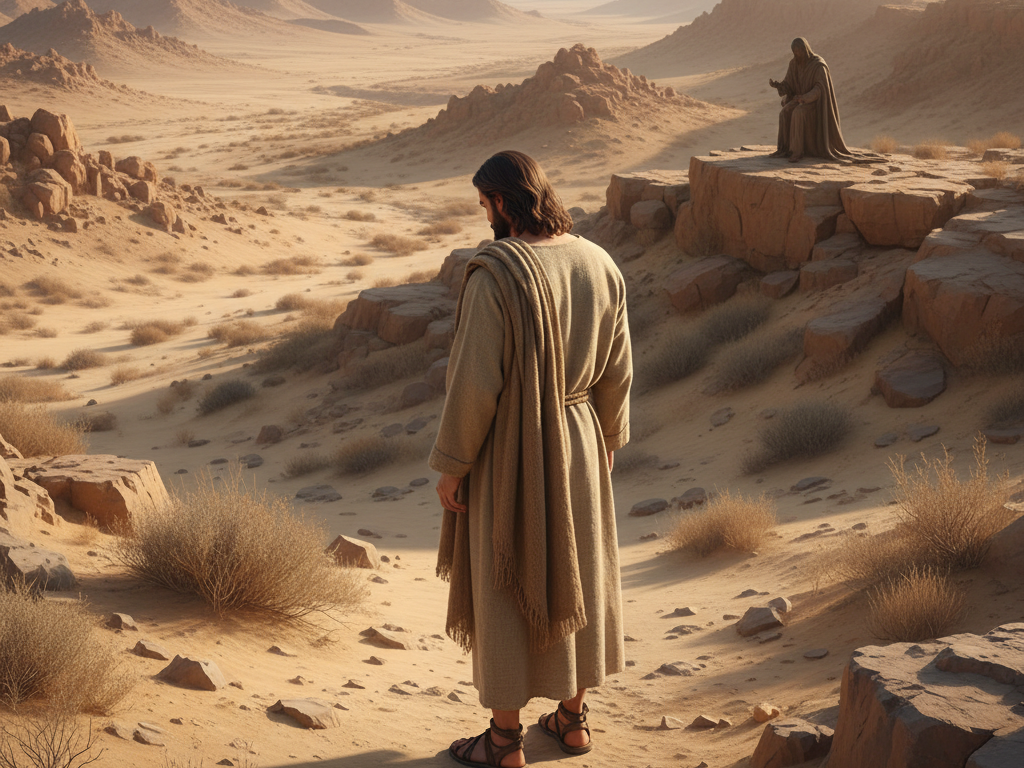
This article explores the temptation of Jesus, his 40-day fast and the Gospel accounts of this period in Judea. The Synoptic Gospels give a harmonized version of these events, while John offers additional details, raising questions of chronology that are addressed in this analysis.
27 min
JesustemptationSynoptic GospelsJohn the BaptistJudean wilderness
16 verses
5 books
The analysis of the Synoptic Gospels makes it possible to trace the sequence of events precisely. After his baptism, Jesus the Messiah goes straight into the Judean wilderness.
He then begins a 40-day fast, during which the Devil tempts him. Afterwards he returns to Galilee, where he begins his ministry.
John’s text seems to contradict this description. It reveals to us a period in the life of Jesus the Messiah that neither Matthew, nor Mark, nor Luke thought it worthwhile to mention. These details oblige us to rethink the chronology of the Synoptic Gospels.
Indeed, John indicates that Jesus the Messiah and John the Baptist worked together in Judea.
Our aim now is to put back into chronological order the events cited by John concerning the beginning of the ministry of Jesus the Messiah, and to harmonize them with the Synoptic accounts.
The information provided by our four authors is based on the testimony of Jesus the Messiah and his apostles. It is therefore relevant to examine why the authors of the Synoptic Gospels do not mention the period when Jesus worked in Judea with John the Baptist.
The apostle John, in keeping with his usual method, provides information about this period in Judea, which raises certain chronological challenges. This situation sometimes leads commentators to speak of apparent contradictions. However, as we will show in this study, these contradictions are in reality only illusions and can be resolved by a thorough analysis of the texts.
I. The information from the Synoptic Gospels
The three Synoptic Gospels relate the baptism of Jesus the Messiah by John the Baptist, then they describe a period of fasting and temptation by the Devil in the Judean wilderness, lasting 40 days and 40 nights. At the end of this ordeal they record the arrest of John the Baptist, which leads Jesus the Messiah to depart for Galilee.
His ministry seems to begin in the region of Capernaum; he calls his disciples to follow him on the shores of the near that town.
Matthew 4.1-11 (King James Version)
Then was Jesus led up of the Spirit into the wilderness to be tempted of the devil.
And when he had fasted forty days and forty nights, he was afterward an hungred.
And when the tempter came to him, he said, If thou be the Son of God, command that these stones be made bread.
But he answered and said, It is written, Man shall not live by bread alone, but by every word that proceedeth out of the mouth of God.
Then the devil taketh him up into the holy city, and setteth him on a pinnacle of the temple,
And saith unto him, If thou be the Son of God, cast thyself down: for it is written, He shall give his angels charge concerning thee: and in their hands they shall bear thee up, lest at any time thou dash thy foot against a stone.
Jesus said unto him, It is written again, Thou shalt not tempt the Lord thy God.
Again, the devil taketh him up into an exceeding high mountain, and sheweth him all the kingdoms of the world, and the glory of them;
And saith unto him, All these things will I give thee, if thou wilt fall down and worship me.
Then saith Jesus unto him, Get thee hence, Satan: for it is written, Thou shalt worship the Lord thy God, and him only shalt thou serve.
Then the devil leaveth him, and, behold, angels came and ministered unto him.
King James Version (1769), domaine public — texte : eBible.org
Mark 1.12-13 (King James Version)
And immediately the Spirit driveth him into the wilderness.
And he was there in the wilderness forty days, tempted of Satan; and was with the wild beasts; and the angels ministered unto him.
King James Version (1769), domaine public — texte : eBible.org
Luke 4.1-13 (King James Version)
And Jesus being full of the Holy Ghost returned from Jordan, and was led by the Spirit into the wilderness,
Being forty days tempted of the devil. And in those days he did eat nothing: and when they were ended, he afterward hungered.
And the devil said unto him, If thou be the Son of God, command this stone that it be made bread.
And Jesus answered him, saying, It is written, That man shall not live by bread alone, but by every word of God.
And the devil, taking him up into an high mountain, shewed unto him all the kingdoms of the world in a moment of time.
And the devil said unto him, All this power will I give thee, and the glory of them: for that is delivered unto me; and to whomsoever I will I give it.
If thou therefore wilt worship me, all shall be thine.
And Jesus answered and said unto him, Get thee behind me, Satan: for it is written, Thou shalt worship the Lord thy God, and him only shalt thou serve.
And he brought him to Jerusalem, and set him on a pinnacle of the temple, and said unto him, If thou be the Son of God, cast thyself down from hence:
For it is written, He shall give his angels charge over thee, to keep thee:
And in their hands they shall bear thee up, lest at any time thou dash thy foot against a stone.
And Jesus answering said unto him, It is said, Thou shalt not tempt the Lord thy God.
And when the devil had ended all the temptation, he departed from him for a season.
King James Version (1769), domaine public — texte : eBible.org
The information in the three Synoptic Gospels concerning this period is in harmony.
–Matthew
In the Gospel according to Matthew, the account first mentions the baptism of Jesus, then moves straight on to that of the temptation. Matthew then places the beginning of Jesus’ ministry in Galilee, immediately after the arrest of John the Baptist. It is on this occasion that the first disciples are called, while they are working as fishermen on the shores of the Sea of Tiberias.
Matthew 4.12-13 (King James Version)
Now when Jesus had heard that John was cast into prison, he departed into Galilee;
And leaving Nazareth, he came and dwelt in Capernaum, which is upon the sea coast, in the borders of Zabulon and Nephthalim:
King James Version (1769), domaine public — texte : eBible.org
–Mark
He includes exactly the same elements as Matthew, thus making a faithful reproduction.
Mark 1.14-15 (King James Version)
Now after that John was put in prison, Jesus came into Galilee, preaching the gospel of the kingdom of God,
And saying, The time is fulfilled, and the kingdom of God is at hand: repent ye, and believe the gospel.
King James Version (1769), domaine public — texte : eBible.org
–Luke
Luke makes some changes to the narrative order of Matthew and Mark. He first closes his account concerning John the Baptist with the episode of his arrest, before returning to the baptism of Jesus, the Messiah. He then includes the genealogy of the Master, followed by the temptation in the wilderness, and concludes this sequence with the beginning of Jesus’ ministry in Galilee.
Luke specifies that the temptation lasted forty days and that it was during this period that Jesus fasted. This statement leads us to rule out the hypothesis of journeys during these forty days of fasting.
The Synoptic Gospels follow a similar chronology and do not detail the Master’s first meeting with his disciples in Judea, nor the beginning of his activity in that region.
The Gospels of Matthew, Mark and Luke present the events as follows: the baptism, the forty-day temptation, the arrest of John the Baptist, the departure for Galilee and the beginning of his ministry in the region of Capernaum.
It is important to note that this succession of events results from an interpretation of the texts, since they provide no temporal markers. The book of John provides additional information that seems to call into question the harmony of these interpretations.
II. The additional details from John
John gives us other details, which took place after the baptism of Jesus the Messiah.
John 1.35-39 (King James Version)
Again the next day after John stood, and two of his disciples;
And looking upon Jesus as he walked, he saith, Behold the Lamb of God!
And the two disciples heard him speak, and they followed Jesus.
Then Jesus turned, and saw them following, and saith unto them, What seek ye? They said unto him, Rabbi, (which is to say, being interpreted, Master,) where dwellest thou?
He saith unto them, Come and see. They came and saw where he dwelt, and abode with him that day: for it was about the tenth hour.
King James Version (1769), domaine public — texte : eBible.org
We have studied precisely this period described by John in the appendix ANN064: The ‘next days’ noted by John. We will therefore not repeat the whole analysis here, but only the conclusions we reached.
Unlike the other evangelists, John makes no mention of the period of temptation of Jesus the Messiah. It is therefore necessary to put this event back into its chronology. We have thus placed this period of temptation before the elements detailed by John in his account.
John 1.40-51 (King James Version)
One of the two which heard John speak, and followed him, was Andrew, Simon Peter’s brother.
He first findeth his own brother Simon, and saith unto him, We have found the Messias, which is, being interpreted, the Christ.
And he brought him to Jesus. And when Jesus beheld him, he said, Thou art Simon the son of Jona: thou shalt be called Cephas, which is by interpretation, A stone.
The day following Jesus would go forth into Galilee, and findeth Philip, and saith unto him, Follow me.
Now Philip was of Bethsaida, the city of Andrew and Peter.
Philip findeth Nathanael, and saith unto him, We have found him, of whom Moses in the law, and the prophets, did write, Jesus of Nazareth, the son of Joseph.
And Nathanael said unto him, Can there any good thing come out of Nazareth? Philip saith unto him, Come and see.
Jesus saw Nathanael coming to him, and saith of him, Behold an Israelite indeed, in whom is no guile!
Nathanael saith unto him, Whence knowest thou me? Jesus answered and said unto him, Before that Philip called thee, when thou wast under the fig tree, I saw thee.
Nathanael answered and saith unto him, Rabbi, thou art the Son of God; thou art the King of Israel.
Jesus answered and said unto him, Because I said unto thee, I saw thee under the fig tree, believest thou? thou shalt see greater things than these.
And he saith unto him, Verily, verily, I say unto you, Hereafter ye shall see heaven open, and the angels of God ascending and descending upon the Son of man.
King James Version (1769), domaine public — texte : eBible.org
The following table presents a summary of our conclusions. The proposed dates remain hypothetical; they result from our analyses as well as from data provided by various date converters available online.
Order
Event
Date
Reference
1
Baptism of Jesus the Messiah
Thursday 4 Oct. AD 29
Matthew 3.13-17
Mark 1.9-11
Luke 3.21-23
2
Departure for the Judean wilderness
Thursday 4 Oct. AD 29
Matthew 3.13
Mark 1.9
3
The period of temptation
From Friday 5 October to Wednesday 14 November AD 29
Matthew 4.1-11
Mark 1.12-13
Luke 4.1-13
4
The angels serve Jesus the Messiah
Thursday 15 Nov. AD 29
Matthew 4.11
Mark 1.13
5
The return
Friday 16 Nov. AD 29
John 1.35
6
Visit of the delegation
Friday 16 Nov. AD 29
John 1.19-20
7
The first next day
Saturday 17 Nov. AD 29
John 1.29
8
The second next day
Sunday 18 Nov. AD 29
John 1.35
9
The discovery of Andrew and John (?)
Sunday 18 Nov. AD 29
John 1.40
10
The meeting with Simon (Peter)
Sunday 18 Nov. AD 29
John 1.41
11
Simon will be named Cephas
Sunday 18 Nov. AD 29
John 1.42
12
The third next day
Monday 19 Nov. AD 29
John 1.43
13
Departure for Galilee
Monday 19 Nov. AD 29
John 1.43
14
Meeting with Philip
Monday 19 Nov. AD 29
John 1.43
15
Arrival in Galilee (Nazareth?)
Wednesday 21 Nov. AD 29 (or Thursday 22)
16
Philip’s meeting with Nathanael (near Nazareth)
Friday 23 Nov. AD 29
John 1.45
17
Meeting of Nathanael and Jesus (near Nazareth)
Friday 23 Nov. AD 29
John 1.47
18
Three days later,
Sunday 25 Nov. AD 29
John 2.1
III. The concordance of the events
In his Gospel, the apostle John does not mention the baptism of Jesus. This may be explained by the fact that he knew the writings of the other evangelists and preferred to provide clarifications and additional information rather than repeat the same facts. He deals only with the testimony of John the Baptist and mentions Jesus in that context, because the two figures are linked.
On the day of his thirtieth birthday, Jesus the Messiah is alone in the wilderness! We thus notice the precision of the detail in Luke 3.23: “Jesus was about thirty years old when he began his ministry”. We have established that the baptism marked the beginning of his ministry. Consequently, he was thirty years old eight days after this event.
In order to grasp the chronology indicated, we invite you to consult the details of our demonstrations in the three following appendices.
By placing the baptism of Jesus the Messiah and his temptation before the calling of his first four disciples in Judea, we scrupulously respect the details of the Gospels of Matthew, Mark and Luke. Thus the four accounts harmonize in a coherent and natural way.
Concerning the question of the calling of the disciples, which involves Judea according to John and Galilee according to the Synoptics, we present a detailed explanation of the course of events in the appendix.
To explain the absence of detail concerning the ministry of Jesus the Messiah in Judea just after his baptism and temptation, we may suppose that Matthew, Mark and Luke judged that these events would not add any relevant further information to their accounts. They may have considered that including these details would have taken up too much space in their writings. (See the appendix: ANN046 The technical requirements of publishing in the 1st century).
IV. The temptation in the wilderness
We have presented the chronology of the events described in the four Gospels. We will now turn to the temptation in the Judean wilderness.
The accounts of the temptation of Jesus appear in Matthew 4.1-11, Mark 1.12-13 and Luke 4.1-13. Although these accounts do not contradict one another, they differ in their details, which may reflect the specific theological and literary aims of each evangelist. Here is a summary of the differences and similarities:
Similarities:
The Spirit leads Jesus into the wilderness: All three Gospels state that Jesus is led by the Spirit into the wilderness after his baptism in order to be tempted there.
The duration: The 40 days of fasting are mentioned in Matthew and Luke, whereas Mark merely mentions that Jesus is in the wilderness for a certain time.
Satan tempts Jesus: All report that Jesus is tempted by Satan.
La tentation: Luc précise bien que le Diable a commencé à tenter le Messie Jésus à la fin du jeûne.
Matthieu et Luc notent trois tentations :
1- The stones turned into bread
The transformation of stones into bread is a temptation for Jesus because it exploits a situation of human vulnerability and seeks to divert him from his divine mission. Here is why this proposal from Satan is significant:
Exploiting an immediate physical need: Jesus has fasted for 40 days and is hungry. The temptation targets a basic human need, that of eating. But by yielding, Jesus would have used his divine power to meet a personal desire, which was not in keeping with his mission of depending entirely on God.
Testing his divine identity: Satan begins by saying: “If you are the Son of God…” (Matthew 4.3). This casts doubt on the identity of Jesus and seeks to provoke him into proving that he really is the Son of God by performing a miracle. Yielding to this temptation would have meant obeying Satan rather than God, and using his power to satisfy a provocation.
Putting the physical before the spiritual: The temptation implies that material needs (such as food) are more important than spiritual needs. Jesus, by his answer, shows that man lives first of all by the Word of God and that spiritual dependence is paramount, even in the face of physical deprivation.
Refuser une solution facile : En transformant les pierres en pain, Jésus aurait choisi un chemin de facilité pour surmonter sa faim. Mais cela aurait contredit sa mission, qui est d’accepter pleinement la condition humaine et de se soumettre à la volonté de Dieu, sans chercher de solutions extraordinaires pour éviter la difficulté.
In sum, this temptation aims to turn Jesus away from his trust in God and to induce him to use his powers for personal reasons, which he firmly refuses.
We must consider that the Father willed this temptation; under these conditions, by changing these stones into bread the Son would have placed himself in contradiction with his Father, who wanted him to be hungry.
The : The to this temptation is extraordinarily significant. When he declares: “Man shall not live on bread alone, but on every word that comes from the mouth of God” (Matthew 4.4), he affirms several fundamental truths:
An unshakable faith in God: Jesus shows that even in a situation of extreme physical need (his hunger after 40 days of fasting), his trust in God takes precedence over his personal desires. He affirms that faithfulness to God goes beyond immediate needs.
The importance of the divine Word: By quoting Deuteronomy 8.3, Jesus teaches that man is nourished not only physically, but above all spiritually. The Word of God is the ultimate source of life, far beyond material necessities.
A response to the subtlety of the temptation: Satan’s proposal seems reasonable; after all, Jesus is hungry and has the power to change the stones into bread. However, by his answer, Jesus shows that he refuses to use his divine power for his own benefit or to yield to a suggestion coming from Satan, even when it seems legitimate.
A reminder for humanity: This statement is not only a defense against Satan, but also a teaching for us. It invites us not to seek only material satisfactions, but to nourish our spirit with the Word and with our relationship with God.
The answer of Jesus is therefore a model of trust, faithfulness and spiritual discernment.
Jesus the Messiah quotes the word, Deuteronomy 8.3, “man shall not live on bread alone, but on the word of God”. It is therefore better to obey God than to satisfy our human desires.
2- Throwing himself down from the pinnacle of the temple
Satan quotes Psalms 91.11-12, which promises divine protection to those who are faithful. The idea was to push Jesus to test God’s faithfulness by deliberately putting his life in danger. This would have implied a lack of trust in God’s plan, turning faith into a kind of divine manipulation.
If Jesus had thrown himself down from the temple and been miraculously saved by angels, it would have been an impressive public demonstration of his divine power. However, it would have turned his spiritual mission into a sensational act, aimed at winning disciples through spectacle rather than through sincere faith and love.
As Messiah, Jesus could have felt the pressure to prove his identity in a dazzling and immediate way. This temptation targeted his humanity by trying to push him toward pride or selfishness, two traps incompatible with his mission of humility and service.
The : At the temptation to throw himself down from the pinnacle of the temple, Jesus answers Satan by saying: “You shall not put the Lord your God to the test” (Matthew 4.7). This answer is a direct quotation from Deuteronomy 6.16, where Moses urges the Israelites not to put God to the test, as they did at Massah.
This answer of Jesus brings out several essential points:
Trust in God: Jesus refuses to put God to the test by demanding a spectacular demonstration of his protection. He shows that true faith rests on trust and obedience, not on tests or visible proofs.
The rejection of spiritual manipulation: By refusing this temptation, Jesus shows that one must not manipulate one’s relationship with God to obtain benefits or to force a divine intervention.
A response to the erroneous interpretation of the Scriptures: Satan uses the Scriptures (Psalms 91.11-12) to urge Jesus to act. But Jesus restores the balance by quoting a passage that emphasizes humility and respect for God, showing that the Scriptures must never be used to justify behavior contrary to the divine will.
This answer brings out the integrity of Jesus the Messiah and his commitment to carry out the divine mission faithfully and humbly.
By refusing this temptation, Jesus the Messiah shows that he places his total trust in God without seeking to put him to the test. He also reminds us that his power and authority will never be used to impress or to satisfy human expectations, but to accomplish the will of his Father.
3- Worshiping Satan
Satan offers Jesus the Messiah “all the kingdoms of the world and their glory” (Matthew 4.8-9) in exchange for his worship. This proposal represents an easy path to power and authority, avoiding suffering, rejection and the cross. But it would have compromised the divine mission of Jesus, which consisted in establishing the kingdom of God through faithfulness, love and sacrifice, and not through corrupt means.
By worshiping Satan, Jesus would have rejected his total obedience to God the Father. This would have symbolized a reversal of the divine order, placing Satan above God and betraying the trust and the mission that Jesus carried as Messiah.
The temptation to receive “all the kingdoms” plays on the human desire for power and glory. For Jesus, who is fully God but also fully man, it was an attempt to draw him toward pride, contrary to his humble mission as a servant.
The response of Jesus the Messiah
The in the face of this temptation is both powerful and instructive. By declaring:
Matthew 4.10 (King James Version) :
Then saith Jesus unto him, Get thee hence, Satan: for it is written, Thou shalt worship the Lord thy God, and him only shalt thou serve.
King James Version (1769), domaine public — texte : eBible.org
he quotes Deuteronomy 6.13, reaffirming his total commitment to God and rejecting every form of spiritual compromise.
This brings out several important things:
The priority of worshiping God: Jesus recalls that God alone deserves absolute worship and faithfulness. This principle is at the heart of the Christian faith.
Mastery of the Word of God: Jesus uses the Scriptures to answer Satan. This shows the importance of a thorough knowledge of the Scriptures in order to resist temptation.
The refusal of easy solutions: Jesus rejects the prospect of acquiring earthly power by means contrary to the will of God, illustrating his faithfulness to his divine mission, even at the cost of great suffering.
This answer is therefore a model of submission to God and of resistance in the face of seductive but destructive compromises.
By refusing this temptation, Jesus the Messiah clearly affirms that God alone deserves worship and faithfulness:
Matthew 4.10 (King James Version) :
Then saith Jesus unto him, Get thee hence, Satan: for it is written, Thou shalt worship the Lord thy God, and him only shalt thou serve.
King James Version (1769), domaine public — texte : eBible.org
This refusal shows that Jesus the Messiah is determined to accomplish the divine mission in God’s ways, even if it means the difficult path of the cross.
Main differences:
1- Ordre des tentations :
In Matthew, the order is: (1) turning the stones into bread, (2) throwing himself down from the pinnacle of the temple, (3) worshiping Satan to receive the kingdoms of the world.
In Luke, the order of the last two temptations is reversed: (1) stones into bread, (2) kingdoms of the world, (3) pinnacle of the temple.
This difference may reflect a theological intention. For example, Matthew seems to emphasize the kingship of Jesus (the kingdoms at the end), whereas Luke focuses on Jerusalem and its spiritual importance.
2-Marc est très succinct :
Mark does not describe the three specific temptations. He merely says that Jesus the Messiah is tempted by Satan, surrounded by wild animals and served by angels.
3-Détails supplémentaires dans Matthieu et Luc :
Matthew and Luke develop the dialogues between Jesus the Messiah and Satan, with references to the Scriptures, which Mark omits.
We have no specific details concerning the material aspects of how this temptation unfolded. For example, when the Devil carries Jesus to the top of the temple, does this happen in the mind of the Messiah, or did he carry him physically to that place?
We favor the hypothesis of a spiritual temptation. Furthermore, was the Devil physically present in some form, or simply in spirit? Here again, we think that everything took place through the thoughts of Jesus the Messiah.
We also believe that, if Jesus the Messiah had succumbed to any of these temptations, the Devil would have orchestrated the event so that it took place publicly, before a crowd of witnesses.
Conclusion
The main difficulty lies in integrating the baptism and the period of temptation of Jesus the Messiah into the chronology presented by the apostle John. It was decided to place these events before the arrival of the delegation of the . According to this approach, the events described by John take place after the temptation, which appears to be the most suitable option.
Our hypothesis is consistent with the data currently available. We have made extrapolations from certain statements in order to come as close as possible to historical truth.
It is therefore possible to reconcile the Synoptic Gospels with that of John. We have no uncertainty about this, since Matthew and John reported precise memories. Mark worked under the direction of the apostle Peter, while Luke carried out thorough research.
The truth presents no contradiction when all the details are examined precisely and objectively.
A title, a person, a place, a reference (“Luke 15”)…
opens in a new window
Bible reference
INF146
Information note
INF146 - The response of Jesus the Messiah
The response of Jesus the Messiah
Context
Witnesses of his miracles accuse him of collaborating with the devil. Jesus the Messiah, knowing their thoughts, answers with a series of logical and spiritual arguments.
Analysis of the passage
The logical argument (Luke 11.17-19)
A kingdom divided against itself cannot stand. If Satan casts out his own demons, his kingdom is doomed to fail. Jesus the Messiah turns the accusation around: if he acts by Beelzebul, then what should be said of the exorcisms performed by the Jewish disciples?
The spiritual revelation (Luke 11.20)
Jesus the Messiah declares that he casts out demons by the finger of God, an expression that evokes direct divine power (cf. Exodus 8.23). This means that the Kingdom of God is already here, present in their midst.
The parable of the strong man (Luke 11.21-22)
Satan is compared to a strong man who guards his possessions. Jesus the Messiah is the stronger one who comes to overcome him, freeing those who were under his grip. It is an image of Christ’s victory over the powers of evil.
The call to commitment (Luke 11.23)
There is no neutrality: one is either with Jesus or against him. Whoever does not take part in his work of gathering contributes to scattering.
The danger of spiritual emptiness (Luke 11.24-26)
A person freed from an unclean spirit who does not fill his life with God remains vulnerable. The return of the demons in greater numbers shows that deliverance must be followed by an inner transformation.
Main teaching
This text is a declaration of the sovereignty of Jesus the Messiah over the forces of evil, an invitation to recognize the presence of the Kingdom, and a warning against spiritual indifference.
INF087
Information note
INF087 - Lake Gennesaret
Lake Gennesaret
Lake Gennesaret, also known as the Sea of Galilee, Lake Tiberias or Lake Kinneret, is an important body of water in Israel, mentioned several times in the Gospels. Here are some key points about it:
Location and geography
Location: Lake Gennesaret is situated in northern Israel, in Galilee, near the Golan Heights. It lies approximately 200 metres below sea level, making it one of the lowest freshwater lakes in the world. Dimensions: The lake is about 21 kilometres long and 13 kilometres wide, with an area of 166 km². Its maximum depth is approximately 43 metres.
Names and meanings
Sea of Galilee: This name is frequently used in the New Testament. Lake Tiberias:Named after the city of Tiberias, on its western shore. Lake Kinneret: Derived from the Hebrew ‘Kinneret’ (meaning ‘harp’), because the lake's shape resembles an ancient harp.
Biblical importance
Jesus' ministry: Lake Gennesaret is a central location in the ministry of Jesus the Messiah. Many of Jesus' miracles and teachings took place around this lake, including walking on water (Matthew 14.22-33), calming the storm (Mark 4.35-41) and the miraculous catch of fish (Luke 5.1-11). Calling of the disciples: Jesus the Messiah's first disciples, such as Peter, Andrew, James and John, were fishermen working on this lake. Miracles and teachings: The lake is the setting for many of Jesus' miracles and teachings, illustrating his power over nature and his relationship with his disciples.
Historical and cultural importance
Local economy: Lake Gennesaret has always been an important source of livelihood for local fishermen and farmers. Tourism and pilgrimage: Today, the lake is a tourist destination and a place of pilgrimage for Christians from around the world, drawn by the biblical sites and the region's natural beauty.
Ecology and environment
Biodiversity: The lake supports a variety of aquatic life and migratory birds, making the region a rich and varied ecosystem. Environmental challenges: Like many bodies of water, Lake Gennesaret faces environmental challenges, including water management and pollution.
Israel has established a project to replenish Lake Gennesaret (also called the Sea of Galilee or Lake Tiberias) with desalinated water. This project aims to maintain the lake's water level, which has been affected by years of drought, irregular rainfall and water diversions.
The desalinated water comes from the Mediterranean Sea and is transported to the lake through a dedicated pipeline. This is a unique initiative to ensure a sustainable source of water for the region.
In summary, Lake Gennesaret is a place of great geographical, historical, cultural and biblical importance, playing a central role in many Gospel accounts and remaining an important site for pilgrims and tourists.
INF122
Information note
INF122 - The wedding at Cana
The wedding at Cana
Why does the Messiah Jesus make a round trip between Bethany and Nazareth shortly after returning to Bethany to be with John the Baptist (John 1.43)?
The available information suggests that he knew of an imminent wedding in his family and intended to attend it. This could explain his sudden departure from Bethany. It seems that he knew the date of this event before leaving Nazareth to be baptized by John the Baptist (Matthew 3.13).
In conclusion, the next day Jesus decided to go to Galilee in order to attend the wedding at Cana.
Weddings at that time were considered important community events that included many guests. However, it seems financially difficult to invite all the surrounding villages.
It is mainly for this reason that we assume that Mary and her children were invited to this wedding. Moreover, she plays a particular role at this event, since it is to her that the shortage of wine is first reported (John 2.3).
All these elements lead us to conclude that the family of the Messiah Jesus is directly involved in this marriage.
Why should we consider Nathanael to be the bridegroom?
John 21.2 indicates that Nathanael is from Cana. He is present at the wedding, perhaps as a disciple of Jesus, but probably as the husband of a half-sister of Jesus. This hypothesis would explain Jesus’ presence at Cana and the importance given to the conversion of Nathanael.
INF002
Information note
INF002 - The Pharisees
The Pharisees
The Pharisees were an important religious and social group in ancient Judaism, particularly during the Second Temple period. Here are some key points about them:
Origins and history
Origins: The Pharisees emerged as a distinct group after the Maccabean revolt, around 165-160 BC. They were often regarded as the spiritual descendants of the Hasideans.
Period: They flourished until the destruction of the Second Temple in AD 70. After that date, their teachings formed the basis of what became rabbinic Judaism.
Beliefs and practices
Sacred Texts: Unlike the Sadducees, who focused solely on the written law (the Pentateuch), the Pharisees believed in both a written law and an oral law (the oral Torah). Resurrection: The Pharisees believed in the resurrection of the dead and in the immortality of the soul. Rites and Laws: They stressed the importance of oral traditions and of interpretations adapted to contemporary circumstances.
Influence and Legacy Influence: The Pharisees had a great influence on Jewish liturgy and religious practice. Their teachings were incorporated into the Mishnah, a compilation of the Jewish oral tradition, around AD 200. Legacy: After the destruction of the Second Temple, the teachings of the Pharisees formed the basis of rabbinic Judaism, which continues to influence modern Judaism.
The Pharisees are often mentioned in the New Testament, notably in the Gospels and the Acts of the Apostles, where they are frequently in conflict with Jesus and the other religious figures of the time.
The Pharisees in the Bible
They are the most representative group of Judaism. Its members, drawn from the people, oppose compromise with the Roman invader, but also with Hellenism. We see them as closer to the population than the Sadducees.
They are mentioned one hundred and three times in the New Testament, ninety-three times in the Gospels, nine times in the Acts of the Apostles and once in the Epistle to the Philippians.
Their relations with the Messiah Jesus frequently appear tense and conflictual. He rebukes them at times in violent terms, such as “woe to you” and “hypocrites”, which clearly shows this opposition. They do not have access to positions of high responsibility, controlled by the Romans and therefore reserved for Sadducees sympathetic to Rome, but they form the largest group in the Sanhedrin.
They regard themselves as the great defenders of the law of Moses, on which they comment. Their interpretation becomes the rule for the people to follow. The Messiah Jesus condemns these excesses on various occasions (Matthew 23.13-29).
They often disagree with their colleagues, the Sadducees, on points of doctrine such as eternal life or angels. To the written Law of Moses they added oral principles, which allow them to get around its prescriptions. Jesus does not fail to point this out (Matthew 23.23).
Nicodemus and Joseph of Arimathea belonged to this political and religious group, which did not prevent them from converting to Christianity.