ANN047

Origins of the 12 apostles

Appendix ANN047 studies the origin of the twelve apostles on the basis of the four canonical lists (Matthew, Mark, Luke, Acts). It analyzes the points of agreement and difference between these lists and the family ties attested among disciples, and carefully distinguishes the biblical data from church traditions. The article sheds light on the human, family and geographical background of the apostolic group in Galilee in the 1st century.

20 min apostles twelve apostles origin of the apostles family ties apostolic lists 23 verses 7 books

Further information

Introduction

The Gospels offer a set of valuable data concerning the origin, family ties and social relationships of the apostles. This information, sometimes brief, has been supplemented over the centuries by Christian tradition, which proposes identifications or connections not explicitly stated in the biblical texts. A careful study makes it possible to distinguish what the Scriptures clearly affirm from what tradition suggests.

Understanding these family and social ties sheds light on how Jesus formed a group of disciples rooted in the daily life of 1st-century Galilee, and reveals the deeply human dimension of his ministry.

I. The lists of the Twelve: points of agreement and difference

A - The four canonical lists

The Synoptic Gospels and the book of Acts present four lists of the Twelve apostles: Matthew 10.2-4, Mark 3.16-19, Luke 6.13-16, and Acts 1.13.

These lists show remarkable stability: Peter always appears first, Judas Iscariot last, and the same names recur despite a few variations. This consistency attests to the solidity of the apostolic tradition in the first Christian communities.

B - The variations in names

Some differences appear between the lists. Thaddaeus is called "Judas, son of James" in Luke 6.16 (Luke 6.16), while Mark 3.18 mentions a disciple named Lebbaeus, probably a nickname. Simon is called "the Canaanite" in Matthew and Mark, but "the Zealot" in Luke 6.15 (Luke 6.15).
These variations reflect the frequent use of nicknames in Jewish culture, where several disciples bore very common names such as James, Simon or Judas.

C - What these variations reveal

The minor differences between the lists testify to diverse oral traditions within the first Christian communities. They also show that nicknames served to distinguish disciples who bore common names. Despite these variations, the identity of the Twelve remains consistent, which underlines the reliability of the Gospel testimonies.

II. The family ties among the apostles

A - The sibling groups attested in the Gospels

1 - Peter and Andrew

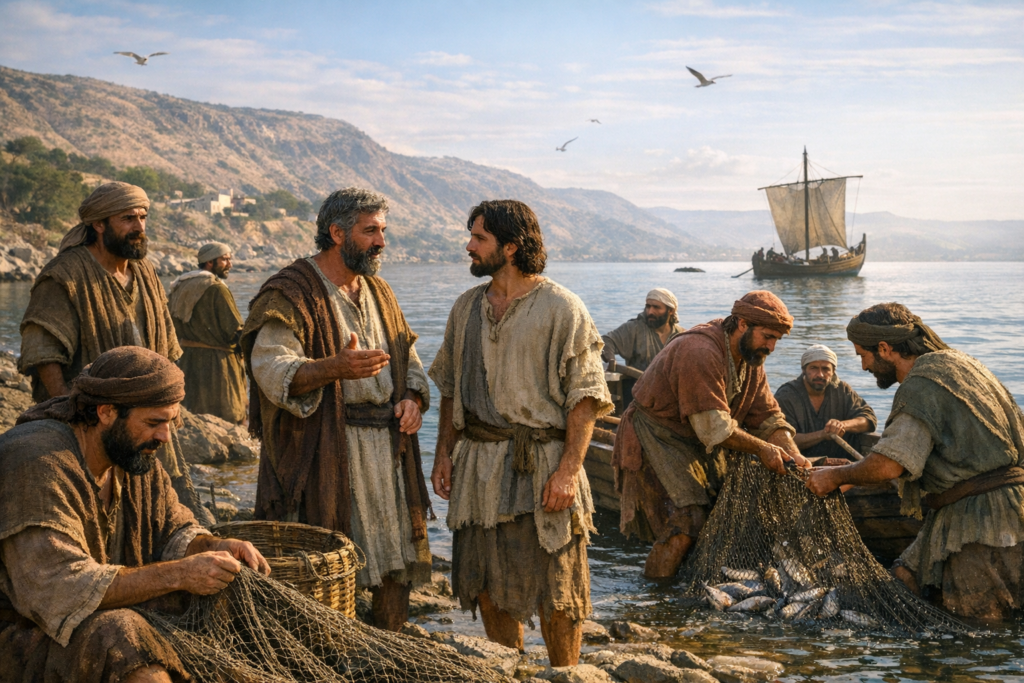
Peter and Andrew are explicitly presented as brothers and as natives of (John 1.44). Both worked as fishermen on the Sea of Galilee (Matthew 4.18). Their calling shows that Jesus began his ministry by relying on an already structured family network, anchored in the economic life of the region.

2 - James and John, sons of Zebedee

James and John, sons of Zebedee and Salome, formed another important set of brothers. They worked with their father, who employed hired workers, a sign of a prosperous fishing business (Mark 1.19-20). Their mother Salome appears among the women who followed Jesus (Mark 15.40), which shows the involvement of the whole family in the movement of Jesus.

3 - James the Less and Judas

James, son of Alphaeus, appears in the apostolic lists (Matthew 10.3). Tradition often identifies Judas (also called Thaddaeus) as his brother, but the Gospels do not state this explicitly. This hypothesis rests on comparisons of names and on ancient traditions, and must be distinguished from the certain biblical data.

B - The apostles whose kinship is uncertain

Bartholomew is sometimes identified with Nathanael, a native of (John 21.2), but this identification remains debated. Thomas, nicknamed Didymus, "the twin" (John 11.16), bears a name that suggests a brotherly relationship, but no brother is mentioned in the Gospels.
These cases illustrate the limits of our knowledge about the family ties of certain apostles.

III. Geographical origins: a mostly Galilean group

A - The strong Galilean presence

Most of the apostles come from Galilee: , Capernaum, or the surroundings of the . This geographical concentration explains the cohesion of the group and the speed with which Jesus was able to form a circle of close disciples.

B - Judas Iscariot: a Judean apostle

Unlike the other apostles, Judas Iscariot seems to have come from Judea. His surname "Iscariot" most likely comes from the Hebrew ish‑Qeriyyot, "the man of Qeriyyot", a town mentioned in the territory of Judah (Joshua 15.25). This origin makes Judas the only known non-Galilean apostle. He came from a cultural environment closer to Jerusalem, the Temple and the religious authorities. This geographical and cultural difference could shed light on certain aspects of his behavior and of his interactions with the other disciples.

IV. The family ties between Jesus and some disciples

A - Jesus and his "brothers"

The Gospels mention several "brothers" of Jesus: James, Joseph, Simon and Judas (Matthew 13.55). The Greek term used in this passage is adelphoi, which generally means "brothers" in the biological sense. Biblical Greek clearly distinguishes this term from anepsios, which designates a "cousin" or a close relative. The fact that the authors of the Gospels chose adelphoi rather than anepsios has fed various interpretations according to Christian traditions, some seeing in them blood brothers, others close relatives or extended members of the family.

However that may be, these men belonged to the extended family circle of Jesus and played an important role in the early Church, notably James, a major figure of the Jerusalem community.

B - The possible ties between Jesus and certain apostles

Paul mentions "James, the Lord's brother" (Galatians 1.19), which suggests a direct family tie. John 19.25 speaks of "Mary, the wife of ", sometimes identified as the mother of James the Less, which would make him a cousin of Jesus.

These identifications, however, rest on traditions and reconstructions, and not on explicit statements of the Gospels.

C – The possible ties between Jesus and Nathanael

As we advanced in our study of the (ANN064 : The next days noted by John), we were led to consider the hypothesis that Nathanael married one of Jesus' sisters. This possibility, raised by some commentators, would explain both Mary's presence at the wedding and Jesus' familiarity with the servants. Without presenting it as a historical certainty, this reading offers an interesting insight into the family and relational ties that surrounded the beginning of Jesus' public ministry.

V. Jesus and John the Baptist: an explicit family tie

A - Luke's testimony

Luke reports that Mary and Elizabeth were relatives (Luke 1.36). John the Baptist is therefore a relative of Jesus, probably a cousin in the broad sense. This family tie sheds light on the spiritual closeness between the two men and their complementary role in the history of salvation.

B - A spiritual relationship as much as a family one

John acknowledges the superiority of Jesus from the very beginning of his ministry (John 1.27). Jesus, for his part, bears an exceptional testimony to John: "Among those born of women there has not risen anyone greater" (Matthew 11.11).
Their relationship thus goes beyond simple kinship and is part of the prophetic dynamic of revelation.

VI. The social and professional networks around Jesus

A - The group of Galilean fishermen

Peter, Andrew, James and John formed a solid professional network even before their calling. Jesus settles in Capernaum, their town (Matthew 4.13), which shows that he relies on an already structured human environment to develop his ministry.
This closeness explains the speed with which these men joined Jesus.

B - Matthew, tax collector

Matthew worked in Capernaum (Matthew 9.9), a strategic place for collecting taxes, notably on fishing. He probably knew the fishermen before his calling, which shows that several apostles belonged to interconnected social circles.

C - Philip, Nathanael and the disciples of John the Baptist

Philip introduces Nathanael to Jesus (John 1.45-46). Several disciples of Jesus had first followed John the Baptist (John 1.35-37), which shows that the two circles overlapped.
The group of Jesus' disciples was thus formed from already existing human networks, which explains the rapid cohesion of the group.

Conclusion

The study of the family, geographical and social ties among the apostles, Jesus and John the Baptist reveals a dense human network, rooted in 1st-century Galilee. Most of the apostles were Galileans, bound together by family or by their trade, while Judas Iscariot stood out by his Judean origin.

The Gospels offer a solid foundation for understanding these relationships, while tradition offers supplements that are sometimes plausible but not always verifiable. A careful reading makes it possible to better grasp how Jesus formed a group of disciples that was at once diverse, united and deeply anchored in the daily life of its time.