ANN029

The conflict between John’s and Jesus’ followers

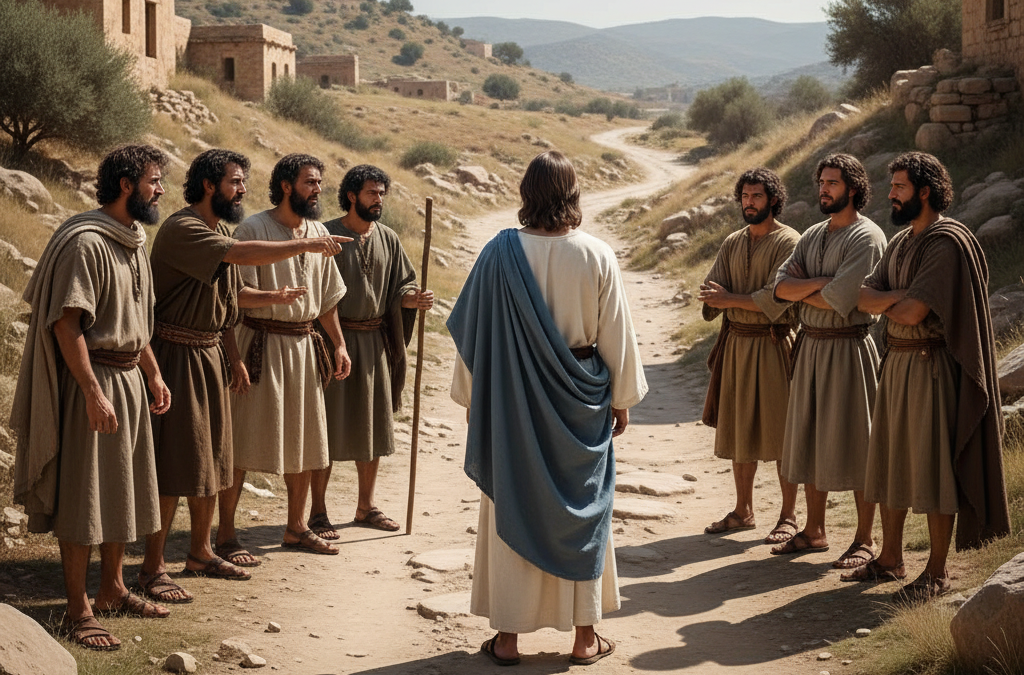
This article addresses the tensions between the disciples of John the Baptist and those of Jesus, two central biblical figures, highlighting their distinct ministries. John was the forerunner, calling for repentance, whereas Jesus was recognized as the Messiah. The rivalry stems from the success of Jesus and from disciples moving over to him. John himself acknowledged the supremacy of Jesus and directed his disciples accordingly.

12 min John the Baptist Jesus followers conflict disciples 14 verses 4 books

Further information

Introduction

The ministry of John the Baptist and that of Jesus overlap for a short period, creating a unique situation in biblical history. Both men carry out their mission in the same region, proclaim a message of repentance, and attract large crowds. Yet their roles are profoundly different: John is the forerunner, Jesus is the Messiah.

The Gospel of John is the only one to report the tensions that arose between the disciples of the two masters. This passage gives us valuable insight into the human difficulty of accepting the transitions that God has willed, even when the roles are clearly defined.

I. General context

From the text of the Apostle John, we learn that the Messiah Jesus began his public ministry in Judea, before devoting himself mainly to Galilee.

The Apostle John reports that Jesus, at the beginning of his ministry, went to Judea with his disciples and baptized there. Meanwhile, John the Baptist was also continuing his work at Aenon near Salim, because there was plenty of water there (John 3.22-24).
John had not yet been imprisoned, so the two ministries were taking place simultaneously in the same geographical area.

Yet John had clearly announced that he was not the Messiah, but the one who was to prepare his coming (John 1.19-20; Isaiah 40.3). He knew that his mission was temporary and that it had to fade before that of Jesus.

The calling of the first disciples took place at Bethany beyond the Jordan, located about 30 km east of Jerusalem, whereas the tension between the disciples of John the Baptist and those of the Messiah Jesus arises later, in the south of Galilee, precisely at Aenon near Salim.

II. The birth of a rivalry

The closeness of the two ministries causes unexpected tension. The growing success of Jesus worries John’s disciples, who see the crowds turning away from their master to follow the Messiah.
Several of John’s disciples had already left their first master to follow Jesus, such as Andrew and probably John the evangelist (John 1.35-37).

A discussion then breaks out between John’s disciples and a Jew about purification. But when they come to John, their real concern comes to light:

John 3.25-26 (King James Version) :
Then there arose a question between some of John’s disciples and the Jews about purifying.And they came unto John, and said unto him, Rabbi, he that was with thee beyond Jordan, to whom thou barest witness, behold, the same baptizeth, and all men come to him.

It is no longer a doctrinal question, but a question of influence and prestige.

This situation recalls the conflict between Abraham’s herdsmen and Lot’s, when divine blessing caused tension between two groups who were nevertheless close (Genesis 13.7-9).

III. Did Jesus intend to win over John’s disciples?

Some exegetes have suggested that Jesus sought to take advantage of John’s preparatory work. But this hypothesis does not stand up to the texts.

John never claimed the position of a spiritual master. He always affirmed that he was not the light, but the one who was to bear witness to it (John 1.6-8).
He acknowledges the preexistence and the superiority of Christ:

John 1.15 (King James Version) :
John bare witness of him, and cried, saying, This was he of whom I spake, He that cometh after me is preferred before me: for he was before me.

John deliberately directs his disciples toward Jesus:

John 1.29 (King James Version) :
The next day John seeth Jesus coming unto him, and saith, Behold the Lamb of God, which taketh away the sin of the world.

He sums up his mission in a sentence that has become famous:

John 3.30 (King James Version) :
He must increase, but I must decrease.

Jesus, for his part, never sought to appropriate John’s disciples. He simply accomplishes the work that the Father has entrusted to him (Mark 1.14-15).

IV. The testimony of John the Baptist

The Gospel of John stresses the Baptist’s faithfulness to his mission.
He is “a man sent from God” (John 1.6), but he is not the light.
He bears witness to Jesus, the true light that enlightens everyone (John 1.9).

John affirms that grace and truth came through Jesus Christ, and that no one has ever seen God except the only Son, who has made him known (John 1.16-18).

Thus, John the Baptist never seeks to hold on to his disciples. He prepares them to recognize the Messiah and to follow him.

Conclusion

The account of the tensions between the disciples of John the Baptist and those of Jesus reveals a deeply human reality: even when God clearly establishes the roles, pride, jealousy, or the fear of losing a position can cloud people’s understanding.

John the Baptist and Jesus were never in conflict. Their missions were perfectly complementary: the one prepares, the other fulfills.

The dispute concerned only some disciples, who were unable to accept the transition willed by God.

This passage reminds us that the true disciple is not attached to a man, but to the will of God. John had understood this: his role was to lead people to Jesus, the true light.
In this, he remains a model of humility, faithfulness, and spiritual discernment.