The article analyzes the different Gospel accounts of the calling of Jesus’ first disciples, showing that these narratives do not contradict one another but complement each other. Matthew, Mark, Luke and John each offer a unique perspective that sheds light on different stages of the disciples’ commitment.
51 min
calldisciplesJesusGospelsPeter
76 verses
5 books
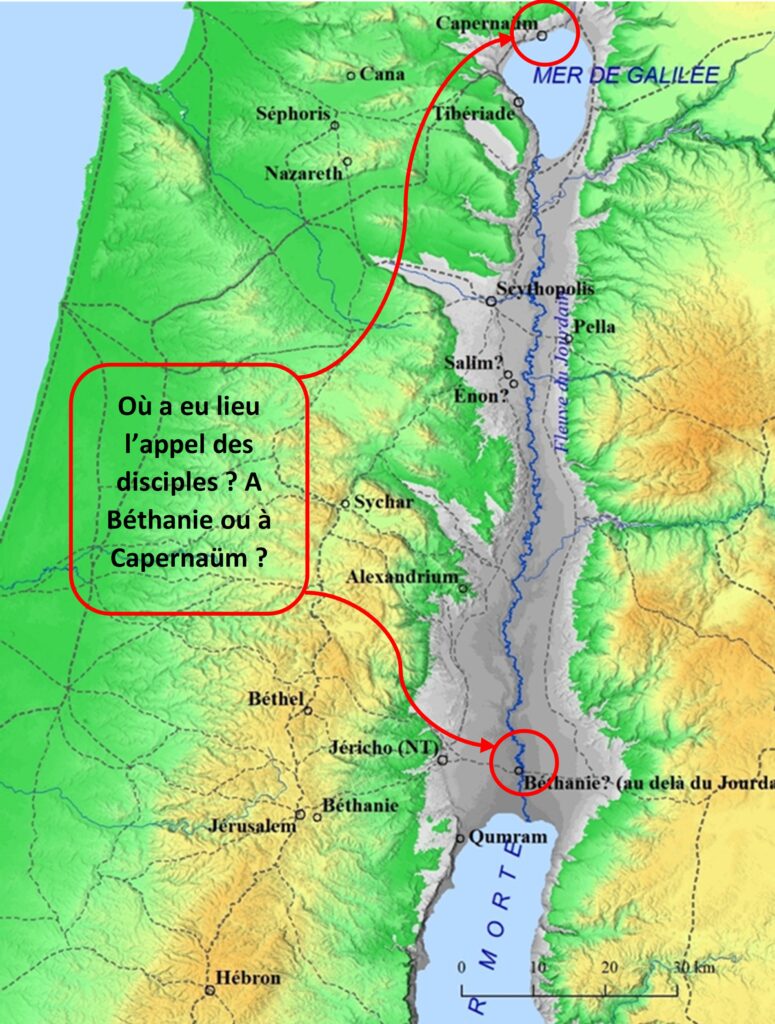
The accounts of the calling of the first disciples by Jesus the Messiah present, at first sight, certain differences. Matthew, Mark and Luke place the calling of several disciples in Galilee, on the shore of Lake Tiberias or the , whereas John reports a first meeting in Judea, near the Jordan, shortly after Jesus’ baptism (Matthew 4.18-22, Mark 1.16-20, Luke 5.1-11, John 1.35-51). This diversity has sometimes led some readers to speak of a contradiction.
However, a careful reading of the texts shows that there is no need to set these accounts against each other. It is instead possible to understand that they describe several successive stages in the disciples’ relationship with Jesus. John seems to report a first meeting and a first attachment. The Synoptics, for their part, emphasize above all a more demanding call, which leads some disciples to leave their occupation to follow Jesus on a lasting basis. We shall therefore examine these texts in order to understand better how they fit together and complement one another.
I. The accounts of Matthew and Mark
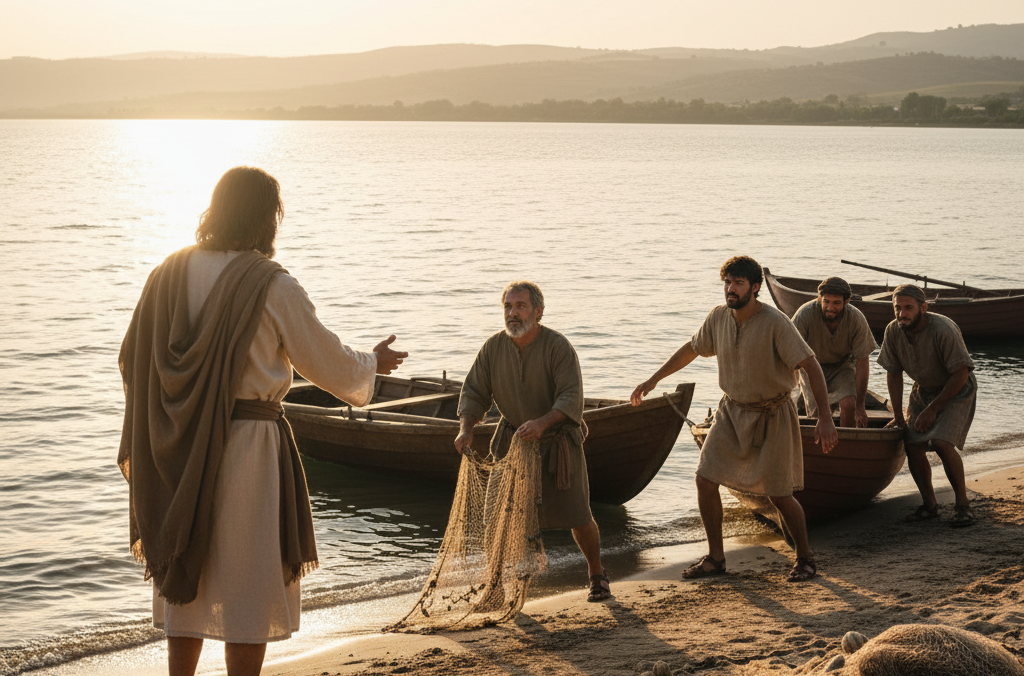
Matthew and Mark both report the calling of Simon, called Peter, of Andrew his brother, and then of James and John, the sons of Zebedee, on the shore of the Sea of Galilee (Matthew 4.18-22, Mark 1.16-20).
Jesus sees them going about their work as fishermen. Simon and Andrew are casting a net into the lake, while James and John are mending theirs in a boat with their father (Matthew 4.18-21, Mark 1.16-19). Jesus then addresses this call to them:
Matthew 4.19 (King James Version) :
And he saith unto them, Follow me, and I will make you fishers of men.
King James Version (1769), domaine public — texte : eBible.org
Mark 1.17 (King James Version) :
And Jesus said unto them, Come ye after me, and I will make you to become fishers of men.
King James Version (1769), domaine public — texte : eBible.org
The account stresses the speed and strength of their response. Simon and Andrew immediately leave their nets, and James and John leave not only their boat but also their father, to follow Jesus (Matthew 4.20-22, Mark 1.18-20). Matthew and Mark do not dwell on earlier details. Above all they want to show the moment when these men answer a decisive call that turns their lives upside down.
In Matthew, this episode takes place after Jesus’ baptism, after the temptations in the wilderness, after the arrest of John the Baptist and after Jesus settled in Galilee, in the region of Capernaum (Matthew 3.13-17, Matthew 4.1-11, Matthew 4.12-16). Mark follows the same general progression (Mark 1.9-15). The setting is therefore the beginning of Jesus’ Galilean ministry, after an earlier phase linked to John the Baptist.
II. Luke’s account
Luke also reports the calling of Simon, James and John in Galilee, but he gives more detail about the circumstances of this event (Luke 5.1-11).
Jesus teaches on the shore of the lake, gets into Simon’s boat to speak to the crowd, and then asks the fishermen to let down their nets into deep water (Luke 5.1-4). Simon answers that they have worked all night without catching anything, but he obeys his word (Luke 5.5). The catch then becomes so abundant that the nets are about to break and they have to signal to their companions to come and help them (Luke 5.6-7).
This scene gives the calling a particular intensity. Faced with such a sign, Simon Peter falls at Jesus’ knees and says to him:
Luke 5.8 (King James Version) :
When Simon Peter saw it, he fell down at Jesus’ knees, saying, Depart from me; for I am a sinful man, O Lord.
King James Version (1769), domaine public — texte : eBible.org
Jesus answers him not to be afraid, and announces that from now on he will be a fisher of men (Luke 5.10). Luke concludes by saying that they brought their boats to land, left everything, and followed him (Luke 5.11).
This account does not contradict those of Matthew and Mark. It is the same general calling, but Luke adds a striking element to it: the miraculous catch of fish. Where Matthew and Mark summarize the event, Luke shows its spiritual depth and the effect it had on Simon. It also helps us understand better why these men were ready to leave everything to follow Jesus.
It should also be noted that before this scene, Luke has already reported the healing of Simon’s mother-in-law in Capernaum (Luke 4.38-39). This means that Simon already knows Jesus before the miraculous catch. The calling of (Luke 5.1-11) therefore cannot be understood as their very first contact, but rather as a new and more demanding stage in a relationship already begun.
III. The context of the Synoptic Gospels
The accounts of Matthew, Mark and Luke therefore show less a first meeting than a call to a deeper commitment. Jesus is not content to invite a few men to come and listen to him; he asks them to follow him from now on more closely. The fishermen become his close collaborators. They are called to enter a new stage of their lives, marked by giving up their ordinary occupation and by learning a new mission (Matthew 4.19, Mark 1.17, Luke 5.10).
It is important to point out that, in the Synoptics, this call already comes after several significant events: Jesus’ baptism, the temptations in the wilderness, the beginning of his preaching in Galilee, and, according to Luke, several miracles in Capernaum (Matthew 4.12-17, Mark 1.14-15, Luke 4.31-41). We are therefore not at the very beginning of their discovery of Jesus. It is more accurate to see in it the call to a fuller consecration.
Thus, when Matthew and Mark say that they immediately left their nets to follow him (Matthew 4.20, Mark 1.18), this does not necessarily imply that they had never met Jesus before. It means above all that they are responding here to a decisive call, which transforms their way of life.
IV. The information in the Gospel of John
The Gospel of John provides valuable complementary information. It places a first meeting between Jesus and some disciples in Judea, in the context of the testimony of John the Baptist (John 1.35-51).
John the Baptist sees Jesus passing by and declares:
John 1.36 (King James Version) :
And looking upon Jesus as he walked, he saith, Behold the Lamb of God!
King James Version (1769), domaine public — texte : eBible.org
Two of his disciples hear this word and begin to follow Jesus (John 1.37). One of them is Andrew, the brother of Simon Peter (John 1.40).
Andrew then goes to find Simon and announces to him:
John 1.41 (King James Version) :
He first findeth his own brother Simon, and saith unto him, We have found the Messias, which is, being interpreted, the Christ.
King James Version (1769), domaine public — texte : eBible.org
He brings him to Jesus, who gives him the name Cephas, that is, Peter (John 1.42). The next day, Jesus calls Philip, and then Nathanael is in turn brought to him (John 1.43-49). So here we have a first phase of gathering around Jesus, distinct from the scene on the lakeshore.
In this account, the disciples do not yet seem to abandon their trade immediately to follow Jesus everywhere. It is rather a first meeting, a first attachment and a first recognition of his identity. Andrew recognizes in him the Messiah (John 1.41), Philip affirms that he has found the one of whom Moses and the prophets spoke (John 1.45), and Nathanael confesses him as Son of God and King of Israel (John 1.49). Faith therefore begins to be born from this first stage.
John then reports several events that are absent, at this point, from the Synoptics. Jesus goes to Galilee for the , where he performs the first of his signs (John 2.1-11). Then he goes down to Capernaum with his mother, his brothers and his disciples (John 2.12). Afterwards, he goes back up to Judea, where he stays with his disciples and where they baptize (John 3.22-26, John 4.1-2). Only after this phase does he leave again for Galilee (John 4.3).
These elements show that between the first meeting reported by John and the more radical call on the lakeshore, several events may have taken place. The disciples therefore had time to see Jesus at work, to hear his teaching and to let their attachment to him mature.
We have placed all these events in chronological order in the synopsis,
Indeed, John’s account differs noticeably from those of Matthew, Mark and Luke. Can a contradiction be seen in this?
V. The role of John the Baptist
The role of John the Baptist is essential in this first phase. It is not a minor detail that Jesus’ first disciples come precisely from the circle of John the Baptist (John 1.35-37). John the Baptist was preparing the way of the Lord (Isaiah 40.3, John 1.23). He points to Jesus as greater than himself, and he agrees to step aside before the one who comes after him (John 1.29-34, John 3.27-30).
This explains why some of his disciples pass naturally from John to Jesus. They do not betray their first master; on the contrary, they follow the direction he shows them. When John the Baptist presents Jesus as the Lamb of God, his disciples understand that the one they were waiting for is now here (John 1.36-37).
This fact is important for understanding the continuity between John and Jesus. The first disciples do not come to Jesus unprepared. They had already been trained, through the ministry of John the Baptist, to await the Messiah, to repent and to listen to the prophetic word (Matthew 3.1-6, John 1.6-8).
VI. How to fit John and the Synoptics together
The simplest way to understand all the texts together is to admit several stages in the calling of the disciples. According to John, there is first a meeting in Judea, shortly after Jesus’ baptism. Some men then begin to follow him, recognize in him the Messiah and attach themselves to his person (John 1.35-51). This first stage can be understood as a first commitment, an initial adherence, or a first step in following Jesus.
Later, after the arrest of John the Baptist, Jesus goes to Galilee and begins his public ministry there more clearly (Matthew 4.12, Mark 1.14, John 4.1-3). It is in this context that the calling reported by Matthew, Mark and Luke occurs. This time, it is no longer only a meeting or even a simple inner adherence. Jesus calls these men to follow him permanently, to leave their main occupations and to enter a closer and more demanding relationship as disciples (Matthew 4.18-22, Luke 5.1-11).
This reading accounts well for all the data. It explains why Simon Peter already knows Jesus when Luke tells of the miraculous catch (Luke 4.38-39, Luke 5.3-5). It also explains why John can report a meeting with Andrew and Simon before the definitive call on the lakeshore (John 1.40-42). These are therefore not contradictory accounts, but distinct events reported according to each evangelist’s own purpose.
VII. The spiritual meaning of these callings
This distinction between several stages is not at all artificial. It corresponds well to the way God often acts in people’s lives. There can be a first meeting, a first conviction, a first faith, then a deeper, more demanding call that engages the whole of one’s life. The disciples first heard the testimony of John the Baptist, then they met Jesus, then they saw his signs, before being called to leave everything to follow him fully (John 1.36-41, John 2.11, Luke 5.11).
The account of the Synoptics shows that following Jesus does not consist only in admiring his teaching or recognizing his identity. It also means responding to his call with a concrete commitment. The disciple does not remain a mere observer; he becomes a collaborator. This is indeed what the saying means:
Matthew 4.19 (King James Version) :
And he saith unto them, Follow me, and I will make you fishers of men.
King James Version (1769), domaine public — texte : eBible.org
Mark 1.17 (King James Version) :
And Jesus said unto them, Come ye after me, and I will make you to become fishers of men.
King James Version (1769), domaine public — texte : eBible.org
Luke 5.10 (King James Version) :
And so was also James, and John, the sons of Zebedee, which were partners with Simon. And Jesus said unto Simon, Fear not; from henceforth thou shalt catch men.
King James Version (1769), domaine public — texte : eBible.org
For his part, John puts more emphasis on the progressive discovery of Jesus’ identity. The first disciples come, see where he stays, remain with him, and then confess that he is the Messiah (John 1.38-41). The Synoptics, for their part, emphasize above all the authority of his call and the radical nature of the response. The two perspectives complement each other admirably.
Conclusion
John’s account places the first meeting of several disciples with Jesus in Judea, in the direct context of John the Baptist’s testimony (John 1.35-51). The accounts of Matthew, Mark and Luke, for their part, place in Galilee a more decisive call, by which Simon, Andrew, James and John actually abandon their occupation to follow Jesus on a lasting basis (Matthew 4.18-22, Mark 1.16-20, Luke 5.1-11).
There is therefore no need to speak of contradiction. The texts can be understood as describing several stages: a first meeting, a first attachment, then a more radical call to discipleship. John provides complementary information that sheds light on the Synoptics, while the Synoptics emphasize the decisive moment when these men leave everything to enter a new phase of their lives with the Messiah Jesus.
We must therefore recognize that the evangelists did not all choose to recount the same moments or to stress the same aspects. This in no way diminishes the historical value of their accounts. On the contrary, this diversity shows that they did not mechanically copy a single outline, but that they retained, under the inspiration of God, the elements most useful to their purpose. The whole forms a coherent picture of the beginnings of the relationship between Jesus and his first disciples.
A title, a person, a place, a reference (“Luke 15”)…
Bible reference
INF087
Information note
INF087 - Lake Gennesaret
Lake Gennesaret
Lake Gennesaret, also known as the Sea of Galilee, Lake Tiberias or Lake Kinneret, is an important body of water in Israel, mentioned several times in the Gospels. Here are some key points about it:
Location and geography
Location: Lake Gennesaret is situated in northern Israel, in Galilee, near the Golan Heights. It lies approximately 200 metres below sea level, making it one of the lowest freshwater lakes in the world. Dimensions: The lake is about 21 kilometres long and 13 kilometres wide, with an area of 166 km². Its maximum depth is approximately 43 metres.
Names and meanings
Sea of Galilee: This name is frequently used in the New Testament. Lake Tiberias:Named after the city of Tiberias, on its western shore. Lake Kinneret: Derived from the Hebrew ‘Kinneret’ (meaning ‘harp’), because the lake's shape resembles an ancient harp.
Biblical importance
Jesus' ministry: Lake Gennesaret is a central location in the ministry of Jesus the Messiah. Many of Jesus' miracles and teachings took place around this lake, including walking on water (Matthew 14.22-33), calming the storm (Mark 4.35-41) and the miraculous catch of fish (Luke 5.1-11). Calling of the disciples: Jesus the Messiah's first disciples, such as Peter, Andrew, James and John, were fishermen working on this lake. Miracles and teachings: The lake is the setting for many of Jesus' miracles and teachings, illustrating his power over nature and his relationship with his disciples.
Historical and cultural importance
Local economy: Lake Gennesaret has always been an important source of livelihood for local fishermen and farmers. Tourism and pilgrimage: Today, the lake is a tourist destination and a place of pilgrimage for Christians from around the world, drawn by the biblical sites and the region's natural beauty.
Ecology and environment
Biodiversity:
The lake is home to a diverse array of marine life and migratory birds, making the region a rich and varied ecosystem. Environmental Challenges:
Like many bodies of water, the Sea of Galilee faces environmental challenges, including water management and pollution.
Israel has launched a project to replenish the Sea of Galilee (also known as Lake Gennesaret or Lake Tiberias) with desalinated water. This project aims to preserve the lake’s water level, which has been affected by years of drought, irregular rainfall, and water diversions.
The desalinated water comes from the Mediterranean Sea and is transported to the lake via a special pipeline. This is a one-of-a-kind initiative to ensure a sustainable water source for the region.
In summary, Lake Gennesaret is a place of great geographical, historical, cultural and biblical importance, playing a central role in many Gospel accounts and remaining an important site for pilgrims and tourists.
INF122
Information note
INF122 - Les noces de Cana
The wedding at Cana
Pour quelle raison le Messie Jésus entreprend-il un aller-retour entre Béthanie et Nazareth peu de temps après son retour à Béthanie aux côtés de Jean le Baptiste (John 1.43) ?
Les informations disponibles suggèrent qu'il était au courant d'un mariage imminent dans sa famille et qu'il avait l'intention d'y assister. Cela pourrait expliquer son départ soudain de Béthanie. Il semble qu'il connaissait la date de cet événement avant de quitter Nazareth pour se faire baptiser par Jean le Baptiste (Matthew 3.13).
En conclusion, le jour suivant, Jésus prit la décision de se rendre en Galilée afin d'assister aux noces à Cana.
Les mariages à cette époque étaient considérés comme des événements communautaires importants qui incluaient de nombreux invités. Cependant, il semble financièrement difficile d'inviter tous les villages environnants.
C'est principalement pour cette raison que nous supposons que Marie et ses enfants étaient invités à ces noces. De plus, elle joue un rôle particulier lors de cet événement car c'est à elle que l'on vient d'abord signaler la pénurie de vin (John 2.3).
Tous ces éléments nous amènent à conclure que la famille du Messie Jésus est directement impliquée dans cette union matrimoniale.
Pourquoi devrions-nous considérer Nathanael comme étant le marié ?
John 21.2 indique que Nathanael est originaire de Cana. Il est présent aux noces, peut-être comme disciple de Jésus, mais probablement comme marié à une demi-sœur de Jésus. Cette hypothèse expliquerait la présence de Jésus à Cana et l'importance donnée à la conversion de Nathanael.