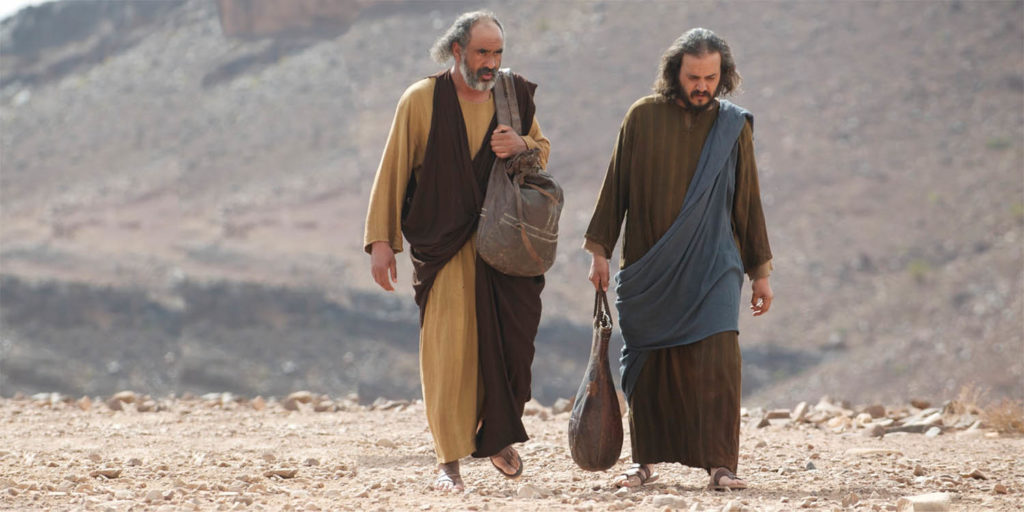

A few weeks before the Passover festival of April 12, AD 32, the weather turns mild with the arrival of spring, making travel and nights under the open sky easier. It is at this moment that the Messiah Jesus sends his disciples out two by two to proclaim the kingdom of heaven to as many people as possible. This period also serves as training for these young preachers, who seek to put their master's teachings into practice.
Matthew is the only one to record the names of his friends and fellow apostles. (Read the appendix ANN022 : The choice of the apostles). Regarding whether or not to take sandals or a staff, we have written the appendix ANN094 : The staff and sandals of the apostles.
Comparing the verses of these three passages can be very interesting for better understanding the nuances and differences in the Gospel accounts.
Matthew 10.1-15
- Context: Jesus sends out his twelve apostles on a mission.
- Instructions: The disciples receive authority to cast out unclean spirits and to heal every disease. Jesus sends them to the lost sheep of Israel with detailed instructions on what they are to do, what to take, and how to behave when they are not received.
- Theme: The mission is presented as an extension of Jesus' ministry, with a strong emphasis on dependence on God and on the hospitality of the communities visited.
Mark 6.6-13
- Context: Jesus goes to the neighboring villages to teach and sends out the Twelve.
- Instructions: The disciples are sent out two by two, with power over unclean spirits. They receive specific instructions: to take nothing for the journey except a staff. They were to preach repentance, cast out demons and heal the sick using oil.
- Theme: The emphasis is on simplicity and faith. The fact that they are sent out two by two underlines the importance of community and mutual support.
Luke 9.1-6
- Context: Jesus calls the Twelve and sends them to proclaim the kingdom of God and to heal the sick.
- Instructions: The apostles receive authority and power over all demons and to heal diseases. They are to take nothing for the journey - neither staff, nor bag, nor bread, nor money. They are to stay in the house where they are received until they leave that town, and to shake the dust off their feet as a testimony against those who will not receive them.
- Theme: The emphasis is on the proclamation of the kingdom of God and the importance of faith and total dependence on God.
Comparison
1- Power and authority: All three passages mention that the apostles receive power and authority over unclean spirits and to heal diseases, underlining the continuity of Jesus' work.
2- Instructions for the journey:
-
- Matthew gives a more detailed list of practical and spiritual instructions.
- Mark focuses on simplicity and the essentials for the journey (only a staff).
- Luke insists on total dependence on God, taking nothing for the journey.
3- Focus on the mission:
-
- Matthew and Mark focus on hospitality and the welcome given to the disciples.
- Luke emphasizes the proclamation of the kingdom of God and the healing of the sick.
The differences between these passages may reflect the different perspectives and intentions of the Gospel authors. Each highlights specific aspects of the apostolic mission and of the life of a disciple.