

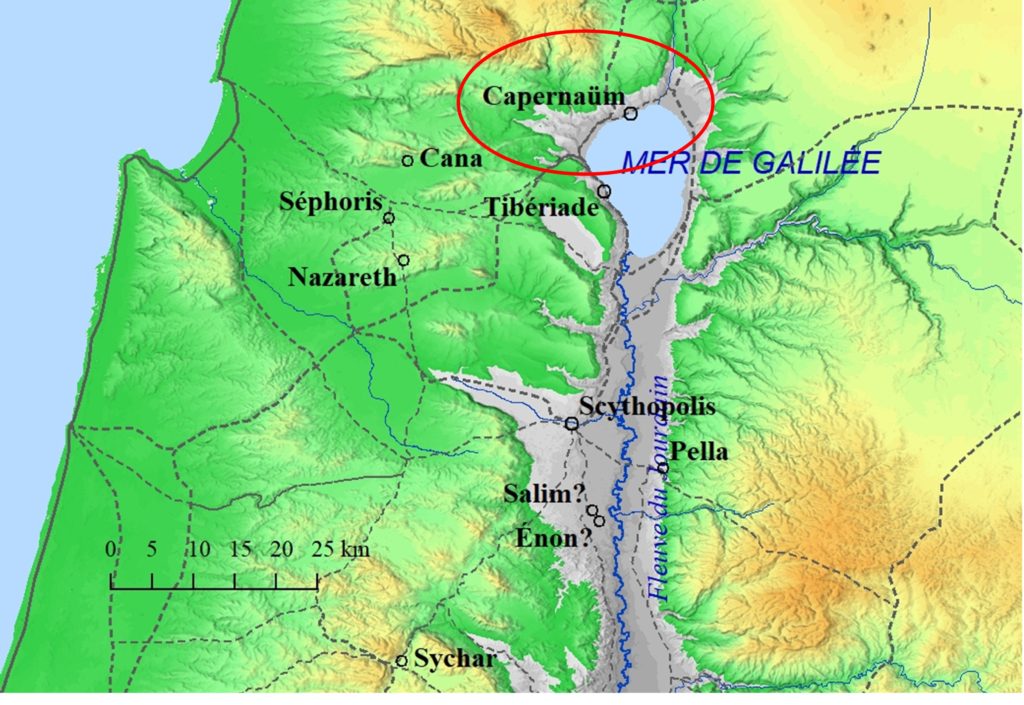
Jesus the Messiah did not limit his activities to the town of Capernaum and its surroundings. He visited both the towns and villages of the region, going wherever he was welcomed. The apostles could thus observe his method of proclaiming the Kingdom of God to the entire population.
This text examines the practical arrangements for these journeys. It is relevant to address the provision of food, clothing and the various material needs associated with these evangelistic campaigns. Luke mentions people responsible for these discreet tasks. They are women, although not all are explicitly named.
Please consult the appendix ANN030 entitled: The women who followed Jesus for detailed information about these women’s role and contributions.
Thanks to this organisation, the Master could concentrate entirely on teaching the crowds. When writing these lines, Luke had to take stringent precautions because persecution was very prevalent at the time. The women mentioned had probably already died, while the others remain anonymous.
Mark, speaking of the women present at the foot of the cross, mentions those ‘who followed him and served him when he was in Galilee, and many other women’ (Mark 15.41), corroborating Luke’s words. Matthew does not mention them, probably for safety reasons, since according to our conclusions he wrote his Gospel very early, before AD46.
Luke specifies that Jesus the Messiah preached and also proclaimed the Kingdom of God, but what is the difference?
Luke 8.1 uses two different verbs: to preach (kērussō in Greek) and to proclaim good news (euangelizō). They are similar, but carry interesting nuances.
‘To preach’ (κῆρυσσω — kērussō)
Primary meaning: to proclaim a message publicly with authority
Context: this evokes the image of a royal herald proclaiming a decree
Implication: emphasis on the solemn and public form of the message
‘To proclaim the good news’ (εὐαγγελίζω — euangelizō)
Primary meaning: to bring good news, to evangelise
Context: this verb is often linked to the announcement of salvation, grace and the coming of God’s reign
Implication: the content is joyful and liberating—a proclamation that transforms
In Luke 8.1, Jesus preaches and proclaims the good news:
‘Jesus went from town to town and village to village, preaching and proclaiming the good news of the Kingdom of God.’
The use of both verbs emphasises the form of the message (a public and solemn proclamation) as well as its substance (joyful news bringing hope).
We can say that Jesus does more than make a statement: he proclaims with authority and brings good news that transforms lives.