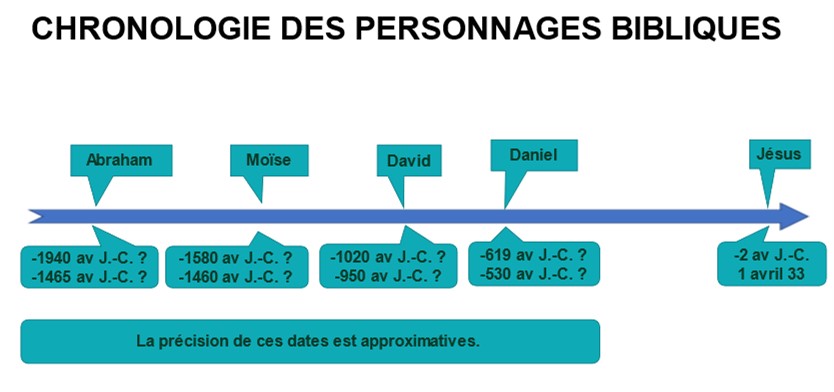
The article explores Daniel's life and prophetic writings in depth, revealing chronological periods vital to understanding the prophecies. Josiah, king of Judah, is described as a devoted servant of God who dies tragically while defying Egypt. Daniel, then a young man, begins his prophetic destiny in this turbulent setting.
78 min
DanielprophetchronologyJosiahBabylon
94 versets
16 books
Cette première étude pose les bases chronologiques nécessaires à la compréhension de la vie publique du Messie Jésus. Les études suivantes viendront compléter progressivement cette analyse en examinant les différentes étapes de son ministère, afin de proposer une reconstitution cohérente et harmonisée des événements rapportés par les Évangiles.
In the course of our study, we will make several references to the prophet Daniel and to the book that bears his name. While his life is fascinating in itself, it is above all his writings that hold our attention here.
In particular, Daniel reveals chronological periods that help us determine the date of the Messiah’s death. Although he mentions a specific length of time, the starting point of that period remains open to interpretation, despite the details he provides.
It is this complexity that makes the study of his writings so intriguing and leads us to explore in depth the life and revelations of this remarkable man.
I. The historical context
Josiah, ruler of the kingdom of Judah, stands out as the last monarch truly devoted to observing the Mosaic law. Unlike his grandfather Manasseh and his father Amon, he committed himself to honoring God and removed all the places of worship dedicated to foreign deities that his predecessors had established in the land.
Reading the writings of Isaiah reveals to him that the Babylonians are about to dominate the region (Isaiah 39.5-7). Aware that divine judgment is imminent upon the nation of Judah — because of its abandonment of the ways of the — the king also knows that the prophet Jeremiah has been warning the people tirelessly, for twenty-three years, of the consequences of their apostasy. However, since he had restored the observance of the Law, Josiah receives the promise that this punishment will not fall during his lifetime (2 Kings 22.18-20).
2 Kings 22.18-20 (King James Version) :
But to the king of Judah which sent you to enquire of the LORD, thus shall ye say to him, Thus saith the LORD God of Israel, As touching the words which thou hast heard;Because thine heart was tender, and thou hast humbled thyself before the LORD, when thou heardest what I spake against this place, and against the inhabitants thereof, that they should become a desolation and a curse, and hast rent thy clothes, and wept before me; I also have heard thee, saith the LORD.Behold therefore, I will gather thee unto thy fathers, and thou shalt be gathered into thy grave in peace; and thine eyes shall not see all the evil which I will bring upon this place. And they brought the king word again.
King James Version (1769), domaine public — texte : eBible.org
It was through the prophetess Huldah that this divine word was announced. This situation is a reminder that nothing is left to chance: a supreme Authority, God himself, orchestrates history according to a sovereignly established purpose.
The thirty-one years of Josiah’s reign were marked by peace, but the announced judgment was bound to come. Having studied the oracles of Isaiah, the king had discerned the profound geopolitical upheavals under way. He understood that the rise of Babylon offered a strategic opportunity: to align himself with this new power rather than remain under the tutelage of Egypt, judged too costly in tribute.
In this context, Josiah made the bold decision to defy Pharaoh Necho. Was this initiative guided by an assurance obtained from Babylon, or was it simply an error of judgment? Be that as it may, his action, which seemed to defy all logic in the face of Egyptian military might, proved to be a fatal mistake.
2 Chronicles 35.20-24 (King James Version) :
After all this, when Josiah had prepared the temple, Necho king of Egypt came up to fight against Carchemish by Euphrates: and Josiah went out against him.aNotetemple: Heb. housebNotethe house…: Heb. the house of my warcNotewounded: Heb. made sickdNotein one…: or, among the sepulchresBut he sent ambassadors to him, saying, What have I to do with thee, thou king of Judah? I come not against thee this day, but against the house wherewith I have war: for God commanded me to make haste: forbear thee from meddling with God, who is with me, that he destroy thee not.Nevertheless Josiah would not turn his face from him, but disguised himself, that he might fight with him, and hearkened not unto the words of Necho from the mouth of God, and came to fight in the valley of Megiddo.And the archers shot at king Josiah; and the king said to his servants, Have me away; for I am sore wounded.His servants therefore took him out of that chariot, and put him in the second chariot that he had; and they brought him to Jerusalem, and he died, and was buried in one of the sepulchres of his fathers. And all Judah and Jerusalem mourned for Josiah.
King James Version (1769), domaine public — texte : eBible.org
In 609 BC, the decision to oppose Necho leads to tragic consequences. In the valley of Megiddo, Josiah loses his life, ending thirty-one years of reign. At that time, the young Daniel is only about ten years old.
II. Daniel and the deportation
Four years after Josiah’s death, the kingdom of Judah finds itself caught in a vise between Egyptian and Babylonian ambitions. In 605 BC, following his victory over the Assyrians and the Egyptians at Carchemish, Nebuchadnezzar II takes part of the people of Judah into captivity in Babylon, among them Daniel and his companions. The young man is then only about fourteen years old. The unwavering commitment of these four adolescents — Daniel, Hananiah, Mishael and Azariah — to their God remains remarkable.
This deportation marks the culmination of a political and social decline that had been worsening for years, as the prophet Jeremiah had foretold. Josiah’s peaceful reign merely delayed this inevitable fall. Although the country’s critical economic and social situation might seem attributable to the heavy tribute demanded by the Egyptians, the true cause lies in the people’s abandonment of the .
The prophet Jeremiah speaks of this period of calamity lasting seventy years:
Jeremiah 25.11 (King James Version) :
And this whole land shall be a desolation, and an astonishment; and these nations shall serve the king of Babylon seventy years.
King James Version (1769), domaine public — texte : eBible.org
Daniel will never return to what he regards as “the most beautiful land in the world,” in the words used by Ezekiel and by himself. Faithful to his God to the end of his days, he will remain in Babylon, serving the various rulers who will succeed one another there.
Daniel 1.21 (King James Version) :
And Daniel continued even unto the first year of king Cyrus.
King James Version (1769), domaine public — texte : eBible.org
The fall of Babylon in 539 BC — marked by the capture of the city by the Persians on 12 October — puts an end to Babylonian domination. Cyrus, the new master of the empire, adopts a policy of tolerance: he encourages the conquered peoples to practice their religion and customs, and authorizes the Judeans to return to their homeland to rebuild the Temple (Isaiah 44.28, Isaiah 45.1-4).
The beginning of Babylonian hegemony can be dated to 609 BC, the year of Josiah’s death, and it ends in 539 BC, a period of seventy years, in accordance with Jeremiah’s prophecy. Other cycles of the same length can be observed in Jewish history, notably the seventy years separating the destruction of the Temple in 587 BC from its partial reconstruction in 516 BC, followed by embellishments until 417 BC under the reign of Darius II. These various periods illustrate the precision of Jeremiah’s oracle and underscore that history is guided by the divine will.
Daniel 9.1-2 (King James Version) :
In the first year of Darius the son of Ahasuerus, of the seed of the Medes, which was made king over the realm of the Chaldeans;aNotewhich: or, in which heIn the first year of his reign I Daniel understood by books the number of the years, whereof the word of the LORD came to Jeremiah the prophet, that he would accomplish seventy years in the desolations of Jerusalem.
King James Version (1769), domaine public — texte : eBible.org
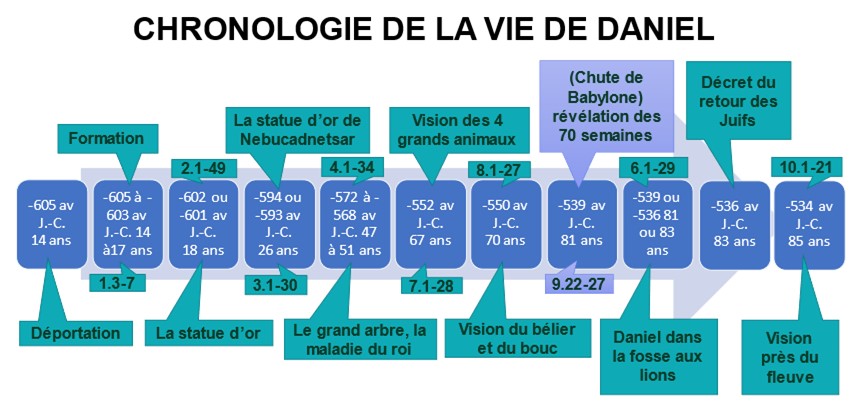
The historical landmarks found in most of the accounts of the book of Daniel make it possible to trace the chronology of his life.
III. The historical landmarks
Daniel takes care to date events, according to the conventions of the time, by the number of years of the kings’ reigns. Consequently, thanks to the clues Daniel gives, we know:
Events
Dates
Daniel’s ages
Bible references
Beginning of the captivity
-605
14 years
Babylonian training
-605 à -603
15 to 17 years
Daniel 1.3-7
Dream of the colossus with feet of clay
-602 or -601
18 years
Daniel 2.1-49
Nebuchadnezzar’s golden statue
-594 or -593
26 years
Daniel 3.1-30
The great tree and the king’s illness
-572 à-568
47 years and 51 years
Daniel 4.4-37
The vision of the four great beasts
-552
67 years
Daniel 7.1-28
The vision of the ram and the goat
-550
70 years
Daniel 8.1-27
The revelation of the 70 weeks
-539
81 years
Daniel 9.22-27
The fall of Babylon
-539
81 years
Daniel 5.1-30
Daniel in the lions’ den
-539 à -536
81 years and 83 years
Daniel 5.31-6.28
The decree for the return of the Jews (rebuilding of the temple)
-536
83 years
The vision by the river
-534
85 years
Daniel 10.1-21
The death of Daniel
?
?
We have now reached the year 539 BC; Daniel is then eighty years old.
Daniel 9.2 (King James Version) :
In the first year of his reign I Daniel understood by books the number of the years, whereof the word of the LORD came to Jeremiah the prophet, that he would accomplish seventy years in the desolations of Jerusalem.
King James Version (1769), domaine public — texte : eBible.org
When biblical data are compared with those of the ancient peoples — Chaldeans, Babylonians and Assyrians — a remarkable historical precision emerges. These civilizations were meticulous in observing the heavenly bodies (sun, moon, stars) and recorded the important dates of their history. These astronomical records served to harmonize months and years, and to attempt to predict the future.
The biblical text provides precise time markers, such as “the first year of the reign of Darius.” Sometimes even the exact month and day are mentioned, offering a wealth of information for dating events.
Ezra 7.8-9 (King James Version) :
And he came to Jerusalem in the fifth month, which was in the seventh year of the king.For upon the first day of the first month began he to go up from Babylon, and on the first day of the fifth month came he to Jerusalem, according to the good hand of his God upon him.
King James Version (1769), domaine public — texte : eBible.org
The precision supplied by the scribe Ezra, establishing the date of 3 April 458 BC according to our Gregorian calendar, proves crucial. This mention is not intended merely to confirm the historical truth of the event: we shall see that this seemingly insignificant detail is of capital importance for our contemporary understanding.
The interest of this datum becomes even more evident when we examine Daniel’s astonishing revelations concerning the seventy weeks. These words, of considerable import, deserve particular attention in the remainder of our study.
IV. Daniel’s research
Daniel is distinguished by his exceptional intelligence and vast learning. On several occasions he successfully interprets dreams and omens for the successive rulers of Babylon, consistently stressing that these revelations come not from his own abilities but from his God (Daniel 2.27-28, Daniel 4.21). Over the years, he is progressively raised to positions of considerable authority (Daniel 2.48, Daniel 6.1-2).
Despite these leading political responsibilities, Daniel remains deeply attached to his origins and to the destiny of his people. He steadily applies himself to understanding the reasons for and the length of the exile of the Judeans. To do so, he immerses himself in the study of the Scriptures, in particular the — Genesis, Exodus, Leviticus, Numbers and Deuteronomy — as well as the oracles of Jeremiah (Daniel 9.2).
Through this careful study, Daniel reaches the conviction that the seventy years of captivity announced by Jeremiah are drawing to a close (Jeremiah 25.11-12, Jeremiah 29.10). He discerns that the historical events he is witnessing confirm the prophetic word.
Three fundamental elements emerge from this approach:
prophecy,
history,
and in-depth study of the Scriptures.
Daniel understands that the end of the exile is imminent. The encounter with the angel Gabriel, a divine messenger, confirms and seals this understanding.
Daniel 10.12 (King James Version) :
Then said he unto me, Fear not, Daniel: for from the first day that thou didst set thine heart to understand, and to chasten thyself before thy God, thy words were heard, and I am come for thy words.
King James Version (1769), domaine public — texte : eBible.org
What is truly surprising in the revelation brought by Gabriel is that it no longer concentrates on the seventy years of captivity. The angel presents a new period: seven times seventy years, that is, four hundred and ninety years. Unlike the exile, this announced era does not relate to the domination of foreign nations over the Judeans, but to a spiritual time culminating in a crucial event: the death of the Messiah (Daniel 9.24-26).
This death will not be a mere historical endpoint; it will mark the beginning of a new era of redemption and salvation for humanity.
Daniel 9.22 (King James Version) :
And he informed me, and talked with me, and said, O Daniel, I am now come forth to give thee skill and understanding.
King James Version (1769), domaine public — texte : eBible.org
We now turn to the text that remains an essential key to understanding the story of Jesus the Messiah.
V. The prophecy of the 70 weeks
This passage has given rise to numerous discussions and an abundance of theories, sometimes hard to grasp. This ferment around the text undeniably testifies to its considerable importance.
VI. Analysis of the text
Daniel 9.22-25 (King James Version) :
And he informed me, and talked with me, and said, O Daniel, I am now come forth to give thee skill and understanding.At the beginning of thy supplications the commandment came forth, and I am come to shew thee; for thou art greatly beloved: therefore understand the matter, and consider the vision.Seventy weeks are determined upon thy people and upon thy holy city, to finish the transgression, and to make an end of sins, and to make reconciliation for iniquity, and to bring in everlasting righteousness, and to seal up the vision and prophecy, and to anoint the most Holy.Know therefore and understand, that from the going forth of the commandment to restore and to build Jerusalem unto the Messiah the Prince shall be seven weeks, and threescore and two weeks: the street shall be built again, and the wall, even in troublous times.
King James Version (1769), domaine public — texte : eBible.org
We would like to highlight an essential observation, which offers an answer to those who consider these texts to be riddles of no interest.
Daniel 12.4 (King James Version) :
But thou, O Daniel, shut up the words, and seal the book, even to the time of the end: many shall run to and fro, and knowledge shall be increased.
King James Version (1769), domaine public — texte : eBible.org
The words of the angel reported by Daniel suggest that these revelations are intended for the generation living in the last times. A question therefore arises: are we that final generation, particularly in view of the signs fulfilled with regard to Israel? If so, it becomes imperative to study these texts in order to draw logical, rational and instructive explanations from them.
If these words are to remain sealed, for whom are they intended? Would God have spoken in vain? Let us recall that in Revelation, John insists that his revelation must not be hidden (Revelation 22.10).
Let us therefore resume the analysis of Daniel’s text concerning these seventy weeks. Verse 24 indicates that this period marks the interval between two major events: the royal decree authorizing the rebuilding of Jerusalem and the death of the Messiah (Daniel 9.24). Six key points linked to the atoning work of Jesus the Messiah — including his death and resurrection — are mentioned there.
The seventh and last week stands apart from the preceding ones by its singular characteristics (Daniel 9.27). The precision of this information makes it possible to analyze History in a new light. However, after examining many commentaries on this subject, one is bound to note a certain disappointment: interpretations vary, and even the most rigorous exegetes do not agree on the dates.
We will therefore first identify the points on which there is consensus, before turning to the subjects of debate. The stakes are high: it is a matter of determining the precise date of the death of Jesus of Nazareth, the Messiah. If this date corroborates the data of the Gospels, it would confirm God’s omniscience and omnipotence, as well as the exactness of his purpose.
VII. On what is agreed upon
Unanimity on this question appears only in in-depth and methodologically sound studies. The term “week,” in this context, must be understood as designating a heptad, that is, a period of seven years. Thus, the seventy weeks mentioned by Daniel correspond to a total of four hundred and ninety years (7 × 70).
Why interpret these weeks as units of years? This reading follows from a logical deduction: weeks made up of days or months would be manifestly disproportionate to the historical scale of the events described. The year therefore appears to be the only coherent unit of time. This interpretation is reinforced by Daniel’s use of the term “years” elsewhere in his accounts (Daniel 9.2), which suggests that he remains in the same temporal register when he speaks of these weeks.
The starting point of this period is linked to a royal decree authorizing the rebuilding of Jerusalem (Daniel 9.25). As for the seventieth and last week, it is generally regarded as distinct from the first sixty-nine, because of the unique characteristics associated with it.
VIII. On what is debated
The main divergence among scholars concerns the date of the royal decree marking the beginning of the four-hundred-and-ninety-year prophetic period, as well as the interpretation of the seventieth week. These differences of analysis affect the coherence of the calculations aimed at linking this period to a precise date for the death of Jesus. Among the possible days for the celebration of Passover falling on a Friday in the period concerned, 7 April AD 30 and 1 April AD 33 are generally retained.
To agree with Daniel’s prophecy, one must identify a royal decree authorizing the rebuilding of Jerusalem, add four hundred and ninety years to it — taking into account the absence of a year zero in the calendar — and arrive at one of these two dates. Moreover, the interpretation of the last week also generates debate. Some consider that it is not an integral part of the period and that it is postponed to the end of time; the count would then be four hundred and eighty-three years rather than four hundred and ninety.
We will now examine these two controversial points in order to propose a satisfactory explanation.
IX. Dating the starting point
The Bible mentions four royal decrees that could mark the beginning of the seventy weeks referred to in the book of Daniel. Each of these decrees, issued by a sovereign authority, constitutes an official act that must satisfy the criterion defined by the prophetic text: the explicit authorization to rebuild Jerusalem.
An old and still lively debate concerns which of these decrees should be retained as the starting point. Without claiming to settle this controversy definitively, our aim is to examine carefully the four royal acts mentioned in the Scriptures in order to propose an interpretation that can be harmonized with Daniel 9.24-25.
X. The first decree: Artaxerxes, 445 BC
The reference most frequently invoked concerns the decree reported by Nehemiah, dated 445 BC (Nehemiah 2.1-8).
Nehemiah 2.4-5 (King James Version) :
Then the king said unto me, For what dost thou make request? So I prayed to the God of heaven.And I said unto the king, If it please the king, and if thy servant have found favour in thy sight, that thou wouldest send me unto Judah, unto the city of my fathers’ sepulchres, that I may build it.
King James Version (1769), domaine public — texte : eBible.org
According to this passage, King Artaxerxes grants Nehemiah permission to go to Jerusalem to restore the city. This decree, dated to the twentieth year of Artaxerxes’ reign, explicitly mentions rebuilding and can therefore constitute a starting point consistent with Daniel’s indications.
However, if we add 490 years to the year 445 BC, we arrive at the year AD 46 — taking into account the absence of a year zero. This date proves too late compared with the years generally accepted for the crucifixion of Christ, namely 7 April AD 30 or 1 April AD 33.
To overcome this difficulty, some scholars have proposed using a 360-day “prophetic year,” relying notably on the time indications relating to the flood (Genesis 7.11, Genesis 8.4). According to this method, the total duration is reduced by about 2,450 days, or approximately 6.8 years. Despite this adjustment, the period still has to be corrected to coincide with the years 30 or 33.
If we retain only the first sixty-nine weeks — excluding the last, regarded as distinct — the calculation becomes: 483 − 445 + 1 = 39. Applying the 360-day year, we then subtract about 6.7 years, which leads to the year 32; some, after correction, finally opt for the year 33. Although this approach is widely disseminated, it gives the impression of forcing the text to reach a predetermined result. The whole resembles a puzzle piece artificially adjusted rather than the expression of a divine plan characterized by precision.
Thus saith Cyrus king of Persia, The LORD God of heaven hath given me all the kingdoms of the earth; and he hath charged me to build him an house at Jerusalem, which is in Judah.Who is there among you of all his people? his God be with him, and let him go up to Jerusalem, which is in Judah, and build the house of the LORD God of Israel, (he is the God,) which is in Jerusalem.And whosoever remaineth in any place where he sojourneth, let the men of his place help him with silver, and with gold, and with goods, and with beasts, beside the freewill offering for the house of God that is in Jerusalem.
King James Version (1769), domaine public — texte : eBible.org
This decree authorizes the people of Judah to return to their homeland, but the rebuilding concerns only the Temple — the text is explicit on this point. Moreover, this date is too early: adding 490 years to 537 BC, we arrive at the year 47 BC, far from the dates envisaged for the death of the Messiah.
XII. The third decree: Darius, 518 BC
Ezra 5.17 (King James Version) :
Now therefore, if it seem good to the king, let there be search made in the king’s treasure house, which is there at Babylon, whether it be so, that a decree was made of Cyrus the king to build this house of God at Jerusalem, and let the king send his pleasure to us concerning this matter.
King James Version (1769), domaine public — texte : eBible.org
Ezra 6.1-5 (King James Version) :
Then Darius the king made a decree, and search was made in the house of the rolls, where the treasures were laid up in Babylon.aNoterolls: Chaldee, booksbNotelaid up: Chaldee, made to descendcNoteAchmetha: or, Ecbatana, or, in a cofferdNotebrought again: Chaldee, goeNoteyour…: Chaldee, their societiesfNoteI make…: Chaldee, by me a decree is madegNotehindered: Chaldee, made to ceasehNoteof sweet…: Chaldee, of restiNotelet him…: Chaldee, let him be destroyedAnd there was found at Achmetha, in the palace that is in the province of the Medes, a roll, and therein was a record thus written:In the first year of Cyrus the king the same Cyrus the king made a decree concerning the house of God at Jerusalem, Let the house be builded, the place where they offered sacrifices, and let the foundations thereof be strongly laid; the height thereof threescore cubits, and the breadth thereof threescore cubits;With three rows of great stones, and a row of new timber: and let the expenses be given out of the king’s house:And also let the golden and silver vessels of the house of God, which Nebuchadnezzar took forth out of the temple which is at Jerusalem, and brought unto Babylon, be restored, and brought again unto the temple which is at Jerusalem, every one to his place, and place them in the house of God.
King James Version (1769), domaine public — texte : eBible.org
This decree is in reality only a confirmation of the one issued by Cyrus. It concentrates exclusively on the rebuilding of the Temple and makes no mention at all of the city. Adding 490 years to 518 BC would bring us to the year 28 BC — a date equally unsuitable.
It should be noted that the policy of the Persian rulers included granting religious freedom and supporting the rebuilding of places of worship. The British Museum holds the famous Cyrus Cylinder, which bears witness to this disposition and corroborates the biblical accounts.
XIII. The fourth decree: Artaxerxes, 458 BC
It remains for us to examine the decree mentioned in Ezra 7.11-26. If this one does not prove to be the sought-after starting point, we would then have to turn to Nehemiah’s decree or consider the hypothesis — surprising and unlikely — of a fifth decree that left no trace in the Scriptures.
Ezra 7.11 (King James Version) :
Now this is the copy of the letter that the king Artaxerxes gave unto Ezra the priest, the scribe, even a scribe of the words of the commandments of the LORD, and of his statutes to Israel.aNoteunto…: or, to Ezra the priest, a perfect scribe of the law of the God of heaven, peace, etcbNoteof the king: Chaldee, from before the kingcNotemeasures: Chaldee, corsdNoteWhatsoever…: Chaldee, Whatsoever is of the decreeeNoteto banishment: Chaldee, to rooting out
King James Version (1769), domaine public — texte : eBible.org
This decree has three remarkable features:
It is reproduced in full in the original language — Aramaic — unlike the rest of the book of Ezra, written in Hebrew. This fidelity to the official text avoids any potential alteration of the meaning.
The date is given with exceptional precision: the 1st of Nisan of the seventh year of Artaxerxes, that is, 3 April 458 BC according to our Gregorian calendar (Ezra 7.7-9).
A specific remark suggests the divine inspiration of this decree (Ezra 7.27-28).
By adding the complete period of 490 years mentioned in Daniel 9.24, we obtain: −458 + 490 + 1 = 33. We thus arrive at 3 April AD 33, one of the two dates suspected for the resurrection of the Messiah — to the very day.
One question remains, however: why is there a debate around this date if the equation seems so obvious? The answer lies in the very text of Ezra 7.11-26: King Artaxerxes does not formally mention there the rebuilding of the city of Jerusalem. That is why many exegetes dismiss this decree as the starting point of the seventy weeks.
We will show that, although this rebuilding is not explicitly cited, it is implicitly authorized.
XIV. Analysis of Artaxerxes’ edict
.
After reading this edict, one must acknowledge that Artaxerxes does not expressly mention the rebuilding of Jerusalem — unlike his later decree addressed to Nehemiah in 445 BC (Nehemiah 2.5).
Let us note, however, the attitude of the sovereign toward Nehemiah: he neither hesitates nor equivocates about the authorization to rebuild the city. The central question seems to concern the means to be employed more than the decision itself. One might deduce that the king had already considered this possibility and was now concentrating on allocating the necessary resources.
Let us examine verse 18:
Ezra 7.18 (King James Version) :
And whatsoever shall seem good to thee, and to thy brethren, to do with the rest of the silver and the gold, that do after the will of your God.
King James Version (1769), domaine public — texte : eBible.org
The king stresses the house of God, but grants Ezra great freedom of action within the framework of the divine will. Now, what was that will? The prophet Isaiah had announced it about one hundred and fifty years earlier:
Isaiah 44.28 (King James Version) :
That saith of Cyrus, He is my shepherd, and shall perform all my pleasure: even saying to Jerusalem, Thou shalt be built; and to the temple, Thy foundation shall be laid.
King James Version (1769), domaine public — texte : eBible.org
Flavius Josephus reports in the Antiquities of the Jews (book XI, chapter 1) that Cyrus became aware of this prophecy and was seized with the desire to accomplish what was written. In the wording “you shall do what seems good to you, in accordance with the will of your God,” the rebuilding of Jerusalem is therefore implicitly included.
Moreover, verses 25-26 give Ezra full powers to reestablish the judicial system:
Ezra 7.25-26 (King James Version) :
And thou, Ezra, after the wisdom of thy God, that is in thine hand, set magistrates and judges, which may judge all the people that are beyond the river, all such as know the laws of thy God; and teach ye them that know them not.And whosoever will not do the law of thy God, and the law of the king, let judgment be executed speedily upon him, whether it be unto death, or to banishment, or to confiscation of goods, or to imprisonment.
King James Version (1769), domaine public — texte : eBible.org
How can one imagine establishing a judiciary in a city in ruins? Rebuilding is automatically presupposed by this mandate.
XV. The reaction of the opponents and of the king
Ezra had evidently understood the meaning of this decree, since he undertook the rebuilding of the city. Chapter 4 of his book mentions two incidents that hindered the progress of the work. The second, reported in Ezra 4.7-16, takes place precisely under the reign of Artaxerxes.
The adversaries of the restoration wrote to the sovereign to protest:
Ezra 4.12-13 (King James Version) :
Be it known unto the king, that the Jews which came up from thee to us are come unto Jerusalem, building the rebellious and the bad city, and have set up the walls thereof, and joined the foundations.Be it known now unto the king, that, if this city be builded, and the walls set up again, then will they not pay toll, tribute, and custom, and so thou shalt endamage the revenue of the kings.
King James Version (1769), domaine public — texte : eBible.org
Remarkably, their complaint is not based on an alleged prohibition against rebuilding the city, but solely on the future risk of revolt. This suggests that the rebuilding was indeed authorized.
The king’s reply is just as significant:
Ezra 4.21 (King James Version) :
Give ye now commandment to cause these men to cease, and that this city be not builded, until another commandment shall be given from me.
King James Version (1769), domaine public — texte : eBible.org
Artaxerxes orders the work to stop, but denounces no transgression of his initial decree. Had it not included — even implicitly — the authorization to rebuild, the king would have reacted with punitive measures far more severe than a mere temporary halt.
At this stage, only three decrees were in force: those of Cyrus (537 BC) and of Darius (518 BC), both relating exclusively to the Temple. It is therefore the decree of 458 BC that provoked this opposition — confirming that all the parties concerned understood the implicit authorization it contained.
This also explains Nehemiah’s distress when he arrived in Jerusalem thirteen years later (Nehemiah 1.3-4): he knew that the rebuilding had been authorized, but progress did not live up to his expectations. Let us recall that certain families involved in the work on the wall under his direction were assigned to sections located near their own houses (Nehemiah 3.10, Nehemiah 3.23, Nehemiah 3.28-30).
XVI. Ezra’s prayer
Ezra’s prayer confirms that he had fully grasped the scope of the decree:
Ezra 9.9 (King James Version) :
For we were bondmen; yet our God hath not forsaken us in our bondage, but hath extended mercy unto us in the sight of the kings of Persia, to give us a reviving, to set up the house of our God, and to repair the desolations thereof, and to give us a wall in Judah and in Jerusalem.
King James Version (1769), domaine public — texte : eBible.org
When Ezra speaks of “a secure shelter in Jerusalem,” he implies rebuilt houses and a restored city.
For all these reasons, we conclude that the decree of King Artaxerxes dated 3 April 458 BC is indeed the starting point of the seventy weeks mentioned by Daniel.
XVII. The seventieth week
The angel Gabriel had announced to Daniel that a period of seventy weeks — that is, 490 years — was to elapse until the death of the Messiah (Daniel 9.24-26). This is why we have not introduced a break between the sixty-ninth and the seventieth week. However, one question remains: what becomes of this last week during which the is supposed to appear?
According to our interpretation, this last week — not having unfolded as planned — was in a sense suspended. Time stopped for the Jewish people while the era of the Church opened, that “mystery” revealed by the apostle Paul (Ephesians 3.3-6). This week will be replayed at the end of time; it will then become a period of judgment and tribulation (Revelation 7.14), and will end with the final victory of Jesus the Messiah.
A historical parallel sheds light on this principle. After Passover, the Hebrews left Egypt and quickly reached the borders of the Promised Land. But their refusal to enter led God to cancel that event and send the people back into the wilderness for forty years (Numbers 14.33-34). At the end of that journey, the event was replayed: this time, the people entered the (Joshua 3.14-17). The seventieth week will unfold according to the same principle.
Seventy weeks are determined upon thy people and upon thy holy city, to finish the transgression, and to make an end of sins, and to make reconciliation for iniquity, and to bring in everlasting righteousness, and to seal up the vision and prophecy, and to anoint the most Holy.
King James Version (1769), domaine public — texte : eBible.org
Daniel announces here a prophetic period of “seventy weeks” set for the people of Israel and for Jerusalem (Daniel 9.24). In the prophetic context, these weeks must be understood as weeks of years, that is, a total duration of 490 years.
The purpose of this period is the fulfillment of the divine plan: to put an end to rebellion, to atone for sin, to bring in everlasting righteousness, to confirm the prophetic vision and to anoint the most holy place. The text thus directly links this prophecy to the work of the Messiah and to redemption.
According to our understanding, these 490 years form a coherent and continuous whole, leading up to the rejection and death of the Messiah, the central event of the atonement (Isaiah 53.5-6 ; Daniel 9.26). However, several objectives mentioned by Daniel do not yet seem fully realized in history. This leads us to envisage a progressive fulfillment of this last prophetic week, the completion of which would still belong to the future.
Daniel 9.25 (King James Version) :
Know therefore and understand, that from the going forth of the commandment to restore and to build Jerusalem unto the Messiah the Prince shall be seven weeks, and threescore and two weeks: the street shall be built again, and the wall, even in troublous times.
King James Version (1769), domaine public — texte : eBible.org
After presenting the vision as a whole, Daniel now details its structure (Daniel 9.25). The period is divided into two segments: seven weeks, then sixty-two weeks, for a total of sixty-nine prophetic weeks.
The first cycle of seven weeks probably corresponds to the restoration and rebuilding of Jerusalem in a context of great difficulties, in keeping with the accounts of Ezra and Nehemiah (Nehemiah 4.23). The second cycle of sixty-two weeks leads up to the appearance of the Messiah.
Daniel thus distinguishes three stages:
a first period of 49 years devoted to the rebuilding of Jerusalem;
a second period of 434 years leading to the Messiah;
and finally, a particular last prophetic week, separate from the preceding ones.
This precise division underscores the orderly and progressive character of the prophetic calendar revealed to Daniel.
Daniel 9.26 (King James Version) :
And after threescore and two weeks shall Messiah be cut off, but not for himself: and the people of the prince that shall come shall destroy the city and the sanctuary; and the end thereof shall be with a flood, and unto the end of the war desolations are determined.
King James Version (1769), domaine public — texte : eBible.org
Verse 26 constitutes a major turning point in the prophecy (Daniel 9.26). Daniel announces that “after the 62 weeks” the Messiah will be cut off. This expression must be understood in light of the preceding verse: the 62 weeks are added to the first 7, for a total of 69 weeks.
The text thus specifies that the Messiah is cut off after the 69 weeks, which implies that this event takes place during the seventieth prophetic week.
Daniel then speaks of the destruction of Jerusalem and the sanctuary by “the people of the prince who is to come.” Historically, this announcement finds a remarkable fulfillment in the events of AD 70, when the Roman armies led by Titus, son of the emperor Vespasian, destroy Jerusalem and the Temple (Luke 21.20-24).
The prophecy also mentions devastations that will last “until the end of the war.” This period can be linked to the definitive crushing of the Jewish revolt at the fall of Masada, at Passover in AD 73.
Here we observe a phenomenon frequent in prophetic texts: a compression of time. Daniel juxtaposes several events separated by long historical periods without detailing the intervals that separate them. This device also appears in other prophetic passages (Isaiah 61.1-2 ; Luke 4.18-21).
Daniel 9.27 (King James Version) :
And he shall confirm the covenant with many for one week: and in the midst of the week he shall cause the sacrifice and the oblation to cease, and for the overspreading of abominations he shall make it desolate, even until the consummation, and that determined shall be poured upon the desolate.
King James Version (1769), domaine public — texte : eBible.org
The last verse introduces a figure distinct from the Messiah (Daniel 9.27). While the Messiah has disappeared from the prophetic account, a new actor imposes a covenant for one week and interrupts the sacrifices in the middle of this period.
This week is divided into two equal parts of three and a half years. During the second half, this leader manifests himself as a violent and destructive adversary. Although Daniel does not explicitly use the term “,” the description corresponds to the one developed later in the apostolic writings (2 Thessalonians 2.3-4 ; Revelation 13.1-8).
Daniel thus seems to present two parallel periods:
a first seventieth week centered on the Messiah;
a second, eschatological one, dominated by an imitator of the Messiah.
In both cases, the week is marked by a break in the middle of the seven years. This parallel structure seems deliberate and underscores the opposition between the work of the true Messiah and that of his imitator.
XIX. The prophetic compression of time
One of the most remarkable features of the book of Daniel is this condensed vision of history. The prophet passes directly from the destruction of Jerusalem to the final period preceding the establishment of the Kingdom of God, without explicitly mentioning the era of the Church.
This absence does not mean that this period does not exist, but rather that it is not part of the main framework of the revelation given to Daniel, centered on Israel and Jerusalem (Daniel 9.24).
History confirms several elements announced by the prophet:
the destruction of the Temple in AD 70;
the dispersion of the Jewish people;
the end of the war against after the fall of Masada in AD 73.
After these events, the prophecy seems to make a considerable temporal leap toward the end of time, when this leader hostile to God and to the Jewish people appears.
XX. Daniel’s vision
We seek to explain the apparent interweaving of the two prophetic weeks: the one associated with the Messiah and the one linked to the . According to our analysis, Daniel did not receive a detailed revelation of all future events in their complete chronological sequence, but rather a condensed prophetic vision, characterized by a form of time compression. This prophetic phenomenon seems to have led him to juxtapose, in a single perspective, distinct events belonging to different periods of salvation history.
Thus, the Messiah and the eschatological figure of the appear associated with a single prophetic week (Daniel 9.26-27), whereas other biblical data show that they belong to two separate historical contexts. The Scriptures indeed indicate a significant interval between the rejection of the Messiah, the destruction of Jerusalem (Luke 21.20-24) and the events of the end times described in Revelation (Revelation 13.1-8).
This way of presenting distant events in a single vision is not exceptional in prophetic texts. The prophets sometimes contemplate several successive fulfillments without clearly distinguishing the intervening periods (Isaiah 61.1-2 ; Luke 4.18-21). We consider that Daniel 9 falls within this prophetic logic.
XXI. A chronological proposal
According to our working hypothesis, the 69 prophetic weeks lead precisely to the beginning of the ministry of John the Baptist and then of the Messiah:
the decree of Artaxerxes would be dated 3 April -458;
483 years later, the ministry of John the Baptist would begin on 5 April AD 26;
the baptism of the Messiah and the beginning of his ministry would be placed on 4 October AD 29, on Yom Kippur;
the rejection and death of the Messiah would occur at the end of the 490 years, in the spring of AD 33 (John 19.14-18).
(The precision of these dates remains a hypothesis arising from our research.)
From this perspective, the ministry of John the Baptist would last about 3.5 years, followed by that of the Messiah for a comparable length of time. The structure of the last prophetic week would then appear clearly.
The birth of Jesus, placed about thirty years before the beginning of his ministry (Luke 3.23), would lead to an approximate date corresponding to the autumn of the year -2, possibly during the (John 1.14).
These elements will be the subject of detailed analyses in the appendices devoted to the chronology of the life of the Messiah.
XXII. The precision of the 49 years
Daniel carefully distinguishes a first period of seven weeks, that is, 49 years (Daniel 9.25). This phase seems to correspond to the complete rebuilding of Jerusalem after the exile.
We are then at the time of Ezra and Nehemiah. Nehemiah arrives in Jerusalem under the reign of Artaxerxes and undertakes the rebuilding of the walls despite the opposition of the neighboring peoples (Nehemiah 2.1-8 ; Nehemiah 4.7-23).
The walls are rebuilt quickly, in fifty-two days (Nehemiah 6.15), but the complete restoration of the city requires several decades. Nehemiah himself governs Judah for twelve years (Nehemiah 5.14).
This first period of 49 years could thus mark the gradual completion of the restoration of Jerusalem, the main objective of the royal decree. This reconstruction constitutes the indispensable historical background to the later fulfillment of the messianic prophecy.
It also recalls several prophetic promises announcing the restoration of Jerusalem after the exile (Isaiah 44.26-28 ; Isaiah 58.12).
Conclusion
Daniel chapter 9 presents a prophecy of remarkable precision, centered on the history of Israel, the coming of the Messiah and the events of the end times. The text establishes a close link between the prophetic calendar and the great historical events tied to Jerusalem and the Jewish people.
We discover a vision of history governed by divine sovereignty. Events do not occur randomly: they are part of a plan announced in advance by the prophets (Isaiah 46.9-10).
Daniel’s prophecy leads the reader toward the Messiah, his rejection, and then toward a future period marked by the appearance of a leader hostile to God. This perspective is taken up and developed in the book of Revelation (Revelation 13.1-10).
Thus, the study of Daniel’s prophecies is not merely a reflection on past events. It also invites us to consider human history as oriented toward a final fulfillment known to God alone.
This first study lays the chronological foundations indispensable for understanding the public life of Jesus the Messiah. However, several questions remain and call for a closer examination of the historical, calendrical and biblical data. The following studies will thus gradually complete this analysis by addressing the various stages of Jesus’ ministry, in order to propose a coherent and harmonized reconstruction of the events reported by the Gospels. Next study ANN067: The Explanation of Daniel’s 70 Weeks.
A title, a person, a place, a reference (“Luke 15”)…
opens in a new window
Bible reference
INF265
Information note
INF265 - The Antichrist or the spirit of the Antichrist
The Antichrist or the spirit of the Antichrist
The Antichrist according to the Scriptures: cross perspectives from Daniel, Paul and John
The in-depth study of the figure of the Antichrist has already been carried out in appendix ANN122: The spirit of the Antichrist. Here we will merely set out the broad outlines and the main perspectives drawn from that work, without going into the detail of that analysis.
A figure traditionally identified from Daniel and Paul
The identification of the Antichrist rests most often on the descriptions given by Daniel and Paul. According to these texts, he is a specific person, who must meet well-defined conditions. Daniel, in particular, announces that a man will rise up, embodying all opposition to God: he will be the Antichrist, the central figure of the final revolt against the Lord.
John's particular contribution: a reality that is both manifold and already present
However, several texts of John seem to contradict this monolithic perspective. John indeed asserts that several antichrists are already at work in the world, and he is speaking of his own time, the first century. This vision broadens our understanding of the Antichrist: it is not only a future, single individual, but a manifold phenomenon and a spirit at work throughout human history.
All the details John gives on this subject are gathered in the note INF266: The Antichrists according to John. We can nevertheless retain here that, according to him, a man will one day rise up to oppose God head-on and will impose himself in this world, drawing behind him a multitude of people into open revolt against the Lord. This figure does not appear suddenly and in isolation: his coming is preceded and prepared by other similar figures and influences.
The spirit of the Antichrist at work throughout history
Thus, as John says, other antichrists have already acted and made themselves known throughout human history, seeking to turn the greatest possible number of people away from God. We can speak of a genuine "spirit of the Antichrist" that animates various figures and influencers, whose aim is to turn their contemporaries away from the salvation offered in Jesus Christ.
Reading Revelation 6.1-2: the first horseman
In this perspective, the first horseman of Revelation 6.1-2 does not represent the Antichrist in person, but rather the spirit of the Antichrist described by John. This horseman symbolizes those figures who, through their influence, encourage the rejection of God and physically oppose the people of God, targeting the Jews first of all.
INF208
Information note
INF208 - Sukkot, or the Feast of Tabernacles
Sukkot, or the Feast of Tabernacles
The Feast of Tabernacles (Sukkot) is one of the three great pilgrimage festivals of Judaism, celebrated in autumn. It commemorates both the divine protection during the Exodus and the end of the annual agricultural cycle.
Origin and meaning
Hebrew name: Hag HaSukkot (חַג הַסֻּכּוֹת), literally “feast of booths” or “of huts.”
Duration: 7 days in Israel (8 in the diaspora), starting on 15 Tishri (September–October).
Double meaning:
Historical : recalls the 40 years of wandering of the Israelites in the desert, living in temporary shelters (Sukkot).
Agricultural: festival of the harvest (Hag HaAsif), marking the end of the agricultural year and thanksgiving for the fruits of the earth.
Practices and rituals
The Sukkah: a booth built with simple walls and a roof of foliage (s’chach) through which the stars can be seen. Meals (and sometimes sleep) are taken in the sukkah to remember fragility and dependence on God.
The Four Species (Arba Minim): Lulav (palm branch), Etrog (citrus fruit resembling a lemon), Hadass (myrtle), Aravah (willow). These plants are shaken in six directions (north, south, east, west, up, down) to symbolize divine sovereignty over all creation.
Hoshana Rabbah: the 7th day, marked by special prayers and processions.
Shemini Atzeret and Simchat Torah: festivals that immediately follow Sukkot, celebrating the conclusion and the new beginning of the annual reading of the Torah.
Spiritual dimension
Sukkot is called Zeman Simchatenu (“the time of our rejoicing”). It is a joyful festival that emphasizes gratitude, trust in God and the unity of the people.
The sukkah recalls human frailty and divine protection, while the Four Species symbolize the diversity of individuals within the Jewish people, all necessary to unity.
Link with the New Testament
In the Gospel of John (chapters 7–9), Jesus goes to Jerusalem for Sukkot. The ceremonies of light and water of the festival serve as the backdrop to his words:
“I am the light of the world” (John 8.12).
The healing of the man born blind (John 9.1-34) illustrates this claim, in direct connection with the theme of light celebrated at Sukkot.
In summary, Sukkot is a festival of joy, memory and gratitude, which links the history of Israel, nature and faith. It lies at the heart of the biblical symbolism of light and divine protection.
We would remind you that, according to our research, we have established the birth of Messiah Jesus at this festival, and more precisely on October 12, 2 BC.
If the birth of Jesus took place at Sukkot, as we have demonstrated, this gives immense theological depth: the Feast of Tabernacles becomes the moment when God “pitches his tent” in humanity through Jesus.
INF011
Information note
INF011 - The land of Canaan
The land of Canaan
The land of Canaan mentioned in our Bibles corresponds approximately to the present-day territories of Israel, Palestine, Lebanon and parts of Jordan and Syria.
This region is called ‘the most beautiful of all lands’ four times in the Bible. Ezekiel 20.6 (S21)
On that day, I pledged to bring them out of Egypt into a land I had sought out for them, a land flowing with milk and honey, the most beautiful of all lands.
(Louis Segond translation S21) In antiquity, several ethnic groups inhabited Canaan, including the Canaanites, Amorites, Hittites and Philistines. The Bible mentions this region as the land promised to the people of Israel.
We observe two stages, separated by approximately 470 years, that led the Hebrews to take possession of this territory.
The first begins with Abraham's arrival, and the second continues with Joshua's conquest, after the period of captivity in Egypt and the forty years of wandering in the wilderness.
INF032
Information note
INF032 - The Pentateuch
The Pentateuch
The Pentateuch is a term that designates the first five books of the Jewish and Christian Hebrew Bible. Here is a brief description of each book:
Genesis: This book tells of the creation of the world, the story of Adam and Eve, Noah's flood, and the stories of the patriarchs Abraham, Isaac, Jacob and Joseph.
Exodus:It describes the departure of the Hebrews from Egypt under the leadership of Moses, and includes the Ten Commandments given at Mount Sinai.
Leviticus:This book contains laws and ritual regulations for the priests and the people of Israel.
Numbers: It narrates the journey of the Israelites in the wilderness for forty years and the various censuses that were taken.
Deuteronomy: This last book is a series of speeches by Moses reiterating and summarizing the laws for the people of Israel before they enter the Promised Land.
The Pentateuch is therefore fundamental to the Jewish and Christian traditions, laying the legal, moral and narrative foundations of these religions.
INF004
Information note
INF004 - The Romans
The Romans
In 63 BC the Roman general Pompey invaded the territory of Israel and took Jerusalem. In 45 BC, thanks to Julius Caesar, Judaism became a legal religion.
Five years later, in 40 BC, Emperor Augustus put an end to the Hasmonean dynasty and appointed Herod the Great, an Idumean and therefore not of royal descent, king of the Jews.
A few years after the death of Herod the Great, in AD 6, Rome changed the status of Judea, together with Samaria and Idumea (the biblical Edom), turning them into Roman provinces placed under the responsibility of Roman procurators.
The sons of King Herod were promoted by the Roman authority to the rank of tetrarchs and governed these various provinces under the aegis of the procurators.
So during the ministry of the Messiah Jesus, a prefect, Pontius Pilate, and a tetrarch, Herod Antipas, shared power. The two men hated each other until the day of the condemnation of the Messiah Jesus (Luke 23.12).
Forty years after the crucifixion of the Messiah Jesus, the Jewish uprising, which began in AD 66, was crushed. Titus destroyed the Temple of Jerusalem in AD 70, and it all ended with the fall of Masada on May 2, AD 73.
Other revolts followed until AD 135.
In AD 130, Emperor Hadrian once again changed the status of the land of Israel by founding a new Roman colony; the name of Jerusalem was replaced by Aelia Capitolina.
The Messiah Jesus carried out His ministry in a territory occupied by the Romans, with a governor appointed by Rome.
At this point in history, three men therefore shared the leadership of the land of Israel:
Pontius Pilate, the Roman prefect, held all powers, particularly over Judea.
Herod Antipas ruled over Galilee and Perea.
The High Priest, Caiaphas, was responsible for religious matters.
INF038
Information note
INF038 - YHWH
YHWH
The tetragrammaton YHWH is the proper name of God used in the Hebrew Bible. Here is some key information:
Meaning and origin
Name of God:YHWH is regarded as the most sacred name of God in Judaism. It is often rendered "the LORD" or "Jehovah" in English.
Origin: The term "tetragrammaton" means "four letters" in Greek, referring to the four Hebrew letters יהוה (yod, heh, waw, heh).
Pronunciation
Unknown: The exact pronunciation of the tetragrammaton is unknown because, in Jewish tradition, it was forbidden to pronounce this name in order to avoid profaning it.
Substitutes: In its place, substitutes such as "Adonai" (Lord) or "HaShem" (The Name) are used.
Usage
Sacred text:The tetragrammaton appears frequently in the Torah and other writings of the Hebrew Bible. Ritual and prayers: In prayers and rituals, Jews generally use "Adonai" to replace YHWH when they read the sacred texts aloud.
Theological importance
Monotheism:YHWH underscores the uniqueness and exclusivity of God in the Jewish faith. Divine relationship:It expresses the personal relationship between God and the people of Israel, marking a divine revelation and a covenant.
The tetragrammaton is therefore a central and sacred element in Jewish theology and religious practice.