ANN024

The Sabbath

The article examines the origin and importance of the Sabbath, one of the Ten Commandments, as a day of rest and worship in Jewish tradition, based on the divine creation. Observance of the Sabbath is also underscored by an example in which its violation brings a severe sentence.

14 min Sabbath rest law of Moses 11 verses 5 books

Further information

Introduction

For a deep understanding of the life of Jesus the Messiah, it is essential to become familiar with the customs of the Jews, their festive celebrations, and the rhythm of their year, their months, their weeks and even their days.

Ritual practices such as pilgrimages to the temple in Jerusalem, the observance of the weekly rest, and the meticulous cleaning of houses to remove every trace of leaven may seem foreign to us. Yet these rites played a decisive role in the life of Jesus the Messiah.

We will now examine the day of the in more detail. We will explore its origin, the prohibitions associated with it, and its development down to our own day.

I. The origin of the Sabbath

According to some historians, the origin of the seven-day week goes back to the time of the Babylonians. They attached an unlucky meaning to the number seven and refrained from all activity on the seventh, fourteenth, twenty-first and twenty-eighth day of each month. These days, observed only by the ruling class, were pauses in their activities rather than days of rest. According to these historians' interpretation, this principle inspired the Jewish .

However, the Jewish has nothing in common with this superstitious practice. Indeed, according to the law of Moses, it has its origin in the creation of the world by (Yahweh), which lasted six days, followed by a seventh day of rest, as the book of Genesis 2.1 reports. The Jewish week was structured on this principle, with six days of work and one day of rest.

Here, with the gift of the Manna, we have the first mention of an imposed weekly rest, called the .

This text states a rule that was engraved in the Jewish law of the time. It was one of the 10 commandments that gave to Moses. It was the 5th commandment.

I. The importance of the Sabbath

The fifth commandment includes the precept of the . God's ordinances were not to be neglected.

We understand better why breaking the was punishable by death.

It is essential not to regard the merely as a day of rest, but also to recognize its religious character, as a day dedicated to God.

II. A concrete example

We have an account describing an event in which a man who had broken the law of the was sentenced to death. This man was imprisoned and put on trial. The death sentence was pronounced by Moses himself and carried out by the community.

This account clearly illustrates the application of this law, although it is the only example explicitly mentioned in our biblical texts. It underscores the importance and the strictness with which the law of the was observed.

III. A law with no time limit

This rule, which has no time limit, is still observed by Jews today.

We see that Jews today honor the , even though the death penalty is no longer in force for those who do not.

IV. Attacks against Israel on the Sabbath

The was originally conceived as a day of joy and communion with God, a day dedicated to . Over time, however, it developed into extreme legalism. In the time of the Maccabean wars, the Jews held to the principle of not fighting on the .

This practice was exploited by their adversaries. For example, Antiochus Epiphanes massacred a thousand Jews and their families on a Sabbath in 168 BC. Later, in 63 BC, Pompey took advantage of the Sabbath to besiege Jerusalem, since the Jews did not fight back.

More recently, in the Yom Kippur War of October 6, 1973, which coincided with Yom Kippur (a holy day of fasting in Jewish tradition, which fell on a Saturday that year), a coalition of Arab countries led by Egypt and Syria launched a surprise attack on Israel.

In 2023, Hezbollah also launched a series of strikes against Israel on December 30, which was a Saturday (the Sabbath). Moreover, on October 7, 2023, also a Saturday (the Sabbath), Hamas launched an attack of unprecedented violence against Israel from the Gaza Strip. This attack marked the beginning of a war that is still going on today (as of 01/04/2025).

Israel's enemies are well aware of this fifth commandment and take advantage of the observance of this rite to launch attacks against the Jews.

V. Jesus the Messiah and the Sabbath

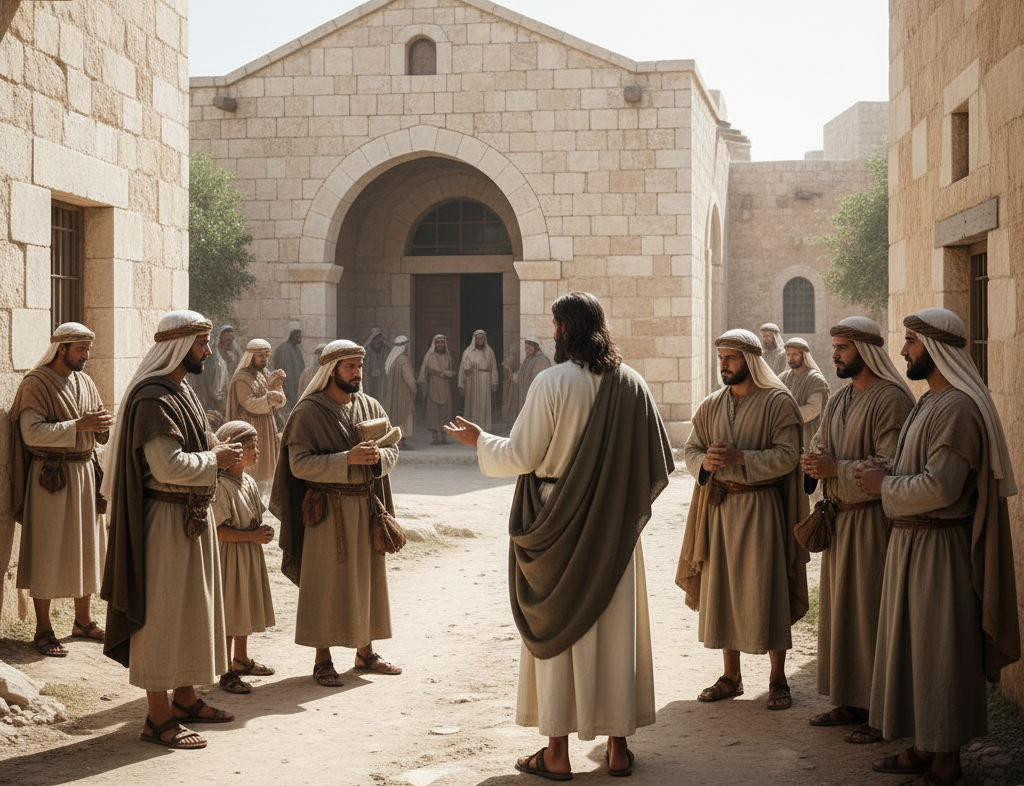
In the Gospels, it is frequently noted that the criticized Jesus the Messiah for the miracles He performed on the Sabbath.

For example, in Mark 3.1-6, Jesus heals a man with a paralyzed hand on the Sabbath. The criticize Him for it, but Jesus answers them by asking whether it is lawful on the Sabbath to do good rather than evil, to save a life rather than to kill.

In Matthew 12.1-8, Jesus' disciples, who were hungry, pick ears of grain to eat on the Sabbath. The criticize this, but Jesus answers them by citing examples from the Old Testament in which the keeping of the Sabbath was interpreted flexibly. He then declares that the Son of Man is Lord of the Sabbath.

Luke 6.6-11 and Luke 13.10-17 report that Jesus performed a healing in a during the Sabbath. The and the scribes were watching Jesus to see whether He would heal on the Sabbath, which would allow them to accuse Him.

Jesus therefore often differed with the over how to honor the Sabbath. For example, the were so attached to the rule of not working that they forgot, in fact transgressed, the commandment to sanctify the Sabbath. By contrast, Jesus (and others, such as the priests of the temple) could keep the Sabbath and dedicate it to while doing works.

These examples show that Jesus had a different interpretation of the Sabbath from the . For Jesus, the Sabbath was a day of mercy and kindness, not a day of strict legal restrictions.

He even declares that He is Lord of the Sabbath in Matthew 12.8 and Mark 2.27-28.

We see the gulf that existed between the interpretation of the Sabbath held by the religious leaders of the time and that of Jesus the Messiah. Moreover, He would not fail to denounce their hypocrisy in Luke 13.15 and Luke 14.5.

By setting Himself up as Lord of the Sabbath, Jesus the Messiah revolutionized the religious legalism of the authorities. He overturned the interpretation and teaching of the sages. Many conflicts flowed from this position. These considered themselves the defenders of the law of Moses; they were the ones who held the knowledge and the competence.

It was therefore unacceptable for a man of the people to take it upon himself to rebuke and contradict them. By denouncing their inconsistencies and their hypocrisy, Jesus the Messiah was indirectly attacking the legal institutions in place. The conflict became inevitable, as we see in the pages of the Gospels. The renown of Jesus the Messiah only hardened the position of these .

We will address the theme of the relationship of Jesus the Messiah to the law in more detail in the appendix ANN037 : Jesus the Messiah and the law of Moses. We see that the Sabbath as practiced in the first century differed greatly from the basic principle: a day of joy and a drawing near to God.

Conclusion

The Sabbath is an essential element in the life of a Jew, flowing directly from the law of Moses, or more precisely, from God Himself. This law, attributed to Moses, was dictated directly by God, as Exodus 31.12-13 mentions.

Jesus the Messiah was often in conflict with the religious leaders of His time over their rigid interpretation of the Sabbath. He did not fail to denounce the hypocrisy of their practices. Faced with these accusations, the , standing firm in their positions, preferred to condemn Jesus the Messiah rather than call themselves into question.

The religious system of that time was the result of many years of drift and of adaptations of the original principles of the law of Moses. Some , who were the official defenders of the application of this law, nevertheless acknowledged that Jesus the Messiah was rightly denouncing contradictions with its fundamental rules.

However, at no time did Jesus the Messiah express a wish to abolish this law, as mentioned in:

Matthew 5.17 (King James Version) :
Think not that I am come to destroy the law, or the prophets: I am not come to destroy, but to fulfil.
.