The article analyzes the Holy Family’s journey to Egypt according to Matthew, and its absence in Luke. It explores the theological and historical implications of this divergence and proposes that the Gospel accounts are complementary.
31 min
journeyEgyptJosephMaryJesus
29 verses
5 books
The study of the journey to Egypt of Joseph, Mary and Jesus rests essentially on the testimony of the Gospel according to Matthew (Matthew 2.13-15). This account, absent from the other Gospel traditions, raises several questions of a historical and literary nature, notably because of the silence of the Gospel according to Luke, which seems to suggest a direct return to Nazareth after the fulfillment of the requirements of the Law (Luke 2.39).
From this point, several questions arise: does the flight into Egypt correspond to a historically plausible event? How should we interpret the absence of this account in Luke, as well as in the Gospel according to Mark and the Gospel according to John? Must we consider a contradiction between the sources or, on the contrary, a complementarity in their composition?
The aim of this study is to examine the data provided by Matthew and Luke, placing them in their historical and theological context, in order to propose a coherent interpretation of the events, while carefully distinguishing what belongs to textual information, to hypothesis and to tradition.
I. Les informations de Matthieu et de Luc
Matthew 2.13-15 (King James Version)
And when they were departed, behold, the angel of the Lord appeareth to Joseph in a dream, saying, Arise, and take the young child and his mother, and flee into Egypt, and be thou there until I bring thee word: for Herod will seek the young child to destroy him.
When he arose, he took the young child and his mother by night, and departed into Egypt:
And was there until the death of Herod: that it might be fulfilled which was spoken of the Lord by the prophet, saying, Out of Egypt have I called my son.
King James Version (1769), domaine public — texte : eBible.org
Luke 2.39 (King James Version)
And when they had performed all things according to the law of the Lord, they returned into Galilee, to their own city Nazareth.
King James Version (1769), domaine public — texte : eBible.org
The account of the flight into Egypt is reported exclusively by the Gospel according to Matthew, who places this event immediately after the visit of the Magi (Matthew 2.13-15). The text describes a divine intervention in the form of a dream, ordering Joseph to flee with the child and his mother in order to escape the threat of Herod the Great. The stay in Egypt lasts “until the death of Herod,” and is interpreted by Matthew as the fulfillment of a prophetic word (Matthew 2.15).
This testimony, however, raises an apparent difficulty when set alongside that of the Gospel according to Luke. Indeed, Luke reports that after fulfilling the requirements of the Law, the family returned to Galilee, to Nazareth (Luke 2.39), with no mention of a stay in Egypt. This wording can give the impression of an immediate succession of events, suggesting a tension between the two accounts.
However, this apparent divergence is not necessarily a contradiction. On the one hand, the Gospel according to Mark and the Gospel according to John do not deal with this period either, their accounts beginning later in the life of Jesus, which limits our documentation to Matthew and Luke. On the other hand, the writing of the Gospels involves choices of selection and condensation of events: Luke, in summarizing the period of childhood, may have deliberately omitted certain episodes in order to favor the continuity of his narrative.
From this perspective, it is possible to consider that the journey to Egypt fits implicitly into the sequence described by Luke, without being explicitly mentioned. Such a hypothesis rests on the idea that the evangelists do not aim at exhaustiveness, but offer theologically oriented accounts adapted to their respective audiences. Matthew, addressing an audience of Jewish origin, highlights the links between the events and the prophetic Scriptures, whereas Luke, writing for a wider audience, favors a more concise and accessible narrative.
Thus, the absence of an explicit mention of the flight into Egypt in Luke allows neither the denial of the existence of this episode nor the conclusion of a direct literary dependence between the gospels. It invites us rather to recognize the diversity of editorial perspectives within the Gospel traditions, and to consider the accounts as complementary rather than strictly opposed. This question therefore opens the way to a deeper analysis of the motives and circumstances of this flight.
Luc 2.39 (S21)
39 Après avoir accompli tout ce que prescrivait la loi du Seigneur,
(Voyage en Egypte)
Joseph et Marie retournèrent en Galilée, à Nazareth, leur ville.
(Louis Segond translation )
II. Pourquoi fuir en Egypte ?
Matthew 2.13-15 (King James Version)
And when they were departed, behold, the angel of the Lord appeareth to Joseph in a dream, saying, Arise, and take the young child and his mother, and flee into Egypt, and be thou there until I bring thee word: for Herod will seek the young child to destroy him.
When he arose, he took the young child and his mother by night, and departed into Egypt:
And was there until the death of Herod: that it might be fulfilled which was spoken of the Lord by the prophet, saying, Out of Egypt have I called my son.
King James Version (1769), domaine public — texte : eBible.org
The flight into Egypt of Mary, Joseph and Jesus takes place in a context of immediate threat linked to the reign of Herod the Great. According to the account of the Gospel according to Matthew, he explicitly plans to put the child to death (Matthew 2.13; Matthew 2.16), which gives the situation a character of urgency that excludes any intermediate solution.
The circumstances surrounding the birth of Jesus may have helped to increase his local visibility. The testimony of the shepherds (Luke 2.17-18) and the coming of the Magi from the East (Matthew 2.1-2) are, within the limited setting of Bethlehem, elements likely to have attracted attention. Without allowing us to measure their impact precisely, these events make plausible the hypothesis of a swift identification in the case of an inquiry ordered by Herod.
In this context, the order given to Joseph in a dream (Matthew 2.13-15) appears as the trigger of the departure. The choice of Egypt can be explained by geopolitical considerations, since this territory escaped Herod’s direct authority and sheltered large Jewish communities likely to offer refuge. It also fits into a theological perspective, Matthew interpreting this episode as the fulfillment of a prophetic word (Matthew 2.15; cf. Hosea 11.1).
Thus, the flight into Egypt appears less as an arbitrary decision than as a coherent response to a threat perceived as imminent, combining both practical considerations of safety and a theological reading of the events.
III. Le départ précipité pour l’Egypte
The departure for Egypt, as reported by the Gospel according to Matthew, occurs in a context of urgency, following the warning Joseph received in a dream (Matthew 2.13-14). The text specifies that this departure took place by night, which can be interpreted as a sign of haste and imminent danger, rather than as a usual way of travelling.
The practical details of the journey are not described by the sources. Any attempt at reconstruction — whether of the route, the means of transport or the length of the trip — is therefore a matter of hypothesis. It is nevertheless plausible that the family joined busy routes, notably those used by the caravans linking Judea to Egypt, in order to benefit from a degree of safety.
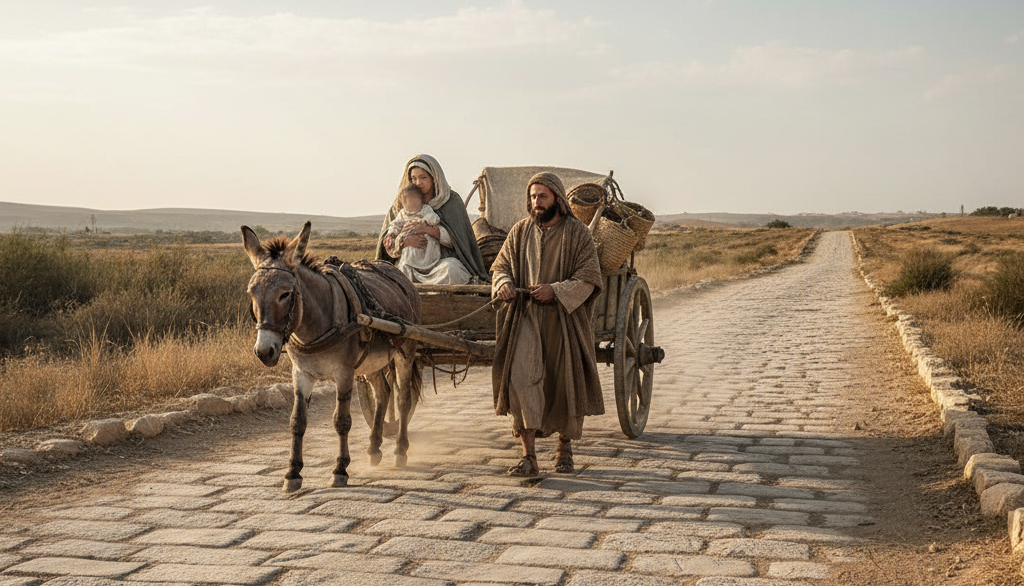
As for the means of transport, no explicit indication is given. The hypothesis of the use of a pack animal or of a rudimentary means of transport, such as a cart, may be considered, notably because of the presence of a young child and the need to carry personal belongings. However, in the absence of precise textual or archaeological data, this proposal must be regarded with caution.
The exact destination in Egypt remains unknown. Given the existence of large Jewish communities in this region, it is conceivable that the family sought refuge in a culturally familiar environment, though this cannot be established with certainty. Likewise, the length of the journey and the material conditions of the trip cannot be determined precisely. The Gospel account is limited to indicating a prolonged stay “until the death of Herod” (Matthew 2.15).
The gifts offered by the Magi (Matthew 2.11) have sometimes been interpreted as having possibly eased the material conditions of this journey and of the stay in Egypt, although this interpretation remains hypothetical. Thus, in the absence of precise data, it is appropriate to distinguish clearly between the information attested by the sources and possible reconstructions.
IV. La citation du Prophète Osée
Matthew takes up, without citing it, the words of the Prophet Hosea.
Matthew 2.15 (King James Version)
And was there until the death of Herod: that it might be fulfilled which was spoken of the Lord by the prophet, saying, Out of Egypt have I called my son.
King James Version (1769), domaine public — texte : eBible.org
We do not think that Joseph or Mary had the prophecy of Hosea 11.1 in mind when they left for the land of Egypt.
Hosea 11.1 (King James Version)
When Israel was a child, then I loved him, and called my son out of Egypt.aNotetake off: Heb. lift up
King James Version (1769), domaine public — texte : eBible.org
The Gospel according to Matthew establishes an explicit link between the flight into Egypt and the fulfillment of a prophetic word: “Out of Egypt I called my son” (Matthew 2.15). This phrase refers to the book of the prophet Hosea (Hosea 11.1), where it applies initially to the people of Israel: “When Israel was a child, I loved him, and out of Egypt I called my son.”
In its original context, this passage evokes the Exodus and the relationship between God and Israel, collectively designated as “son.” At first reading, then, the text does not present an explicit reference to an individual messianic figure. The connection made by Matthew is thus an interpretive rereading of the prophetic text.
This interpretation can be understood within the framework of typology, in which Jesus is presented as recapitulating the history of Israel. Just as Israel is called out of Egypt, Jesus, as “Son,” repeats and fulfills this course in a theological perspective. Such a reading is characteristic of Matthew’s approach, which frequently draws correspondences between the events of the life of Jesus and the Scriptures (Matthew 1.22; Matthew 2.17).
On the other hand, nothing in the text allows us to affirm that Joseph and Mary were aware, at the time of the events, of this prophetic dimension. The account suggests rather that the interpretation is formulated after the fact by the evangelist, from a theological perspective aimed at illuminating the meaning of the events.
Thus, the quotation from Hosea should not be understood as the direct announcement of a specific event, but as a theological rereading integrating the life of Jesus into the history of Israel’s salvation.
V. La durée du voyage
The length of the journey and of the stay in Egypt remains difficult to establish precisely, because of the fragmentary nature of the sources. The account of the Gospel according to Matthew is limited to indicating that the family remained there “until the death of Herod the Great” (Matthew 2.15), without providing other chronological markers.
The exact destination in Egypt is not specified. Given the existence of large Jewish communities in this region, notably in Alexandria, it is conceivable that the family sought refuge in a culturally familiar environment, though this cannot be established with certainty.
Any attempt to estimate the length of the trip or of the stay is therefore based on hypotheses. Depending on the distances and the travelling conditions of the time, the journey may have lasted several weeks; however, no textual data allows us to fix its length precisely. Likewise, the stay in Egypt may have extended over a variable period, ranging from a few months to several years, depending on the date adopted for the death of Herod and the moment of departure.
Some chronological reconstructions propose more precise datings for the departure and the return. However, in the absence of explicit sources, these proposals must be regarded with caution and cannot be accepted as established facts.
The return to Israel is likewise presented as following a divine intervention, conveyed in a dream to Joseph (Matthew 2.19-22). The account specifies that the family avoids Judea and goes to Galilee, to Nazareth, without providing further indications about the conditions of the journey.
Finally, the later traditions that propose detailed itineraries or prolonged durations of stay in Egypt do not rest on sources contemporary with the events and must be distinguished from the data drawn from the Gospel text. Thus, the historical study of this period invites us to recognize the limits of our knowledge, clearly distinguishing the information attested by the sources from later reconstructions.
The question of a possible earlier marriage of Joseph belongs to interpretive traditions later than the Gospel accounts. Indeed, the Gospels give no explicit indication in favor of such a former state. This issue is closely linked to the interpretation of the passages mentioning the “brothers” and “sisters” of Jesus (Matthew 13.55-56; Mark 6.3).
Several readings have been proposed in the history of exegesis. Some interpreters understand these terms in a direct sense, as designating children born of the union of Mary and Joseph after the birth of Jesus. Other traditions, notably patristic ones, have proposed alternative interpretations, seeing in these “brothers” either close relatives or children born of a possible earlier marriage of Joseph.
From a historical perspective, however, one must take into account the sociocultural setting of first-century Judaism, in which having descendants was a strongly structuring social norm. Marriage is ordered toward the transmission of the family line, and fertility holds a central place in it. Childlessness could be perceived as a situation of shame or disgrace, as the case of Elizabeth and Zechariah illustrates (Luke 1.25).
In this context, the hypothesis of a family life in keeping with the customs of the time — including the birth of several children within the couple formed by Mary and Joseph — appears the most coherent on the sociological level. Conversely, the hypothesis of an earlier marriage of Joseph belongs mainly to later interpretive constructions, without direct support in the oldest sources.
However, in the absence of explicit data, a distinction must be maintained between what belongs to historical plausibility and what can be established with certainty. While some hypotheses appear more coherent than others in light of the context, none can be decisively demonstrated from the available textual data alone.
VII. L’hypothèse d’un séjour prolongé en Égypte dans la tradition islamique
Certain extra-biblical traditions, notably those from the religious framework of Islam, mention a prolonged stay in Egypt of the family of Jesus, sometimes estimated at about three years. In this perspective, Jesus is regarded as a prophet, and later accounts associate this stay with various places, such as Deir el-Moharraq, located in Upper Egypt, where various miraculous events are said to have occurred.
These traditions mention in particular extraordinary manifestations, such as the destruction of idols or the appearance of springs, attributed to the child Jesus. However, these elements do not rest on the oldest sources concerning the life of Jesus, in particular the Gospels, which report no episode of this kind during his childhood.
From the standpoint of historical analysis, these accounts must be regarded with caution. They belong to late traditions, whose purpose is often theological or devotional rather than documentary. In the absence of contemporary testimonies or independent sources, it is not possible to integrate them as historically established data.
Moreover, according to the testimony of the Gospels, the first public miracle of Jesus took place at (John 2.1-11), which reinforces the idea that the accounts of miracles attributed to his childhood belong to later developments.
Thus, although these traditions may be of interest for the study of religious representations and their evolution, they must be distinguished from the data drawn from the canonical sources, which remain the main references for a historical approach to the life of Jesus.
Conclusion
The study of the stay in Egypt of Mary, Joseph and Jesus brings out real documentary limits, while still allowing a coherent historical core to emerge. The testimony of the Gospel according to Matthew is the main source for this episode (Matthew 2.13-23). Although this testimony stands alone, it fits into a credible historical context, notably because of the profile of Herod the Great, whose violence and suspicion of any potential threat are attested by the ancient sources.
Moreover, the localized nature of the event, as well as the probably limited number of witnesses, may explain the absence of mention in other contemporary sources, without thereby invalidating Matthew’s account. From this perspective, the hypothesis of a historical basis for the flight into Egypt appears the most coherent, even if its precise details — route, length of stay, material conditions — remain unknown.
The later traditions, often rich in detail, must be distinguished from the Gospel testimony itself. In the absence of assured historical foundations, they belong rather to secondary elaborations.
One point remains solidly attested by the Gospel according to Luke: at the age of twelve, Jesus is in the Temple at Jerusalem (Luke 2.41-49), which implies that the family was then settled in Nazareth, in Galilee, and took part in the annual pilgrimages linked to the feast of Passover (Luke 2.41). The absence of explicit mention of the flight into Egypt in this account is not a contradiction, but is probably explained by editorial choices proper to the evangelist.
Thus, despite the documentary gaps, all the available data allow us to regard the flight into Egypt as a historically plausible and coherent event, whose general reality can be retained, while acknowledging the limits inherent in any precise reconstruction.
A title, a person, a place, a reference (“Luke 15”)…
opens in a new window
Bible reference
INF082
Information note
INF082 - The Segond 21 Bible (S21)
The Segond 21 Bible (S21)
The Segond 21. Here is some key information about this version:
Background and aims
Publication date: 2007 Modernisation: The Segond 21 aims to modernise the language of Louis Segond's translation while remaining highly faithful to the original Hebrew and Greek texts. Clarity and accessibility: The emphasis is on making the text clear and accessible to contemporary readers.
Main features
Faithfulness to the original texts: The Segond 21 draws on the most reliable ancient manuscripts to ensure an accurate and faithful translation. Linguistic revision: The language was revised to reflect modern French usage better while preserving the richness and depth of the biblical text. Notes and references: The version often includes explanatory notes and references to help readers understand and study Scripture.
Importance
Widespread use: The Segond 21 is widely used in French-speaking Protestant circles, particularly for Bible study and personal reading. Accessibility: Its modernised language makes it accessible to a wider audience, including new generations of readers.
The Segond 21 was produced by a multidisciplinary team of translators, linguists and theologians and took approximately twelve years of work to complete.
These revisions show how Louis Segond's translation has evolved to adapt to linguistic changes and readers' needs over time.
INF088
Information note
INF088 - Cana
Cana
Cana is a town mentioned in the New Testament of the Bible, best known for the first miracle of Jesus the Messiah at the wedding at Cana in Galilee (John 2.1-11).
Here is some further information about Cana:
Historical and geographical background
Location: Cana is situated in the region of Galilee, in northern Israel, near the town of Nazareth. Meaning: The name ‘Cana’ means ‘queen’ in Hebrew, which could symbolise the town's importance in the biblical context.
Jesus' first miracle
Location: The wedding at Cana in Galilee (John 2.1-11). Description: During this celebration, Jesus the Messiah turns water into wine after Mary, his mother, tells him that the wine has run out. This miracle is often interpreted as a metaphor for spiritual transformation and the new covenant brought by Jesus.
Theological importance
Symbol of Jesus' glory: This miracle is Jesus' first in the Gospels and reveals his glory and divine power. Faith and obedience: Mary plays a crucial role by informing Jesus and obeying his instructions, demonstrating faith and trust in Jesus.
Bible references
John 2.1-11: This passage describes in detail the miracle of turning water into wine at the wedding at Cana.
Cana remains a symbolic town in Christian tradition, recalling the beginning of Jesus' public ministry and the manifestation of his divine power.