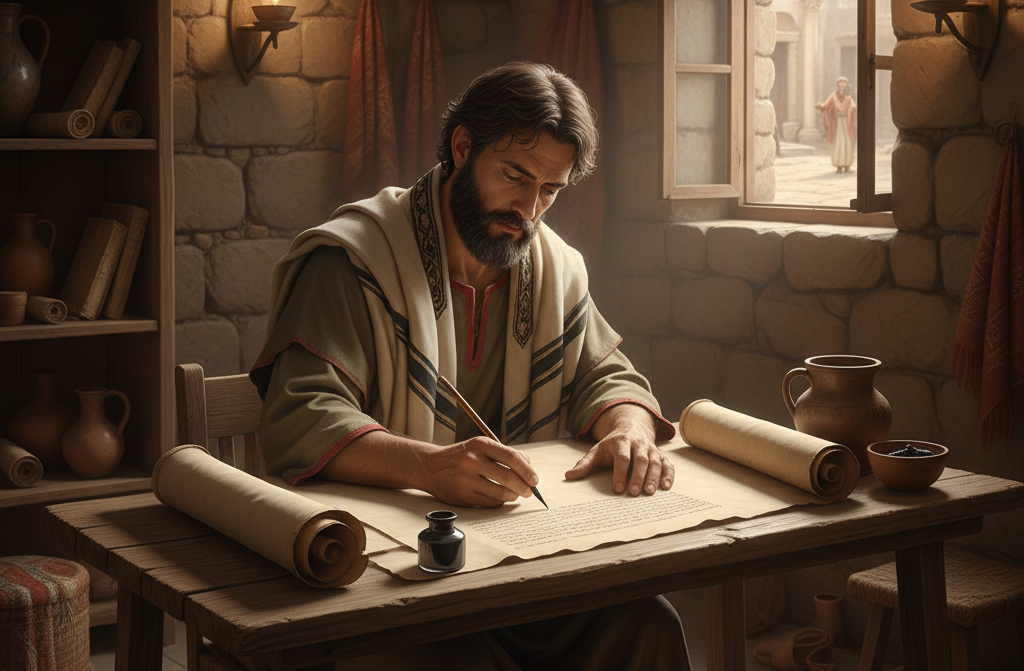
The Gospel according to Mark holds a place apart among the four accounts. Its origins, its composition and the links between Mark and the events he reports, illuminated by historical sources and tradition, establish the credibility of its author.
28 min
Gospel of MarkCompositionNew Testament
14 verses
5 books
In this appendix we will summarize the information we find mainly in the Bible, and in particular in the New Testament.
Many commentators on the texts of the New Testament claim that the Gospel of Mark was the first to be written, followed by those of Matthew and Luke, and finally that of John.
However, the hypothesis that Mark came first is disputed, and other experts rather place Matthew first, just before Mark. In the chapter entitled "The Gospels", we explain the reasons that led us to defend the hypothesis that Matthew came first.
The Gospel of Mark followed quickly, so that we could say they were published almost simultaneously. In this study we will analyze the origins of this Gospel without going into details that anyone can read on the Internet.
I. Mark, the author of the Gospel
We note that the books of Mark and John are signed indirectly; in John's case, this is done through the recurring expression "the disciple whom Jesus loved", and in Mark's case, through an unusual and very personal anecdote.
As for the Gospel of Mark, it is not strictly speaking a signature, but rather a personal note that guides us toward identifying the author.
But who was this young man? He seems to be the author of this Gospel, since he is the only one to know such an intimate detail. Luke reports another fact which, as we shall see, will allow us to identify this person.
We are a few months after the death of the Messiah Jesus, and Mark is a well-known man. His mother, Mary, very active in supporting the disciples, is called "the mother of John, whose other name was Mark".
But what link allows us to affirm that the Mark of the Gospel and John, also called Mark, son of Mary, are one and the same person?
The young man mentioned in the Gospel of Mark could not have known when and where the Messiah Jesus and his disciples would go on the night of the arrest, unless he himself was in the same house, the house of Mary mentioned by Luke.
In that case, Mary is the mother of Mark, the author of the Gospel that now bears his name. We notice that when two disciples bear the same name, they are often distinguished by a nickname, such as James the son of Zebedee and the other James, the son of Alphaeus. James, the brother of the Lord, was called the Just, James the Just.
No other Mark is mentioned in the Gospels. We can therefore affirm that Mark, the author of the Gospel, is that young man running at night through Jerusalem and that he is the son of Mary, owner of a large house in Jerusalem.
This young man was therefore not one of the Apostles and was not a direct witness of what he is going to write for us. Under these conditions, why was this writing considered authentic?
What are Mark's sources?
II. An interesting testimony
Eusebius, bishop of Caesarea, cites around the year 325 the testimony of Papias, bishop of Hierapolis (around the years 125-130), who himself reported the statements of a certain John the Elder, who could be the apostle John. Here is what he says:
"Mark, who had been Peter's interpreter, wrote down accurately everything he remembered, though not in order, of the words and deeds of the Lord. For he had neither heard the Lord nor been his disciple, but later, as I mentioned, was Peter's. Peter gave his teachings as needs required, without seeking to give an orderly account of the Lord's discourses. So Mark committed no error in writing down some things just as he remembered them. His one concern was to omit nothing of what he had heard and to report nothing but the truth."
This quotation gives us the following information: Mark, or John Mark, was the interpreter of the apostle Peter. This testimony goes back to the apostle John, author of the fourth Gospel.
Indeed, given the importance of the apostle Peter, it is surprising that he did not write a Gospel himself. We would like to stress two points: the first, why did Peter, as he did for his epistles or like Paul, not sign this writing if he was its main source?
The second, how is it possible that at no point, in reading this text, do we sense a mere secretary who is content to write down what is dictated to him?
Indeed, reading these lines, one has the impression that the one writing lived what he describes!
III. The Gospel according to Mark
The attribution of the writing of this Gospel to Mark did not occur until the end of the 2nd century. At that time, Mark, already deceased, was very well known in Christian circles.
So it was not Mark himself who claimed authorship of this work. The habit was already established: it was Mark who had written this Gospel, and the title 'according to Mark' merely confirmed what was obvious to everyone at the time.
It is probably to restore a historical point that was important in his view that Eusebius reports to us the information we mentioned. Perhaps he simply wished to support the authenticity of this writing?
It seems obvious that, even if Mark was not an apostle, he was a disciple. Thanks to his mother, Mary, he drew close very early to the circle of intimates who followed Jesus, the Messiah.
Thus, even if he was not a witness of all the miracles he reports, he nevertheless attended some of the events. He also knew most of the facts that Peter told him.
Moreover, he spent time with the apostles, who often met, especially during the great Jewish feasts, in his mother's house. It is for all these reasons that, when we read Mark's accounts, we have the impression that he was a direct witness of them.
IV. The house of Mary
Mark remains discreet in his writing. When he mentions the house where the Lord's last meal would take place, he does not state explicitly that it is the house of Mary, his mother.
Instead, he provides details that maintain a certain confidentiality about the location of the place. This discretion contrasts with Luke's second book, which clearly discloses all the details.
This difference leads us to think that the book of Acts of the Apostles, written by Luke, was published at a time when the witnesses were no longer at risk of being persecuted, which is not the case when Mark's account was written.
We observe that Luke in his Gospel, even though it was written later than Mark's, still takes precautions in describing the house of Mary, whereas in his second work he reveals all the details.
This episode reminds us of the account of Mark 11.1-7, where we observe the supernatural knowledge of the Messiah Jesus. In our case, caution was called for, because the religious authorities were seeking information about the group of apostles with the aim of arresting them as well Mark 14.11, John 11.57.
This testimony, attributed to the apostle Peter and cited by Mark and then taken up by Luke, leads us to suppose that it is the house of Mary, the mother of Mark. Mark, living in this dwelling, could have discreetly followed the events of the meal, the departure of the group and been present at the final arrest. He could not openly reveal that it was his mother's house, but the details could only have come from someone close, a direct witness of the events.
The fear of the Jewish religious authorities was palpable. Too many details could allow the authorities to locate the meeting place, thus endangering Mary, his mother, as well as her servants. This house would later become a gathering place for disciples seeking refuge.
The resurrection of the Messiah Jesus and Peter's speech at Pentecost were surely triggering factors in Mark's personal commitment. He was therefore a witness of the last moments of the Messiah Jesus' earthly life and present at Pentecost, this gathering being held, in all likelihood, in this same house. It is unlikely that the disciples had several large houses in Jerusalem. The hypothesis of this single house, that of Mary, mother of John whose other name was Mark, becomes logical and helps us understand the course of events at the last Passover meal.
Mary, the mother of John Mark, was well known to the Messiah Jesus and the disciples, which facilitated her son's introduction into this group. Judas Iscariot was also present in this house, but he did not lead the soldiers there for the arrest of the Messiah Jesus.
It seems that Judas did not wish to denounce his former companions, but only the Messiah Jesus. By his suicide, he escaped the interrogations of the Jewish religious authorities, who wished to eradicate this nascent movement by persecuting the disciples and their supporters.
The disciples were in hiding, and this young man, Mark, fled, leaving his tunic in the hands of his assailants. It was spring, in the middle of the night, and everyone was asleep, so Mark probably did not get too cold and, above all, narrowly escaped capture.
Mary, the mother of John whose other name was Mark, thus owned a house in Jerusalem, which became a rallying point for the apostles. It was large enough to welcome a considerable number of disciples, 120 being present on the day of Pentecost.
Located in a residential district of Jerusalem, this dwelling had maidservants and probably menservants, including the man carrying a jar mentioned in Mark 13.13.
John Mark therefore grew up in a privileged environment. It is clear that Mary had unshakable trust in her servants, men and women, for welcoming the apostles sought by the soldiers was not without risk. They were probably disciples of the Messiah Jesus themselves, as the words of Rhoda in Acts 12.14-16 suggest.
V. Joseph of Arimathea
Some exegetes have suggested a link between Joseph of Arimathea and Mary, the mother of John whose other name was Mark. The Gospels, which provide no information on the identity of Mark's father, allow speculation about various possibilities.
Joseph of Arimathea, considered as the husband or father of Mary, is one of these hypotheses, motivated in particular by the fact that Mary's vast dwelling implies a certain financial comfort. Joseph, known to be a man of considerable standing and probably the owner of a large house, could fit this profile. However, these links remain purely conjectural in the absence of direct scriptural evidence.
There is no direct link between Joseph of Arimathea and Mary, the mother of John whose other name was Mark, mentioned in the biblical texts. Joseph of Arimathea is known for having asked Pilate for the body of Jesus after his crucifixion in order to bury it in his own new tomb, as reported in all four gospels Matthew 27.57-60, Mark 15.42-46, Luke 23.50-54 and John 19.38-42.
Mary, the mother of John whose other name was Mark, is mentioned in the Acts of the Apostles as an important figure of the early Christian community in Jerusalem. Her house served as a gathering place for prayer Acts 12.12.
The Gospels and the Acts of the Apostles make no mention of a family tie or a specific interaction between these two persons. They appear in different contexts and play distinct roles in the accounts of the New Testament.
VI. Peter's special bond with Mark, and Peter's project
Mark's father is never mentioned, which suggests that Mary may have been a widow. He surely belonged to the wealthy religious elite of the time living near the temple.
From his earliest age, Mark is immersed in this environment. Although he is then only an adolescent, he knows the Apostles and the Messiah, Jesus. He maintains a special bond with one of them, Peter.
This affectionate expression surely comes from the fact that Mark was converted during a speech by Peter, perhaps at Pentecost, just after the crucifixion, on 22 May AD 33.
Mark is very committed to this new mission and decides to accompany Paul and Barnabas on a great journey aimed at proclaiming the Good News in the neighboring countries. It is then the year 45.
We notice that Barnabas, the friend and main collaborator of the apostle Paul, is Mark's cousin. Paul agrees to take this young man along as an assistant for the journey.
But not everything goes as Mark had imagined.
Mark evidently did not expect so many difficulties on this journey. He did not manage to keep up with Paul and Barnabas, who were more seasoned. He quickly gives up and returns to Jerusalem.
We can imagine his distress and even the shame of this premature return.
Peter will help this young man overcome this trial. We can suppose that as soon as he returned in 45, Peter, seeing an opportunity, began to work with Mark on writing his Gospel. He had the desire to leave a written testimony for posterity, as is evident from the texts written later.
Peter had understood long before that writing was the most reliable way to leave a trace of his testimony and teaching. He therefore saw to it that his words were put in writing. Silvanus, his secretary, seems to have been entrusted with writing the two epistles.
His Gospel had already been put in writing with Mark long before. This text remained anonymous for the first two centuries, but it was commonly accepted that Peter was its author and Mark the writer or interpreter.
Mark would never have dared, or even wished, to claim the writing of this Gospel. As for the epistles, the principle is different: mentioning the author's name is essential.
Silvanus makes it quite clear that Peter is their author. These letters can be dated before the years 64 to 68, the period corresponding to the persecution led by the emperor Nero.
VII. The text of the Gospel
Mark had received a solid education. His well-off family, living in Jerusalem, had enabled him to have access to the best teachers of the capital. He mastered Greek.
Could the presence of this young intellectual have been a sign for Peter to undertake the writing of a new version of the Gospel? We have already mentioned it: the first version of the Gospel, known as 'according to Matthew', did not entirely meet Peter's expectations.
Indeed, this book, mainly directed toward Jewish readers, needed a revision to speak better to non-Jewish readers, in particular the Greeks.
However, Mark's intellectual qualities do not seem as remarkable as one might have supposed. The majority of scholars agree that the style is rather rudimentary and that neither Mark nor Peter possessed the literary skills of a Paul.
Despite these harsh and surprising criticisms, it is undeniable that this text has been read and reread by hundreds of millions of people.
The Greek style of Peter's two epistles is markedly different, which suggests a significant contribution from Silvanus.
Across the ages, whether in Antiquity, the Middle Ages, the Age of Enlightenment or modern times, these lines have captivated countless readers for undeniably personal reasons. There is truly something exceptional in this Gospel of Mark, and, more broadly, in the whole Bible.
VIII. The adventure of the young Mark
Mark's story does not end there. After the Council of Jerusalem in 49, he wishes once again to accompany Paul and Barnabas on a second journey. About five years have passed, and the position of the apostle Paul has become radical.
The apostle Paul categorically refuses to take Mark back as a helper; his decision is irrevocable. Faced with this situation, Barnabas parts from Paul and decides to leave for the island of Cyprus, where he is from, accompanied by his cousin Mark. Paul, for his part, will leave with Silas.
We have no further details about this journey, because all attention is now captured by Saul of Tarsus, who became the Apostle Paul. It is nevertheless interesting to note that relations between Paul and Mark improved markedly afterward.
Toward the end of his life, Paul requests Mark's help, acknowledging his usefulness for the ministry. If the apostle Paul says this, it is presumably because he personally observed Mark's new qualities.
It seems that Mark and Luke, two authors of the Gospels, spent time together during this period. They probably exchanged views on their respective work, even though the writing of the Gospel of Mark had long been completed.
IX. Date of composition of the Gospel of Mark
It is difficult to determine a precise date of composition for this Gospel. It is important not to confuse composition with translation or copying. The success of this book is due to the fact that, at its first publication, many people could authenticate the events it recounts. The testimony of these first readers strengthened the credibility of the writing.
We must not suppose that these readers were gullible and accepted these extraordinary accounts without proof. They too needed proof, and confirmation by many witnesses still alive was decisive in the spread and success of this Gospel.
We cannot affirm that the first published version was as complete as the one we know today. Some passages may have been added by the authors themselves over the years, before reaching our final version.
This practice is not questionable, but rather reflects the desire of the writers, witnesses of the events, to pass on the most perfect and understandable version.
We are convinced that the first draft of this Gospel was already known before the Council of Jerusalem in 49 and that, from the year 45, Peter and Mark had begun working on this project. Initially, it involved taking up and revising the text of Matthew.
It is for all these reasons that we envisage a publication around the years 46 or 47 at the latest.
X. The ending of the Gospel of Mark
For more information you can consult the chapter: "The Gospels"
The last twelve verses of Mark 16.9-20 do not appear in some of the oldest manuscripts, which has led various scholars to claim that they were added late to the original text.
However, we have testimonies of second-century writers who refer to it. In our modern translations, this passage is often placed in brackets, as the translation does, to indicate that it is not present in all the manuscripts considered original. We are thus facing a debate among experts with no clear consensus.
Reading the text, we notice an abrupt transition between verses Mark 16.8 and Mark 16.9, with no apparent link between these two parts, which indeed suggests an addition to this conclusion. Nevertheless, two important points should be noted. First, the text remains consistent with the other writings of the Gospels and at no point contradicts or departs from the other accounts. Second, the Church included these twelve verses in the canon.
Under these conditions, there is no reason to doubt the authenticity of this account, even though we can consider that it was written slightly later.
We consider two main hypotheses: the first, Mark and Peter concluded their account at verse Mark 16.8, then judged that this ending could be improved, thus adding the last twelve verses later.
The second, the original ending of their account was lost, prompting this new composition. It is even possible that another author, with a certain authority within the Church, made this change based on the accounts of Matthew and Luke.
It seems difficult, given the limited information we have, to determine the true reasons for this change at the end of the Gospel of Mark, but the information it provides aligns with the texts of the other Gospels.
Conclusion
This text attributed to Mark and Peter appears as a revision of that of Matthew, with references to Jewish culture removed. This Gospel seems to be addressed mainly to non-Jews, unfamiliar with the writings of the great prophets mentioned in the .
Although its writing does not reach the literary quality of Paul's writings, its fast pace and its short sequences of events, devoid of embellishment, make it a captivating account, particularly suited to a generation seeking direct information.
Unlike his contemporaries, Mark does not bring new elements and is therefore contained in the accounts of Matthew and Luke. In theory, he could be omitted without significantly altering the overall understanding of these events. However, the importance of this account lies elsewhere: today it perfectly meets the needs of a generation that is turning away from in-depth reading and traditional literary conventions in favor of a more direct approach to information.
The different scenes presented by Mark and Peter resemble our modern comic strips that captivate so many young readers. The living message of the Messiah Jesus, reported in the Gospel of Mark, was probably also intended for the contemporary young generation.
A title, a person, a place, a reference (“Luke 15”)…
opens in a new window
Bible reference
INF082
Information note
INF082 - The Segond 21 Bible (S21)
The Segond 21 Bible (S21)
The Segond 21. Here is some key information about this version:
Background and aims
Publication date: 2007 Modernisation: The Segond 21 aims to modernise the language of Louis Segond's translation while remaining highly faithful to the original Hebrew and Greek texts. Clarity and accessibility: The emphasis is on making the text clear and accessible to contemporary readers.
Main features
Faithfulness to the original texts: The Segond 21 draws on the most reliable ancient manuscripts to ensure an accurate and faithful translation. Linguistic revision: The language was revised to reflect modern French usage better while preserving the richness and depth of the biblical text. Notes and references: The version often includes explanatory notes and references to help readers understand and study Scripture.
Importance
Widespread use: The Segond 21 is widely used in French-speaking Protestant circles, particularly for Bible study and personal reading. Accessibility: Its modernised language makes it accessible to a wider audience, including new generations of readers.
The Segond 21 was produced by a multidisciplinary team of translators, linguists and theologians and took approximately twelve years of work to complete.
These revisions show how Louis Segond's translation has evolved to adapt to linguistic changes and readers' needs over time.
INF012
Information note
INF012 - The different Bible versions
The different Bible versions
There are not several Bibles, whether Protestant, Catholic or otherwise. There are different translations, all of which have the same origins: Greek texts for the New Testament and Hebrew texts for the Old Testament.
The Hebrew Bible contains only the Old Testament.
It is important to note that the so-called New World Translation is subject to criticism, particularly because certain translation choices were made to bring it into line with Jehovah's Witnesses' theology. Some scholars regard these choices as dishonest and indefensible.
The meanings of our words change over time, and some words disappear. It therefore becomes necessary to use terms that readers can understand, hence the successive adaptations.
These are often merely revisions, as we see with the different versions of Louis Segond's or Augustin Crampon's translations. Catholic Christians have added seven further books to their translations, exclusively in the Old Testament. These books are called deuterocanonical or apocryphal.
INF004
Information note
INF004 - The Romans
The Romans
In 63 BC the Roman general Pompey invaded the territory of Israel and took Jerusalem. In 45 BC, thanks to Julius Caesar, Judaism became a legal religion.
Five years later, in 40 BC, Emperor Augustus put an end to the Hasmonean dynasty and appointed Herod the Great, an Idumean and therefore not of royal descent, king of the Jews.
A few years after the death of Herod the Great, in AD 6, Rome changed the status of Judea, together with Samaria and Idumea (the biblical Edom), turning them into Roman provinces placed under the responsibility of Roman procurators.
The sons of King Herod were promoted by the Roman authority to the rank of tetrarchs and governed these various provinces under the aegis of the procurators.
So during the ministry of the Messiah Jesus, a prefect, Pontius Pilate, and a tetrarch, Herod Antipas, shared power. The two men hated each other until the day of the condemnation of the Messiah Jesus (Luke 23.12).
Forty years after the crucifixion of the Messiah Jesus, the Jewish uprising, which began in AD 66, was crushed. Titus destroyed the Temple of Jerusalem in AD 70, and it all ended with the fall of Masada on May 2, AD 73.
Other revolts followed until AD 135.
In AD 130, Emperor Hadrian once again changed the status of the land of Israel by founding a new Roman colony; the name of Jerusalem was replaced by Aelia Capitolina.
The Messiah Jesus carried out His ministry in a territory occupied by the Romans, with a governor appointed by Rome.
At this point in history, three men therefore shared the leadership of the land of Israel:
Pontius Pilate, the Roman prefect, held all powers, particularly over Judea.
Herod Antipas ruled over Galilee and Perea.
The High Priest, Caiaphas, was responsible for religious matters.