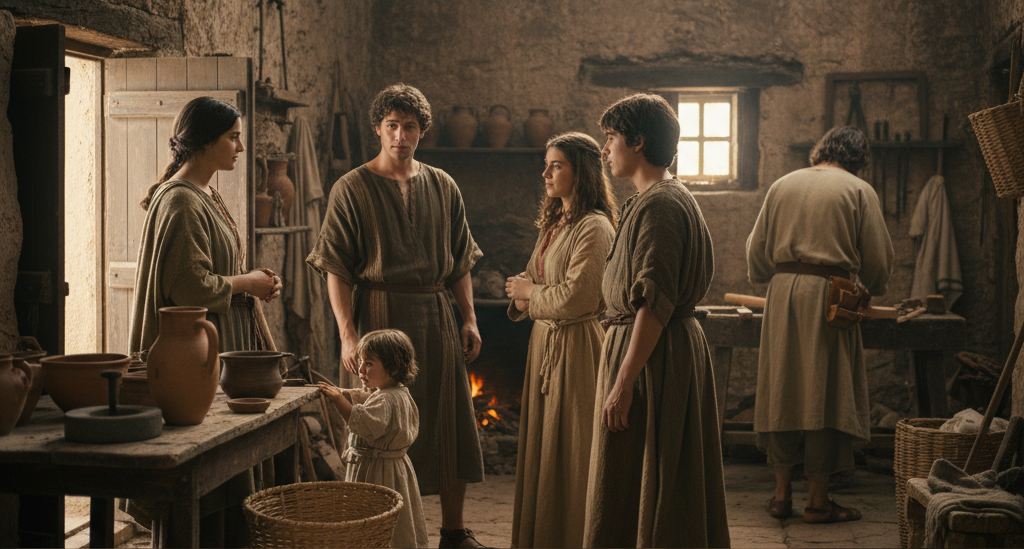
It appears that, once the doctrine of the perpetual virginity of Mary had been progressively affirmed, interpreters developed specific readings of the Gospel passages concerning the “brothers and sisters” of Jesus, in order to offer an understanding compatible with this conviction. These interpretations, though supported by certain real linguistic and cultural arguments, belong to a process of theological harmonization that tends to guide the reading of the text.
In this perspective, the idea that the relative ambiguity of the Gospel data would, on its own, have given rise to the diversity of interpretations within the Christian traditions needs to be qualified. While this indeterminacy did make several readings possible, it also appears that some of them developed within an already established doctrinal framework, which influenced their orientation.
Thus, these positions do not rest solely on a direct analysis of the texts, but belong to broader theological constructions. It is therefore necessary to present them by carefully distinguishing their foundations, in order to differentiate what belongs to textual exegesis from what proceeds from doctrinal elaboration.
1- The Protestant position
The Protestant tradition generally favors a literal and direct reading of the Gospels. In this perspective, the “brothers and sisters” of Jesus are understood as members of a biological set of siblings, children of Mary and Joseph.
This position rests on several elements:
the ordinary meaning of the term adelphos, understood as “brother” in the strict sense;
the absence, in the Gospel texts, of explicit indications suggesting another relationship;
the desire to stay with what the text affirms without adding interpretations derived from later traditions.
In this approach, passages such as Matthew 13.55-56 or Mark 6.3 are read in their most natural sense. The “brothers” appear there as part of an ordinary family setting.
It should be noted, however, that this reading, although it presents itself as strictly textual, also rests on a hermeneutical choice: that of privileging the literal sense of the Greek of the Gospels over possible Semitic cultural influences.
2- The Catholic position
The Catholic tradition affirms the doctrine of the perpetual virginity of Mary, according to which Mary remained a virgin before, during and after the birth of Jesus. Within this framework, the “brothers and sisters” of Jesus cannot be understood as children of Mary.
Several interpretations have been proposed to account for the texts:
identification of the “brothers” as cousins or close relatives;
appeal to the broader use of the term “brother” in the Semitic context;
connections between certain figures mentioned in the Gospels in order to propose indirect family ties.
This position rests both on exegetical arguments (flexibility of the vocabulary, cultural context) and on the continuity of the church’s tradition. The doctrine itself belongs to a broader theological reflection on the person of Mary and her role in the history of salvation.
From a methodological point of view, it is important to stress that this reading does not derive solely from the Gospel texts taken in isolation, but from a coherent whole integrating Scripture, tradition and theological interpretation.
3- The position of the Orthodox Churches
The Orthodox Churches generally adopt an intermediate position, identifying the “brothers” of Jesus as half-brothers, born of an earlier marriage of Joseph.
This interpretation makes it possible to:
take seriously the Gospel mentions of the “brothers”;
preserve the virginity of Mary;
rely on ancient traditions found in certain non-canonical Christian writings.
As in the case of the Catholic position, this reading goes beyond the textual data alone and belongs to a broader interpretive tradition.
4- Distinction between exegesis and dogma
The examination of these different positions brings out an essential distinction between cwhat the texts allow us to affirm and what the traditions deduce from them.
Exegesis, understood as the analysis of texts in their context, establishes the existence of “brothers and sisters” of Jesus, without specifying the exact nature of their kinship.
Confessional doctrines, for their part, propose interpretations that belong to broader theological systems and respond to specific concerns.
Thus, the divergence between the Protestant, Catholic and Orthodox positions stems not only from a different reading of the texts, but also from distinct hermeneutical frameworks:
priority given to the literal sense of the text;
taking tradition into account;
the articulation between Scripture and doctrine.
Intermediate conclusion
The confessional interpretations of the “brothers and sisters” of Jesus illustrate how a single textual datum can give rise to diverse readings, depending on theological presuppositions and methods of interpretation.
This diversity does not call into question the reality of the Gospel mentions, but underlines the limits of a strictly historical inquiry. It confirms the need to distinguish clearly between what belongs to the textual data and what belongs to their doctrinal interpretation.
It is now appropriate to offer a critical synthesis that brings out the most solid elements of the analysis, while acknowledging the limits inherent in this type of study.