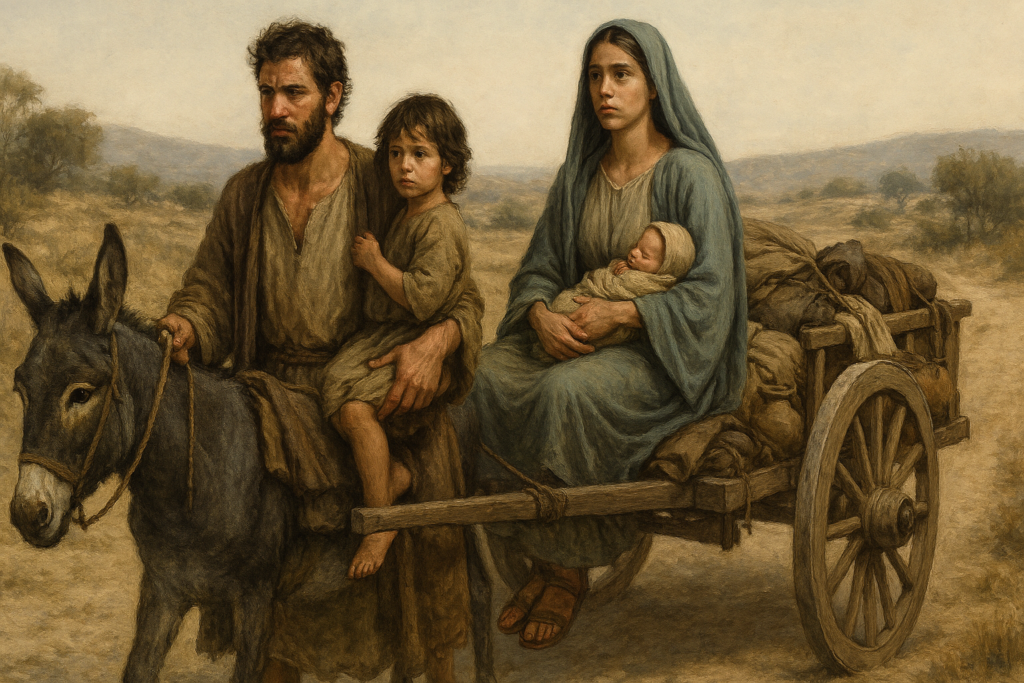
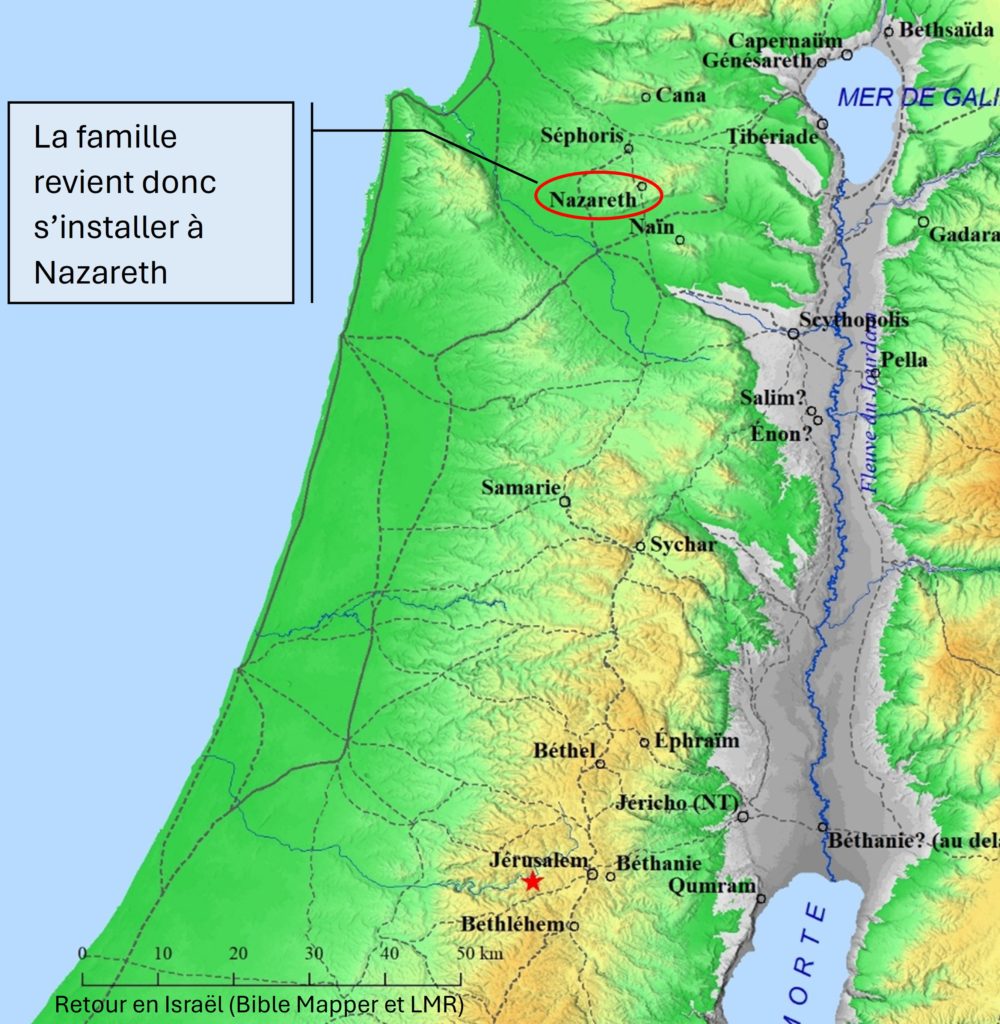
Reading Luke, we get the impression that Joseph, Mary and Jesus return quickly to Nazareth after Jesus' birth. Luke did not deem it necessary to mention the stay in Egypt described by Matthew, probably to avoid overloading his account. The two evangelists had different aims, choosing facts that served their purposes without getting lost in details that might obscure understanding.
Matthew thus supplies additional information that casts a different light on the events. We might envisage the family's return to Nazareth after the political upheaval of Herod's succession and 's decisions, probably after the intense summer heat, around October of the year -1. We therefore suppose they arrived in Nazareth in November that year after a month's travel, bringing the total time away to approximately fourteen months.
The texts convey different impressions: a rapid return to Nazareth in Luke, and a discovery of the town in Matthew. A superficial reading might suggest contradictions, raising doubts about the events' truthfulness.
However, Luke's reason for omitting the stay in Egypt seems straightforward: he chooses to move directly to the return to Nazareth, where the family previously lived, because the detail of the Egyptian stay adds nothing to his presentation. He is addressing non-Jews!
Matthew, meanwhile, highlights Hosea 11.1's prophecy, ‘I called my son out of Egypt’, as further proof of Jesus' messiahship to persuade a Jewish audience, and therefore includes it in his account.
Each evangelist had his own narrative strategy aimed at persuading particular audiences: Matthew addressed Jews, whereas Luke addressed Greeks and non-Jews.
How could a non-Jew understand references to Prophets he had never heard of? The evangelists were also limited by the technical constraints of publishing in their time, such as the size of available papyri.
It is essential to see each Gospel not as an exhaustive account but as part of a whole. Only by bringing Matthew, Mark, Luke and John together do we obtain a complete picture of this extraordinary story.