

_29 One last small point remains to be dealt with: the Messiah Jesus had spoken of resurrection, so it is safer to place guards in front of the tomb. This is the request made to Pilate on the very day of the ; nothing stops these devout men. Matthew 27.62-66.
_30 The resurrection takes place on Sunday morning at dawn. We indeed have the 3 days and 3 nights according to the Jewish inclusive reckoning. Matthew 28.2-4 ; Mark 16.2-4 ; Luke 24.1-3. We take into account the night at midday.
_31 Now come the various appearances of the living Messiah Jesus, starting on Sunday, April 3, AD 33, early in the morning. John 20.11-18 ; Matthew 28.8-10 ; Mark 16.8 ; John 20.24-34 ; Mark 16.13-14 ; Luke 24.13-35 ; Mark 16.14 ; Luke 24.36-49 ; John 20.26-31 ; John 21.1-14.
You can consult the complete chronology in the study ANN026 : The hour of the crucifixion.
Commentary:
1- The First Appearance of the Risen One
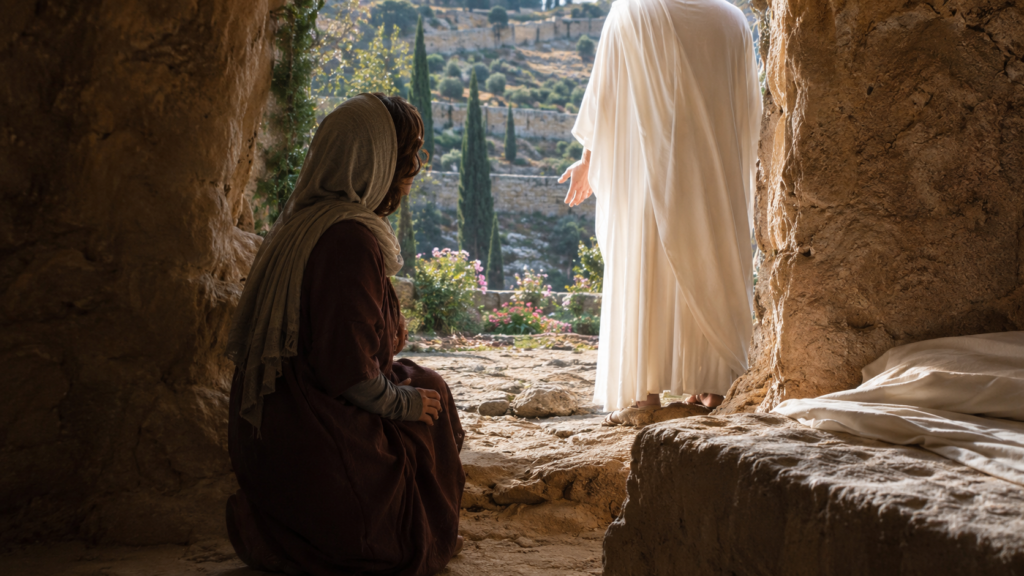
The evangelist Mark states that the first person to whom the risen Christ appeared was Mary Magdalene (Mark 16.9). His account remains very concise, however, and gives no details about the circumstances of this encounter. It is mainly the Gospel according to John that reports this exceptional event in a more developed and more personal way (John 20.11-18).
This first appearance has particular importance in the resurrection accounts, since it places in the foreground a disciple who remained faithful to the end, even while most of the apostles were still in fear and uncertainty (John 20.19).
2- Mary Magdalene’s Persistent Ignorance
The whole Johannine account is an additional argument in favor of the hypothesis that Mary Magdalene was still unaware of the resurrection when she returned to the tomb.
Her dialogue with the two angels shows that she remains convinced that Jesus’ body has been moved: “They have taken away my Lord, and I do not know where they have laid him” (John 20.13). Had she already heard the announcement made to the other women: “He is not here, for he has risen” (Matthew 28.6; Luke 24.6), such a reaction would be harder to explain.
This observation fits with John’s account, which indicates that after warning Peter and the beloved disciple, Mary returned to the tomb when they had already left (John 20.2-10).
3- The Risen One Mistaken for the Gardener
John reports that after her conversation with the angels, Mary turns around and sees Jesus, though without recognizing him at once. She takes him for the gardener of the place (John 20.14-15).
This mistake is particularly significant. It suggests that neither the angels nor the risen Lord appear in a spectacular or terrifying form. Mary speaks to them simply and naturally.
This difficulty in recognizing Jesus is found in other accounts. The disciples of Emmaus walk with him for a long time without discerning his identity (Luke 24.13-16), and the disciples gathered on the shores of do not recognize him at once (John 21.4-7). These various scenes show that the appearances of the Risen One have a distinctive character that goes beyond ordinary human experience (1 Corinthians 15.42-49).
4- An Affection Stronger Than Any Hope of Resurrection
Convinced that she is dealing with the keeper of the garden, Mary asks him where the body has been taken so that she herself may take it back (John 20.15).
This request testifies to her deep attachment to her Master. Her only concern is still to find the one she continues to call “my Lord” (John 20.13). Nothing in her words suggests that she expects an imminent resurrection.
This attitude confirms once again that the first witnesses did not at all expect the event that had nevertheless just fulfilled Jesus’ repeated predictions (Matthew 16.21; Mark 8.31; Luke 18.31-34).
5- The Personal Call of the Good Shepherd
The turning point of the account comes when Jesus calls her personally: “Mary!” (John 20.16). She then instantly recognizes her Lord and answers him: “Rabboni!”, that is, “Teacher” (John 20.16).
This recognition seems to rest less on mere visual perception than on the familiar voice of the one she had followed for several years. The scene naturally recalls the words of the Good Shepherd: “He calls his own sheep by name” (John 10.3) and “My sheep hear my voice, and I know them, and they follow me” (John 10.27).
The link between these two passages is one of the most beautiful theological correspondences unique to the Gospel according to John.
6- Why Does Mary Not Recognize Jesus Immediately?
Several factors may help explain Mary’s initial difficulty in recognizing her Lord. John first emphasizes that she is weeping abundantly (John 20.11). The dim light of dawn, the position of the sun, and the emotional upheaval caused by the recent events may also have played a role.
To this is added the distinctive character of the glorified body of the Risen One. The disciples of Emmaus likewise recognize Jesus only at the breaking of the bread (Luke 24.30-31), while the apostles gathered in the upper room at first think they see a spirit (Luke 24.37).
These various accounts show that the appearances of the risen Christ already belong to the order of the future glory proclaimed by the apostle Paul (1 Corinthians 15.42-49; Philippians 3.20-21).
7- The First Messenger of the Resurrection
John reports no reaction of terror or stupor in Mary. As soon as she recognizes Jesus, the relationship of trust and affection that bound her to her Master naturally resumes its place.
The Lord then entrusts her with a particular mission: to announce to the disciples that he is ascending to his Father and their Father, to his God and their God (John 20.17). Mary Magdalene thus becomes the first messenger of the resurrection: “Mary Magdalene went and announced to the disciples that she had seen the Lord” (John 20.18).
Mark also summarizes this mission by recalling that Jesus appeared first to Mary Magdalene (Mark 16.9-10).
8- A Woman’s Testimony in the Context of the First Century
This mission has particular importance in the context of first-century Judaism, where the testimony of women generally did not carry the same legal value as that of men.
It is therefore remarkable that God chose precisely a woman to become the first herald of the resurrection. This choice shows that divine criteria often differ from those of men (1 Samuel 16.7) and recalls Paul’s words: “God chose the weak things of the world to put to shame the strong” (1 Corinthians 1.27-29).
9- A Personal Memory Carefully Preserved
The remarkable precision of the details reported by John suggests that they come, directly or indirectly, from Mary’s own testimony.
Indeed, no other human witness seems to have been present at this private conversation between the Risen One and this disciple. The words exchanged, the emotions expressed, and the progression of the account bear the marks of a personal memory carefully preserved and handed down within the early Church (Luke 1.1-4).
Without being able to demonstrate it with certainty, it is not impossible that John deliberately preserved this testimony in order to honor the memory of this faithful woman.
10- A Model of Faithfulness and Perseverance
The contrast with the apostles appears particularly striking. While they remain shut in for fear of the (John 20.19) and receive the first announcements of the resurrection with unbelief (Luke 24.11), Mary Magdalene shows remarkable faithfulness.
Her perseverance leads her to remain near the tomb while Peter and John have already left (John 20.10-11). It is in this solitude and incomprehension that she receives the unique privilege of being the first witness of the risen Christ (John 20.14-18).
Thus Mary Magdalene appears not only as the first witness of the resurrection, but also as one of the most endearing figures of the Easter accounts. Her example illustrates the faithfulness of a disciple who, having come to look for a dead man, finally meets her Lord alive.