

_29 One last small point remains to be dealt with: the Messiah Jesus had spoken of resurrection, so it is safer to place guards in front of the tomb. This is the request made to Pilate on the very day of the ; nothing stops these devout men. Matthew 27.62-66.
_30 The resurrection takes place on Sunday morning at dawn. We indeed have the 3 days and 3 nights according to the Jewish inclusive reckoning. Matthew 28.2-4 ; Mark 16.2-4 ; Luke 24.1-3. We take into account the night at midday.
_31 Now come the various appearances of the living Messiah Jesus, starting on Sunday, April 3, AD 33, early in the morning. John 20.11-18 ; Matthew 28.8-10 ; Mark 16.8 ; John 20.24-34 ; Mark 16.13-14 ; Luke 24.13-35 ; Mark 16.14 ; Luke 24.36-49 ; John 20.26-31 ; John 21.1-14.
You can consult the complete chronology in the study ANN026 : The hour of the crucifixion.
Commentary:
1- An apparent difficulty between Mark and Matthew
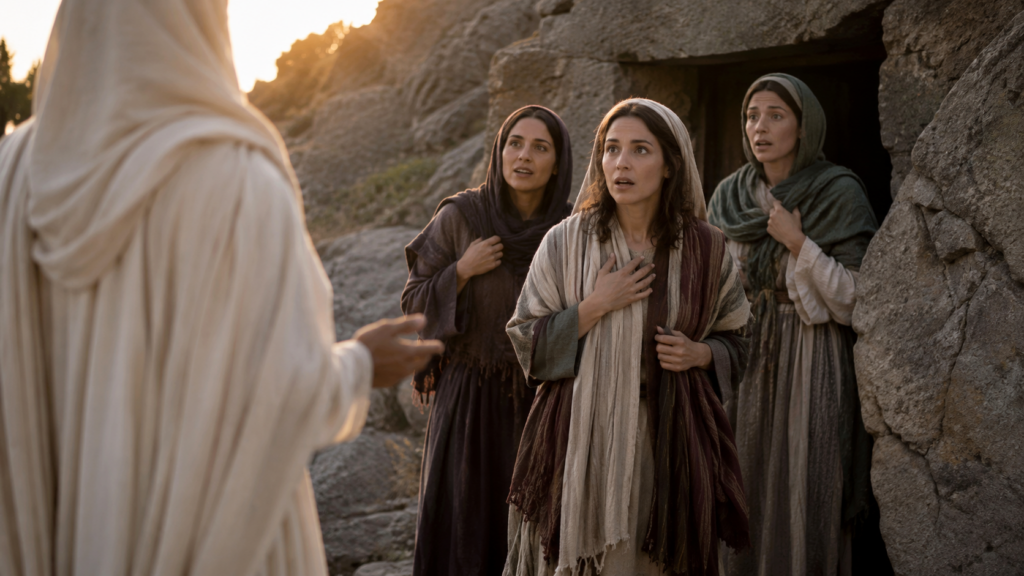
Mark's statement that the women “went out quickly, and fled from the sepulchre; for they trembled and were amazed: neither said they any thing to any man; for they were afraid” (Mark 16.8) may, at first sight, seem hard to reconcile with Matthew's account, which reports that they then met Jesus himself (Matthew 28.9-10).
However, a careful reading shows that these two accounts appear more complementary than contradictory. The evangelists describe different moments of one and the same sequence of events and emphasize particular aspects of the women's experience.
2- The women's immediate reaction
Mark describes above all the women's spontaneous reaction as they leave the tomb. They have just discovered the empty sepulchre and heard the extraordinary announcement of the young man clothed in white: “He is risen; he is not here” (Mark 16.5-7).
Faced with such an unexpected event, they are seized with trembling and fear (Mark 16.8). This fear is not incompatible with faith; it corresponds to the feeling frequently experienced in the Scriptures before a manifestation of divine power (Luke 1.12 ; Luke 2.9 ; Luke 24.37).
The expression “neither said they any thing to any man” therefore seems to describe their immediate reaction. It probably does not mean that they kept silent for good, but that they did not stop to tell the people they might have met along the way what they had just seen.
3- A fear mixed with joy
This interpretation seems confirmed by Matthew's parallel account. He specifies that the women left the tomb “with fear and great joy” (Matthew 28.8).
Far from contradicting each other, Matthew and Mark describe the same experience from different angles. The fear mentioned by Matthew corresponds to the one Mark stresses, while Matthew brings out more the joy that gradually accompanies this extraordinary announcement.
The mixture of fear, wonder and joy appears as a natural reaction to an event that surpasses all human expectation.
4- The meeting with the Risen One
It is precisely on their way to Jerusalem that Jesus comes to meet them: “And behold, Jesus met them, saying, All hail” (Matthew 28.9).
The women then come up to him, take hold of his feet and worship him (Matthew 28.9). This detail is of particular importance, for it underlines the bodily character of the resurrection. The women are not in the presence of a mere vision or a spiritual apparition, but of the Lord truly risen (Luke 24.39 ; John 20.27).
Jesus then renews the mission already entrusted to them by the angels and tells them that the disciples will see him again in Galilee (Matthew 28.10).
5- A coherent sequence of events
The most natural chronology seems to be the following:
1- The women discover the empty tomb and receive the message of the angels (Mark 16.5-7 ; Matthew 28.5-7 ; Luke 24.4-7).
2- They leave the place in a mixture of fear and joy (Mark 16.8 ; Matthew 28.8).
3- Under the effect of their emotion, they do not stop to tell their experience to the people they meet on their way (Mark 16.8).
4- As they are heading toward the disciples, Jesus appears to them personally (Matthew 28.9-10).
5- After this meeting, they carry out their mission and report the events to the eleven apostles and to the other disciples (Luke 24.9-10).
Although it cannot be demonstrated with absolute certainty, this reconstruction offers a satisfactory harmonization of the different accounts.
6- Mark's silence is not final
The interpretation according to which the women would have remained silent for good runs into several difficulties.
It would first be incompatible with the command given by the angels to inform the disciples (Mark 16.7). It would also contradict the testimonies of Matthew and Luke, which state explicitly that the women eventually reported what they had seen and heard (Matthew 28.8 ; Luke 24.9-10).
The silence mentioned by Mark therefore seems to be temporary and to correspond to the initial upheaval caused by the events.
7- From fear to worship
The meeting with Jesus marks a gradual transformation of the women's state of mind. The terror that dominated their first reaction gives way to joy, then to worship.
This progression is a recurring theme of the resurrection accounts. The disciples themselves will pass from fear and doubt to certainty and joy (Luke 24.41 ; John 20.20). A few weeks later, those who had shut themselves in for fear of the (John 20.19) will proclaim the resurrection of Christ publicly with remarkable boldness (Acts 2.22-24 ; Acts 4.19-20).
Thus, Mark mainly describes the women's first reaction, while Matthew continues the account by showing how the meeting with the Risen One gradually transforms their fear into joy and worship (Matthew 28.9).
The