

_29 One last small point remains to be dealt with: the Messiah Jesus had spoken of resurrection, so it is safer to place guards in front of the tomb. This is the request made to Pilate on the very day of the ; nothing stops these devout men. Matthew 27.62-66.
_30 The resurrection takes place on Sunday morning at dawn. We indeed have the 3 days and 3 nights according to the Jewish inclusive reckoning. Matthew 28.2-4 ; Mark 16.2-4 ; Luke 24.1-3. We take into account the night at midday.
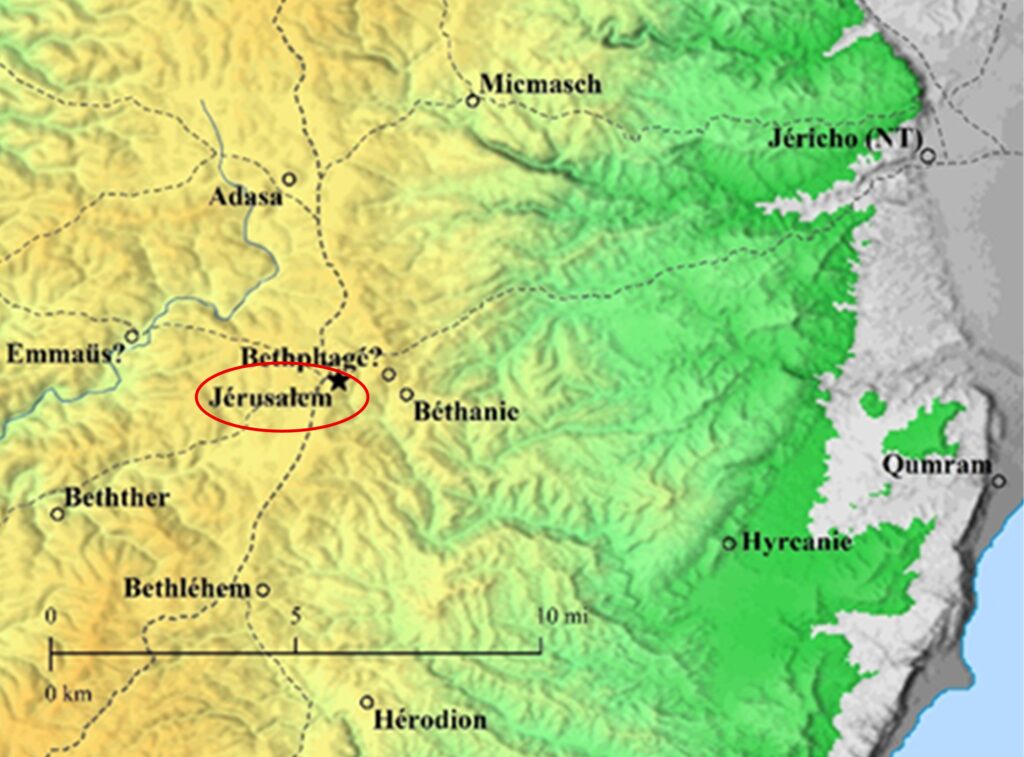
_31 Now come the various appearances of the living Messiah Jesus, starting on Sunday, April 3, AD 33, early in the morning. John 20.11-18 ; Matthew 28.8-10 ; Mark 16.8 ; John 20.24-34 ; Mark 16.13-14 ; Luke 24.13-35 ; Mark 16.14 ; Luke 24.36-49 ; John 20.26-31 ; John 21.1-14.
You can consult the complete chronology in the study ANN026 : The hour of the crucifixion.
Commentary:
1- Mary Magdalene and the First Appearance of the Risen One
John’s account sheds particular light on the circumstances that lead Mary Magdalene to become the first person to whom the risen Lord manifests himself personally (John 20.11-18 ; Mark 16.9). Unlike the other women, she seems to remain alone near the tomb after Peter and John have left, which explains the exceptional encounter she is about to experience.
This privileged place given to Mary Magdalene underscores the importance of her role among the disciples of Jesus. Already during the public ministry, she was among the women who accompanied the Master and supported his work materially (Luke 8.1-3). Her faithfulness to the cross and to the tomb contrasts with the scattering of most of the disciples after the arrest of Jesus (John 19.25 ; Matthew 26.56).
2- The Discovery of the Open Tomb
At daybreak, Mary Magdalene goes to the tomb with other women who have come to complete the burial rites interrupted by the start of the (Mark 16.1-2 ; Luke 24.1). On arriving, they find that the stone closing the sepulchre has already been rolled away (Mark 16.4 ; Luke 24.2 ; John 20.1).
This discovery deeply distresses Mary Magdalene. Nothing indicates that she is thinking of a resurrection at that moment. She immediately interprets the disappearance of the body as the result of human intervention.
3- The First Testimony of Mary Magdalene
Thinking that the Lord’s body has been moved, Mary Magdalene hurries back to Jerusalem to warn Peter and the beloved disciple. Her testimony contains no allusion to an appearance of angels or to a resurrection: “They have taken the Lord out of the tomb, and we do not know where they have laid him” (John 20.2).
This statement seems to indicate that she had not yet witnessed the encounter between the other women and the angels. Several attempts to harmonize the Gospel accounts thus lead to the view that she separated from the group immediately after discovering the open tomb.
4- The Angels’ Announcement to the Other Women
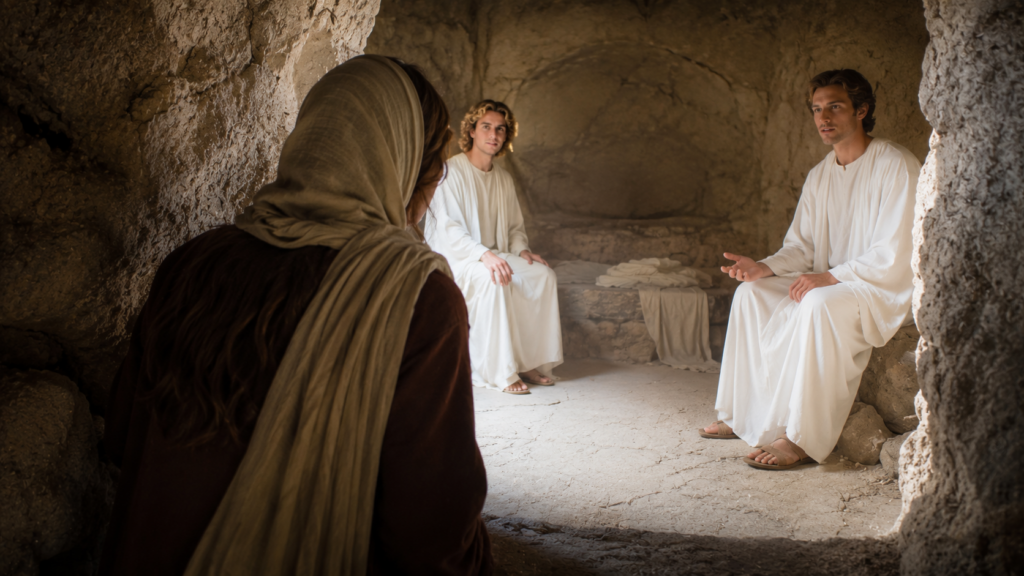
Meanwhile, the other women who stayed behind enter the sepulchre. There they meet heavenly messengers who announce to them that Jesus has risen, just as he himself had said (Luke 24.4-7).
Matthew and Mark also report this announcement, even though they mention only one angel speaking (Matthew 28.5-7 ; Mark 16.5-7). Filled with both fear and great joy, the women leave to carry this news to the disciples (Matthew 28.8).
The angelic announcement does not present the resurrection as an unexpected event, but as the fulfillment of the words Jesus had spoken earlier (Matthew 16.21 ; Luke 9.22 ; Luke 18.31-33).
5- The Visit of Peter and John to the Tomb
Warned by Mary Magdalene, Peter and John go to the tomb at once to verify the truth of her claims (John 20.3-4). At that moment, they still know nothing of the angels’ message.
John himself stresses that the two disciples do not yet understand the meaning of the empty tomb: “For as yet they did not know the Scripture, that he must rise again from the dead” (John 20.9). Their purpose is therefore above all to verify the disappearance of the body.
The fourth Gospel provides particularly precise details about the burial cloths and their arrangement in the tomb (John 20.5-8). These details are probably an indication of the autobiographical character of the beloved disciple’s testimony (John 21.24).
6- The Movements of the Different Groups
The Gospels do not explain why Peter and John do not meet the other women on the way back. In the climate of fear that has prevailed since the arrest and crucifixion of Jesus, it is likely that the different groups were moving with caution.
On the evening of the resurrection itself, the disciples are still gathered behind closed doors “for fear of the Jews” (John 20.19). It is therefore not impossible that each group took different routes to avoid drawing the attention of the religious authorities who had obtained the condemnation of the Master (John 19.15-16).
Any precise reconstruction of these movements nevertheless remains hypothetical, since the evangelists do not seek to describe every chronological detail of this extraordinary morning.
7- Mary Magdalene Remains Alone Near the Tomb
After confirming that the tomb is indeed empty, Peter and John return to Jerusalem (John 20.10). Mary Magdalene, for her part, seems to stay behind. Her deep attachment to the Lord and her incomprehension of the events probably explain her decision to remain near the sepulchre.
Her attitude contrasts with that of the two disciples, who go back to their place of refuge. In the context of persecution and fear that follows the crucifixion, it was no doubt wiser for them not to expose themselves needlessly.
8- The Second Appearance of the Angels
John then reports a new episode. Mary Magdalene sees two angels in white sitting where the body of Jesus had been laid (John 20.11-12).
Her dialogue with them shows that she is still unaware of the reality of the resurrection: “They have taken away my Lord, and I do not know where they have laid him” (John 20.13). Her concern remains focused exclusively on the disappearance of the body.
This lack of understanding seems to support the hypothesis that Mary Magdalene had not been present at the first angelic announcement made to the other women.
9- The First Person to See the Risen One
If Mary Magdalene had already heard the angels’ words announcing the resurrection (Matthew 28.6 ; Luke 24.6), it would be harder to explain why she persists in believing in a mere removal of the body.
It is precisely in this state of sorrow and incomprehension that the risen Lord reveals himself personally to her (John 20.14-16). At first she does not recognize him and takes him for the gardener. But when Jesus calls her by name, she recognizes him at once and cries out: “Rabboni!”, that is, “Teacher” (John 20.16).
Thus the one who had come to honor a dead man becomes the first witness of a living Savior. Jesus then entrusts her with the mission of going to announce this news to the disciples (John 20.17-18). This exceptional privilege granted to Mary Magdalene is also recalled by Mark (Mark 16.9).
10- A Plausible Harmonization of the Accounts
The hypothesis of an early departure by Mary Magdalene offers a coherent explanation of the differences in perspective among the four Gospels. Without claiming to resolve every chronological difficulty, it makes it possible to understand Mary’s initial ignorance of the resurrection, her sorrowful attitude as described by John, and the reasons why she becomes the first person to whom the risen Christ appears.
The evangelists do not seek to provide an exhaustive chronicle of events, but to transmit faithfully the testimony of the first witnesses (Luke 1.1-4). Despite their differences in presentation, the four accounts converge on one fundamental reality: the tomb is empty and Jesus has truly risen (Matthew 28.6 ; Mark 16.6 ; Luke 24.6 ; John 20.1-18).
?