

_24 All these members of the can now take part in the family Passover feast, rested in spirit after what they regard as a magnificent victory. But events are not going to unfold as they imagined!
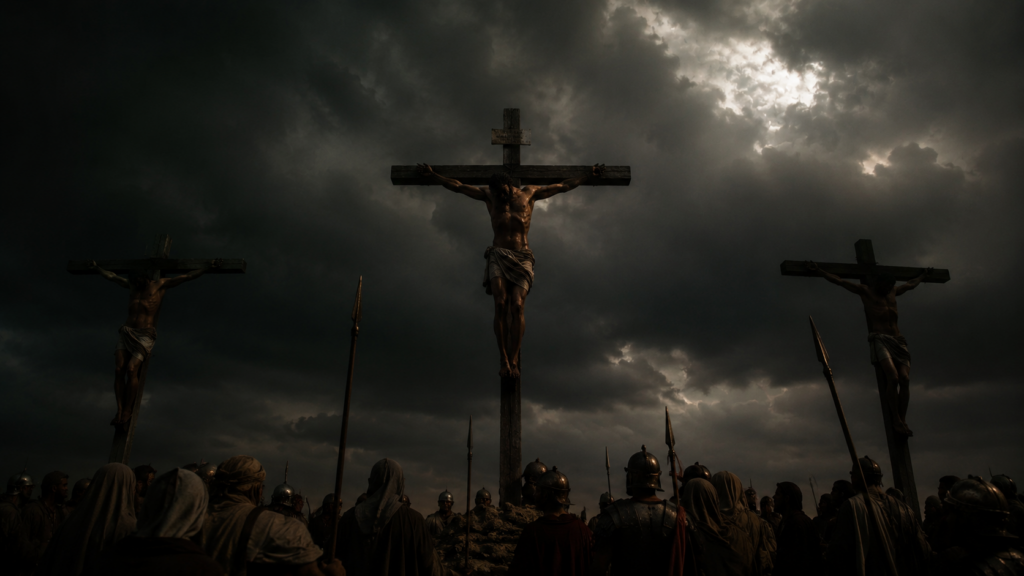
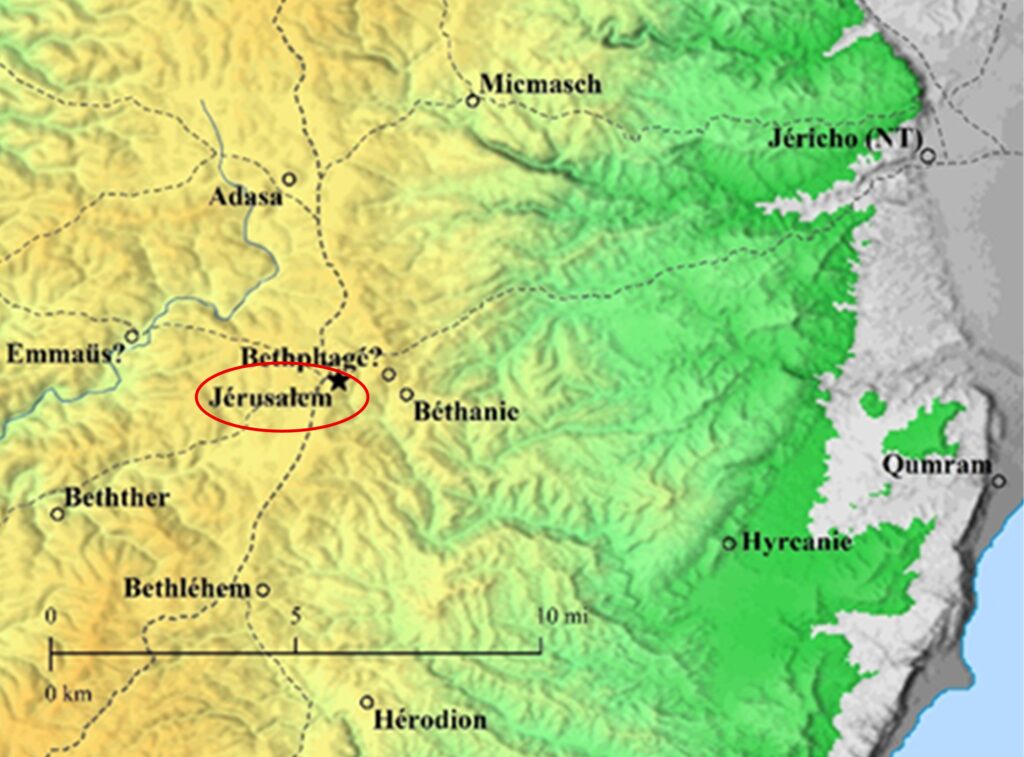
_25 From about noon until 3 p.m., there is darkness over the region of Jerusalem. Matthew 27.45 ; Mark 15.33 ; Luke 23.44.
_26 Death on the cross takes place on Friday, April 1, AD 33, around 3 p.m., according to the Gospels. It occurs before the end of this extraordinary night. The three days and three nights begin with this night, as the Jewish calendar requires.
You can consult the complete chronology in the study ANN026 : The hour of the crucifixion.
Commentary:
The accounts of Matthew and Mark are very close and report essentially the same events (Matthew 27.45-50; Mark 15.33-37). They state in particular that Jesus finally accepts to drink the vinegar offered to him, whereas he had earlier refused the drink mixed with myrrh meant to dull the suffering (Matthew 27.34; Mark 15.23). John, a direct witness of the scene, also confirms this detail in his own account (John 19.28-30).
Luke reports a testimony that is largely consistent, while emphasizing certain particular elements. He cites another saying uttered by Jesus at the moment of his death: “Father, into your hands I commit my spirit” (Luke 23.46). He also highlights the reaction of the Roman who, overwhelmed by the events, acknowledges the innocence of the crucified man: “Certainly this man was righteous” (Luke 23.47). Finally, Luke adds that many of the spectators leave the place beating their breasts, a sign of regret, fear, or repentance (Luke 23.48).
As is often the case, it is John who provides additional information left unmentioned by the other evangelists. His account helps us better understand the events that follow immediately after the death of the Messiah Jesus.
The Jewish religious authorities are indeed concerned that the bodies should not remain exposed on the crosses after sunset. The feast that begins that evening is particularly solemn, because the that follows the Passover is called a “great day” (John 19.31). In accordance with the requirements of the Law (Deuteronomy 21.22-23), they therefore ask Pilate that the condemned men be finished off quickly and that their bodies be taken down before the feast begins.
To hasten their death, the soldiers break the legs of the two robbers crucified with Jesus (John 19.32). This practice prevented the condemned from pushing themselves up to breathe and quickly caused asphyxiation.
However, when they come to Jesus, they are surprised to find that he is already dead (John 19.33). It is therefore not necessary to break his legs. To make sure of the reality of his death, one of the soldiers nevertheless pierces his side with a spear, and blood and water immediately come out (John 19.34).
John attaches particular importance to this detail, because he sees in it the fulfillment of several prophecies. On the one hand, not a bone of the Messiah is broken, in accordance with the regulations concerning the Passover lamb (Exodus 12.46; Numbers 9.12). On the other hand, the spear thrust recalls the prophecy of Zechariah: “They will look on me, the one they have pierced” (Zechariah 12.10; John 19.37).
John, moreover, insists on the value of his testimony. Present at the foot of the cross (John 19.25-27), he reports what he personally saw and affirms the truthfulness of his account (John 19.35). This dramatic scene would remain engraved in his memory until the end of his life.
Unlike the other evangelists, he does not return to the darkness that covered the land for several hours. His purpose lies elsewhere: he wishes to complete the accounts already known by adding details that he considers essential to understanding the events.
According to our hypothesis, Jesus yields up his spirit during this supernatural darkness or at its immediate end. The witnesses present then have little visual evidence to see what has just happened, because the land is still plunged in darkness (Matthew 27.45; Mark 15.33; Luke 23.44-45).
As the light gradually returns, the observers can only face the reality: the Messiah Jesus is dead. The one who had announced his own death and resurrection has just completed his sacrifice. Silence then follows the cries, as the events that will lead to his burial begin.