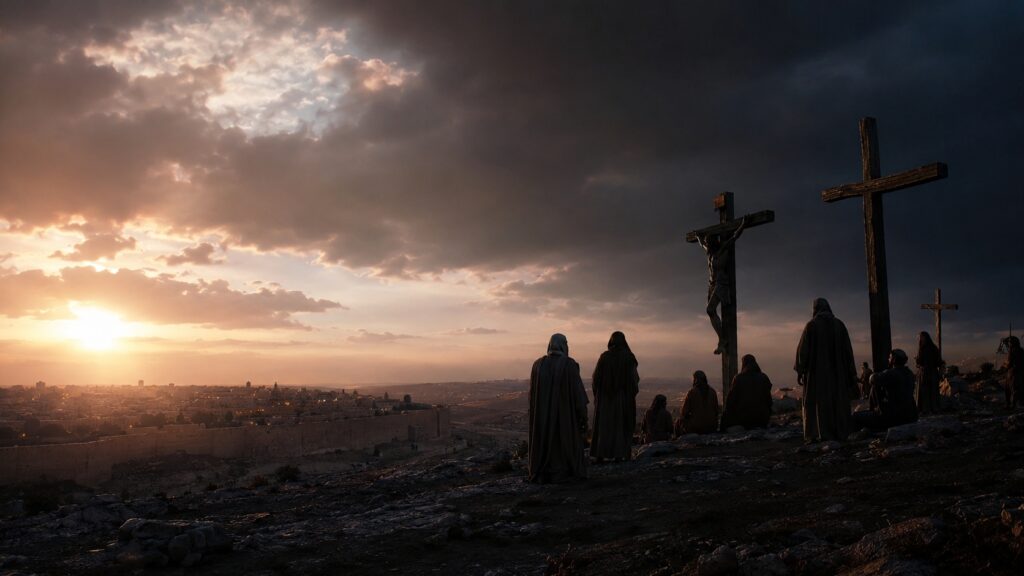

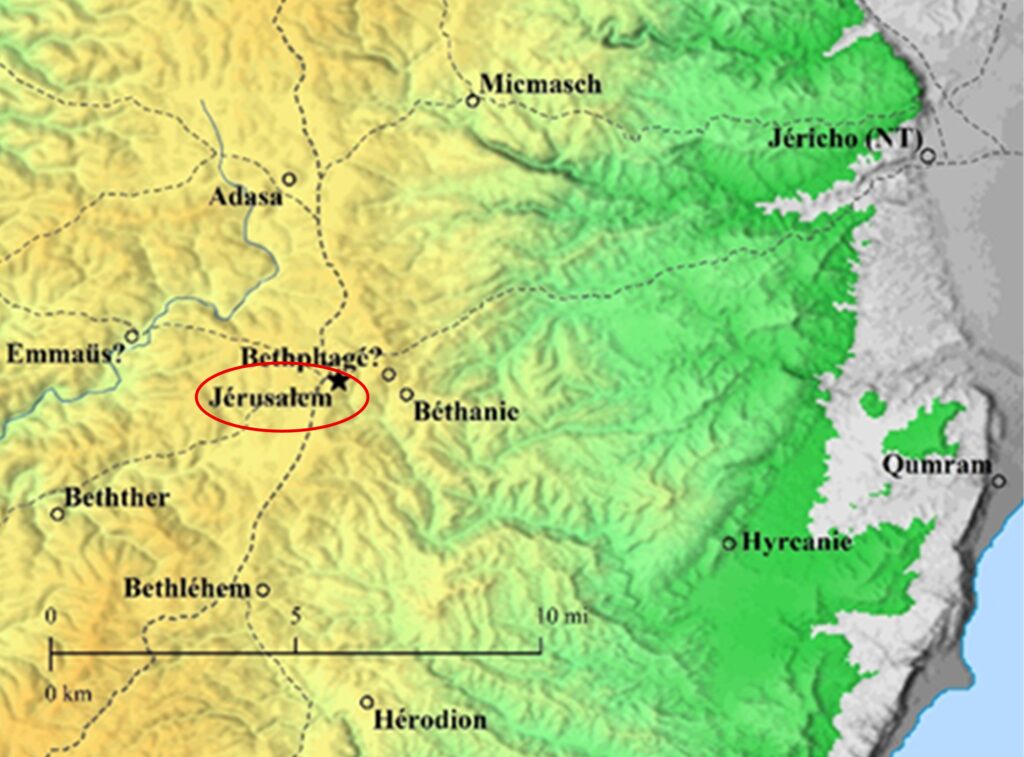

_23 The placing on the cross therefore takes place around 9 a.m. according to Mark's text. The imprecision of the measurement allows for the time needed to travel to Mount Golgotha. Mark 15.20-41 ; Matthew 27.31-56 ; Luke 23.26-49 ; John 18.17-30.
_24 All these members of the can now take part in the family Passover feast, rested in spirit after what they regard as a magnificent victory. But events are not going to unfold as they imagined!
_25 From about noon until 3 p.m., there is darkness over the region of Jerusalem. Matthew 27.45 ; Mark 15.33 ; Luke 23.44.
You can consult the complete chronology in the study ANN026 : The hour of the crucifixion.
Commentary:
Among the events that accompany the crucifixion of the Messiah Jesus, the appearance of darkness in broad daylight is one of the most remarkable signs reported by the Gospels. The three Synoptic authors mention this phenomenon in agreement: "From the sixth hour until the ninth hour there was darkness over all the land" (Matthew 27.45 ; Mark 15.33 ; Luke 23.44-45).
In the Jewish way of reckoning the hours, the sixth hour corresponds approximately to noon and the ninth hour to three in the afternoon. Thus, at the very time when the sun should have been at its zenith, an unusual darkness covers the land for about three hours. This striking contrast between the brightest moment of the day and the onset of darkness could not fail to make a deep impression on those who witnessed the event.
From a theological point of view, this darkness seems to carry major symbolic significance. In the Scriptures, darkness is frequently associated with divine judgment, with distress, or with an exceptional intervention of God in human history (Exodus 10.21-23 ; Joel 2.10 ; Amos 8.9). The prophet Amos had announced: "And in that day, declares the Lord GOD, I will make the sun go down at noon, and darken the earth in broad daylight" (Amos 8.9). Without asserting with certainty that this prophecy directly concerned the crucifixion, the similarity remains striking.
This darkness can also be understood as a manifestation of the exceptional gravity of the moment. According to the Christian faith, Jesus is then bearing the sins of the world and accomplishing the redemptive work announced by the prophets (Isaiah 53.4-6 ; 1 Peter 2.24). Some commentators have therefore seen in this darkness a cosmic sign underscoring the universal importance of the Messiah's death.
It is also possible to discern in it a form of divine modesty. While the Son of God is exposed to public humiliation, beaten, insulted and crucified, the darkness seems to partially veil this scene of ignominy. Although the biblical texts do not state it explicitly, this interpretation illustrates how God may have signaled his disapproval of the violence inflicted on his righteous Servant (Isaiah 52.13-14 ; Isaiah 53.3).
Around the ninth hour, Jesus cries out with a loud voice. Luke reports his last words: "Father, into your hands I commit my spirit" (Luke 23.46). Matthew and Mark also preserve the memory of this mighty cry immediately preceding his death (Matthew 27.50 ; Mark 15.37). For those present, this cry was no doubt first perceived as the ultimate expression of extreme suffering. It was only after the return of the light and the confirmation of his death that they fully understood that the Messiah had just breathed his last.
The ninth hour was also the time of the evening prayer and of the daily sacrifice at the Temple (Exodus 29.39 ; Acts 3.1). Usually marked by the ritual trumpet calls, this hour set the rhythm of religious life in Jerusalem. Yet this 14th of Nisan stands apart from all others. At the very moment when the Passover lamb was being celebrated in the collective memory of Israel, Jesus was completing his sacrifice on the cross (John 1.29 ; 1 Corinthians 5.7).
The phenomena that follow further reinforce the exceptional character of that day: the veil of the Temple is torn from top to bottom, the earth shakes and the rocks are split (Matthew 27.51 ; Mark 15.38 ; Luke 23.45). Faced with all these signs, the in charge of supervising the execution is deeply moved. Matthew reports his declaration: "Truly this was the Son of God" (Matthew 27.54). Luke, for his part, stresses that he glorifies God by acknowledging the innocence of Jesus (Luke 23.47).
Thus, the darkness at noon appears as much more than a mere atmospheric phenomenon. It is a solemn sign accompanying one of the central events of the biblical narrative: the death of the Messiah Jesus. While the light of the world is rejected by men (John 1.4-5 ; John 8.12), creation itself seems to bear witness to the importance of this unique moment in the history of salvation.