

_24 All these members of the can now take part in the family Passover feast, rested in spirit after what they regard as a magnificent victory. But events are not going to unfold as they imagined!
_25 From about noon until 3 p.m., there is darkness over the region of Jerusalem. Matthew 27.45 ; Mark 15.33 ; Luke 23.44.
_26 Death on the cross takes place on Friday, April 1, AD 33, around 3 p.m., according to the Gospels. It occurs before the end of this extraordinary night. The three days and three nights begin with this night, as the Jewish calendar requires.
You can consult the complete chronology in the study ANN026 : The hour of the crucifixion.
Commentary:
As he often does in his Gospel, John provides here several pieces of information absent from the Synoptic accounts. His testimony helps us better understand the events immediately following the death of Jesus the Messiah and highlights certain details essential to the theological significance of the crucifixion (John 19.31-37).
The Jewish religious authorities wish the bodies not to remain exposed on the crosses after sunset. The feast beginning that evening is indeed of an exceptional character. John specifies that the that is beginning is a “high day,” that is, a coinciding with the Passover period (John 19.31). This concern also fits with respect for the prescriptions of the Law of Moses, which forbade leaving a body hanging overnight (Deuteronomy 21.22-23). Anxious to avoid any ritual defilement, the authorities therefore ask Pilate to have the condemned men finished off quickly and taken down before the feast begins.
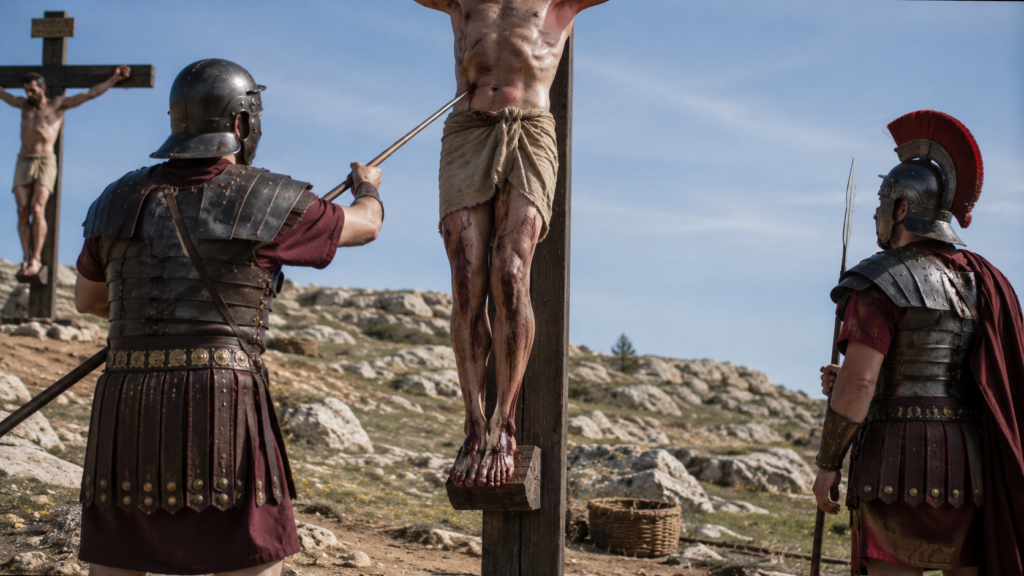
To hasten their death, the soldiers practice the crurifragium, a method consisting of breaking the legs of the crucified (John 19.32). Deprived of any support to lift their bodies and breathe properly, the condemned would then quickly die of asphyxiation. This procedure is applied to the two robbers crucified beside Jesus.
However, when the soldiers come to Jesus, they find that he is already dead (John 19.33). This detail is particularly significant. Despite the abuse he had suffered, the Roman authorities do not deem it necessary to break his legs, proof that they consider his death certain. To obtain definitive confirmation, one of the soldiers nevertheless pierces his side with a spear. John then reports that “blood and water” immediately came out (John 19.34).
Since the earliest centuries, this phenomenon has prompted much reflection. Without entering into complex medical considerations, it is enough to note that John sees in it above all a real fact of which he was a direct witness. His aim is not to explain the event scientifically, but to attest unambiguously the reality of the death of Jesus. The one who will be proclaimed risen a few days later truly died on the cross (John 19.35).
A little later, when Joseph of Arimathea asks permission to take Jesus' body to place it in a tomb, the Roman prefect will send a close and trusted officer in order to be certain of the death.
John gives particular importance to these events because he recognizes in them the precise fulfillment of the Scriptures. He stresses first that not one bone of the Messiah was broken (John 19.36). This remark directly recalls the regulations concerning the Passover lamb, of which no bone was to be broken (Exodus 12.46 ; Numbers 9.12). The apostle Paul will also develop this parallel by presenting Christ as our sacrificed Passover (1 Corinthians 5.7). Thus, down to the details of his execution, Jesus fulfills the symbolism of the Passover lamb instituted several centuries earlier.
John also draws a link with the prophecy of Zechariah: “They will look on him whom they have pierced” (Zechariah 12.10 ; John 19.37). The spear thrust given by the Roman soldier then takes on an unexpected prophetic dimension. This act, performed with no particular religious intent, nonetheless contributes to the fulfillment of the divine purpose announced by the Scriptures.
Aware of the importance of these facts, John briefly interrupts his account to stress the value of his testimony. Present at the foot of the cross with a few faithful women (John 19.25-27), he states that he personally saw these events and insists on their truth: “He who saw it has borne witness, and his witness is true” (John 19.35). This solemn statement shows how deeply this scene remained engraved in his memory.
Unlike Matthew, Mark and Luke, John does not return to the darkness that covered the land for several hours (Matthew 27.45 ; Mark 15.33 ; Luke 23.44-45). His aim is not to repeat information already known to the first Christian communities, but to complete the existing accounts with details of which he was a direct witness.
According to our reconstruction, Jesus gives up his spirit at the end of this period of supernatural darkness, most likely in the moments immediately preceding the return of the light. As the darkness gradually lifts, the witnesses discover the reality of the drama that has just taken place: the Messiah Jesus is dead. The one who had announced several times his passion, death and resurrection (Matthew 16.21 ; Mark 8.31 ; Luke 9.22) has just completed the work for which he came into the world (John 17.4 ; John 19.30).
Silence now follows the cries of the crucifixion. While the authorities hasten to have the bodies removed before the beginning of the great , events are already being prepared for the burial of the Messiah and the extraordinary manifestations that will follow his resurrection.