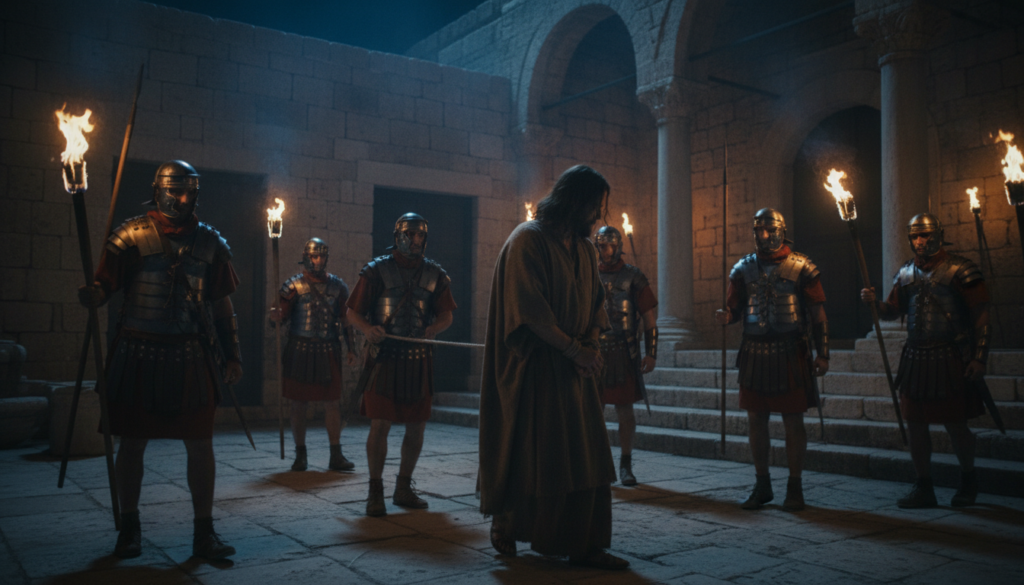


_13 Several disciples, and in particular Simon Peter and John, follow the procession from a distance. They go into the courtyard of the house of the High Priest Caiaphas. Matthew 26.58; Mark 14.54.
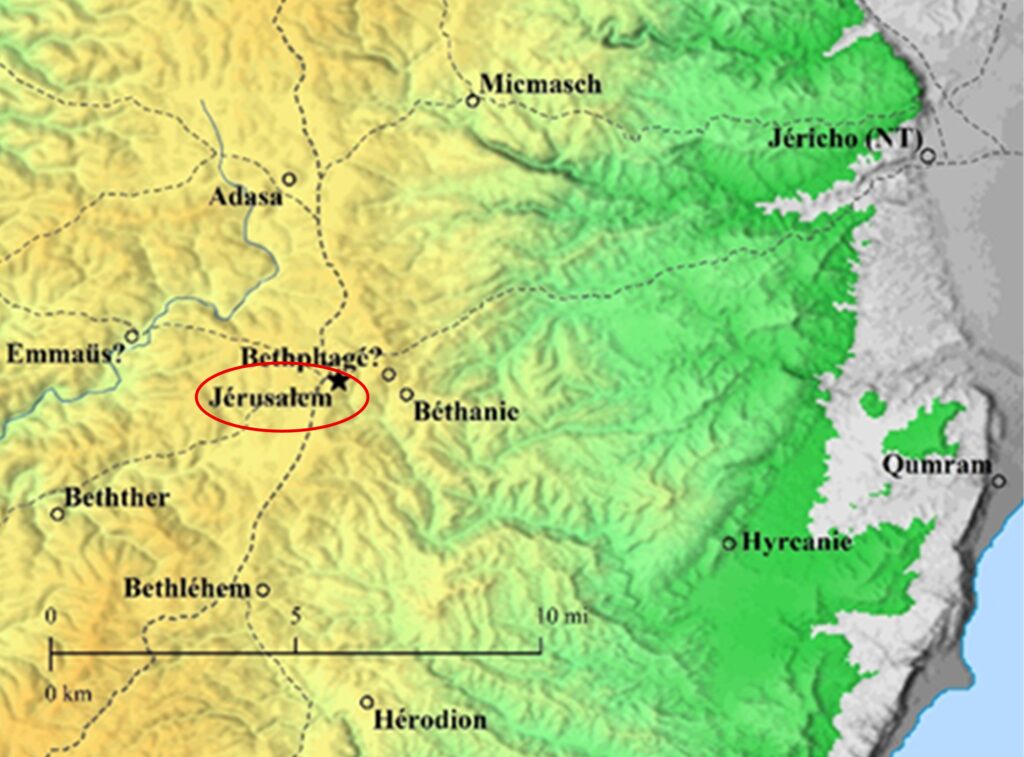
_14 The Messiah Jesus is led to the incumbent High Priest, Caiaphas, who also lives near the Temple, at about 4:30 a.m. Luke notes that Peter and John remained in the courtyard for more than an hour. Mark 14.53-72; Matthew 26.57-75; Luke 22.54-62; John 18.15-27.
You can consult the complete chronology in the study ANN026 : The hour of the crucifixion.
Commentary:
After his arrest, Jesus the Messiah is taken by the troop of soldiers to the residence of the high priest. The opponents of the Messiah Jesus have carefully prepared the course of operations: nothing is left to chance. The summoning of the , the request for a military detachment from Pilate, and the various appearances planned for the Messiah Jesus are part of a plan already drawn up. It was imperative for the religious authorities to control everything and leave no room for improvisation, because the situation could easily degenerate into a riot. Their goal was clear: to obtain a swift condemnation, while giving the procedure a semblance of legality.
John specifies that the Messiah Jesus is first taken to Anna, the former high priest, who retains considerable influence despite his official removal from office (John 18.13). Anna questions Jesus briefly, not to conduct a genuine inquiry, but to say something and play his part in this judicial staging (John 18.19). His opinion, though unofficial, carries great weight, for he remains a figure respected and feared by the people. After this formal interview, the Messiah Jesus is sent to Caiaphas, the incumbent high priest, who presides over the Jewish court and must make the decision to indict (John 18.24).
Matthew, Mark and Luke emphasize that the Messiah Jesus is taken directly before Caiaphas, where the scribes, the elders and the members of the are already gathered, as if awaiting his arrival (Matthew 26.57, Mark 14.53, Luke 22.54). This nighttime meeting, unusual and contrary to the normal rules of the court, shows that everything had been prepared in advance.
The want to give the appearance of a regular trial, but the conclusion has already been decided. Caiaphas, who has a perfect command of the workings of Jewish and Roman justice, knows how to steer the proceedings to obtain the desired condemnation. He had, moreover, already declared that it was better for one man to die for the people (John 11.49-50), a statement which, despite its political intent, coincides with the divine plan of redemption (John 3.16-17).
The next step must be the appearance of the accused before the . The authorities are absolutely determined to give a legal framework to this operation, even though the procedure is in reality irregular and hasty. The Messiah Jesus, for his part, advances without resistance, fulfilling the Scriptures and revealing the quiet sovereignty of the one who gives himself up voluntarily. While the religious leaders manipulate the rules to achieve their ends, the Messiah Jesus remains master of events, walking toward the cross with a determination that shows the Father’s love for the world.