

_13 Several disciples, and in particular Simon Peter and John, follow the procession from a distance. They go into the courtyard of the house of the High Priest Caiaphas. Matthew 26.58, Mark 14.54.
_14 The Messiah Jesus is taken to the house of the incumbent High Priest, Caiaphas, who also lives near the Temple, around 4:30 a.m. Luke notes that Peter and John stayed more than an hour in the courtyard. Mark 14.53-72, Matthew 26.57-75, Luke 22.54-62, John 18.15-27.
_15 The Messiah Jesus is questioned for two hours, from 4:30 to 6:30 a.m. Matthew 26.59-68, Mark 14.55-65, Luke 22.67-71, John 18.19-24.
_16 The rooster crows around 6:15 a.m., a little before sunrise. Matthew 26.74, Mark 14.72, Luke 22.61-62, John 18.27.
_17 The appearance before the should have taken place after sunrise at 6:38 a.m. But this was not the case, because at the moment the rooster crows the Master is, according to our interpretation of Luke’s text, taken to Pilate right after the sentence of the , which therefore waited for daybreak to pronounce it. Luke 22.66-71, Mark 15.1, Matthew 27.1-2.
You can consult the complete chronology in the study ANN026 : The hour of the crucifixion.
Commentary:
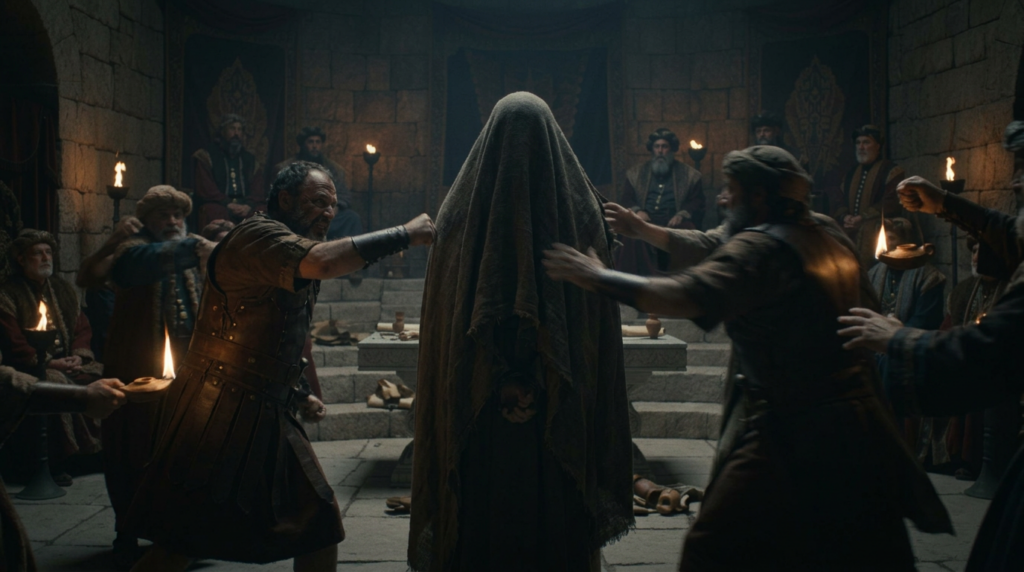
After Caiaphas’s decision, the mistreatment of the Messiah Jesus begins. It is not soldiers who brutalize him, but most probably the members of the , men placed under the direct authority of the . Their role was to keep order within the sacred precincts, but here they become the instruments of humiliation. We cannot yet speak of torture in the strict sense, but the violence is real: blows, mockery, , insults. The humiliation is terrible. Yet this attitude does not reflect that of the Jewish population as a whole; we are faced with men entirely devoted to the religious authorities, ready to carry out their orders without scruple.
In all likelihood, this abuse begins after the sentence pronounced by Caiaphas, a sentence that then had to be made official at sunrise before the gathered in regular session (Luke 22.66). Jewish law in fact forbade night-time trials. The night trial was only a sham intended to obtain a verdict quickly, but this decision then had to be given an appearance of legality. The therefore waits for dawn to officially ratify the sentence.
However, even this sentence cannot be carried out without the consent of the Roman authorities. Now, the do not recognize blasphemy as a valid ground for a death penalty. Caiaphas knows this perfectly well. He will therefore turn the religious accusation of blasphemy into a political accusation of sedition, which corresponds more closely to Roman law and might convince Pilate to intervene. The Messiah Jesus, who spoke of the Kingdom of God, will be presented as an agitator claiming kingship, a potential threat to public order.
The therefore plans to transfer the prisoner to the Roman procurator, Pontius Pilate. But there is an obstacle: they cannot present to him a bloodied man bearing obvious marks of abuse. The required that proceedings be clear and that the accused be presented in a condition compatible with an interrogation. Everything had to appear legal, controlled, in keeping with custom. The want a Roman condemnation, but without giving the impression of having mistreated the prisoner themselves.
Thus the violence inflicted on the Messiah Jesus is limited, not out of compassion, but out of calculation. It is meant to humiliate, but not to compromise the rest of the trial. Yet even in this dark scene, the Messiah Jesus remains master of himself. He endures the blows without answering, fulfilling the Scriptures and advancing willingly toward the cross, where the Father’s love for the world will be fully revealed (John 3.16-17).