

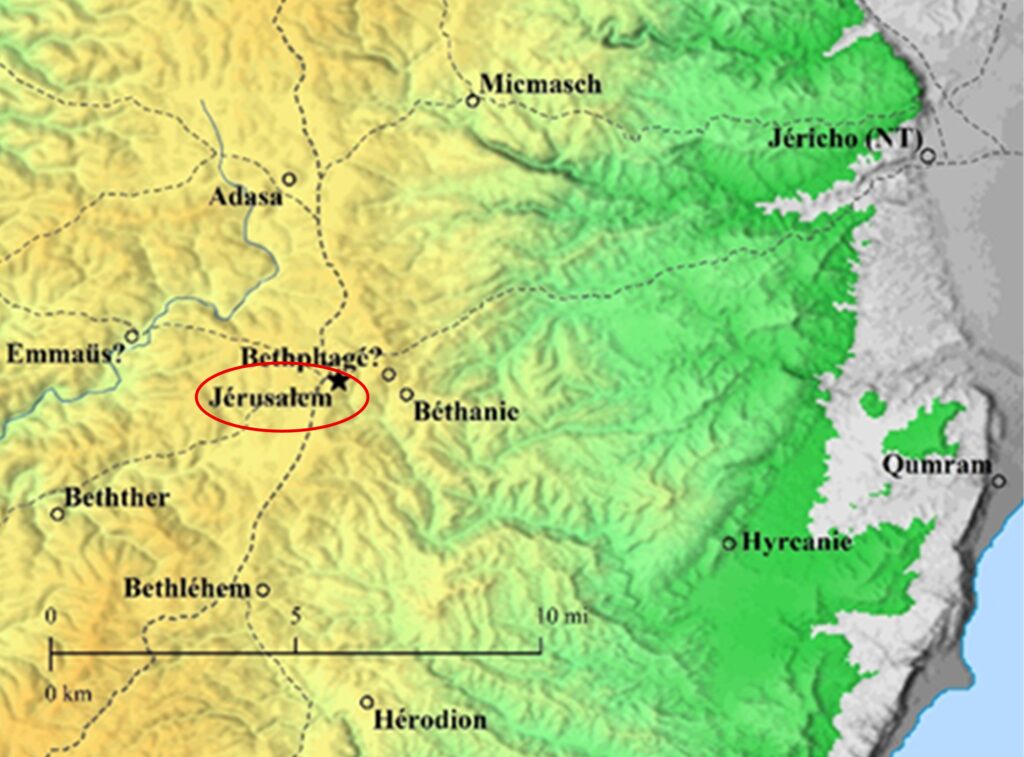

_11 The arrest takes place at that moment, around 3:30 a.m. We are about 1 km from the Temple. Matthew 26.47; Mark 14.43; Luke 22.47; John 18.3.
_12 The appearance before the High Priest Anna, who holds this distinction as an honorary title because he is no longer in office, takes place quickly before dawn on Friday, around 4 a.m. His residence is near the Temple. John 18.12-14.
You can consult the complete chronology in the study ANN026 : The hour of the crucifixion.
Commentary:
After the arrest of the Messiah Jesus, John gives us details that the other Gospels do not mention. He specifies that the cohort, the tribunes and the guards of the Jews seize the Messiah Jesus and take him not to the high priest in office, but to his predecessor, Anna (John 18.12-13). Peter and John, who followed the troop at a distance, are able to observe this unusual move. The choice to bring the Messiah Jesus first to Anna is not insignificant: although he no longer holds the official title of high priest, Anna remains an extremely influential religious figure. The had deposed him in AD 15, and his son-in-law Caiaphas had been appointed in his place in AD 18. Caiaphas would remain in office until AD 36, which testifies to an excellent relationship with the Roman authorities and with Pontius Pilate, governor of Judea.
Anna, despite his official removal, retains considerable moral and political authority among the people and the religious authorities. Several of his sons would in fact hold the office of high priest after him, which shows the importance of his family in the priestly hierarchy. The fact that the Messiah Jesus is brought first to him indicates that his opinion carries great weight in the decisions of the . His position, his experience and his influence make him a key player in the proceedings that will lead to the condemnation of the Messiah Jesus.
John also recalls that Caiaphas, the high priest in office, had already declared that it was better for one man to die for the people (John 18.14). This statement, made earlier, reveals the mindset of the authorities: to preserve political stability and avoid a Roman intervention, Jesus had to be eliminated. Ironically, this declaration, motivated by political calculations, coincides with the divine plan of redemption, in which the death of the Messiah becomes the means by which God saves the world (John 3.16-17).
Thus, John 18.12-14 shows that the arrest of the Messiah Jesus is not only a religious act, but also a deeply political event. The and Roman authorities collaborate to neutralize the one they perceive as a potential threat to the established order. Yet, in the midst of these human maneuvers, the Messiah Jesus advances willingly toward what must be fulfilled. He does not endure events passively: he passes through them with sovereign mastery, fulfilling the Scriptures and revealing the depth of the divine plan.