
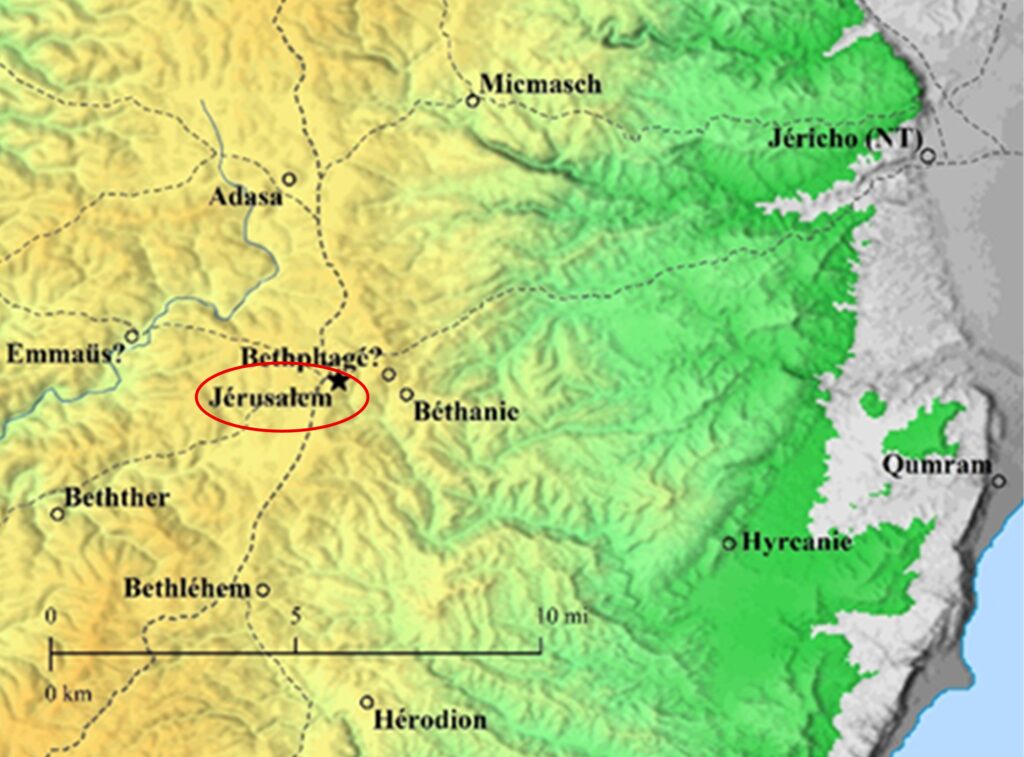

_8 They stop at the foot of the , in the Garden of Gethsemane. Matthew 26.36; Mark 14.32.
_9 They spend an hour in prayer, from 2 a.m. to 3 a.m. Matthew 26.40.
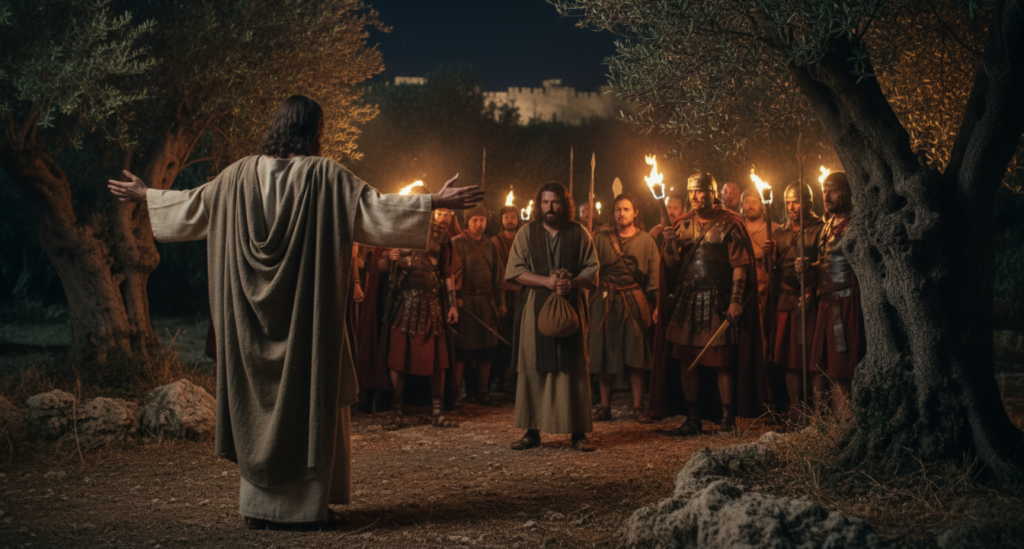
_10 The troop led by Judas Iscariot arrives. It is still Thursday night, before dawn on Friday, around 3 a.m. Mark 14.43-52; Matthew 26.47-56; Luke 22.47-53; John 18.2-12.
_11 The arrest takes place at that moment, around 3:30 a.m. We are about 1 km from the Temple. Matthew 26.47; Mark 14.43; Luke 22.47; John 18.3.
You can consult the complete chronology in the study ANN026 : The hour of the crucifixion.
Commentary:
Before being led away, Jesus the Messiah addresses the crowd that has come to arrest him. His intervention, far from being a cry of protest, acts as a word that calms overheated spirits. He reminds them that he taught every day in the Temple, in full view of everyone, never hiding, and yet no one tried to arrest him at that time (Matthew 26.55, Mark 14.49, Luke 22.53).
This contrast highlights the hypocrisy and fear of the religious authorities, who chose the night to act, far from the crowd that might have opposed this unjust arrest. Jesus the Messiah points out that this way of proceeding reveals the dominion of darkness, for this moment is precisely the one when evil believes it is triumphing (Luke 22.53).
The crowd present was made up largely of servants of the religious leaders, members of the , and even soldiers sent as reinforcements. Their presence shows that the authorities feared a riot, since Jesus the Messiah enjoyed great popularity among the people (Matthew 21.8-11). Priests and also followed the procession, anxious to make sure the operation went as planned. Everything had been carefully organized, because the situation could tip at any moment.
Yet the operation ends without further violence. Calm returns, and several among them realize they came close to a revolt. No one would have imagined such a peaceful arrest, especially after the incident with Peter. Clearly, Jesus the Messiah is different from the guilty men usually arrested. Contrary to what one might expect in the face of such injustice, he shows no rebellion. On the contrary, it is he who calms the situation, he who soothes the crowd, he who stops his disciples from fighting, he who even heals one of his aggressors (Luke 22.51). All this reveals that he remains master of events, walking willingly toward what must be fulfilled according to the Scriptures (Matthew 26.56).
Jesus recalls that his arrest is neither the work of chance nor the victory of his enemies, but the fulfillment of the divine plan. He gives himself up freely, out of love for the world, in order to accomplish the redemptive work announced long ago (John 3.16-17). His serenity, his self-control and his compassion toward those who arrest him testify that he is truly the Son of God. Where everything could have gone wrong, he brings peace. Where violence could have broken out, he imposes calm. Where darkness seems to prevail, he reveals the light of his mission.
Thus, in these few verses, the Gospels show a Messiah who does not merely endure his arrest, but goes through it with sovereign authority and disarming gentleness. He is arrested, yet he is the one who leads the scene. He is surrounded by weapons, yet he is the one who brings calm. He is accused, yet he is the one who fulfills the Scriptures. He is truly the Son of God.