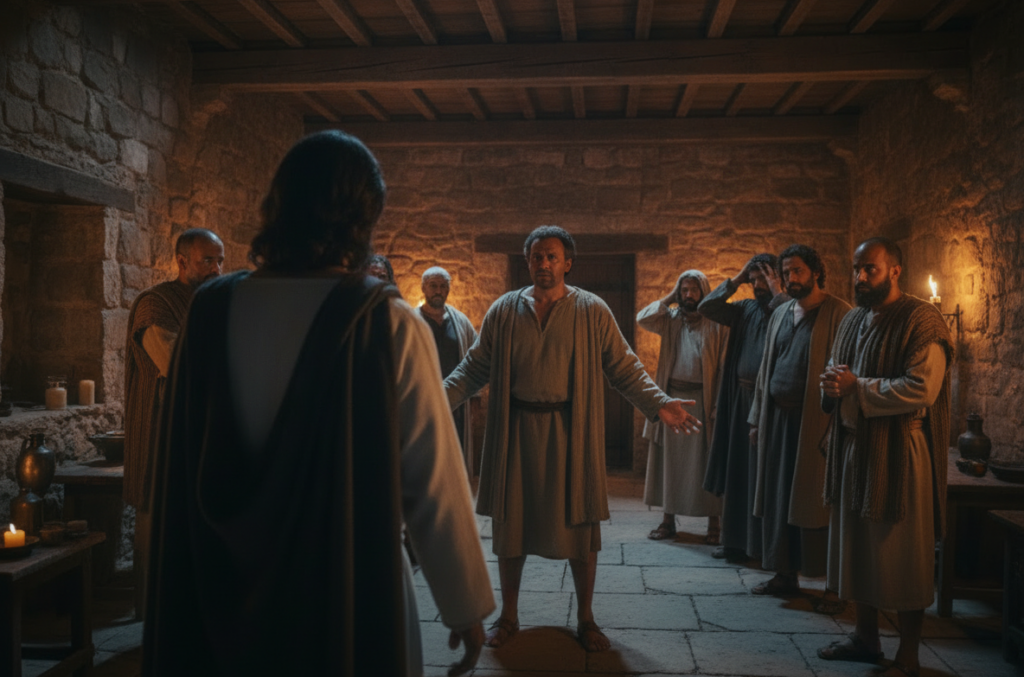

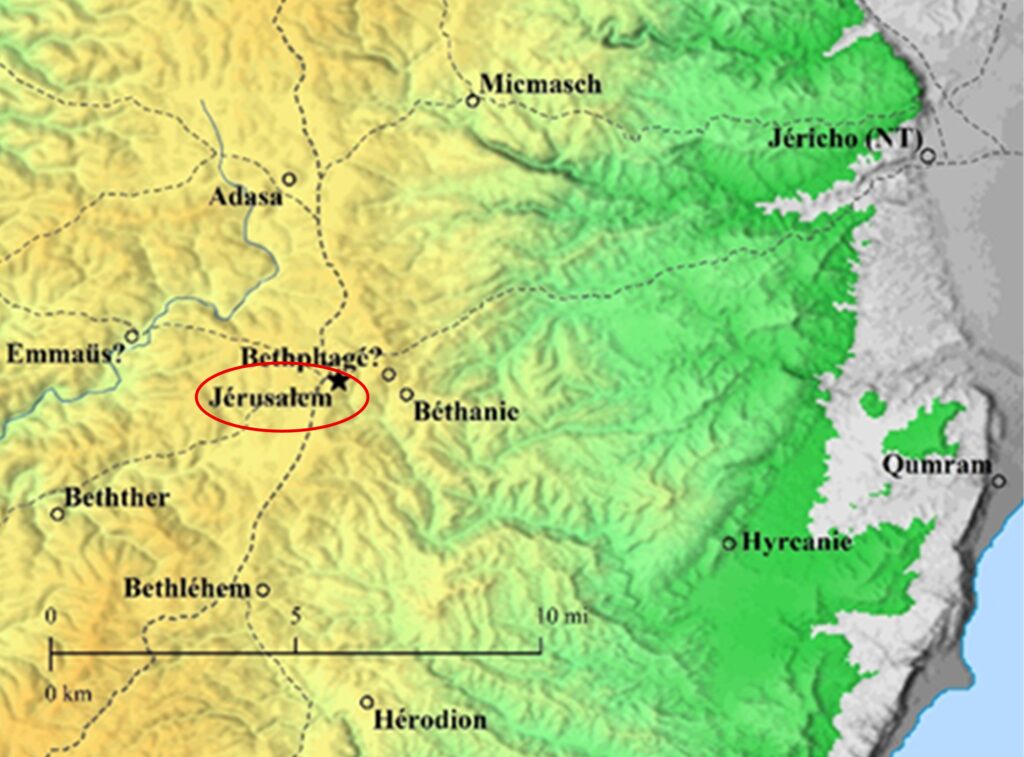

_7 The Messiah Jesus and the disciples set out for the Mount of Olives between midnight and 2:30 a.m., before dawn on Friday. The young man Mark follows them (Mark 14.26, Mark 14.32-42, Matthew 26.30,Matthew 26.36-46, Luke 22.39-46, John 18.1).
_8 They stop at the foot of the , in the garden of Gethsemane (Matthew 26.36, Mark 14.32).
You can consult the complete chronology in the study ANN026 : The hour of the crucifixion.
Commentary:
The Messiah Jesus addresses his disciples after the Passover meal and announces to them that on that night they will all be shaken because of him (Matthew 26.31). He quotes the prophet Zechariah, recalling that the shepherd will be struck and the sheep of the flock will be scattered (Zechariah 13.7).
Yet he immediately reassures his disciples by declaring that after his resurrection he will go before them into Galilee (Matthew 26.32). Peter, filled with zeal and deep attachment, reacts forcefully: he declares that even if everyone else abandons him, he never will (Mark 14.29).
The Messiah Jesus, knowing human weakness and the pressure of the hour to come, answers him with painful precision:
Peter insists further, declaring that he is ready to die with him rather than deny him (Matthew 26.35), and the other disciples share the same apparent determination.
Luke provides a more intimate insight into this exchange. The Messiah Jesus speaks directly to Simon and reveals to him that Satan has demanded the right to sift them all like wheat (Luke 22.31). But the Lord adds that he has prayed for Peter, that his faith may not fail, and that once he has turned back, he will strengthen his brothers (Luke 22.32). These words show both the tenderness of the Master and his foreknowledge, for he does not condemn Peter; he prepares him for his fall and his future restoration (John 21.15-17).
John, for his part, reports this dialogue with a different nuance: Peter asks the Messiah Jesus where he is going; the Master answers that he cannot follow him now, but will do so later (John 13.36). Peter replies fervently that he is ready to lay down his life for him, and Jesus then announces to him:
This declaration marks the boundary between sincere enthusiasm and the reality of human weakness.
The four evangelists each report distinct but complementary details; their writings, though condensed, complete one another, and it is from the synthesis of their accounts that the full truth emerges.
These combined accounts reveal a moment of rare spiritual intensity: in the midst of Peter’s proclaimed faithfulness, Jesus announces the bitterest betrayal, not to humiliate him but to prepare him for a stronger faith. In the light of the cross and the resurrection, this denial becomes a testimony to grace: the fall is not the end but the starting point of a transformed disciple.
John now adds 6 points of teaching that will follow one another. These are also the Master’s farewells to his disciples.
1- The Messiah Jesus is the way that leads to heaven.
2- He announces the coming of the Holy Spirit.
3- He compares himself to the vine.
4- He gives warnings about the persecutions to come.
5- He comforts his disciples.
6- He concludes with a prayer, like a farewell.
John takes care to report faithfully the last instructions of the Messiah Jesus and places them just before his arrest. According to our analyses, the group has already arrived at the . We will therefore incorporate these six elements into our synopsis in order to offer a detailed commentary.
This passage once again highlights the importance and richness of John’s writings. His thorough knowledge of the other gospels enables him to complete their content harmoniously, offering a more precise view of the events.
The last words of a man always carry a particular intensity. In this text, we are in the presence of the Master’s final teachings, marked by a unique depth and solemnity.