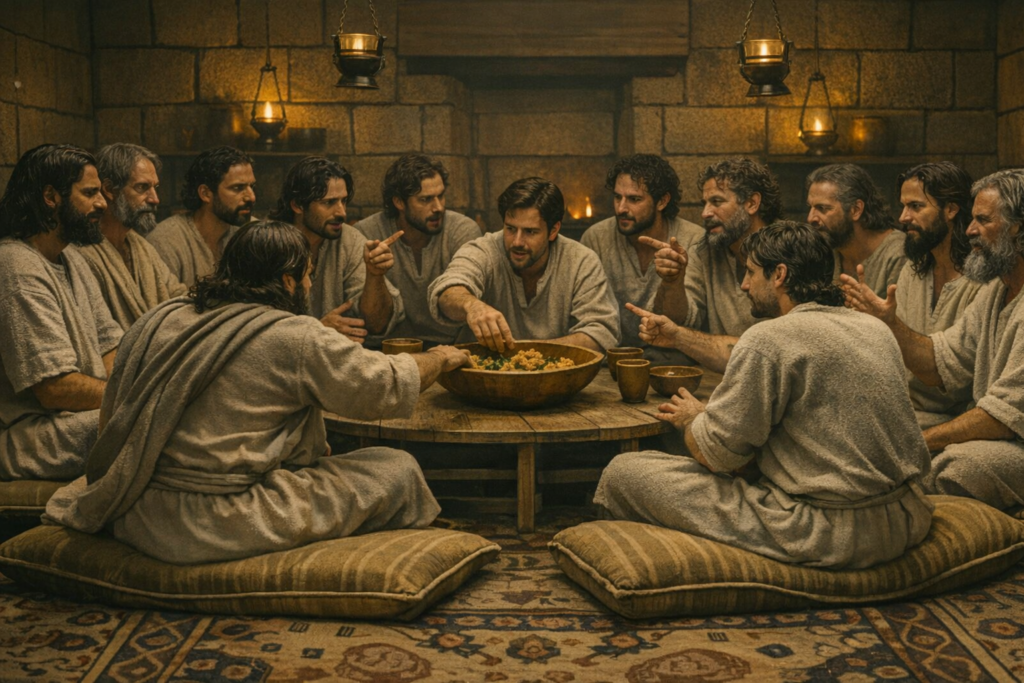

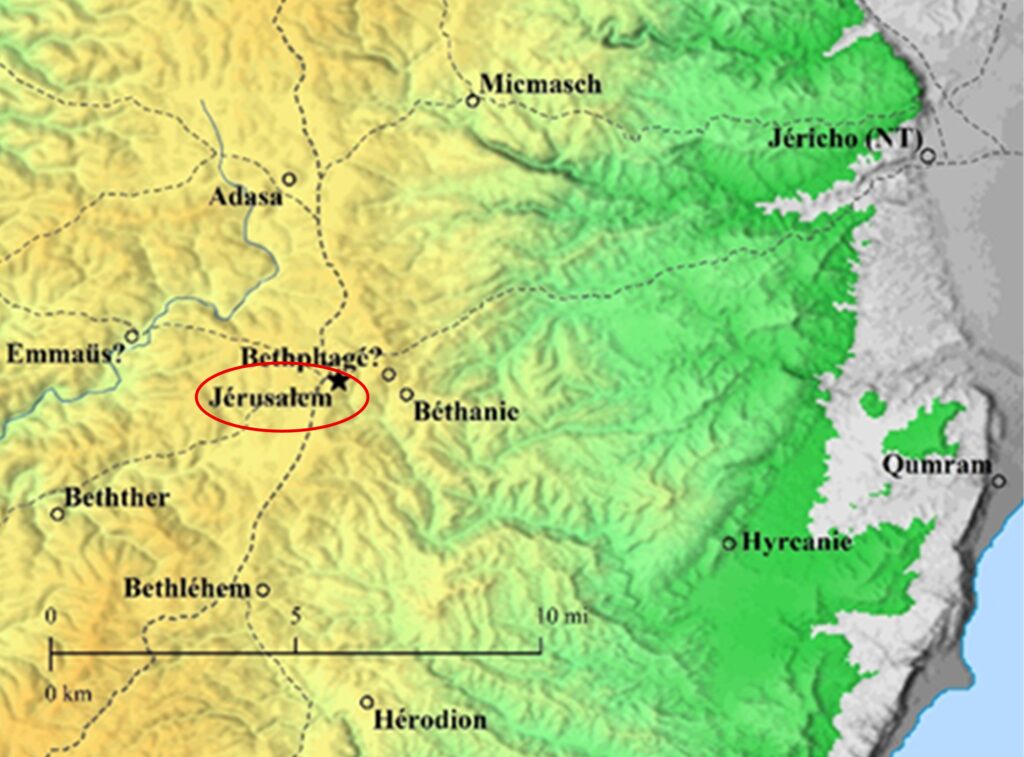

_3 The house is, in our view, that of Mary, the mother of John, surnamed Mark. Acts 12.12.
_4 The Passover meal begins on Thursday evening, after 6 p.m. It is already Friday for the Jews (Mark 14.17, Matthew 26.20, Luke 22.14-18). It is therefore not the official Seder, which will take place on Friday evening John 18.28.
You can consult the complete chronology in the study ANN026 : The hour of the crucifixion.
Commentary:
1- The Dispute over Greatness: A Striking Contrast
We observe here that the disciples still do not grasp the spiritual significance of the solemn moment they are living through. Just after the Messiah Jesus has announced his imminent betrayal and approaching death, a dispute breaks out among them over which of them should be considered the greatest (Luke 22.24). This narrative contrast is striking: at the very moment when the Master reveals the mystery of his voluntary humiliation, his disciples engage in a quarrel over precedence.
This scene is not isolated in the Gospels. Mark and Matthew report similar disputes that occurred earlier in the ministry of Jesus, notably after the second announcement of the Passion (Mark 9.33-34) and at the request of the sons of Zebedee (Mark 10.35-41 ; Matthew 20.20-24). The recurrence of this quarrel testifies to how deeply the disciples were attached to a worldly conception of authority and prestige.
2- The Persistent Attachment to an Earthly Vision of the Kingdom
This reaction reveals how far the disciples remain attached to a human and political understanding of the Kingdom of God. They still imagine an earthly messianic reign, in line with the popular expectations of the time, in which authority and glory would be measured by each person’s greatness and rank (Acts 1.6). The mental categories of temporal power — hierarchy, domination, places of honor — still shape their thinking (Matthew 18.1-4).
This vision was rooted in the Jewish messianic hope of the first century, which awaited a Davidic king who would restore Israel’s political sovereignty and establish a glorious empire (Psalms 2.6-9 ; Psalms 110.1-2). Despite three years of training with the Master, the disciples had not yet grasped the spiritual and paradoxical dimension of the Kingdom proclaimed by Jesus: a kingdom that is not of this world (John 18.36).
3- The Messiah’s Teaching on True Greatness
The Master, with a patience marked by pastoral kindness, seizes this occasion to teach them that true greatness lies not in domination but in selfless service:
This saying radically overturns the values of the world. While the kings of the nations lord it over them and those in authority are called benefactors, it will not be so among the disciples of the Messiah. The greatest must become like the youngest, and the one who governs like the one who serves (Luke 22.25-26). This ethic of service is the foundation of New Testament ecclesiology and the distinguishing mark of Christian authority (1 Peter 5.2-3).
4- The Messiah, the Embodied Model of Service
The Messiah Jesus is not content to teach this truth in words; he embodies it himself in an exemplary way. “For who is greater, the one who reclines at table, or the one who serves? Is it not the one who reclines at table? But I am among you as the one who serves” (Luke 22.27). The Lord and Master paradoxically presents himself as the servant of all.
The evangelist John illustrates this reality through the account of the washing of the feet, a prophetic act by which the Messiah performs the task reserved for the lowliest slaves: “If I then, your Lord and Master, have washed your feet, you also ought to wash one another’s feet. For I have given you an example, that you should do as I have done to you” (John 13.14-15). This gesture foreshadows the supreme humiliation of the cross, where the Son of God will give his life as a ransom for the many (Mark 10.45 ; Philippians 2.5-8).
5- Psychological Denial and Resistance to the Cross
Perhaps there is in the disciples’ hearts a form of denial, an unconscious resistance to accepting the prospect of the cross and of separation from their beloved Master. After three years of daily closeness with the Messiah Jesus, after witnessing his miracles and his divine power (John 2.11 ; John 11.43-45), they cannot imagine his death.
This psychological resistance had already burst into the open when Peter, after confessing Jesus as the Messiah, took it upon himself to rebuke him: “God forbid it, Lord! This shall never happen to you” (Matthew 16.22). The Messiah’s stern reply — “Get behind me, Satan!” (Matthew 16.23) — shows how much this resistance to the cross springs from a carnal way of thinking that is incompatible with the divine plan.
6- Death as the Gateway to Life: The Paschal Mystery
The disciples have not yet grasped that the work of salvation will be accomplished not in the immediate and triumphant glory they hope for, but in humiliation and suffering willingly accepted. Yet the Messiah had taught this fundamental paradox through the image of the grain of wheat: “Unless a grain of wheat falls into the earth and dies, it remains alone; but if it dies, it bears much fruit” (John 12.24-25).
The death of the Messiah is the gateway to life, not only for himself in his glorious resurrection, but for all who will believe in him (John 11.25-26 ; Romans 6.3-5). This paschal mystery — life springing from death, glory emerging from humiliation — will remain incomprehensible to the disciples until the dawn of Easter (Luke 24.25-27).
7- The Promise of the Kingdom: An Eschatological Opening
But the Messiah Jesus, far from stopping at the implicit reproach that their dispute deserves, turns his disciples’ gaze toward the glorious future that awaits them. He makes them a solemn promise: “You are those who have stood by me in my trials; and I confer on you a kingdom, just as my Father conferred one on me, that you may eat and drink at my table in my kingdom, and sit on thrones judging the twelve tribes of Israel” (Luke 22.28-30).
This extraordinary promise confers on the Twelve an unprecedented eschatological dignity. Despite their present lack of understanding, despite their unworthy dispute, the Messiah acknowledges their faithfulness and announces to them that they will share in his reign. Matthew reports a similar saying in another context: “Truly, I say to you, in the new world, when the Son of Man will sit on his glorious throne, you who have followed me will also sit on twelve thrones, judging the twelve tribes of Israel” (Matthew 19.28).
8- Death as a Transition to Glory
By this prophetic announcement, the Messiah Jesus reveals to his disciples that his death is not a tragic end but a necessary transition to the glory of the Kingdom. The cross is not a failure; it is the necessary path to exaltation (Philippians 2.8-11 ; Hebrews 12.2). The Messiah must enter into his glory through suffering (Luke 24.26).
The fellowship they share at this Passover meal is only a foreshadowing, a sacramental anticipation of the heavenly feast promised to those who remain faithful to the end. Revelation describes this ultimate communion: “Blessed are those who are invited to the feast of the !” (Revelation 19.9). The earthly Supper announces and prepares the eschatological banquet of the Kingdom (Isaiah 25.6-8 ; Matthew 8.11).
9- The Inversion of Values: Service as the Expression of Greatness
Thus, while the disciples are still attached to the present and to their human ambitions of precedence, the Lord opens to them the vision of a spiritual kingdom radically different from earthly kingdoms. In this kingdom, greatness is expressed not by domination but by service, life triumphs over death, and voluntary humiliation precedes divine exaltation (James 4.10 ; 1 Peter 5.6).
This inversion of worldly values is the heart of gospel ethics. The Beatitudes had already proclaimed it: “Blessed are the poor in spirit, for theirs is the kingdom of heaven” (Matthew 5.3). Mary’s Magnificat had sung it prophetically: “He has scattered those who were proud in the thoughts of their hearts. He has brought down the mighty from their thrones and exalted those of humble estate” (Luke 1.51-52).
10- Conclusion: Love as the Foundation of the Kingdom
The account of this dispute and of the teaching that follows thus reveals the Messiah’s patient pedagogy toward his disciples. Where a severe reprimand might have seemed called for, the Master chooses to teach, to illustrate by his own example, and to open a perspective of hope. True greatness in the Kingdom of God is measured by the yardstick of love that gives itself, not of power that imposes itself.
“For God so loved the world that he gave his only Son, that whoever believes in him should not perish but have eternal life” (John 3.16-17). This divine love, supremely manifested in the gift of the Son on the cross, becomes the model and the source of the brotherly love that must characterize the community of disciples: “Just as I have loved you, you also are to love one another” (John 13.34).