
It is important not to confuse this event with the one in which Mary of Bethany anoints Jesus the Messiah’s feet (PER275: Mary anoints Jesus the Messiah). For further details, please consult the appendix ANN088: The two anointings.
This passage proves particularly relevant because, besides telling this woman’s story, Luke reveals through Simon’s words the mindset prevailing among most of the . To summarise this attitude, we note three points:
- The Pharisee’s contempt for this woman (Luke 7.39).
- The Pharisee’s contempt for Jesus the Messiah (Luke 7.39).
- The Pharisee’s lack of respect towards his guest (Luke 7.44-46).
This attitude is not unique to this particular Pharisee, Simon, but reflects the outlook of the vast majority of these men, who considered themselves superior to the people and even to Jesus, whom they did not recognise as the Messiah.
Simon was a Pharisee, meaning that he held the position of a religious teacher responsible for passing on the teaching of the law of Moses.
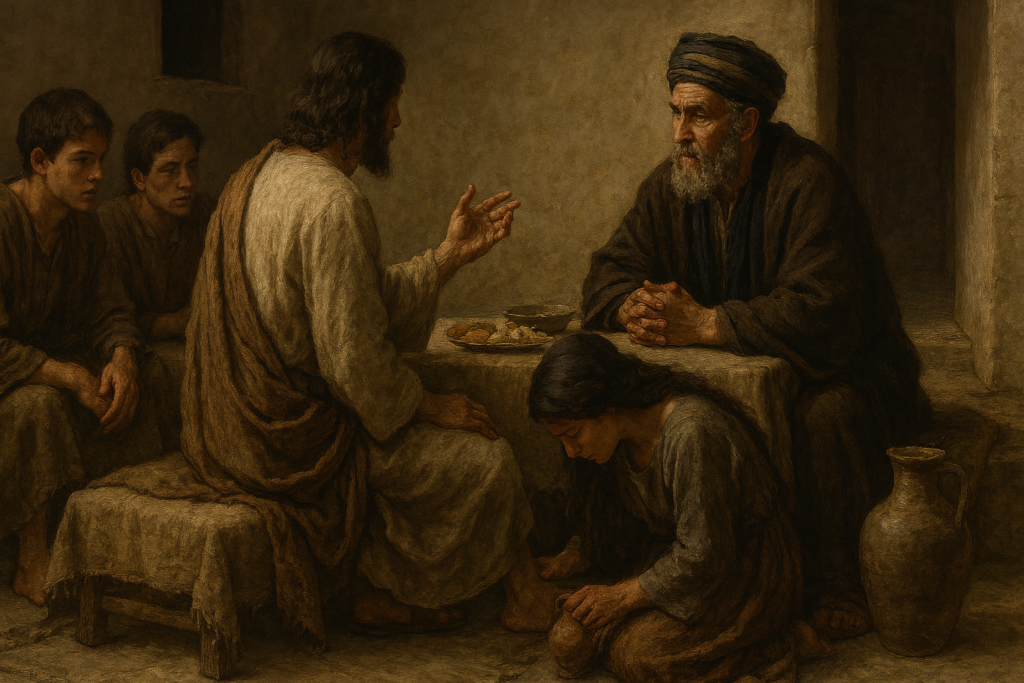
This account presents a contrast between two people during a meal to which Jesus the Messiah has been invited. These people embody the two extremes of Jewish society at the time.
On one side is Simon, a cultured, educated and religious man belonging to the party of the . He is a prominent citizen, probably financially comfortable. On the other is a woman of disreputable life, a prostitute. She has no education, no religion and no money. The first possesses everything, while the second lacks everything.
An event will disrupt this meal, which is largely devoted to theological discussions. Indeed, this is the sole reason Luke recounts it.
A woman known for her dissolute reputation enters the courtyard where the banquet is taking place. She approaches discreetly to wash the Lord’s feet. This gesture immediately draws Simon’s attention, and he concludes that the man he has invited is not a prophet.
It might seem surprising for someone not invited to a meal to appear among the guests. However, it is essential to place this situation back within the Jewish tradition of the time, when this kind of meal took place in an inner courtyard and was accessible to the public. This did not mean they were invited to eat, but rather that they could attend and appreciate the host’s standing.
This woman showed considerable courage by approaching the Master despite the guests’ judgement. Knowing Jesus the Messiah’s reputation, she was aware that he would welcome her without condemning her.
The situation is therefore particularly intriguing, with this woman unintentionally interrupting the meal and drawing every disapproving gaze upon herself. Normally, servants would have intervened to drive this unwanted person away, but the situation intrigues Simon, who seeks to confirm his opinion of Jesus: ‘If this man were a prophet, he would know!’ Of course he knows, and Jesus the Messiah is going to speak.
He speaks openly before those present to tell a . Simon answers the question appropriately, and the Lord’s explanation is then delivered with authority.
Simon, who already possessed everything, received nothing from Jesus the Messiah; this woman, however, who lacked everything, will leave with forgiveness for her many sins and the salvation of her soul.
The notion of repentance had ceased to exist among these people, who thought their status as Jews was enough. Simon’s fate remains unknown, but it is certain that he never forgot this meal.
We observe Jesus the Messiah’s care as he encourages this woman to leave the place where she was under the guests’ accusing gaze. This kind of meal was not a time of relaxation for the Master; nevertheless, he also strove to persuade these people.