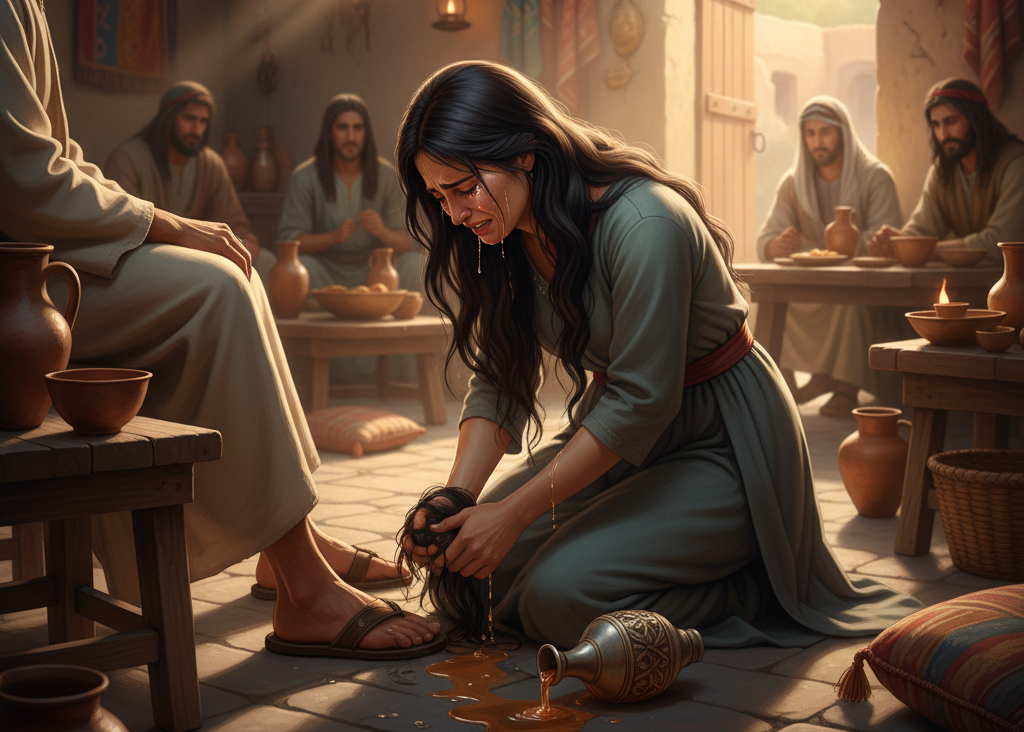
We will now compare the three accounts of this same story as reported in Matthew 26.6-13, Mark 14.3-9 and John 12.1-3.
In Matthew 26.6-13, Jesus the Messiah is in Bethany, in Simon the leper's house. A woman approaches him with a jar containing very valuable perfume and pours it on his head while he is at the table. The disciples are indignant at what they consider waste, arguing that the perfume could have been sold for a large sum and the money given to the poor. Fully aware of the situation, Jesus the Messiah defends the woman, declaring that she has done a good deed for him.
In Mark 14.3-9, the account is similar. Jesus the Messiah is in Bethany, in Simon the leper's house, and a woman enters while he is at the table. She holds a jar containing very expensive pure nard perfume, breaks it and pours the perfume on Jesus the Messiah's head. Some express indignation, believing that the perfume could have been sold for more than 300 silver coins and the money given to the poor. Jesus defends the woman, declaring that she has done a good deed for him.
In John 12.1-8, six days before Passover, Jesus the Messiah arrives in Bethany, where Lazarus, whom he had raised from the dead, is living. A meal is given for him there; Martha serves, and Lazarus is among those at the table with him. Mary takes half a litre of very expensive pure nard perfume, pours it on Jesus the Messiah's feet and wipes his feet with her hair. The house is then filled with the fragrance of the perfume. Judas Iscariot, who was going to betray Jesus the Messiah, criticises this act, suggesting that the perfume could have been sold for 300 silver coins to give to the poor. Jesus the Messiah defends Mary, saying that she kept this perfume for the day of his burial.
All three accounts take place in Bethany, at Simon's house; he was a former leper, probably healed by Jesus. John does not name him, presumably because he was already known to his friends. He generally makes a habit of adding information rather than repeating what has already been written.
All three authors describe the scene in the same way: a woman pours costly perfume on Jesus the Messiah's head (or his feet). This act is criticised in all three texts because the money spent could have helped the poor. Mark and John give an estimated price (300 silver coins), and John specifies the quantity: 500 ml. John adds the detail that it was Judas Iscariot who stirred up this indignation, seeing the act as wasteful. Knowing Judas Iscariot's true motives, John reveals that he stole money from the common purse, a fact apparently unknown to Matthew and Mark. In all three texts, we observe that Jesus the Messiah defends the woman.
One question remains unresolved: did Mary pour the perfume on Jesus the Messiah's head, as Matthew and Mark specify, or on his feet, according to John?