ANN013

The Star of Bethlehem

The article analyzes the Star of Bethlehem in the Gospel of Matthew, questioning whether it is symbolic or real. It describes how the Magi, thanks to their astronomical skills, could have observed a discreet phenomenon. The star's movement is interpreted according to the ancient view of celestial motion, without requiring a supernatural interpretation.

20 min star Bethlehem Magi Matthew celestial body 15 verses 1 book

Further information

Introduction

Among the evangelists, only Matthew reports the appearance of a singular celestial body associated with the birth of Jesus. In antiquity, it was common to interpret celestial phenomena as signs announcing major events, notably the birth or death of important figures. Ancient authors such as Flavius Josephus thus mention eclipses and celestial phenomena to underline the significance of a historical event.

The question therefore arises: is the Star of Bethlehem a symbolic construction, or does it refer to a real phenomenon observed in the ancient sky? While some exegetes favor a theological or literary reading, a balanced approach is to consider that the account can combine a real historical anchoring with a meaningful interpretation.

It should also be recalled that the term “star” (ἀστήρ) in antiquity covered a wide range of realities: fixed stars, planets, comets, conjunctions, even transient phenomena. This polysemy calls for a careful analysis of the text.

The aim of this study is to examine the data provided by Matthew, to evaluate the main hypotheses proposed, and then to formulate a coherent interpretation integrating the historical, astronomical and theological dimensions.

I. Matthew's account

Matthew reports that Magi from the East declare:

Matthew 2.1-2 (King James Version) :
Now when Jesus was born in Bethlehem of Judaea in the days of Herod the king, behold, there came wise men from the east to Jerusalem,Saying, Where is he that is born King of the Jews? for we have seen his star in the east, and are come to worship him.

He then adds:

Matthew 2.9-11 (King James Version) :
When they had heard the king, they departed; and, lo, the star, which they saw in the east, went before them, till it came and stood over where the young child was.When they saw the star, they rejoiced with exceeding great joy.And when they were come into the house, they saw the young child with Mary his mother, and fell down, and worshipped him: and when they had opened their treasures, they presented unto him gifts; gold, and frankincense, and myrrh.

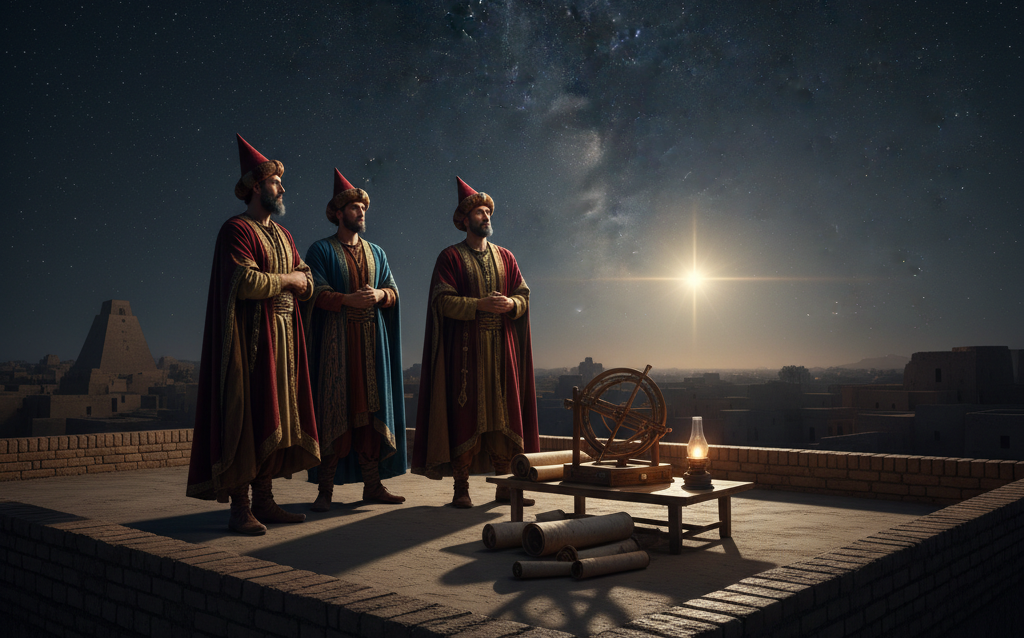
These verses constitute all the available data. Matthew describes neither the physical nature of the phenomenon, nor its duration, nor its intensity. He reports an event perceived and interpreted by the Magi, whose profile suggests expertise in observing the sky.

The term ἀστήρ designates a celestial body without further specification. The text does not explicitly suggest a supernatural manifestation visible to all, but a phenomenon observed and understood by specialists.

Matthieu 2.9-11 (Frédéric Boyer)

9 Et eux après avoir écouté le roi, ils partent.
Oh voyez ! l’étoile qu’ils avaient aperçue à l’Orient les précède dans sa course, jusqu’à s’immobiliser au-dessus du lieu où était le petit enfant.

10 A la vue de l’étoile, leur joie est alors une très, très grande joie.

11 Et en arrivant dans la maison, ils voient le petit enfant avec Marie, sa mère, et s’abaissent pour lui rendre hommage, tout en ouvrant leurs trésors.
Et lui offrent leurs dons : or et encens et myrrhe.

(Traduction Frédéric Boyer)

II. Analyse des faits rapportés

  1. Un phénomène observé par un groupe restreint

The fact that only the Magi identified the celestial body is significant. Neither Herod nor the religious authorities appear to have been aware of it (Matthew 2.3-4).

This suggests:

  • a discreet phenomenon,
  • or one requiring particular observational skill,
  • or a specific interpretation tied to their knowledge.
  1. Le déplacement apparent de l’astre

Matthew states that the star “went before them” (Matthew 2.9). This description corresponds to the apparent motion of celestial bodies in the sky, which seem to move from east to west because of the Earth's rotation. For an ancient observer, this motion was perceived as that of the celestial bodies themselves.

Thus, the movement mentioned by Matthew can be understood as a phenomenological description, faithful to visual observation, without implying a real and autonomous movement of the celestial body. From this perspective, nothing in this detail requires an extraordinary interpretation; on the contrary, it fits within the common experience of observing the sky.

  1. L’« arrêt » de l’étoile

The statement that the star “stopped” (Matthew 2.9) is the main difficulty.

Two interpretations can be considered:

  • Astronomical: the phenomenon could correspond to the retrograde motion of a planet (notably Jupiter), giving the impression of a momentary stop.
  • Phenomenological: this would be observational language describing an apparent stabilization in the sky.

It is important to note that Matthew does not claim that the celestial body guided the Magi precisely to the house. The decisive role is played by the information provided in Jerusalem (Matthew 2.4-6).

III. Les principales hypothèses

  1. Une construction littéraire

Some exegetes regard the account as a symbolic elaboration intended to illustrate the universal recognition of the Messiah.

However, this hypothesis runs up against:

  • the restraint of the account,
  • the absence of explicit symbolic developments,
  • and the narrative anchoring in a precise historical context.
  1. Un miracle surnaturel

Another approach regards the celestial body as an exceptional divine creation.

Although compatible with a theological perspective, this hypothesis raises a question:
why would a spectacular phenomenon be intended for a small group rather than as a public manifestation?

  1. Un phénomène astronomique réel

Several hypotheses have been proposed:

  • planetary conjunctions,
  • comets,
  • novae or supernovae,
  • rare astronomical configurations.

However, none fully accounts for all the textual data, in particular the duration and the limited perception of the phenomenon.

IV. Difficultés et contraintes

Several elements impose limits on interpretation:

  • the impossibility of pinpointing a place from a celestial body;
  • the duration of the phenomenon (several months);
  • the need to explain why only the Magi interpreted it as significant.

These constraints invite a nuanced approach.

V. Une hypothèse synthétique : un phénomène réel interprété

A coherent hypothesis consists in envisaging:

1- The observation of a real, probably discreet, celestial phenomenon;

2- Its interpretation by eastern specialists, according to their knowledge;

3- A natural movement of the celestial body, without precise guidance;

4- A direction toward Jerusalem by political logic (Matthew 2.2);

5- An identification of Bethlehem through the Scriptures (Matthew 2.5-6);

6- A subjective confirmation through the reappearance of the celestial body (Matthew 2.9-10).

This hypothesis has several advantages:

  • it respects the textual data;
  • it avoids over-interpretation;
  • it fits within the ancient context;
  • it allows a theological reading without breaking with history.

Read the appendix ANN012: The Magi from the East.

VI. Évaluation critique

Strengths

  • consistency with Matthew's text;
  • compatibility with ancient astronomical knowledge;
  • consideration of the historical and cultural context.

Limits

  • absence of a certain astronomical identification;
  • dependence on an interpretive reconstruction;
  • impossibility of complete empirical verification.

VII. L’hypothèse d’un nouvel astre observé par des spécialistes

Another hypothesis, often underestimated, is to envisage the discovery of a new celestial body in the sky, perceptible only to experienced observers. In antiquity, observation of the sky received particular attention in certain eastern cultures, notably among the Magi, whose role included the study of celestial phenomena and their interpretation.

In this context, it is plausible that a discreet phenomenon — such as a nova, a variable star or a celestial body of low luminosity — was detected only by trained specialists. This hypothesis explains why the Magi are the only ones to mention the celestial body, while neither Herod nor the religious authorities of Jerusalem appear to have been aware of it (Matthew 2.3-4).

Moreover, in ancient thought, celestial phenomena were frequently interpreted as signs announcing major events, in particular the birth or death of rulers. Ancient authors such as Flavius Josephus attest to this association between celestial events and historical facts. Likewise, in the Greco- world, comets or new celestial bodies were sometimes regarded as omens linked to the destiny of important figures.

From this perspective, the Magi would not merely have observed an astronomical phenomenon, but interpreted it in light of their knowledge and traditions. The expression “we have seen his star” (Matthew 2.2) suggests precisely an interpretive appropriation of the phenomenon: the celestial body is not only seen, it is understood as meaningful.

This hypothesis has several advantages:

  • it accounts for the discreet and selective character of the observation;
  • it fits within ancient astronomical and astrological practices;
  • it avoids recourse to a miraculous intervention visible to all;
  • it explains the link established between the celestial body and the birth of a “king of the Jews” (Matthew 2.2).

It also makes it possible to understand the unfolding of the account: the celestial body directs the Magi toward a region (Israel), while the precise identification of the birthplace rests on the Scriptures (Matthew 2.5-6) and on a local inquiry, not on direct celestial guidance.

Thus, the Star of Bethlehem could correspond to a real astronomical phenomenon, discreet but significant, interpreted by specialists within a cultural framework in which the sky was perceived as bearing meaning. This approach reconciles the data of the text, scientific knowledge and the historical context, without reducing the account either to a symbolic construction or to an arbitrary miracle.

VIII. Parallèles historiques : novae orientales et astrologie royale

The hypothesis of a new celestial body observed by the Magi finds interesting support in the astronomical sources of the Far East, in particular the Chinese chronicles. Chinese astronomers, renowned for the rigor of their observations, recorded many transient celestial phenomena, designated “guest stars” (ke xing), corresponding to what we identify today as novae or supernovae.

For example, chronicles of the Han dynasty mention the appearance of a “new star” around 5 BC, visible for several weeks, even several months. This type of phenomenon corresponds precisely to the idea of a new celestial body, remarkable enough to be observed by specialists, but not necessarily so spectacular as to attract the attention of the whole population.

These data are of particular interest within the framework of the present study. On the one hand, they demonstrate that transient celestial phenomena were indeed observed and recorded at the time of the birth of Jesus. On the other hand, they confirm that such events could go unnoticed by the general public while being significant for experienced observers.

Moreover, in the ancient world, the observation of the sky was closely linked to the interpretation of political events. In the Mesopotamian traditions, from which the Magi probably came, royal astrology held a central place. Cuneiform tablets, notably the series Enūma Anu Enlil, establish systematic correspondences between celestial phenomena and the destinies of rulers.

In the Greco- world, this association is also well attested. The comet that appeared after the assassination of Julius Caesar was interpreted as the sign of his apotheosis, while the birth of Augustus was surrounded by astrological traditions. Likewise, Flavius Josephus reports celestial phenomena interpreted as announcing major events.

In this cultural context, the Magi's statement — “we have seen his star” (Matthew 2.2) — takes on a particular meaning. It does not simply denote the observation of a phenomenon, but its interpretation within a precise symbolic framework: that of a celestial sign announcing the birth of a king.

Thus, the hypothesis of a new celestial body observed and interpreted by the Magi fits fully within the intellectual and religious practices of the time. It makes it possible to understand:

  • why only the Magi recognized the significance of the celestial body;
  • why they associated this phenomenon with the birth of a ruler;
  • and why they went to Jerusalem, the natural political center for such a search (Matthew 2.2-3).

Ultimately, the data from the Chinese chronicles and from ancient astrological traditions reinforce the plausibility of a real astronomical phenomenon, interpreted according to the cultural categories of the time. The Star of Bethlehem then appears not as an inexplicable anomaly, but as an event consistent with the knowledge and worldview of the ancient world.

IX. Différents travaux de chercheurs

An examination of the specialized literature reveals sustained interest in the interpretation of this phenomenon. For example, the works of Johannes Kepler, Edwin M. and Frederick A. Larson are significant contributions. Despite distinct methodological approaches, these authors share a common orientation of seeking an explanation grounded in observable phenomena, rooted in a historical and astronomical reality.

The
The contribution of Edwin
The

Conclusion

The Star of Bethlehem remains a phenomenon difficult to identify with certainty. However, the analysis of the textual and historical data leads to favoring the hypothesis of a real phenomenon, interpreted in light of the Magi's knowledge.

From this perspective, Matthew's account is neither pure invention nor an arbitrary prodigy, but an event perceived as meaningful. The star then appears as a sign accessible to those who held the keys to interpret it, consistently with a dynamic in which observation, knowledge and the search for meaning converge.