
This study is one of the elements of our research devoted to establishing a chronology of the life of Jesus the Messiah on the basis of Daniel’s prophecy of the seventy weeks (Daniel 9.24-27). It should be understood in connection with the other studies in this series, each of which contributes complementary historical, calendrical and biblical data. Together, these works form a coherent analysis aimed at reconstructing, as precisely as possible, the sequence of events reported in the Gospels.
The chronology of the life of Jesus is a major issue for New Testament exegesis and for the history of first-century Judaism. It lies at the crossroads of several disciplines — history, textual analysis and ancient astronomy — and therefore remains a widely debated subject. While the Gospels offer a number of chronological landmarks, their interpretation depends closely on the methodological framework adopted.
In this context, the prophecy of the seventy weeks holds a unique place. It proposes a temporal structure oriented toward the appearing and the cutting off of the “Messiah” (Daniel 9.24-27 ; Daniel 9.26). This study sets out to revisit its interpretation by linking it to the data of the Gospels, in order to establish a coherent chronology of the main events in the life of Jesus.
Taking the decree of Artaxerxes (Ezra 7.8-9) as the starting point, and taking into account the calendar constraints of ancient Judaism, this research leads to placing the crucifixion on April 1, AD 33 and the resurrection on April 3, AD 33.
However, this proposal cannot be assessed without a rigorous comparison with competing hypotheses, in particular the one that places the crucifixion in the year 30. A critical examination of this dating brings to light the tensions it creates with the historical synchronisms reported by Luke (Luke 3.1-2). A thorough discussion of this debate is offered in the appendix (ANN045 : Debate over the date of Jesus’ death).
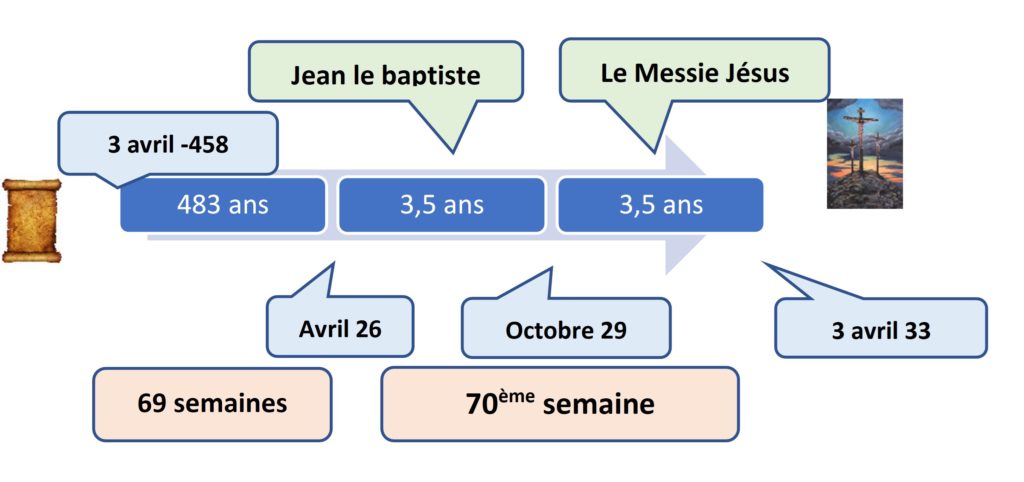
The aim of this study is therefore twofold:
1- to propose a chronological reconstruction based on the internal data of the Scriptures;
2- to evaluate critically the main hypotheses arising from historical research.
The whole analysis suggests that dating the crucifixion to AD 33 offers better coherence between the prophetic structure, the Gospel accounts and the historical setting of the first century.
Note on the appendices
Certain technical demonstrations, notably those concerning calendar calculations, the chronology of Herod the Great and the debate between the dates of 30 and 33, have been developed in appendices in order to lighten the main text. The reader may refer to them for a detailed analysis of the points raised.