ANN008

The Gospel of Matthew

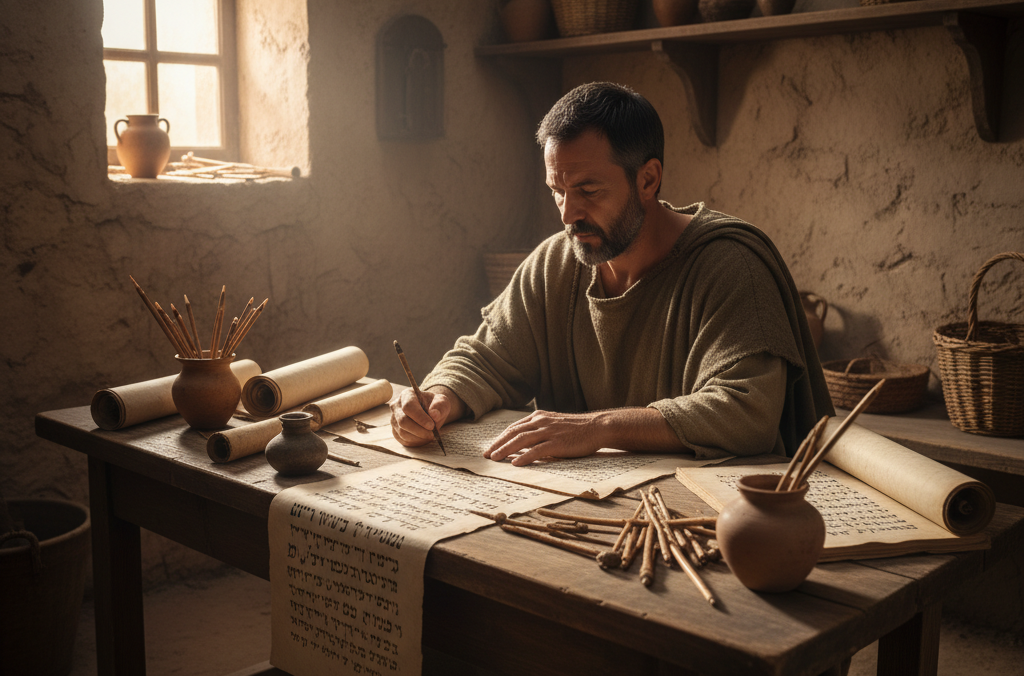
The Gospel according to Matthew is the work of the apostle, the former tax collector of Capernaum, appointed by the Twelve to set down their collective testimony. He wants to show the Jews that Jesus is the Messiah announced by the prophets, by carefully linking the Scriptures to the deeds and words of Jesus.

31 min Gospel of Matthew Matthew the apostle tax collector Capernaum Messiah 32 verses 5 books

Further information

Introduction

Among the twelve apostles, Peter and John hold a prominent place in the biblical texts. The others are cited less often and receive only brief, scattered mentions. The conversion of Matthew does not stand out as a particularly significant event, any more than those of Andrew or James. It therefore appears that the information about Matthew mainly aims to introduce to us the author of the Gospel.

In reality, these few passages recounting the conversion of Matthew and the banquet he gave afterwards in Capernaum serve only to strengthen the authority of the one who would put in writing the accounts of the deeds of the Messiah Jesus.

Thus, our information about Matthew is very limited and insufficient to draw up his biography. We can nevertheless draw a few conclusions, notably concerning his intellectual abilities.

I. The Gospel of Matthew

Our intention is not to carry out an in-depth academic analysis of the Gospel of Matthew. Rather than repeating widely known writings, we wish to highlight certain aspects that still give rise to discussion today because of a lack of concrete evidence.

In the appendix ANN049: The objectives of the Apostles, and in the chapter: The Gospels, we examine the motives which, according to our analysis, led the twelve apostles to entrust Matthew with the writing of the first Gospel.

In summary, Matthew, often seen as the intellectual of the twelve, was given the arduous task of putting the testimony of the Apostles into writing.

According to our conclusions, this is a collaborative work, and Matthew relies on the notes made with his friends. We believe he was one of the initiators of this project. Matthew is in the habit of writing everything down and certainly seems to understand better than his peers the importance of documenting those years spent with the Master.

He masters Aramaic and probably Hebrew, as well as Greek, which was indispensable for his role as a tax collector. Writing is instinctive for him, like second nature.

Matthew faces a real challenge with the multitude of information available. How can he condense all these events, each one exceptional in its own way?

It is crucial to make a selection in order to produce an account that is brief, clear and above all persuasive. Using his notes and with the help of his friends, he will draw up a representative list of the miracles performed by the Messiah Jesus. He will draw from this list to compose his text.

The central axis of his account was to weave the link between the prophecies and the deeds of Jesus, the Messiah. This text is therefore designed as a proof intended for the Jewish people, showing that Jesus is truly the Messiah King announced in the holy Scriptures.

II. Matthew, the man

Matthew, the author of the Gospel which will bear his name from the second century onward, is in fact the tax collector of Capernaum who was called to become an Apostle, being one of the twelve.

He is therefore a direct witness of the events he is about to describe. In fact, he will record not only his own memories, but also those of his friends.

Matthew carries out his duties at the tax office of Capernaum, in Galilee, probably for the and perhaps also for Herod, who directly collected the taxes on fishing in the .

Obtaining such a post testifies to a mutual trust between the Roman occupier and the beneficiary. It seems clear that Matthew's father must have maintained close relations with these authorities.

Matthew comes from a well-off family, which facilitated his studies and his career.

He masters Greek, the language of commerce, as well as Aramaic to communicate with his fellow citizens, and probably Hebrew, the religious language of the time. He writes fluently and is comfortable with figures. The ideal treasurer for the group, but Judas Iscariot already seems to hold that position.

Mark and Luke call him Levi.

We have few details about the conversion of Matthew, except that Jesus called him while he was working at the toll booth of Capernaum. It is likely that they had already met before, and that Matthew had been convinced by the teachings of Jesus by the time of this call.

We know that he organized a great banquet in honor of the Messiah Jesus, inviting all his friends and colleagues.

Although he is among the 12 Apostles, he remains a modest and little-known figure, distinguished only by writing the Gospel to which his name is attached.

The names of the authors attributed to the Gospels as we know them today will only appear from the second century onward, with the aim of simplifying their study.

Matthew appears in the various lists of the Apostles. His last mention is found in Acts 1.13.

Once the writing of their testimony was decided, Matthew naturally imposed himself as the best choice. He is the only one to possess the intellectual skills needed to put their account into writing.

Although Matthew was a direct witness of the events he describes, he did not choose alone the facts to be recorded. It seems that a draft was drawn up by the group, then used mainly by Matthew for his composition. Peter and Mark would also use it.

III. The result of his work

Matthew's objective is easily discovered by reading his text. He seeks to demonstrate that this Jesus, whom he accompanied for 3.5 years, is indeed the Messiah announced by the prophets, the King of the Jews.

He will therefore draw parallels between the life of Jesus and the description of the Messiah King in the books of the . These references, this genealogy of Joseph, the choice of the stories he is going to tell us, all work together to demonstrate, to people who know the law of Moses well, and therefore to Jews first, that the man crucified on April 1, AD 33 is indeed the one everyone was waiting for, Shiloh.

His book is consequently not a biography, but a plea in favor of the messiahship of Jesus.

We must acknowledge that others before him had presented themselves to the people as the Messiah, but proved to be impostors; that is why Matthew will demonstrate to us, with supporting evidence, that this Jesus is indeed, and he alone, the true Messiah, the King of the Jews.

All the Jewish kings had to be descendants of the family of Judah and therefore of David, so Matthew will report to us the genealogy of Joseph. As the adoptive father of Jesus, Joseph brought the inheritance of his descent, so that for every Jew, Jesus could lay claim to the title of king.

Matthew will record between 32 and 50 prophecies of the Old Testament, depending on how precise a citation one accepts. We can even go up to 53 direct quotations and 76 allusions.

Analyzing all the references to the Old Testament in the four Gospels, according to the Westphal Bible Dictionary we have:

50 quotations and 437 reminiscences or allusions in Matthew,

23 quotations and 204 reminiscences in Mark,

25 quotations and 474 reminiscences in Luke and

15 quotations and 364 reminiscences in John.

We notice that Matthew stands out clearly in the number of allusions to prophecies.

To summarize, Matthew wrote a text relying heavily on the writings of the , with the simple aim of proving that Jesus is truly the announced Messiah. He addresses Jews, and writes his text in the only language understood by this population, Aramaic. A Greek translation, perhaps made by himself, would quickly follow.

It should be remembered that Matthew had no model to follow for this undertaking. He is often considered the pioneer in the writing of what would become the Gospel.

IV. The distinctive features of Matthew's text

The author of the first Gospel uses certain linguistic forms connected with kingship, more than his friends do.

–The Son of David

Matthew presents Jesus to us as the king of the Jews, the son of David; he uses this expression 9 times (Matthew 1.1; Matthew 9.27; Matthew 12.23; Matthew 15.22; Matthew 20.30; Matthew 20.31; Matthew 21.9; Matthew 21.15 and Matthew 22.42).

Mark will use this same form only 3 times (Mark 10.48; Mark 10.48; and Mark 12.35).

Luke also notes this formula 3 times (Luke 18.38; Luke 18.39; and Luke 20.41). He also mentions the throne of David (Luke 1.32). As for John, he does not use this expression.

For Matthew, the important point is that the Messiah Jesus is indeed the king of Israel, the son of David and of Abraham.

–David's hometown, Bethlehem

He records this occurrence 5 times in his account (Matthew 2.1; Matthew 2.5; Matthew 2.6; Matthew 2.8; Matthew 2.16). Mark does not mention this village, while Luke notes it only twice (Luke 2.4; Luke 2.15) and John only once (John 7.42).

–The throne of His glory

He is the only one to use this expression, twice (Matthew 19.28 and Matthew 25.31). He also notes the throne of God twice (Matthew 5.34 and Matthew 23.22), which Luke uses only once (Luke 1.32). Mark and John do not even use this term, throne.

–The kingdom

Jerusalem is called only by Matthew the holy city (Matthew 4.5), the city of the great King (Matthew 5.35) or the city of the kingdom; this term occurs 52 times in his account.

He is the only one in the whole New Testament to use the expression "kingdom of heaven", which he notes 32 times, not counting the 4 times he uses the form "kingdom of God"!

By way of comparison, Mark uses the term "kingdom" 19 times, 7 of them in the form "kingdom of God", which Luke uses 33 times out of his 40 occurrences of this term, while John uses it twice out of his 5 uses of the word kingdom.

We notice this very marked link between the Messiah Jesus and the kingdom of heaven or of God in the Gospel of Matthew. He is therefore King!

–the reminder of the prophets' quotations

We have already dealt with these references in the previous chapter. The text of Matthew presents itself as a plea solidly built on numerous allusions to the and to the prophetic books. The Jewish reader is able to understand this argument easily and to accept its conclusion more readily: Jesus is the Messiah.

V. The chronology of events in Matthew's account

By comparing Matthew's account with that of Mark, which seems to be the most similar, we observe notable differences in the series of events. Indeed, Matthew does not strictly follow the chronological order of the facts, unlike Mark, who respects this sequence more according to our study.

Let us consider chapters 5 and 7 of Matthew, which include various lessons from the Sermon on the Mount. Comparing them with Luke 6.20-49, we observe some differences resulting from their different ways of recounting the facts.

The thirteenth chapter of Matthew perfectly illustrates his style of writing, for it gathers several in order to examine them thoroughly. Matthew tends to favor an in-depth analysis of the events rather than a purely chronological account.

We must remember that Matthew, Mark, Luke and John did not write a biography of Jesus according to current standards. Their aim was to support their argument by relating historical events.

VI. The date of composition of the Gospel of Matthew

We do not intend to repeat the arguments set out in the earlier sections.

Please read the appendix ANN049: The objectives of the apostles, as well as the chapter on the Gospels.

Thus, our position is unambiguous: Matthew wrote his Gospel first, before the year 46, the period corresponding to Mark's return from his journey with the Apostle Paul and his cousin Barnabas. Peter, assisted by Mark, quickly set about a second version intended for non-Jews, around 46 or 47. This new text would be a simple adaptation of Matthew's, intended for the Gentiles.

We acknowledge the existence of multiple points of view, often serious ones, on this subject. However, for the moment, these are only suppositions.

We will be able to give a definitive and precise answer to this question only after the discovery of documents dating from the middle of the first century. Until then, we must resign ourselves to conjectures.

We consider our demonstration to be the most realistic and the most pragmatic.

VII. The priority of Matthew

We acknowledge that many contemporary scholars defend the priority of the Gospel of Mark. This means that they consider Mark to be the first Gospel, on which the others were based.
Our analysis leads us, on the contrary, to consider that Matthew wrote his Gospel first. This was moreover the thesis that prevailed until the end of the 18th century. It was Protestant exegetes who, at that time, called this theory into question.

Read the chapter: The Gospels.

The priority of Matthew confirms that the order of the Gospels in our Bibles is chronological. We have already explained, in the chapter on the Gospels, the reasons that lead us to consider this.

Indeed, among the twelve members of the group, Matthew was the only one, because of his intellectual abilities, who could write down their testimony.

It is only after a first reading of the result of his work that the Apostle Peter realizes that this document is hard to understand for a Gentile. Matthew used too many references to Jewish writings and to Judaism, unknown to new converts who were foreign to the Jewish world.

At this stage, he understands that another version is needed and envisages the creation of a new text. Together with Mark, they revisit Matthew's account, removing many references to the Old Testament.

They aspire to a clear and universal text, understandable first of all to the Greeks, but also to all foreigners afterwards.

Read the appendix ANN015: The Gospel of Mark.

Conclusion

We notice that the information about Matthew is scarce and has the sole purpose of introducing the one who would write the first account of the deeds of the Messiah Jesus.

The priority of his account that we envisage simply follows from the information found in our Gospels and from the climate of persecution experienced by the apostles.

This priority was widely accepted for 19 centuries without significant opposition, until Protestant intellectuals proposed that the Gospel of Mark was the first. Although this new theory has a certain interest, it appears hardly plausible in light of our analysis of the political context of the first century.

Matthew addresses his Jewish compatriots using a clear and accessible argument for an audience familiar with Judaism. Subsequently, in order to reach a wider audience, Matthew or those close to him would produce a Greek version of this writing.

We also believe that Matthew's intellectual aptitudes prompted him, within the group of the twelve, to suggest and support the idea of writing down their testimony. This project is also part of the divine plan to give a universal character to the message of the Messiah Jesus.