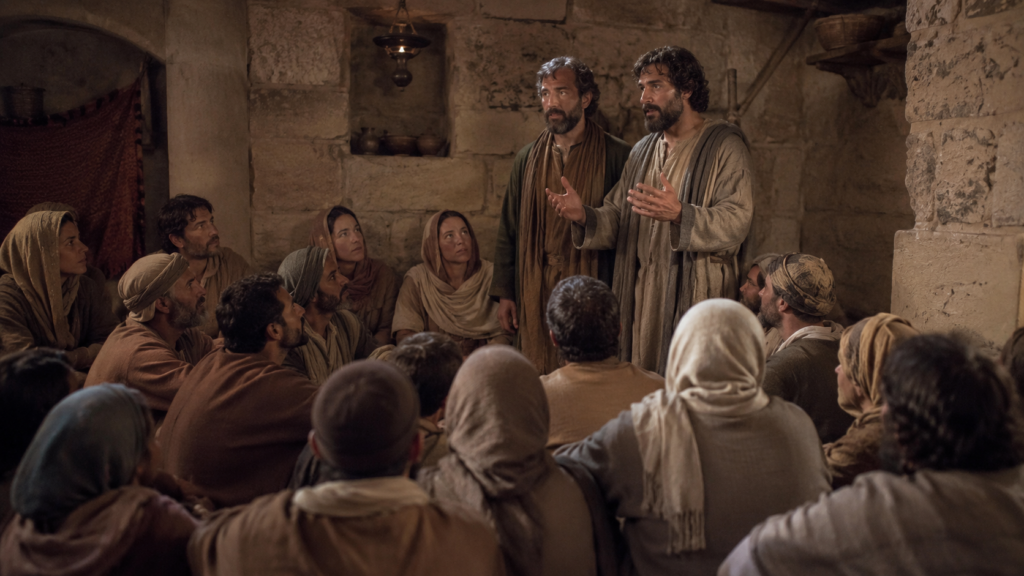

Luke now reports three events that follow one another naturally. First, Peter and John give an account of their appearance before the ; then all the believers present lift up a prayer to God; finally, the assembly experiences a new action of the Holy Spirit (Acts 4.23-31).
It is likely that the brothers and sisters gathered were already aware of the arrest of Peter and John. The appearance before the could give cause to fear severe penalties, all the more so since these same authorities had obtained the condemnation of the Messiah Jesus a few weeks earlier (Luke 22.66-71; John 19.15-16). The unexpected release of the two apostles could only arouse astonishment and gratitude.
Peter and John then report to the assembly “all that the chief priests and the elders had said to them” (Acts 4.23). Their testimony is a new illustration of the assistance of the Holy Spirit promised by Jesus to His disciples when they would be brought before the authorities (Matthew 10.19-20; Luke 12.11-12). The members of the , though led by Annas and Caiaphas, could neither contest the nor refute the arguments of the apostles (Acts 4.14).
For the first believers, this deliverance shows that the divine power that accompanied the ministry of the Lord continues to work within His Church. It also confirms that the death of Jesus was not the result of a defeat, but was part of God's sovereign plan for the salvation of men (Mark 10.45; Acts 2.23; Acts 4.27-28).
2- A community united in prayer
On hearing the testimony of Peter and John, the assembly reacts spontaneously with prayer. Luke stresses that all “lifted their voices together to God” (Acts 4.24). This unity in prayer recalls that which already characterized the disciples before Pentecost (Acts 1.14) and which remains one of the marks of the young Church (Acts 2.42).
The text reported by Luke is probably not a formula recited in unison, but rather a faithful summary of the essential content of this communal prayer. The evangelist does not describe the precise course of these moments of fellowship, but it clearly appears that the believers express together their thanksgiving and their supplications before God.
3- A prayer founded on the sovereignty of God
The prayer begins with an affirmation of divine sovereignty: God is the Creator of heaven, earth and the sea (Acts 4.24). The recent events are not interpreted as mere human circumstances; they are placed back within the wider framework of the divine plan revealed in the Scriptures.
The believers thus quote the Psalms 2.1-2, which they apply to the opposition Jesus met and to that which they themselves are facing (Acts 4.25-28). The crucifixion of Christ and the hostility of the authorities are therefore not regarded as failures, but as events that God had sovereignly permitted.
4- A remarkable request
It is particularly remarkable that the disciples ask neither for the disappearance of their adversaries, nor for the end of the persecutions, nor even for their own safety. Their only request is to receive the assurance necessary to continue faithfully proclaiming the word of God (Acts 4.29).
They also ask that God continue to confirm the message of the Gospel by healings, miracles and wonders performed in the name of Jesus (Acts 4.30).
Their first concern is therefore not their personal preservation, but the progress of the work of God.
5- A new action of the Holy Spirit
The believers do not seek an extraordinary experience for its own sake. Their desire is above all to remain faithful witnesses of Christ and to fulfill the mission entrusted by Jesus (Acts 1.8). Aware of their weakness in the face of growing opposition, they place their trust in divine assistance.
God's answer is not long in coming. Luke reports that “the place where they were gathered together was shaken” (Acts 4.31), a visible sign of divine presence and approval recalling certain manifestations of the Old Testament (Exodus 19.18; Isaiah 6.4).
The evangelist then adds: “They were all filled with the Holy Spirit” (Acts 4.31). This is not a new Pentecost, for these believers had already received the Spirit (Acts 2.1-4). Luke rather describes a renewed action of the Holy Spirit granting the disciples the strength needed to pursue their mission.
Unlike the events of Pentecost, no phenomenon comparable to speaking in tongues is mentioned. The essential manifestation of this new fullness appears in its consequences: “they spoke the word of God with boldness” (Acts 4.31). Courage and freedom of speech are thus the direct answer to the prayer offered a few moments earlier.
6- A Church transformed by the Spirit
Finally, Luke specifies that this grace does not concern only Peter and John. All those who were gathered share in this work of the Holy Spirit. From the first days of its existence, the Church thus appears as a community united in prayer, sustained by divine power and wholly devoted to the proclamation of the Gospel despite the oppositions of the world.
A few weeks earlier, the disciples had been scattered and fearful at the time of Jesus' arrest (Mark 14.50). Now, under the action of the Holy Spirit, they confidently face the same authorities who had condemned their Master.
This remarkable transformation is one of the major themes of the first chapters of the book of Acts and prepares the reader for the rapid development of the Church despite growing oppositions.
The
A